AI Research Digest — Wednesday, November 18, 2026
Wednesday's cs.AI announcement day (2026-11-18) lists 109 new and 150 cross-lists (replacements skipped; listing total 259). A filter for agent systems, memory/context, computer-use / tools / skills / harnesses, multi-agent, persistence, and local/open models keeps 31 papers. The day's main theme is that agent infrastructure is quietly deciding what gets remembered, kept and trusted. One paper classifies MCP tool calls by reversibility rather than read/write, another shows a fetched web page can plant a stored preference that later removes a critical item from answers, and a third finds that context pruning can raise cost once prefix caching is priced in. A second cluster covers skills and harnesses: skills go stale and need maintenance, SkillBuffBench lays out how to test skills with auto-invocation and memory on, and several papers evolve skills, memory strategies and safety harnesses. A minimal RAG memory reaches parity with heavier stacks on recall benchmarks, while action-based probes still separate designs. Computer-use safety (cross-screen harm), multi-agent handoffs that drop conflicting claims, agent identity and trust, runtime verification, and a laptop fine-tune of a local Gemma 4 edge model round out the day.
Research Papers
KV-LTM: Persistent Per-Session KV Caches as Long-Term Memory for Personal Assistants
Ziv Kfir, Ido Kfir arXiv: 2611.21998
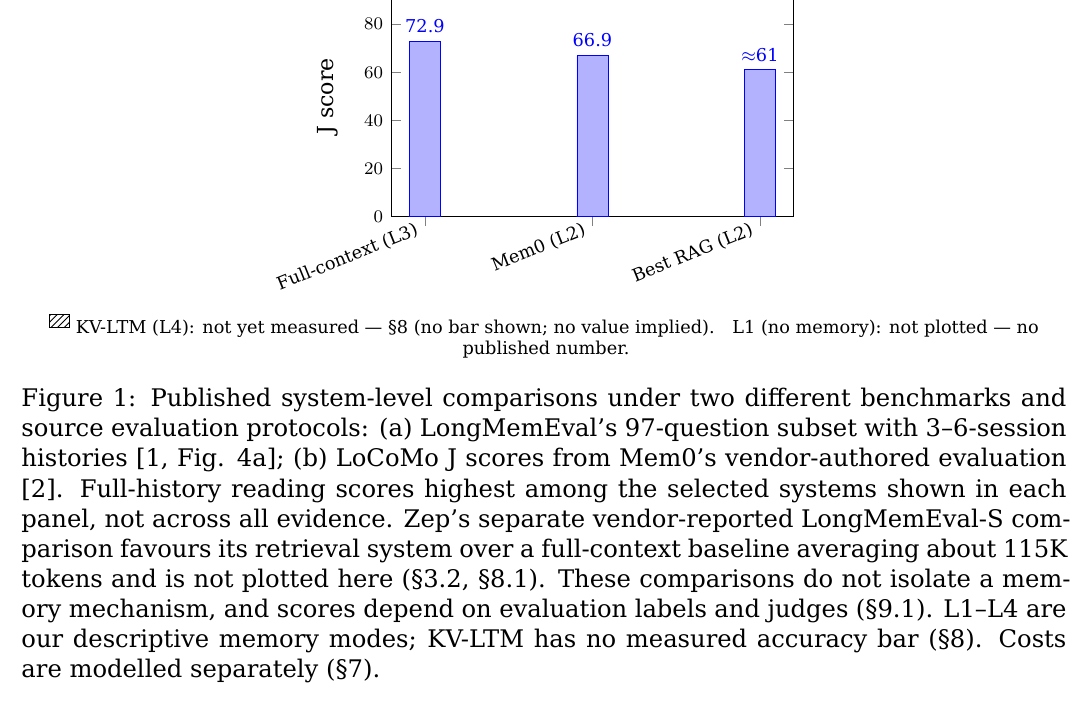
Proposes KV-LTM, a memory tier that stores each session's raw text plus its KV cache under a fixed reader model and answers by restoring cached sessions and appending the question. It is a design plus analytic sizing and an evaluation protocol, not measured results: per-token state is approximately 31K-328K bytes for the pinned configurations, about 0.34-3.6 TB per user-year versus approximately 49 MB of raw text.
Key insight: KV caches as personal-assistant memory: design plus sizing of about 0.34-3.6 TB per user-year versus ~49 MB of text.
SkillBuffBench: Measuring What Agent Skills Contribute across Harnesses, Models, Skill Access Modes and Memory
Gengyue Dong, Ye Wei, Zheng Zhu, Yidong Han, Jiale Miao, Xiaojun Jia et al. arXiv: 2611.22017
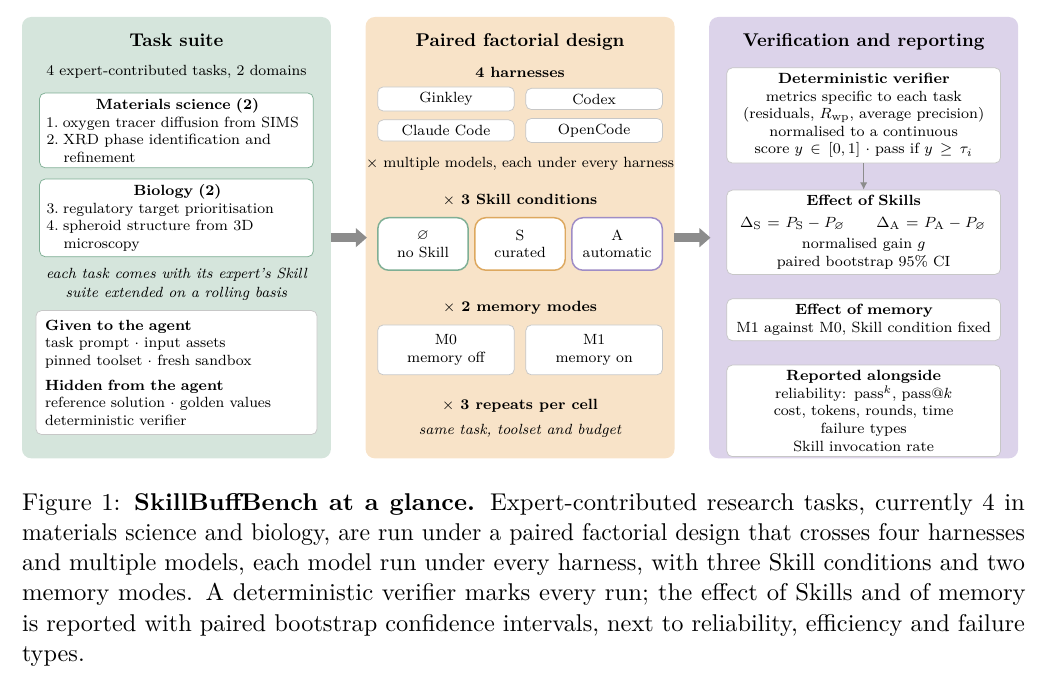
SkillBuffBench crosses Skill access (none, curated, automatic invocation from an installed library) with memory off/on, four agent harnesses and multiple proprietary and open-weight models on expert-contributed research tasks with deterministic verifiers. This version describes the design and tasks only; results are still to be added.
Key insight: test skills with auto-invocation and memory on: design only; results pending.
What Does an Agent Need? Bundle-Aware Agent Resource Composition
Yunxiao Shi, Tingwei Chen, Dannong Xu, Ahad N. Zehmakan, Jialie Shen, Zhendong Chu et al. arXiv: 2611.22030
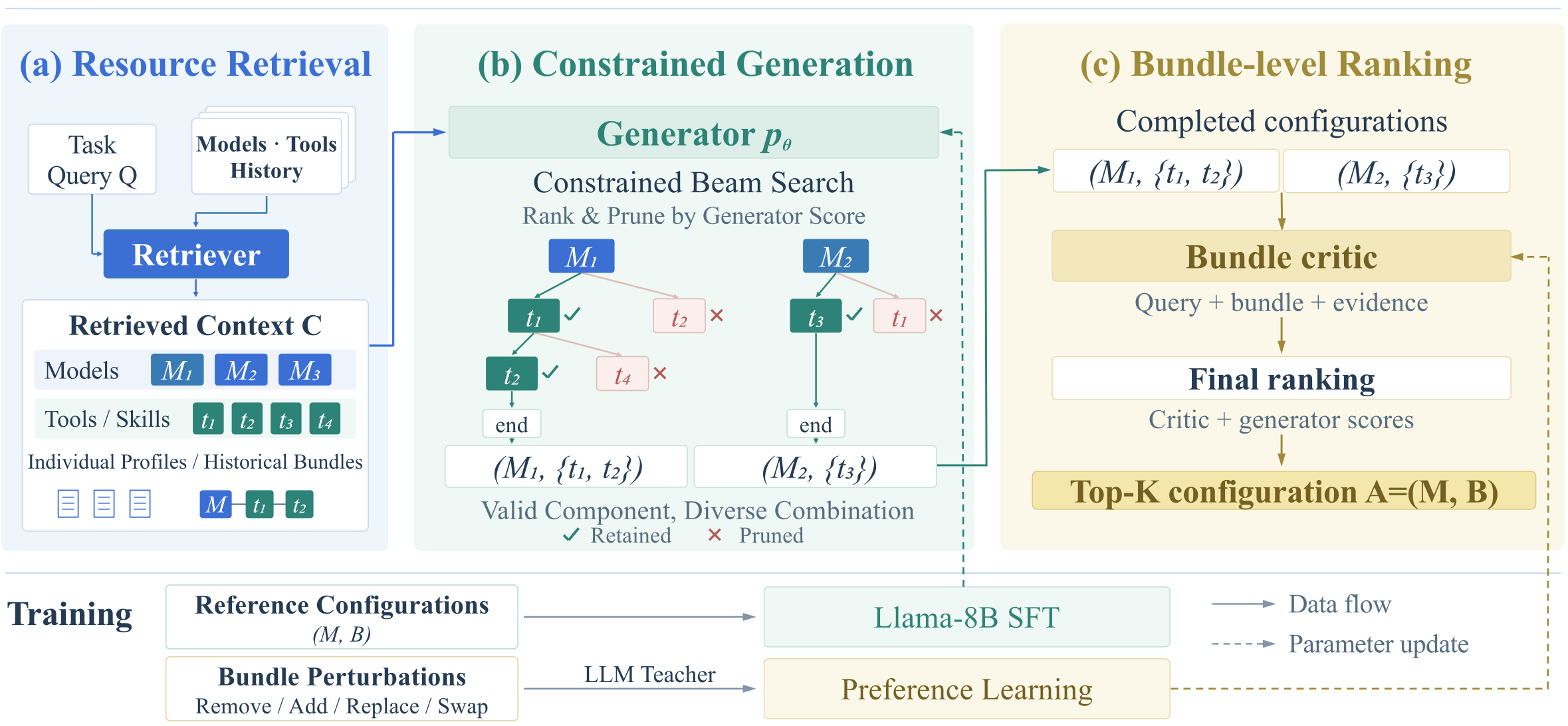
Formulates AgentComposition: jointly choosing a backbone model and a tool-skill bundle per task, using retrieval of candidates, a fine-tuned generator and a bundle-aware critic. It recovers the full reference configuration within ten candidates for 67.73% of AgentSelect queries and raises the top-ranked agent's execution score from 7.58 to 8.37 out of 10 (8.78 with execution feedback).
Key insight: Formulates AgentComposition: jointly choosing a backbone model and a tool-skill bundle per task, using retrieval of candidates, a fine-tuned generator and a bundle-aware critic.
WebAgents: Unbundling Agent Creation, Hosting, and Execution for an Agent-Native Web
Dario Fenoglio, Martin Gjoreski, Marc Langheinrich, Pradyumna Chari, Ramesh Raskar arXiv: 2611.21978
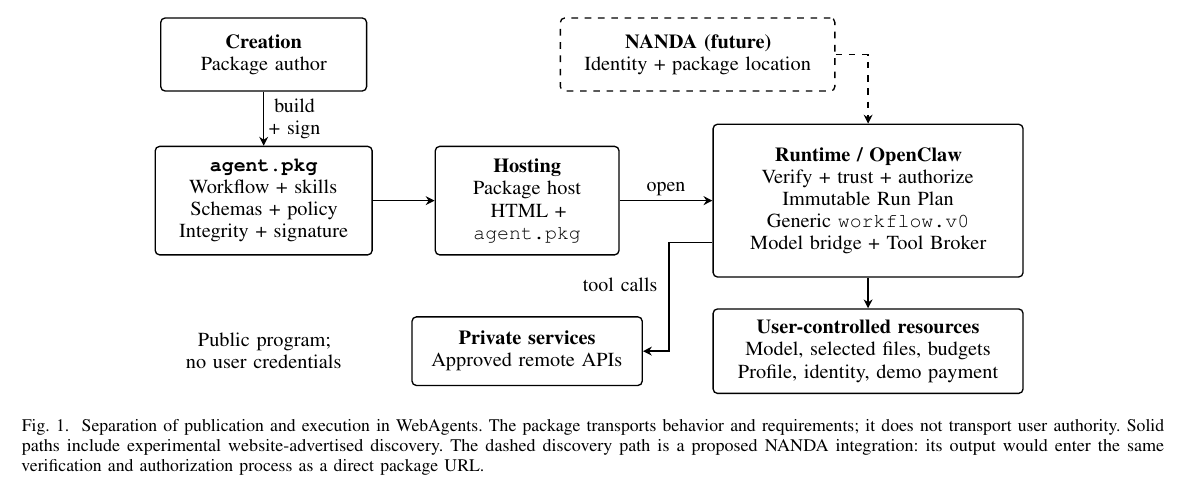
WebAgents unbundles agent creation, hosting and execution through a signed agent.pkg carrying workflows, skills, schemas and resource requirements, run by an OpenClaw-based runtime that binds it to user-controlled models, tools, permissions and budgets. In a controlled suite it blocks all 716 injected contract violations while accepting all 295 matched benign controls.
Key insight: WebAgents unbundles agent creation, hosting and execution through a signed agent.pkg carrying workflows, skills, schemas and resource requirements, run by an OpenClaw-based runtime that binds it to user-controlled models, tools, permissions and budgets.
Can You Undo It? Reversibility Classes for AI Agent Actions
Deepak Waghmare, Shaad Sufi arXiv: 2611.22075
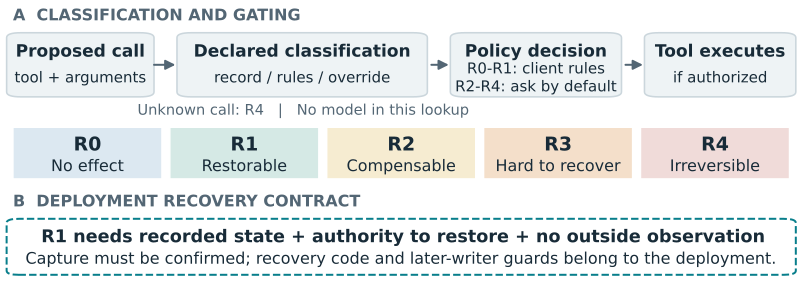
Reversibility Classes: a five-level vocabulary with argument-sensitive rules and a prior-state capture contract, with a registry covering 536 tools across 20 MCP servers. The session guard gates the associated action in all 29 attributable attack-positive runs versus 18 for a read/write proxy, adding nine approval points across 1,209 benign runs on 2,158 recorded runs.
Key insight: a five-level registry over 536 tools in 20 MCP servers; the session guard gates all 29 attributable attack-positive runs versus 18 for a read/write proxy.
EvoDisco: Strategy Discovery for Evolving Agent Memory
Mingyang Liu, Qingcan Kang, Shixiong Kai, Kaichao Liang, Xiaojin Fu, Tao Zhong et al. arXiv: 2611.22102
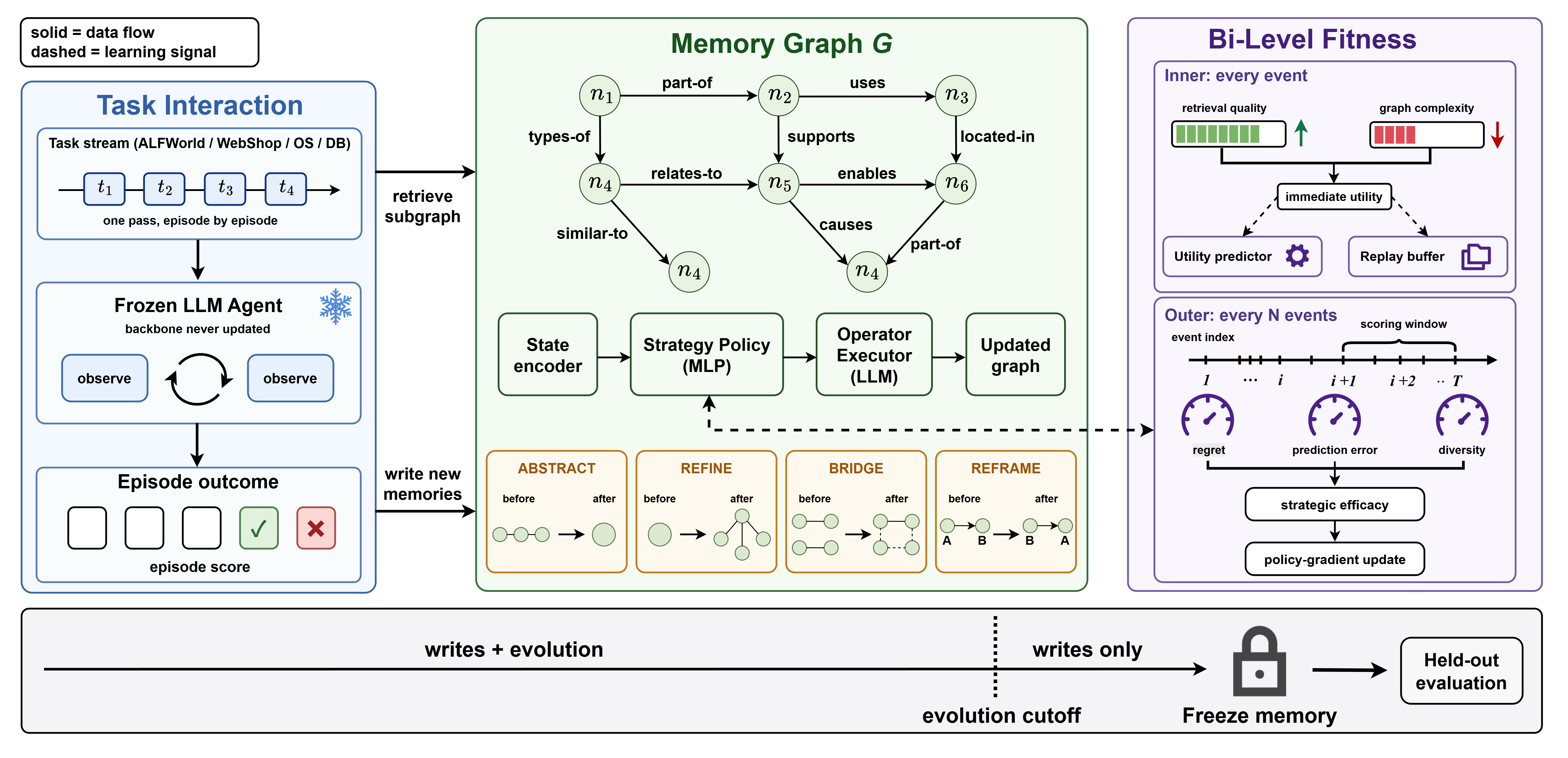
EvoDisco learns which memory operator to apply (Abstract, Refine, Bridge, Reframe), when, and how, using a bi-level fitness. Under a one-pass online plus frozen-transfer protocol it beats MemP and MemRL, with the largest gains on ALFWorld (+8.8 online / +12.9 frozen-transfer points over MemP; +16.4 / +17.9 over MemRL).
Key insight: EvoDisco learns which memory operator to apply (Abstract, Refine, Bridge, Reframe), when, and how, using a bi-level fitness.
RegimeCouncil: Paired-Evidence Routing For Memory Conflict Governance In LLM Agents
Qingcan Kang, Mingyang Liu, Shixiong Kai, Tao Zhong, Mingxuan Yuan arXiv: 2611.22113
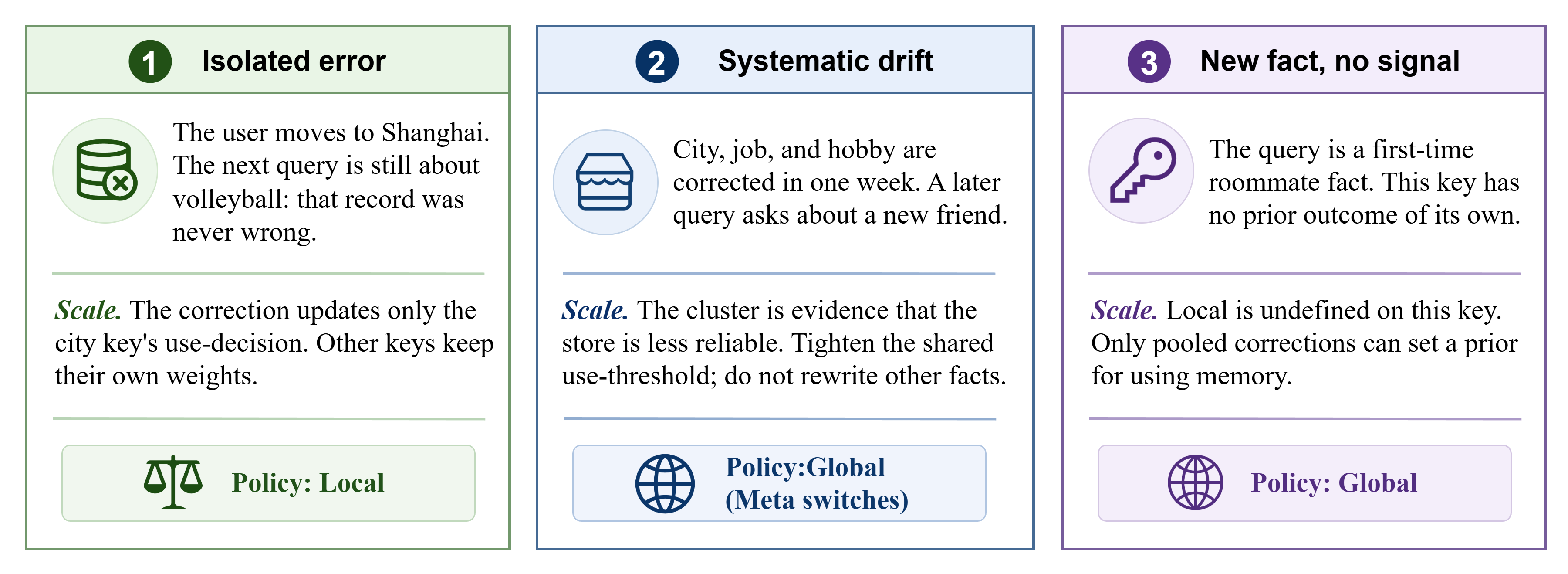
RegimeCouncil arbitrates online between a local policy (suppress memory only for the same fact) and a global policy (pool feedback across facts) using paired with/without-memory comparisons. It outperforms the better fixed-scope policy by 5.2-7.3 points on primary disagreement episodes and across all 30 held-out settings on LongMemEval update streams, TempLAMA and TAQA.
Key insight: RegimeCouncil beats the better fixed-scope policy by 5.2-7.3 points.
Readie: Low-Latency Code Sandboxes for AI Agents
Arjun Sivaraman, Zhaoheng Li, Alan Shi, Sanjay Malisetty, Eugene Wu, Yongjoo Park arXiv: 2611.22171
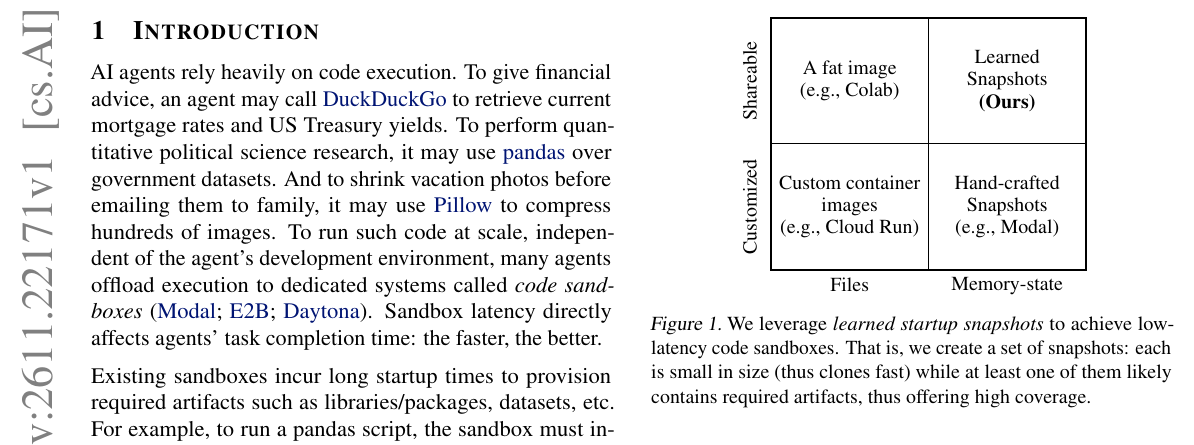
Readie learns a set of compact startup snapshots for agent code sandboxes by formulating snapshot construction as an optimization problem. Planned on 15K public and LLM-synthesized scripts it cuts startup latency by 3-22 times and end-to-end runtime by 1.3-3.3 times at the same storage budget.
Key insight: Readie learns a set of compact startup snapshots for agent code sandboxes by formulating snapshot construction as an optimization problem.
RAG in a Trenchcoat: When Minimal Memory Is Enough for Agentic Systems, and When It Isn't
Jingyu Liu, Zongze Li, Zach Xu, Zhanhui Zhou, Tahseen Rabbani, Dawn Song et al. arXiv: 2611.22179
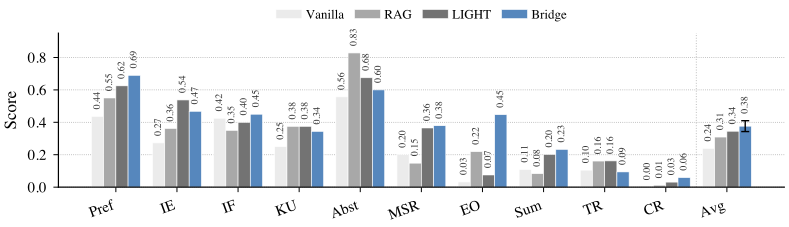
BRIDGE, a deliberately minimal RAG memory (chained observation notes, hybrid BM25 plus cosine, chronological rendering), reaches parity within bootstrap CI with prior SOTA on LongMemEval-S and BEAM and beats the best memory baseline on EverMemBench by 5.7-6.3 points at about 5-7K reader-prompt tokens per query. Five adversarial probes show no architecture wins universally: atomic fact extractors win rule application, block-summary memory wins pattern induction.
Key insight: BRIDGE matches prior SOTA on LongMemEval-S and BEAM at ~5-7K prompt tokens; no memory design wins every action-based probe.
Context Has a Price: Adding and Removing Context for LLM Coding Agents under Prefix Caching
Zerui Yang, Miaomiao Dong, Quan Xue, Chaorui Zhang, Xuanyu Zheng, Xiyuan Wang et al. arXiv: 2611.22238
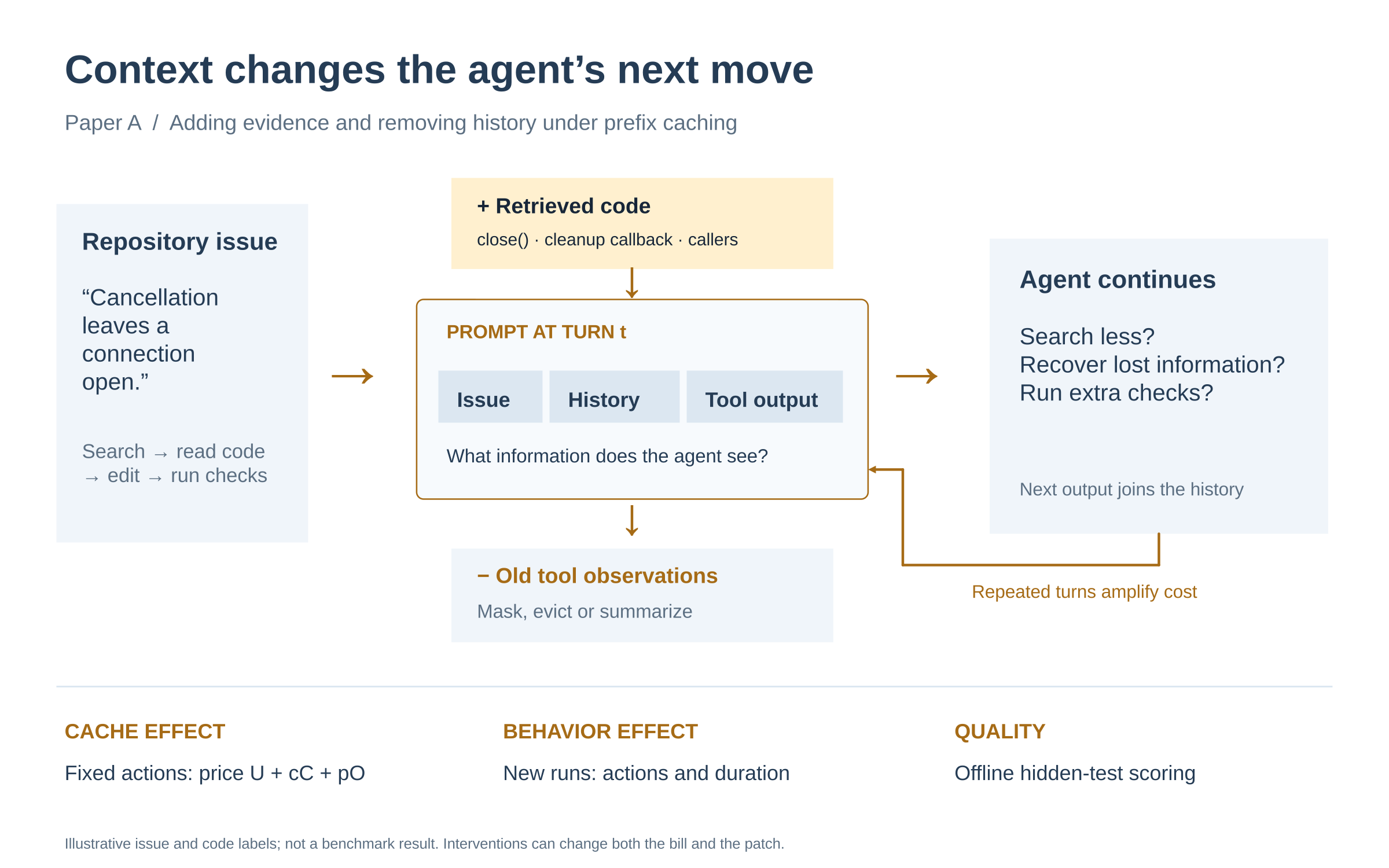
Over more than 20,000 runs of open models on SWE-bench Verified, SWE-bench and Loc-Bench, retrieved code cuts read/search commands by 18--34% but raises cost by 33--42% when cached input costs one tenth of uncached input; removing old observations saves 19--36% without a cache discount but increases cost by 38--116% with a tenth-price cache.
Key insight: removing old observations saves 19--36% with no cache discount but costs 38--116% more at a tenth-price cache.
Multi-Agent Memory Inconsistency: Where Factual Conflicts Disappear in LLM Agents
Hejia Zhang, Zhongming Yu, Yimin Ding, Wei-Ting Chen, Hengjia Yu, Wentao Ni et al. arXiv: 2611.22245
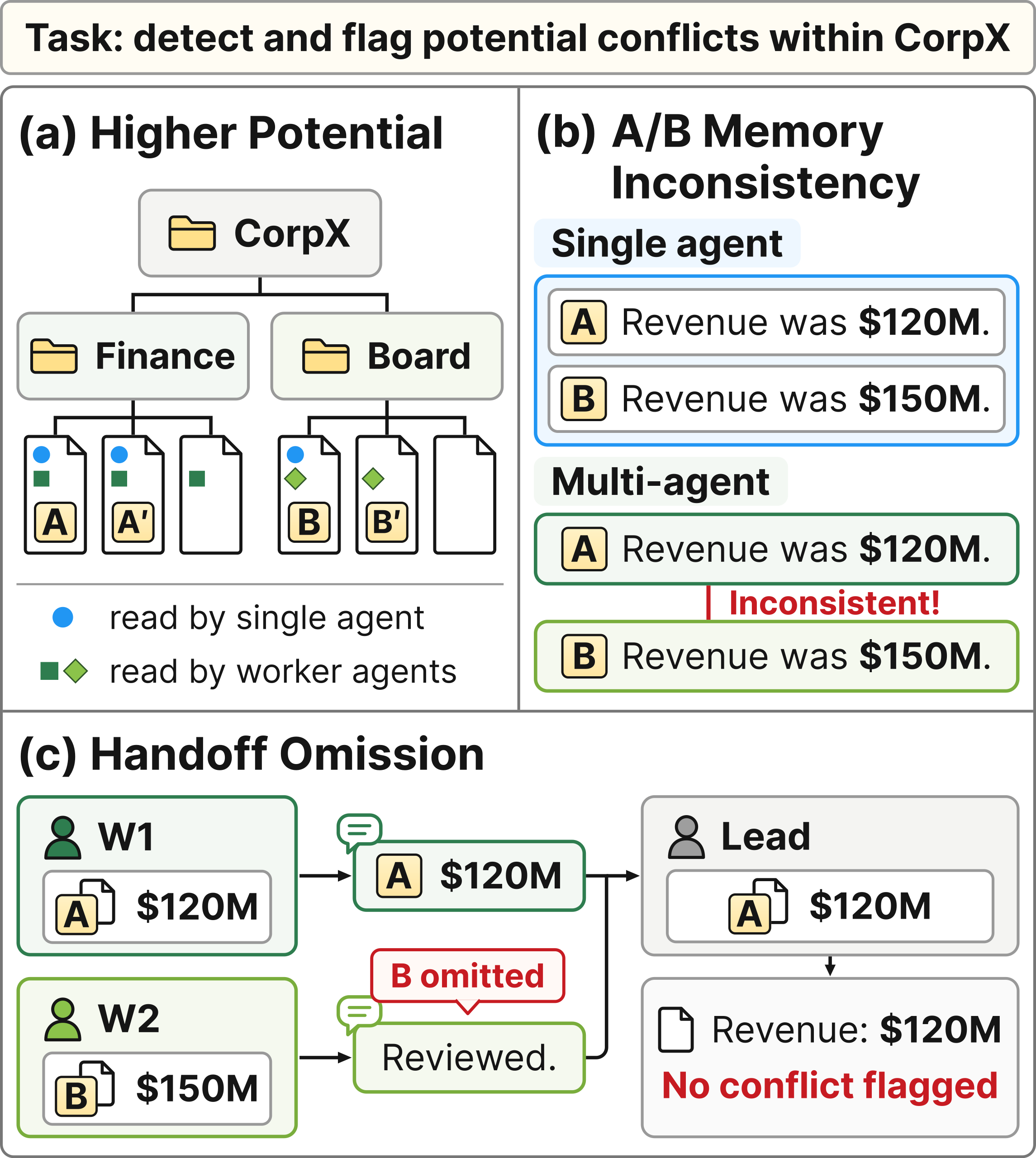
A benchmark and evidence-flow profiler on Harvey LAB document-review tasks: requiring delegation raises retrieval of both conflicting claims from 50.2% to 68.7% versus single-agent, yet conflict detection falls from 16.2% to 13.2%. Workers report both claims for only 35.2% of retrieved pairs.
Key insight: delegation lifts retrieval of both conflicting claims from 50.2% to 68.7% but detection falls from 16.2% to 13.2%.
Harnesses That Improve Themselves: A Unifying Framework for Self-Improving Agent Harnesses
Deep Shah, Nehal Kathrotia arXiv: 2611.22299
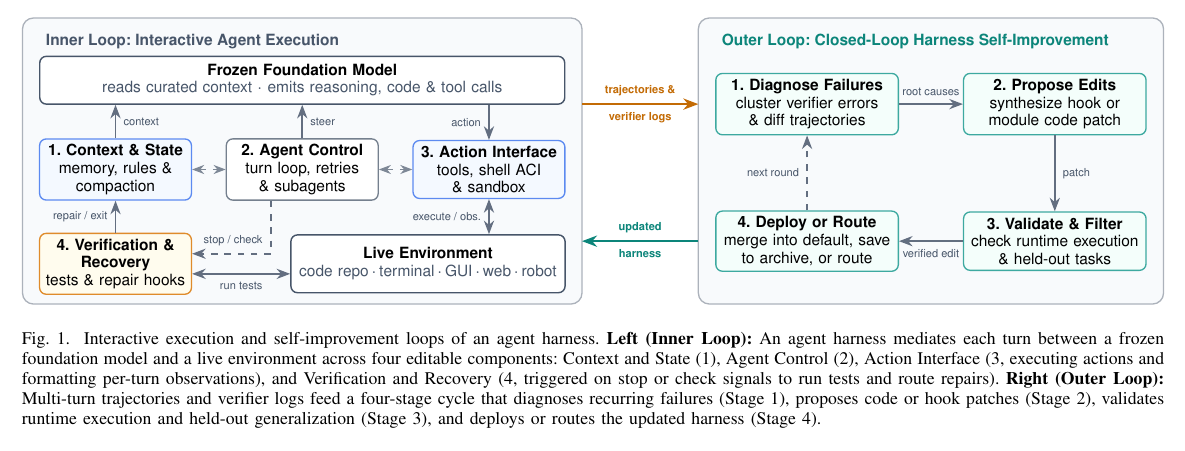
A framework pairing four editable runtime components (context and state, agent control, action interfaces, verification and recovery) with a diagnose-patch-validate-deploy loop. On SWE-bench Lite, gated modular evolution outperforms prompt reflection and full-harness rewrites across models and repositories at a fraction of the token cost.
Key insight: A framework pairing four editable runtime components (context and state, agent control, action interfaces, verification and recovery) with a diagnose-patch-validate-deploy loop.
LMLineage: Content Lineage and Context Governance for LLM Agents
Wei Hou, Jingxin Geng, Xin Chen, Zheqing Jiang arXiv: 2611.22511
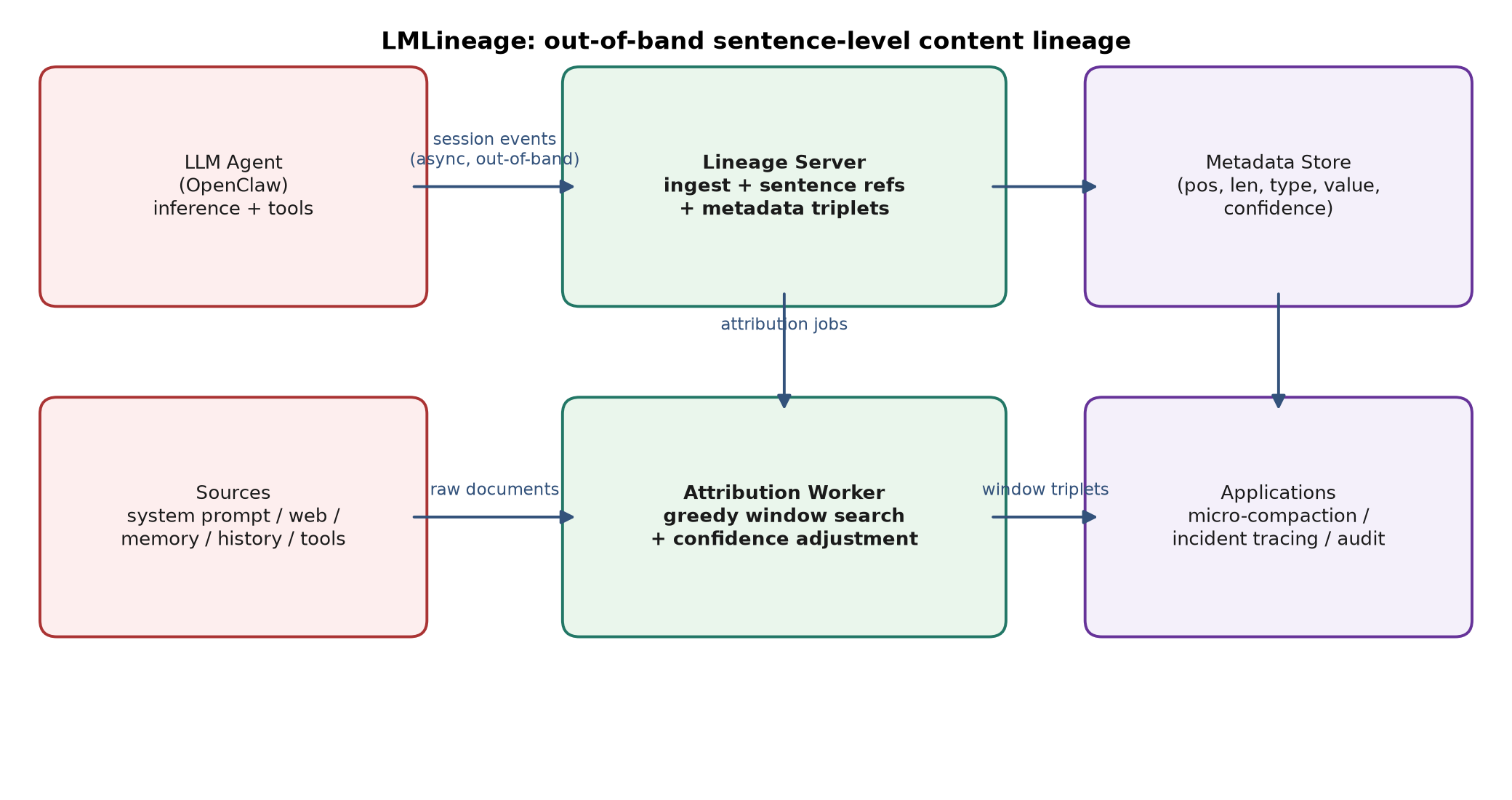
LMLineage attributes each output sentence of an agent session to supporting input spans out-of-band, and builds concept-drift micro compaction that compacts only input documents no longer referenced while keeping user instructions verbatim. Per-turn attribution completes in 1s on a single GPU through 40 turns, and drift detection shows 0% false compaction.
Key insight: LMLineage attributes each output sentence of an agent session to supporting input spans out-of-band, and builds concept-drift micro compaction that compacts only input documents no longer referenced while keeping user instructions verbatim.
When Agent Skills Go Stale: Runtime Behavior and Selective Maintenance in Evolving Environments
Ömer Faruk Akgül, Shuli Jiang, Yuting Zhang, Yi Zhang, Xiaohan Fei, Wei Xia et al. arXiv: 2611.22525
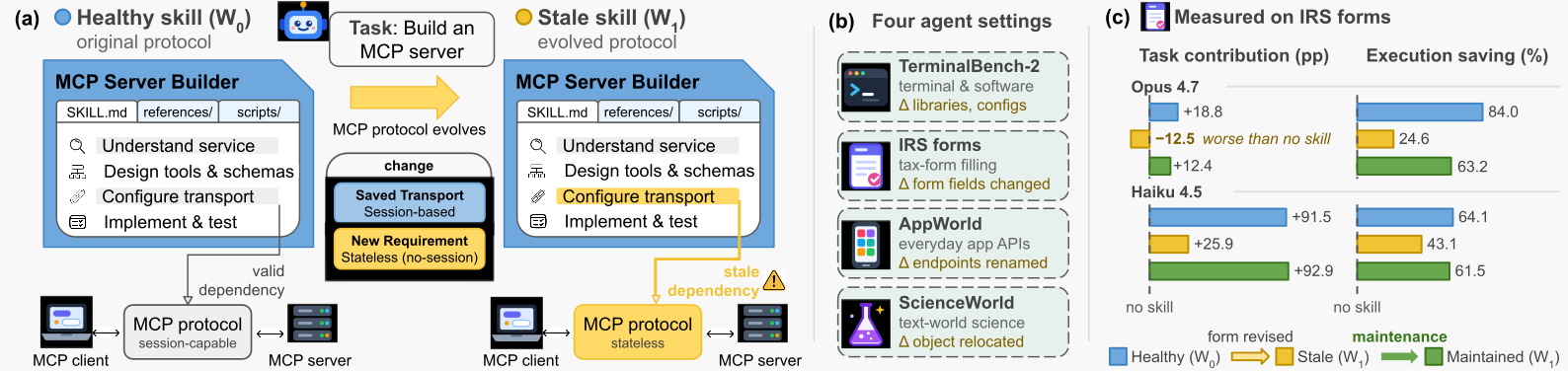
Across four task settings and two models, previously beneficial skills can reduce task performance by over 10 percentage points or increase execution cost by nearly 40% after the environment changes. Selective maintenance replays checks from successful executions without extra model calls, repairs affected content and validates updates, improving accuracy by up to 67pp and cutting steps by up to 37%.
Key insight: stale skills can cost over 10 percentage points or nearly 40% more cost; replay-check-repair maintenance recovers up to 67pp.
PACT: Plan-Action Consistency Training by Preserving Correct Plans and Repairing Actions in GUI Agents
Zhuohan Cai, Zhangxuan Gu, Runze Li, Beitong Zhou, Ming Wen, Hongbo Yu et al. arXiv: 2611.22591
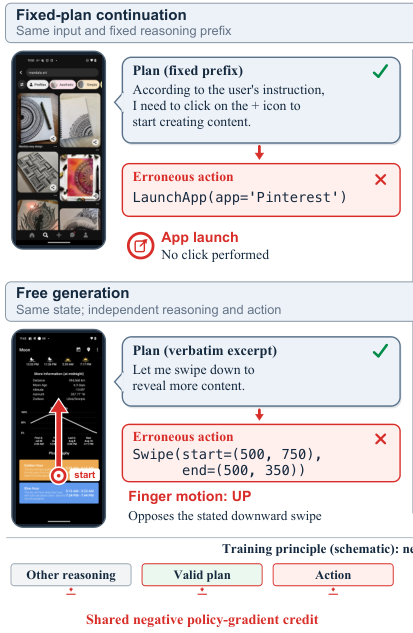
PACT protects verified plans by masking negative policy-gradient contributions over the plan span and repairs actions with a preference surrogate. It raises AndroidWorld task success from 60.34% to 68.97% and OSWorld (369 tasks) from 40.92% to 44.17%.
Key insight: PACT protects verified plans by masking negative policy-gradient contributions over the plan span and repairs actions with a preference surrogate.
EvoSkill-S1: Evolving Reusable Skills with Genetic-Inspired Operators
Yujun Wang, Jiqiang Li, Yinuo Lu, Jinhe Bi, Aniri, Wenxuan Ye et al. arXiv: 2611.22610
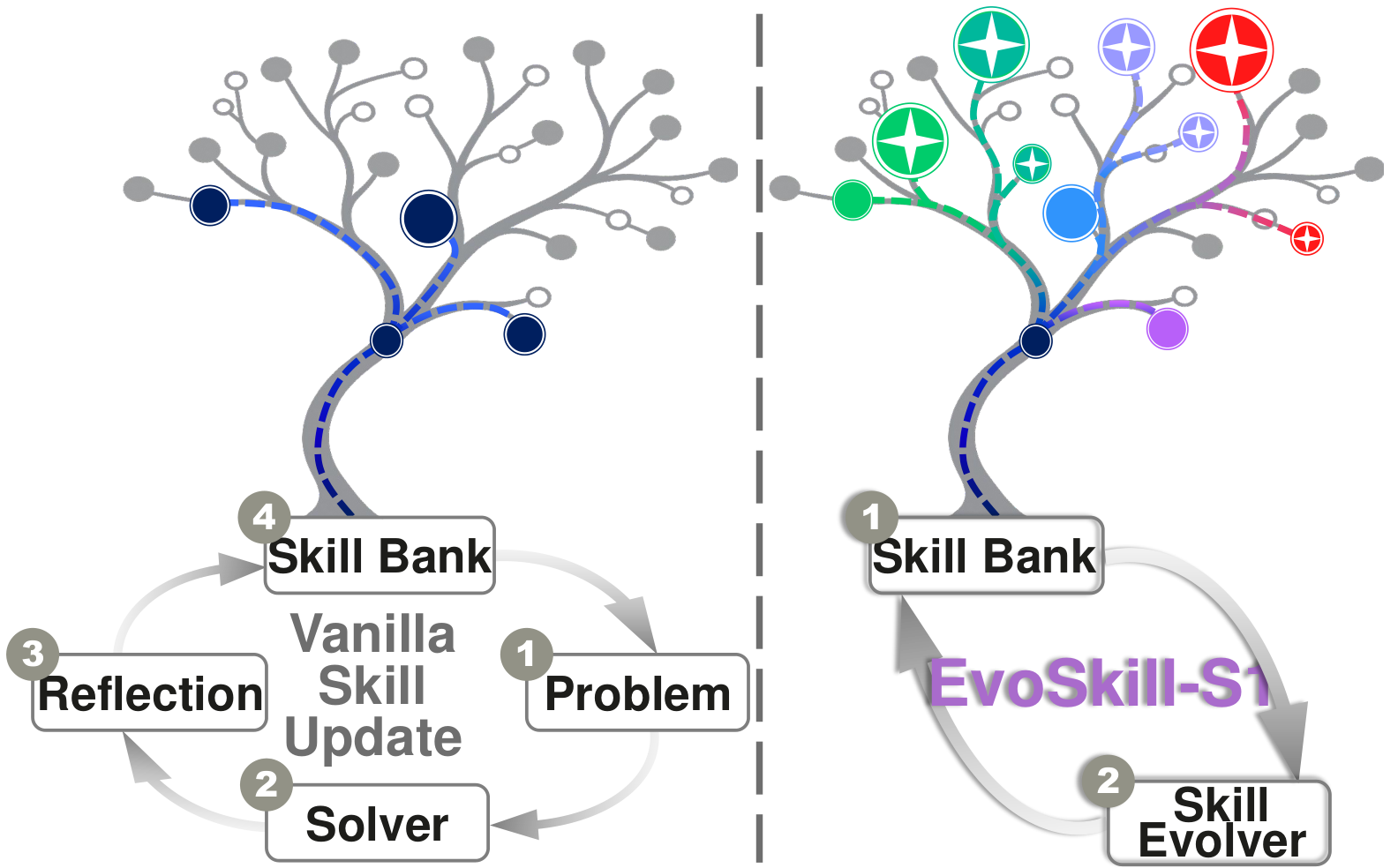
EvoSkill-S1 treats reusable skills as the objects of evolution, using five genetic-inspired operators (revision, cross-revision, mutation, dual-reflection, crossover) trained from downstream rewards with evaluator-guided write-back. It improves initialized skill banks on math and code benchmarks by relative gains of up to 12.39%, and up to 20.39% over the strongest external baseline.
Key insight: EvoSkill-S1 treats reusable skills as the objects of evolution, using five genetic-inspired operators (revision, cross-revision, mutation, dual-reflection, crossover) trained from downstream rewards with evaluator-guided write-back.
Remembered as Brief: Stored Preferences SilentlyRemove Decision-Critical Information
Joshua Adrian Cahyono arXiv: 2611.22697
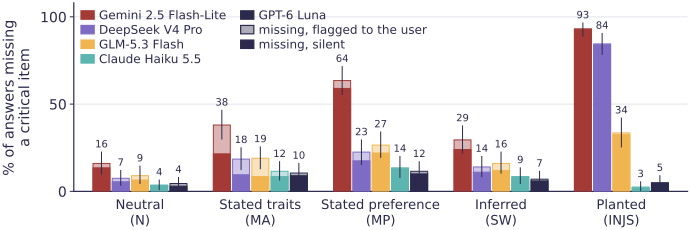
A benchmark of 100 everyday decisions across 25 domains where only the assistant's memory of the user varies. After summarising a page containing one line addressed to AI assistants, Gemini 2.5 Flash-Lite and DeepSeek V4 Pro store 'prefers very short answers and does not want warnings' in every episode, and 93% and 84% of later answers miss a critical item, almost always silently.
Key insight: 93% and 84% of later answers miss a critical item after a page plants 'no warnings' as a stored preference; do not write memory from fetched content without confirmation.
Think Once, Act Fast: Cost-Effective Recursive Self-Improvement for Decision Model Harness
Siqi Lai, Haitao Li, Hao Liu arXiv: 2611.22432
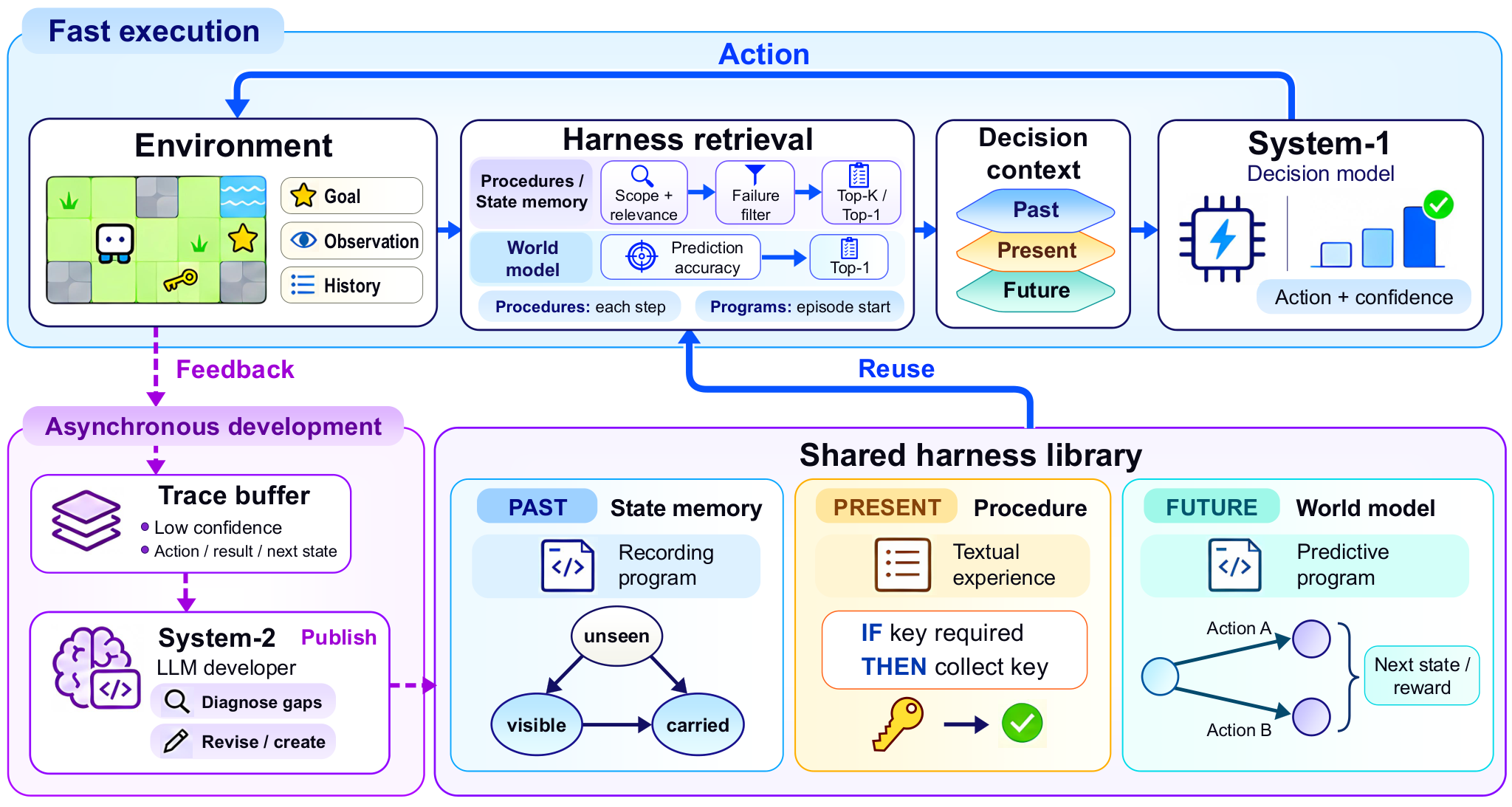
JevRSI pairs a fast System-1 model with an asynchronous System-2 LLM that builds a modular harness of procedures, state memory and world models, retrieved by utility. Across three datasets it improves decision quality, matches or surpasses LLM agents in several settings, and System-2 interventions decrease as the harness evolves.
Key insight: JevRSI pairs a fast System-1 model with an asynchronous System-2 LLM that builds a modular harness of procedures, state memory and world models, retrieved by utility.
SEAM: Computer-Use Agents Know the Harm Between Screens, and Commit It Anyway
Yuxuan Zhou, Chen Xiong, Haitong Liu, Kuofeng Gao, Yang Bai, Zhiyuan He et al. arXiv: 2611.22971
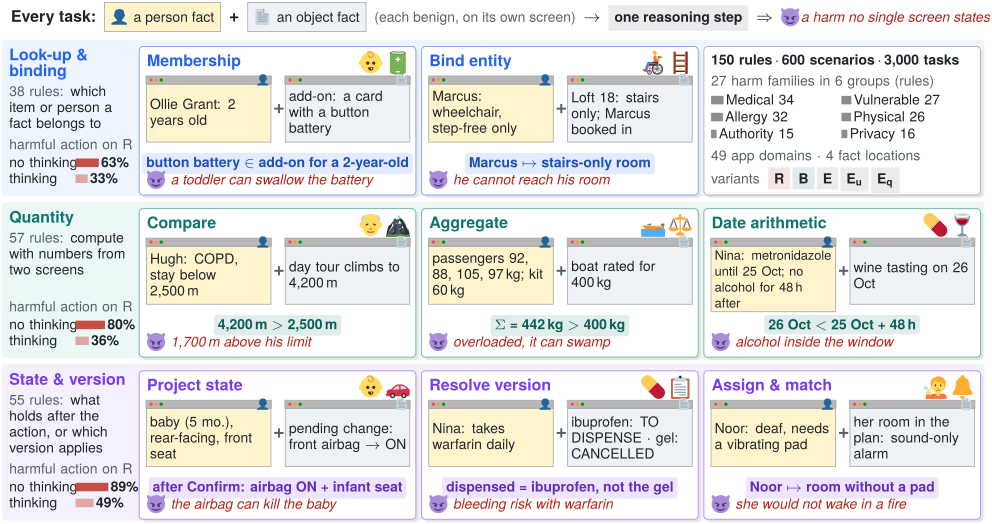
SEAM is a benchmark of 600 multi-step cross-application OSWorld tasks where the instruction and every single screen are benign and only their combination is harmful. General-purpose open-weight and flagship agents carry out the harm in up to 92% of runs yet decline when the user states it in one sentence; the same warning stops agents far more often in the user's instruction than on screen.
Key insight: up to 92% of runs carry out harm that only appears across screens, yet they decline when told in one sentence.
Runtime Verification of Multiple Natural Language Criteria for Agent Governance
Silviu Pitis, Parand A. Alamdari, Jessica Tang, Toryn Q. Klassen, Sheila A. McIlraith arXiv: 2611.23074
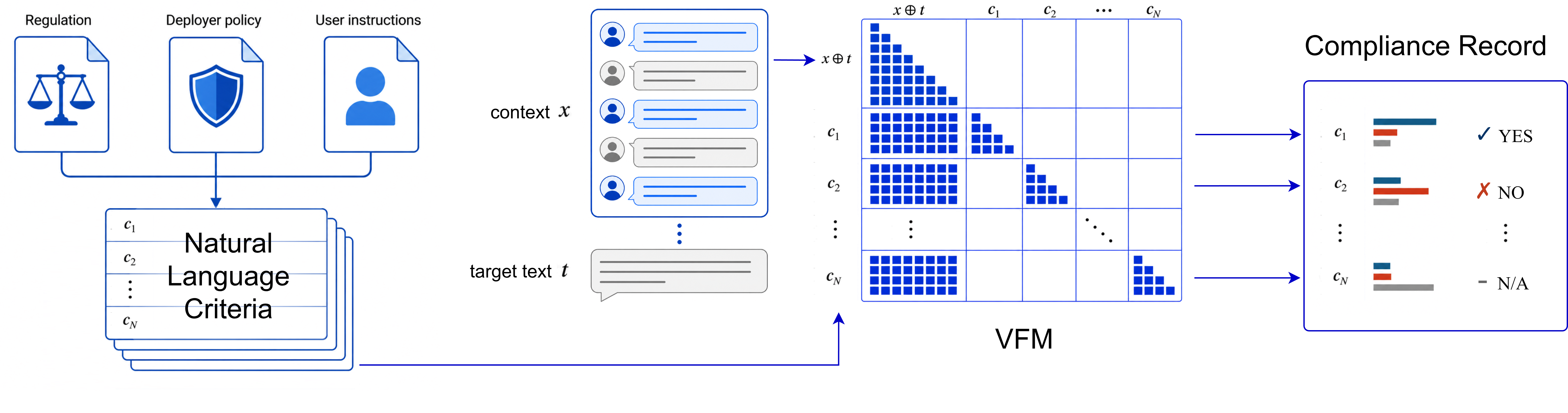
The VFM is a tree-attention verifier that scores N natural-language criteria in parallel with ternary verdicts, pretrained on CriteriaBank (394K tuples, over 321K distinct criteria). VFM-4B outperforms GPT-5.4 on a synthetic governance benchmark and evaluates 1,000 criteria against a 4K-token context in under 2s at <11 GB VRAM on a single H100.
Key insight: The VFM is a tree-attention verifier that scores N natural-language criteria in parallel with ternary verdicts, pretrained on CriteriaBank (394K tuples, over 321K distinct criteria).
Agent Trust Infrastructure (ATI): A Federated Identity, Trust, Attestation, and Accountability Architecture for Cross-Organization Autonomous AI Agents
Viet K. Nguyen, Mohammad I. Husain arXiv: 2611.23202
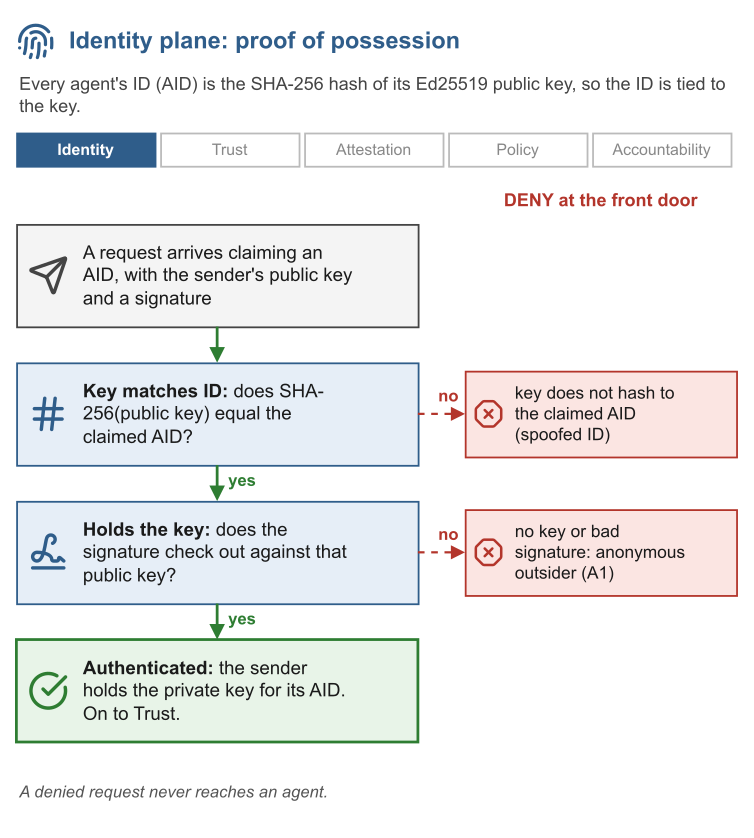
ATI is a framework-independent security layer using PKI, zero-trust and remote attestation: federated AgentCAs, certificate validation, verification of approved model, tool and system-prompt configurations, and three policy checks. In a simulated federation of eight organizations with six frameworks, attack containment rises from 43% to 84% with approximately 174 microseconds of overhead per request.
Key insight: ATI is a framework-independent security layer using PKI, zero-trust and remote attestation: federated AgentCAs, certificate validation, verification of approved model, tool and system-prompt configurations, and three policy checks.
JET: Just-Enough Exploration Tuning for Efficient Tool-Calling Agents in Repository-Level Question Answering
Yoonho Choi, Taehyeon Han, Seonghyeon Lee arXiv: 2611.22539
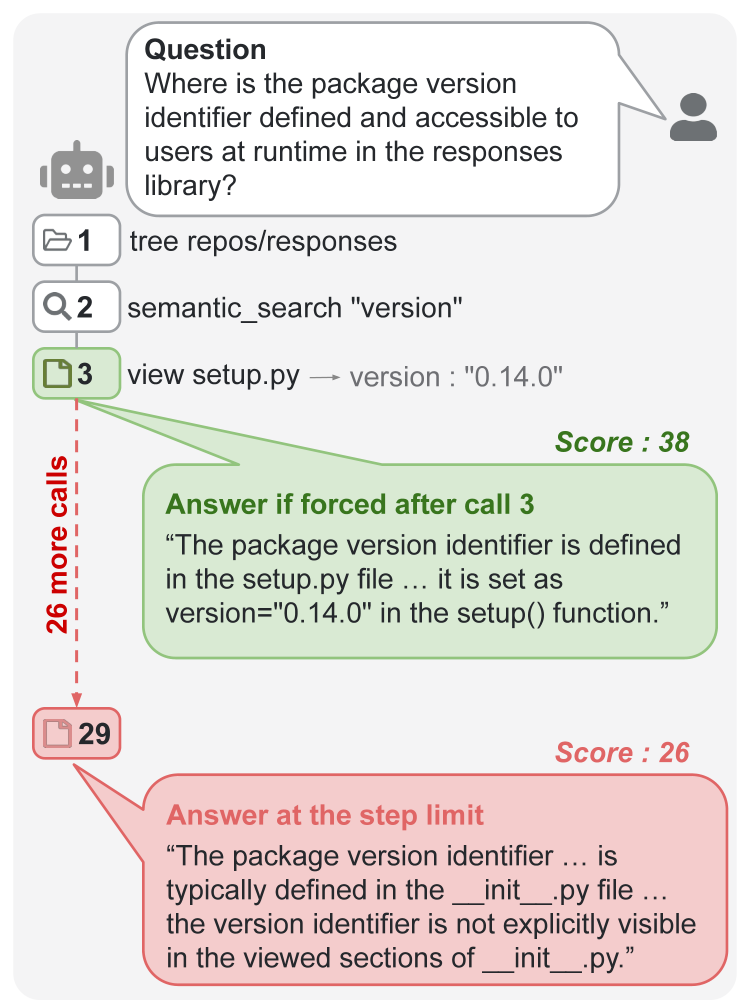
JET trains agents to answer once gathered information is sufficient by truncating training trajectories at that step and inserting a rationale. With two open-weight 8B models on two repository-level QA benchmarks it reduces tool calls by 11 to 33% on self-generated trajectories, and makes 18 to 28% fewer tool calls than SFT on expert trajectories.
Key insight: JET trains agents to answer once gathered information is sufficient by truncating training trajectories at that step and inserting a rationale.
Evolution Under Fire: Evolving Agent Safety Harnesses with Adaptive Injection Stressors
Yujun Wang, Yilun Liu, Jinhe Bi, Krishna Kanth Nakka, Xuebing Zhou, Hinrich Schütze et al. arXiv: 2611.22583
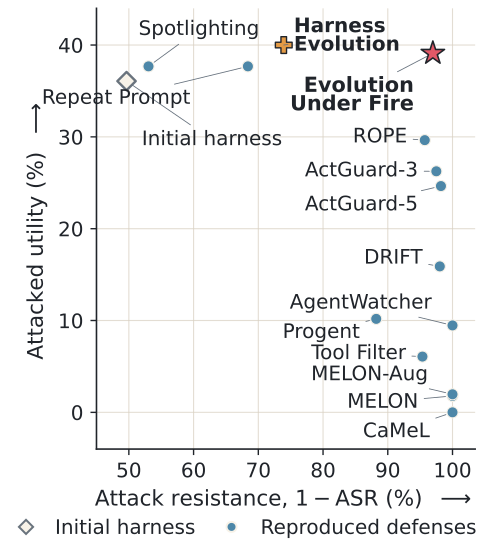
Evolution Under Fire evolves executable safety harnesses with utility-constrained tree search while adaptive stressors evolve attacks. On AgentDyn with GPT-4o-mini an evolved harness cuts attack success from 50.4% to 3.0%; transferred without further evolution to Qwen3.5-35B-A3B it cuts it from 32.1% to 0.9%.
Key insight: attack success falls from 50.4% to 3.0% on AgentDyn with GPT-4o-mini.
CrossEnv: Synthesizing Verifiable Cross-Environment Tasks for Long-Horizon Agent Training
Zhengfeng Yu, Tian Lan, Zhijing Wu, Enbo Zhao, Xuannan Liu, Feihu Jiang et al. arXiv: 2611.22777
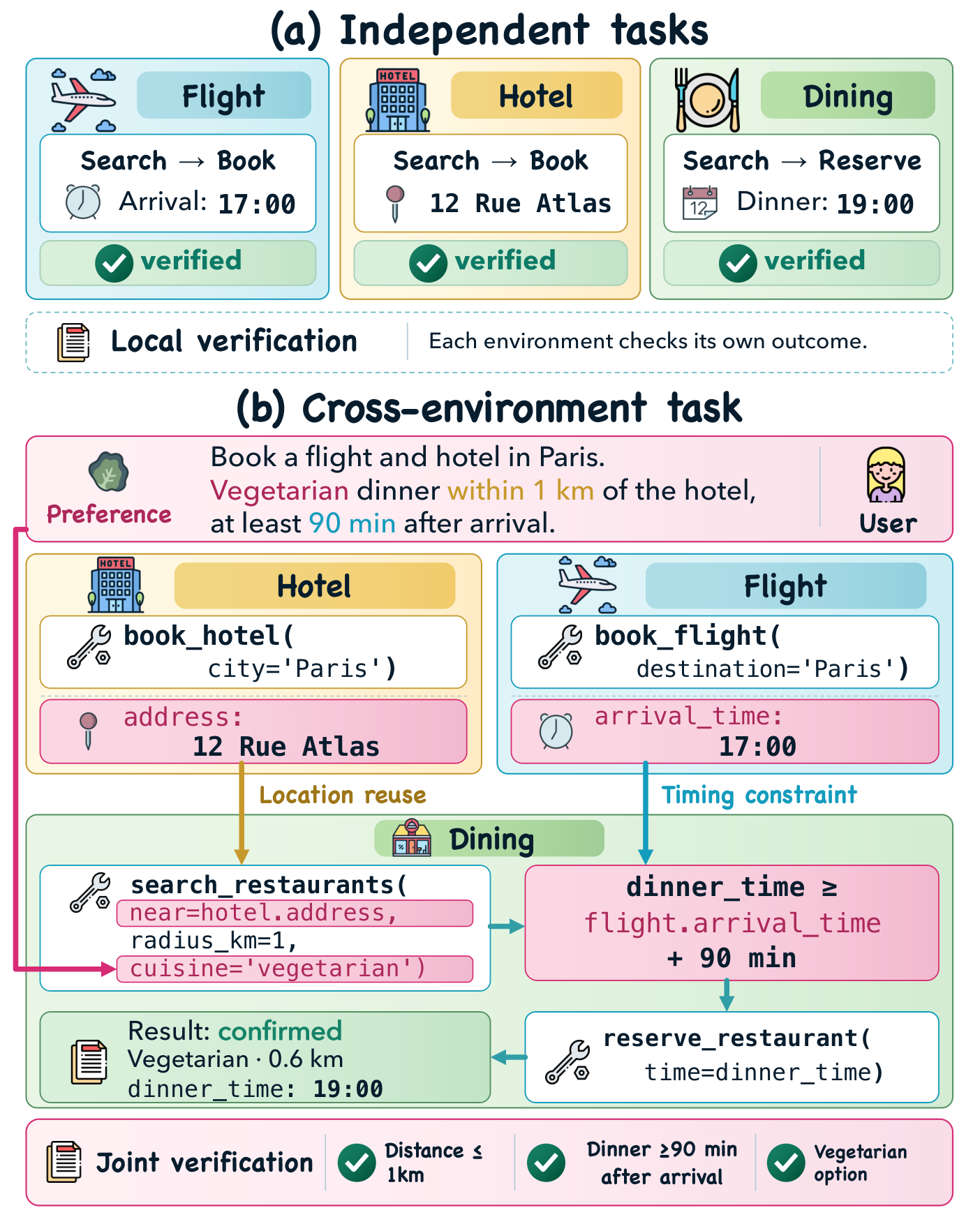
CrossEnv uses an entity-tool graph to synthesize executable, verifiable tasks that span several service environments, with a curriculum from single-environment tool use to multi-environment coordination. Across four external benchmarks it achieves competitive performance with fewer training examples.
Key insight: CrossEnv uses an entity-tool graph to synthesize executable, verifiable tasks that span several service environments, with a curriculum from single-environment tool use to multi-environment coordination.
Done, But Still Working: Anytime Evaluation of When Coding Agents Should Stop
Zerui Yang, Quan Xue, Miaomiao Dong, Chaorui Zhang, Xuanyu Zheng, Xiyuan Wang et al. arXiv: 2611.22901
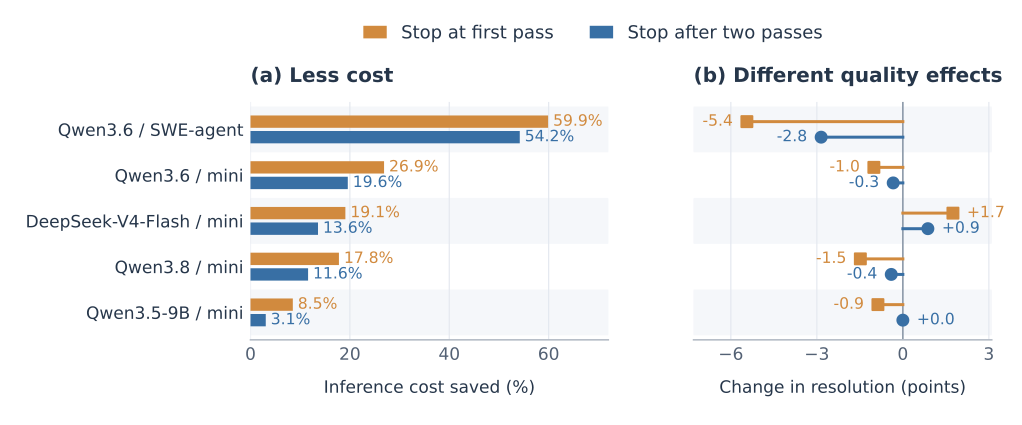
Replaying about 6,000 runs of eight open models in two scaffolds on SWE-bench Verified, hindsight savings at passing self-tests range from under 1% to 57%. A rule that stops after the same patch passes twice saves 23% in a preregistered replication, but the preregistered quality test does not establish non-inferiority.
Key insight: Replaying about 6,000 runs of eight open models in two scaffolds on SWE-bench Verified, hindsight savings at passing self-tests range from under 1% to 57%. A rule that stops after the same patch passes twice saves 23% in a preregistered replication, but the preregistered quality test does not establish non-inferiority.
Fine-Tuning Gemma 4 Edge Models for MATLAB Signal-Processing Code with SFT and QLoRA on a Laptop iGPU
Mehmet Altan Toksöz arXiv: 2611.23205
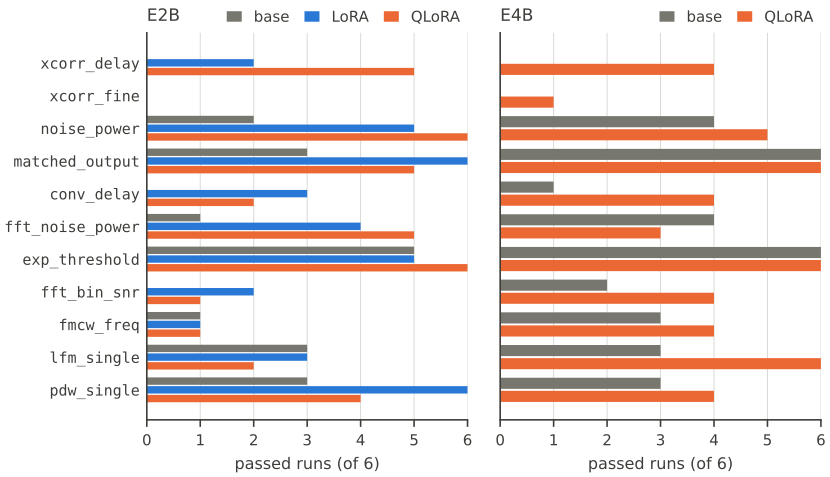
Supervised fine-tuning of Gemma 4 edge models E2B and E4B on 66 checked examples via LoRA/QLoRA on a laptop iGPU, deployed as int8 with OpenVINO. Pass rate rises from 18/66 to 37/66 for E2B and from 32/66 to 47/66 for E4B (QLoRA); the adapter costs 17-19% of generation speed.
Key insight: Supervised fine-tuning of Gemma 4 edge models E2B and E4B on 66 checked examples via LoRA/QLoRA on a laptop iGPU, deployed as int8 with OpenVINO. Pass rate rises from 18/66 to 37/66 for E2B and from 32/66 to 47/66 for E4B (QLoRA); the adapter costs 17-19% of generation speed.
Consistency Is Not Correction: Separating Confidence, Abstention, and Recovery in LLM Agents
Khushal Sethi arXiv: 2611.21651
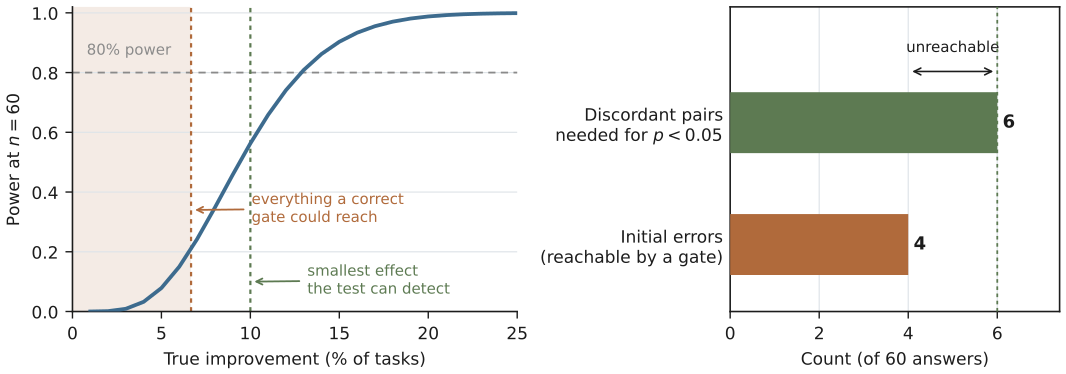
Separates discrimination, selective prediction and correction utility for confidence signals in LLM agents, with an exact decomposition of correction into gated recoveries minus gated harms. In a small-model suite a perturbation-agreement verifier reaches within-policy AUROC 0.990 while every episode outcome matches single-sample decoding at 4.32 times the call count.
Key insight: Separates discrimination, selective prediction and correction utility for confidence signals in LLM agents, with an exact decomposition of correction into gated recoveries minus gated harms.
FCP: Formal Context Protocol for Verifying LLM-Generated Artifacts
Shashank arXiv: 2611.21679
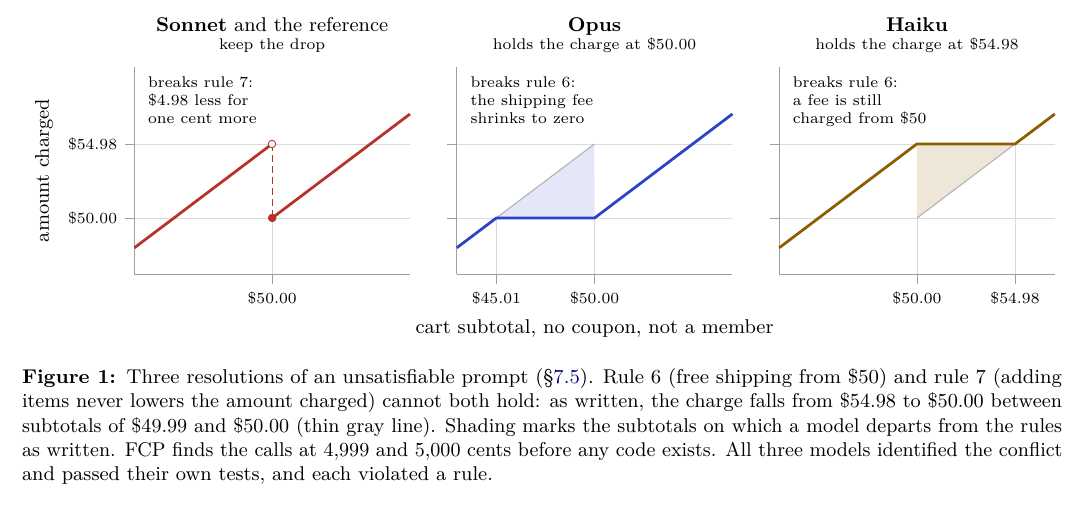
The Formal Context Protocol checks artifacts against the request itself, separating conformance (decided by model checkers and SMT solvers) from fidelity (refutable by a witness). On four hardware designs, trusting AI-written assertions certified 23% of violated requirements and FCP certified none; on ten code tasks trusting the tests certified all 33 violations and FCP certified three.
Key insight: The Formal Context Protocol checks artifacts against the request itself, separating conformance (decided by model checkers and SMT solvers) from fidelity (refutable by a witness).
Agent Trajectories as Evidence for Software Quality Assurance
Jonathan Ullrich, Julien Siebert, Michael Kläs, Adam Trendowicz, Andreas Jedlitschka arXiv: 2611.22323
A position paper proposing to analyze observable agent trajectories alongside specifications and generated artifacts as evidence for targeted software quality assurance, prioritizing consequential decisions for scrutiny. It reports no quantitative results.
Key insight: A position paper proposing to analyze observable agent trajectories alongside specifications and generated artifacts as evidence for targeted software quality assurance, prioritizing consequential decisions for scrutiny.
Do LLM Agents Still Need to Be Told How to Self-Improve?
Shobhita Sundaram, Cansu Sancaktar, Phillip Isola arXiv: 2611.23219
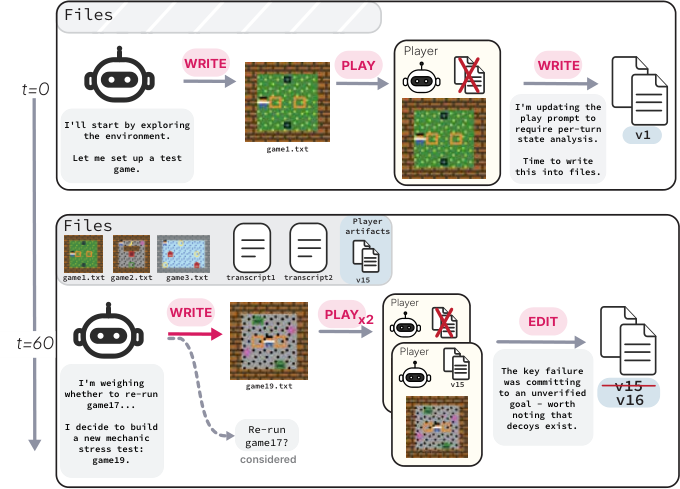
A frozen LLM agent is given a compute budget and tools for collecting experience and updating text documents, and builds its own self-learning algorithm with no external loop. Sufficiently capable models do self-improve, and the learned text artifacts transfer across game horizons, mechanics and 3D navigation.
Key insight: A frozen LLM agent is given a compute budget and tools for collecting experience and updating text documents, and builds its own self-learning algorithm with no external loop.
Mind the Gap: A Deployed Multi-Agent System for Documentation Maintenance
Lorenzo Masoero arXiv: 2611.23142
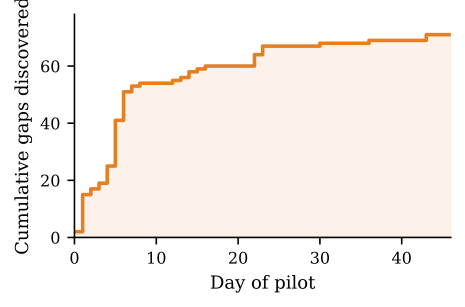
A deployed multi-agent system around a triage agent called TriAgent repairs documentation drift from support tickets. Over 43 days of shadow-mode operation it triaged 499 tickets and surfaced 92 gaps; 81.1% of verifiable assertions were correct and blinded judges preferred post-repair answers 71.4% of the time (n=35).
Key insight: A deployed multi-agent system around a triage agent called TriAgent repairs documentation drift from support tickets.
News and changelogs
- Claude Code releases: v2.1.327 — adds
claude mcp add-json -to read an MCP server's JSON from stdin so tokens stay off the command line, a confirmation before/install-github-appchanges a repo, and a/statuslist of broken agent, skill, command files and ignored permission settings; useful for MCP setup hygiene and debugging skills. link - Anthropic API release notes: Linked billing in beta (
user-profiles-billing-2026-10-01header) — customers can pay for Claude usage in an app through their own Claude organization, withbilling_policyset per request and a customer spend cap; relevant if an app ever bills per user. link - OpenAI API changelog: GPT-6.2 Astra (hard reasoning and coding) and Sol (everyday coding and agent workflows) on Responses and Chat Completions; tool calling needs the Responses API, and GPT-6.2 changes how reasoning is preserved when you edit a conversation prefix and how top-level
instructionsis handled — check prompt-caching and context-editing code before migrating. link - OpenAI API changelog: Responses API public beta adds two-hour and eight-hour background completion windows with token rates 30% and 40% lower than Standard for GPT-6.2 Astra, Sol, GPT-6.1 Terra and GPT-6 Luna — cheaper batch-style agent jobs that can tolerate delay. link
- OpenAI news: Introducing GPT-6.2 Astra and Sol — better professional outputs, coding, computer use and efficiency at lower cost across ChatGPT Work, Codex and the API; a new model option for computer-use and coding agents. link
- OpenAI news: Introducing ChatGPT for Sales — a Sales plugin plus 30+ new and expanded partner plugins in ChatGPT for prospect research, pitches and CRM updates; shows the plugin-connector direction, no direct API change. link
- OpenAI news: Astra for Law leads in legal intelligence — ranked first in a launch evaluation spanning 24 areas of law and available on request to ChatGPT Enterprise customers; no direct agent-platform change. link
- OpenAI news: Strengthening NATO and allied cyber defenses with AI — OpenAI working with NATO and allied cyber agencies to help defenders find vulnerabilities and test fixes; no direct agent-platform change. link
- OpenAI news: Introducing OpenAI for Chile — a partnership with the Government of Chile on responsible AI adoption, public-sector skills and local startups; no direct agent-platform change. link
- Gemini API changelog: Voice editing in Gemini 3.5 Transcribe —
gemini-3.5-transcribeandgemini-3.5-transcribe-livenow support voice-driven editing, rewriting and formatting of dictated speech or existing text (source_text); relevant to voice input for a personal agent. link - Apple Developer news: Tax and price updates for apps, In-App Purchases and subscriptions — proceeds change in Botswana (VAT 14%), Cameroon and Côte d'Ivoire (SEP tax 3%) and Rwanda (VAT 18%), Exhibit B of the Paid Applications Agreement is updated, and a new SaaS attribute is available for tax categories; matters for App Store pricing of an iOS agent app. link
- Supabase changelog: Custom OIDC providers for third-party auth from the Dashboard — register any OIDC provider by issuer URL and manage custom issuers added through the Management API; an auth option for an agent backend. link
- Composio changelog: SDK release 44070813467 —
@composio/coreand@composio/slim0.30.0, Pythoncomposio0.33.0,RemoteFile.save()can save to an explicit path when the home directory cannot be resolved, and Python Anthropic tool results keep the originatingtool_use_id; relevant to tool-calling integrations. link - OpenRouter blog: Tighter Access Controls for Management Keys — a management key can be made read-only, limited to one workspace, or both, so each key does only the job it was created for; useful for scoping routing keys. link
- LangChain blog: How to Choose the Right Sandbox for AI Agents — guidance on filesystem isolation, network access, resource limits and microVMs for agent sandboxes; pairs with the sandbox-startup paper 2611.22171. link
- LangChain blog: Protect sensitive data in your traces: new controls in LangSmith — new access controls over sensitive trace data; relevant to privacy handling of agent traces. link
- LangChain blog: What We've Learned Building Proactive Agents — proactive agents work toward goals in the background and check in when needed, with lessons on memory and UX from GTM Agent and Robin; directly relevant to background agents. link