AI Research Digest — Monday, November 16, 2026
Monday's cs.AI announcement day (2026-11-16) lists 82 new and 82 cross-lists (replacements skipped; listing total 164). A filter for agent systems, memory/context, computer-use / tools / skills / harnesses, multi-agent, persistence, and local/open models keeps 27 papers. The day's main theme is where agents silently lose or misread information. One paper shows that hard-deleting memories a resolver labels stale can cost accuracy, another that tool lookups returning only a count of competing records lead agents to act on the wrong one, and a third that agents see the clock but do not use it. A second cluster is multi-agent safety and value: a 516-configuration meta-analysis finds multi-agent systems rarely beat matched baselines, agent teams are less aligned than single agents, and safety in Claude Code, Codex and a reference harness drops to that of the weakest delegated sub-agent. Context management (CarryOn, ModHarness-RL), harnesses as externalized control (Co-Sight Harness), verifier judgments that fail when history is compacted, and a local inference server that keeps an interactive chat responsive beside eight busy agents round out the day.
Research Papers
When Should LLM Agents Forget? Memory Filtering Under Query-Critical Resolver Errors
Samarth Vinayaka arXiv: 2611.17338
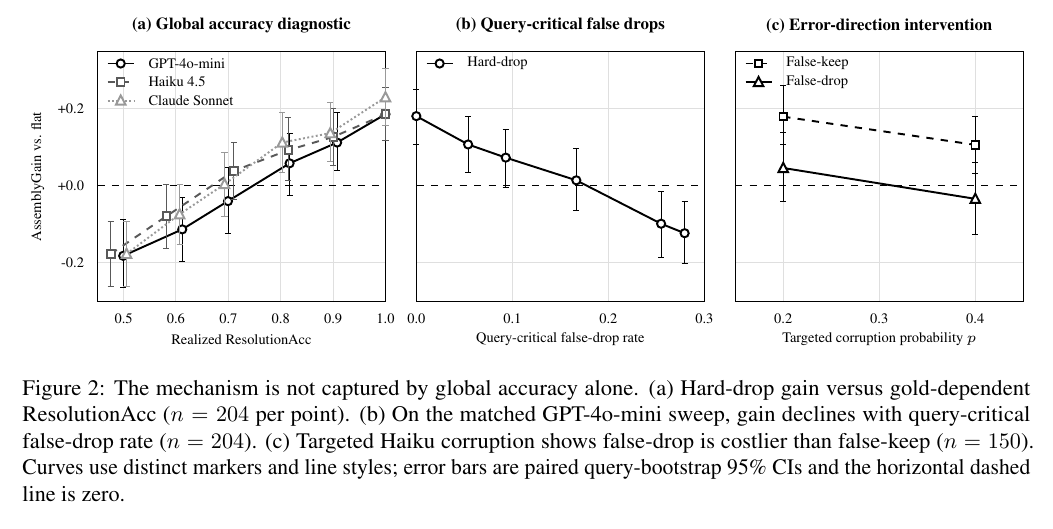
Shows that hard-deleting facts a resolver labels stale can reduce downstream accuracy when resolver errors delete query-critical facts. Across three models, hard-drop moves from gains of +0.186 to +0.230 at perfect resolution to losses of -0.176 to -0.181 at the lowest tested reliability; false-drop hurts significantly more than false-keep. A deployment-matched gate reaches 0.655 accuracy versus 0.641 for always hard-drop.
Key insight: Hard-deleting memories a resolver calls stale swings from gains of +0.186 to +0.230 at perfect resolution to losses of -0.176 to -0.181 at the lowest reliability, so retention is the safer default.
Does the Ranking Hold? A Practitioner-Facing Audit of Hallucination Detectors on Small, Quantized, On-Device LLMs
Shubhra Mittal, Gaurav Naresh Mittal arXiv: 2611.17339
Audits four hallucination detectors on 4-bit Llama-3.2-3B-Instruct and Qwen2.5-3B-Instruct on one Colab T4. The detector ranking inverts between the two models (Spearman rho -0.80) and the cheap lexical baseline is statistically indistinguishable from the sampling-based consistency detectors. Harness, prompts and per-item scores are released.
Key insight: Hallucination-detector rankings invert between two 3B 4-bit models (Spearman rho -0.80), so a detector choice has to be re-validated per model.
More Agents, More Samples, or More Thinking? Untangling Coordination, Ensembling, and Test-Time Compute in Multi-Agent LLMs
Seyed Mahmoud Sajjadi Mohammadabadi arXiv: 2611.17610
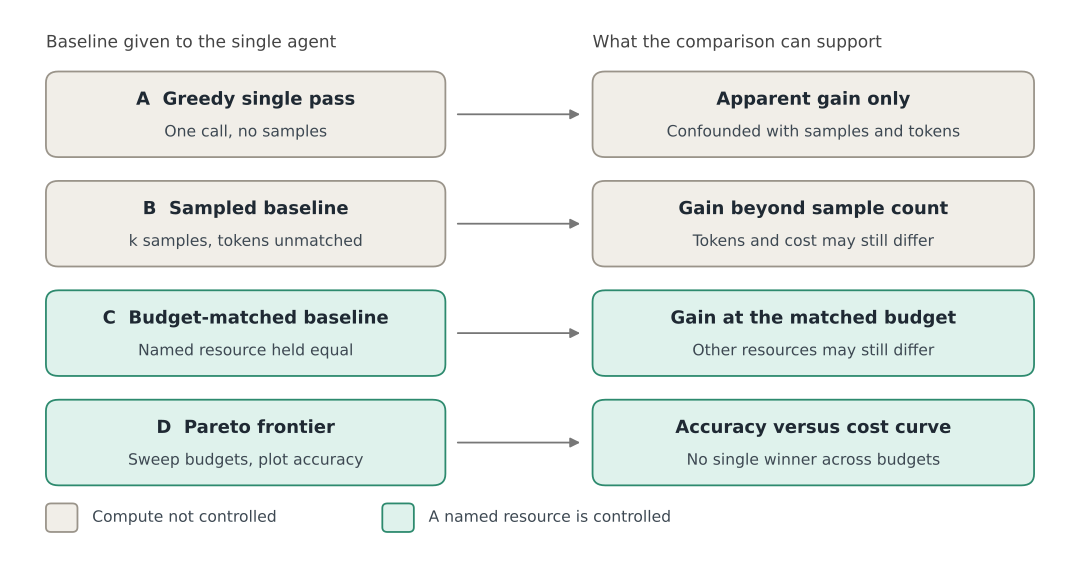
Synthesizes nine evaluations (516 multi-agent configurations) against baselines matched on single pass, sample count and resource budget. Against matched baselines multi-agent systems average -0.042 accuracy and equal or fall below the baseline in 74% of comparable contrasts. Positive returns need partitioned evidence, external verification or error diversity across models.
Key insight: Across 516 configurations, multi-agent systems average -0.042 accuracy against matched baselines and equal or trail them in 74% of contrasts.
Generated Evaluation Suites as Diversity-Driven Search for Real Agent Regressions
Pulkit Yadav arXiv: 2611.17632
Treats generated evaluation suites as diversity-driven search and injects 7 controlled defects into a tau^2-bench agent. Suite-level pass rate can move the wrong way (tool removal destroys every covered scenario while the suite pass rate rises); per-cell scoring recovers it. A kind-diverse suite detects the orchestration defect in 5 of 20 draws, a happy-path-only suite detects nothing.
Key insight: Suite-level pass rate can rise while a removed tool destroys every covered scenario; per-cell scoring recovers the regression.
What LLM Agents See and What Users Say
Yue Zhao, Angela Huyue Zhang, S. Alex Yang et al. arXiv: 2611.17639
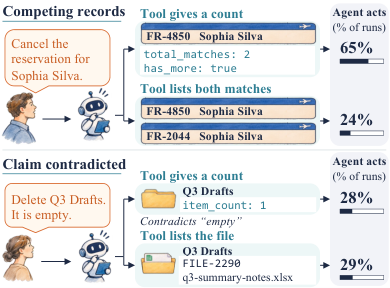
Uses presupposition theory: an agent should act only if each claim behind the act is seen to hold, answered by the user, or disclosed while undoable. Under a role-only prompt a count of a second record leaves most of 36 earlier agents acting on the one they see, whereas listing both stops most. A lookup returning a same-name customer first led to wrong-account writes in about a quarter of conversations.
Key insight: When a tool returns only a count of a second record, most earlier agents act on the one they see; listing both records stops most of them.
Learn then Bet: Learning Interpretable Rules for Reliable Agent Intervention
You-Lin Chen, Xinyi Lisa Chen, Pedro Herrero-Vidal et al. arXiv: 2611.17662
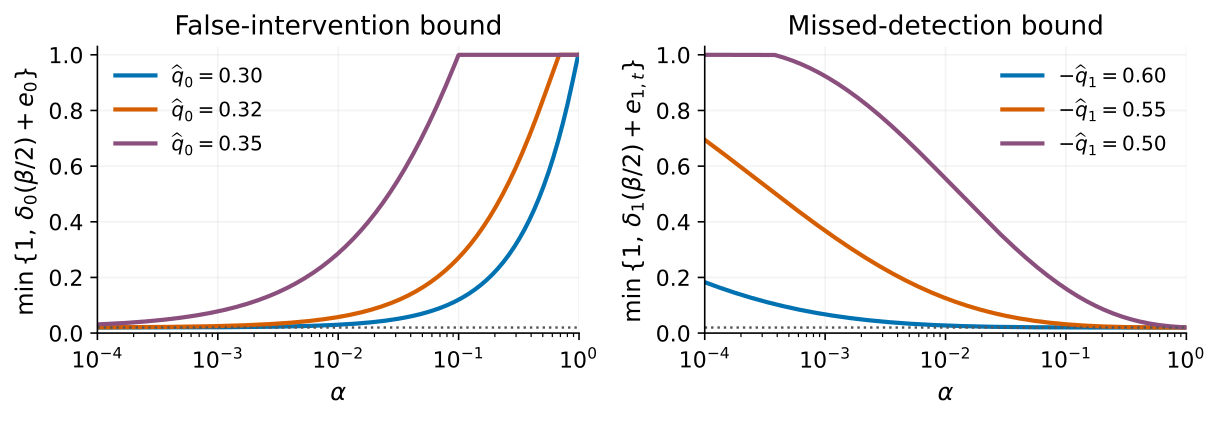
LeBet learns an interpretable OR-of-AND monitor and accumulates evidence with a betting statistic, with finite-sample false-positive control. On SWE-bench Lite with Ministral 3 8B the learned monitor saves 34.46% of input-plus-output tokens and raises output precision from 18.33% to 21.59%, with an empirical false-positive rate of 13.64%.
Key insight: A learned interpretable monitor saves 34.46% of tokens on SWE-bench Lite with Ministral 3 8B while controlling false positives.
Co-Sight Harness: Externalized Control Assets and Deterministic Enforcement for Long-Horizon Business Agents
Luyao Wang, Xijun Zhu, Zhaohui Hao et al. arXiv: 2611.17696
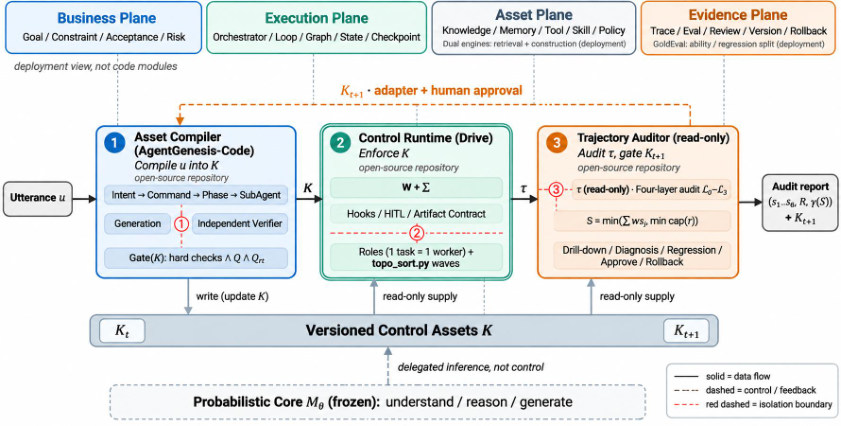
Keeps the model fixed and moves workflow definition, state and domain knowledge into versioned control assets enforced by a state machine and machine-checkable acceptance gates, with an independent auditor. On Domain A unattended completion rises from 50% to 100% and end-to-end latency drops from 440 to 159 minutes; two other domains were taken over by teams that did not write the assets. Code is released.
Key insight: Moving workflow control into versioned assets with a state machine and acceptance gates lifted unattended completion from 50% to 100% on one domain.
Vision-as-a-Tool: Visual Harness for Multimodal Agentic Coding
Haolin Yang, Wenshan Wu, Jin Jiang et al. arXiv: 2611.17797
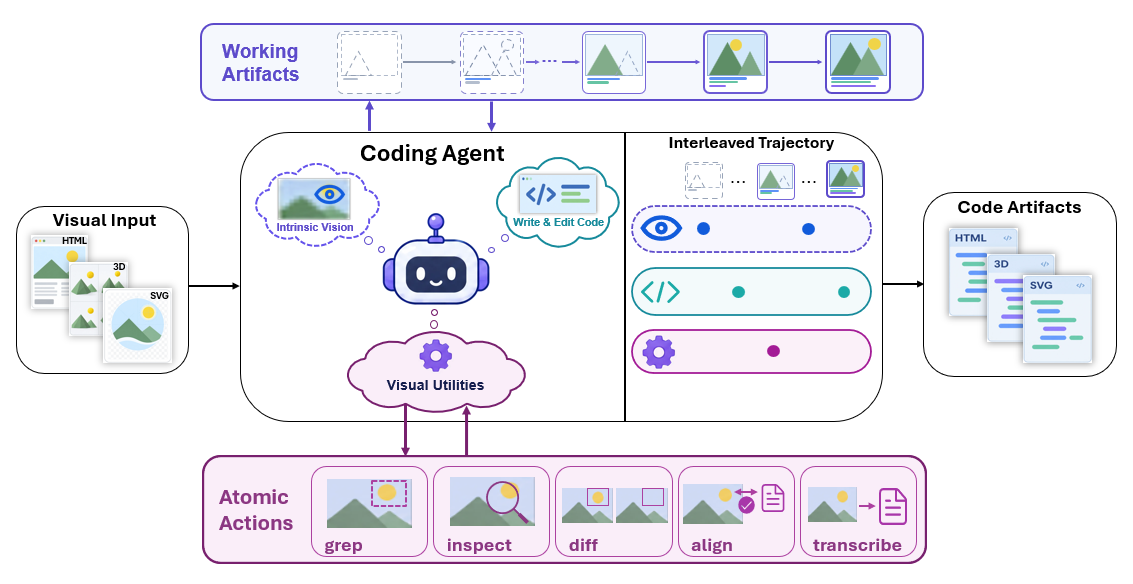
Vision-as-a-Tool reframes multimodal LLMs as callable external utilities so text-only coding agents can offload visual reasoning; VHarness exposes five atomic actions. Evaluated on Image-to-HTML, Image-to-SVG and Image-to-3D, it improves visual fidelity and geometric accuracy for text-only and multimodal agents.
Key insight: Exposing multimodal models as callable tools lets text-only coding agents improve visual fidelity and geometric accuracy on image-to-code tasks.
Can Agents Keep Up with Time? An Empirical Analysis of Temporal Adaptation After a Conversational Hiatus
Hongguan Su, Ming Wang, Shun Zhang et al. arXiv: 2611.17806
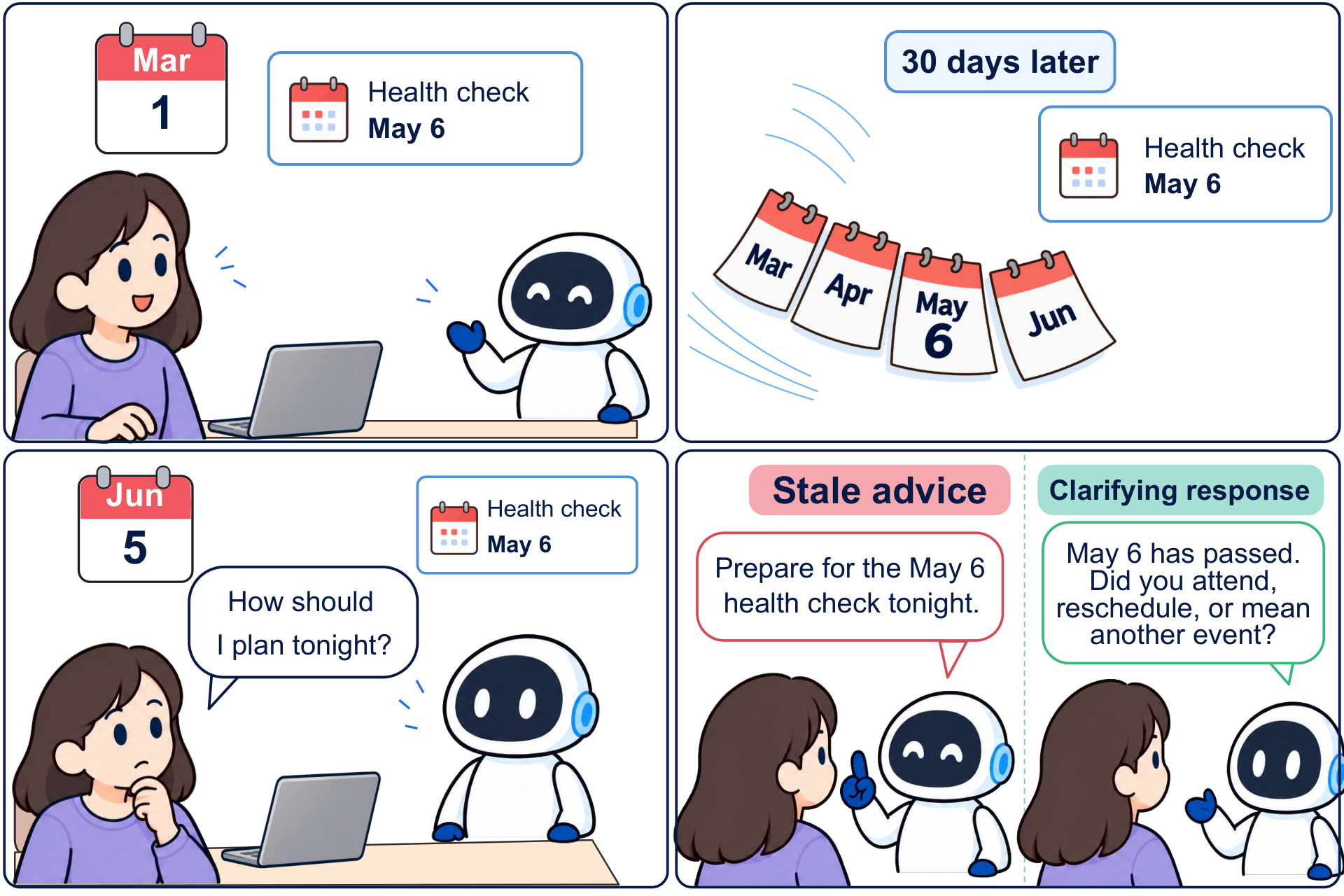
Studies agents returning to a conversation after a long hiatus while scheduled dates have passed. Agents reliably query the clock and note the date has passed, yet many still tell users to prepare for the expired event; supplying explicit temporal context reduces this and providing the computed date relation removes it entirely. Benchmark code is released.
Key insight: Agents query the clock yet still advise preparing for expired events; supplying the computed date relation removes the error entirely.
G-CAST: Governed Continual Self-Training for E-Commerce Agents under Evolving Demands
Yuechun Yu, Wenzheng Kong, Xiaofeng Mao et al. arXiv: 2611.17814
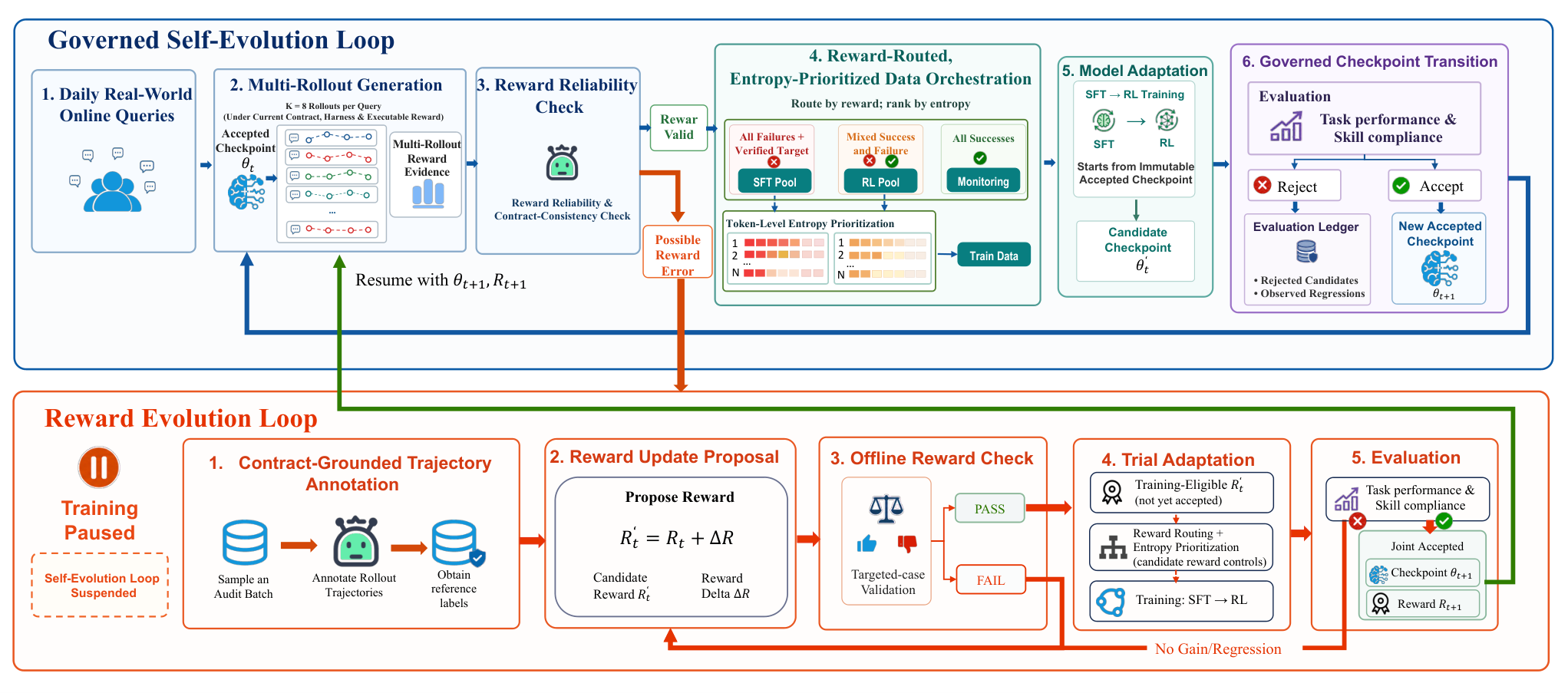
G-CAST turns daily production evidence into reward-routed, entropy-prioritized training data and governed reward evolution, with governed checkpoint transitions under cumulative evaluation controls so new tools and skills are learned without losing accepted behavior. On a real e-commerce agent it adapts better to new demand while preserving previous behavior; it is deployed on Alibaba's 1688 platform.
Key insight: Governed checkpoint transitions let a deployed e-commerce agent learn new demand without losing previously accepted behavior.
Aligning AI Teams
Siddarth Srinivasan, Morgan Jane Matthews, Jascha Sohl-Dickstein et al. arXiv: 2611.17820
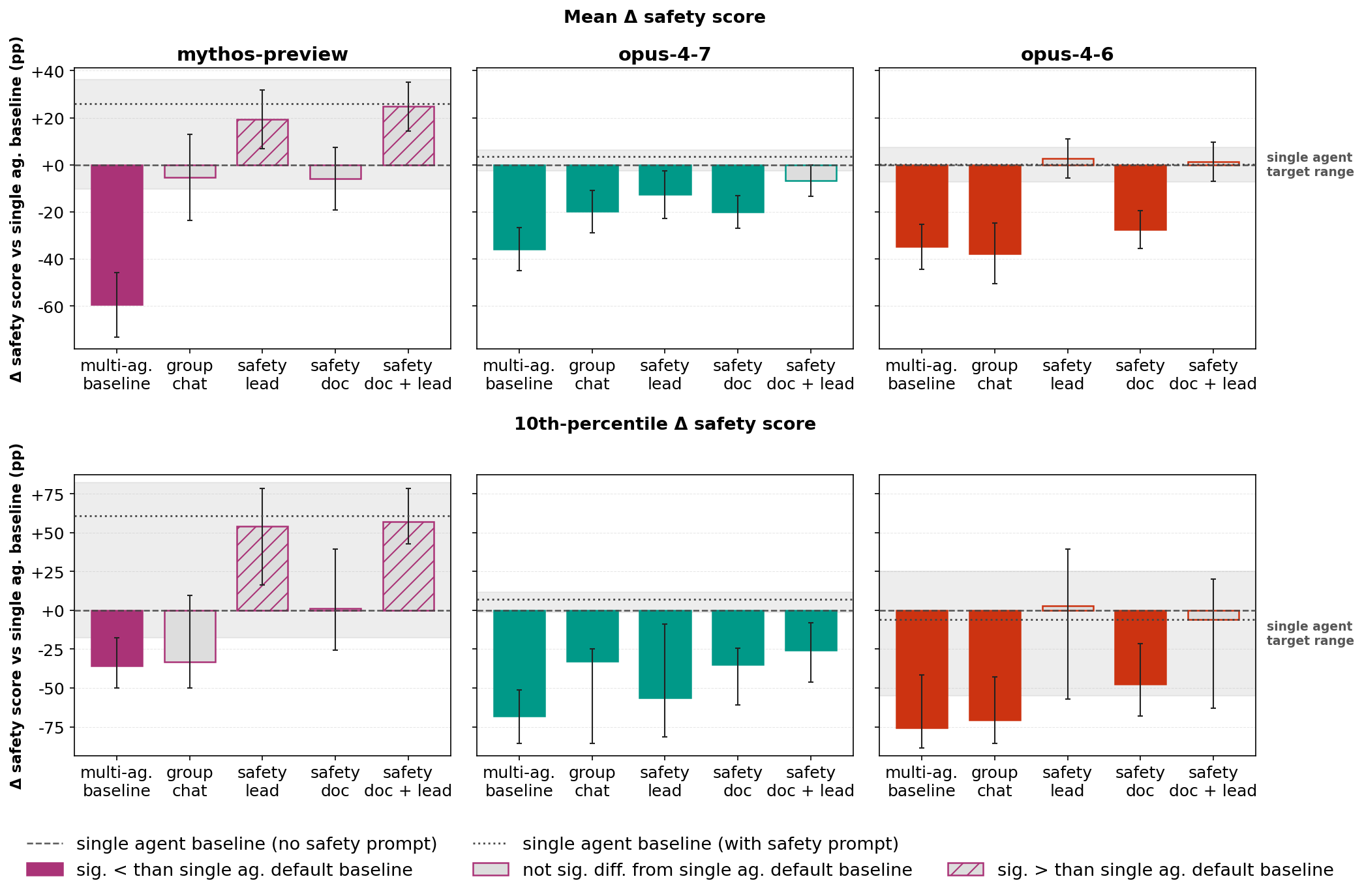
Finds that agent teams are less aligned than single agents; critique or group-chat interventions do not reliably fix it, diffusion of responsibility accounts for much of the gap, and a designated safety lead agent or a coordinator-published safety specification document restores single-agent alignment. Releases magelab, a multi-agent orchestration framework.
Key insight: Agent teams are less aligned than single agents, and a designated safety lead or a published safety specification restores single-agent alignment.
Soteria: Formally Verified Planning with Runtime Enforcement for Safe LLM Agents
Mike He, Ankush Desai, Sharad Malik et al. arXiv: 2611.17880
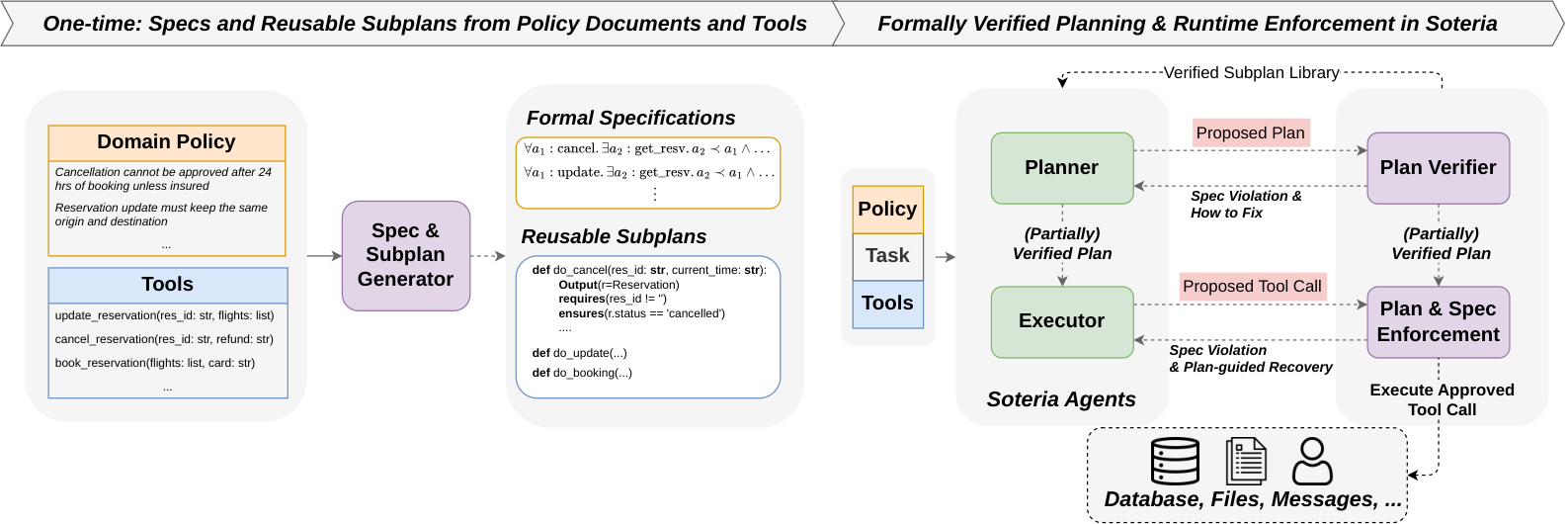
Soteria has the agent produce a structured plan that is formally verified against specifications before any tool call; at runtime the verified plan enforces conformant actions and gives guidance when unsafe actions are blocked. Across tool-use benchmarks it achieves 1.7 times the average task success rate of the best baselines with no violations of policy specifications.
Key insight: Verifying a structured plan before any tool call yields 1.7 times the task success of the best baselines with no policy violations.
OutfitterBench: Evaluating LLM Agents on Long-Horizon Resource Allocation and Commitment Coordination
Jie Huang, Yuecheng Hong, Yao Chen et al. arXiv: 2611.17933
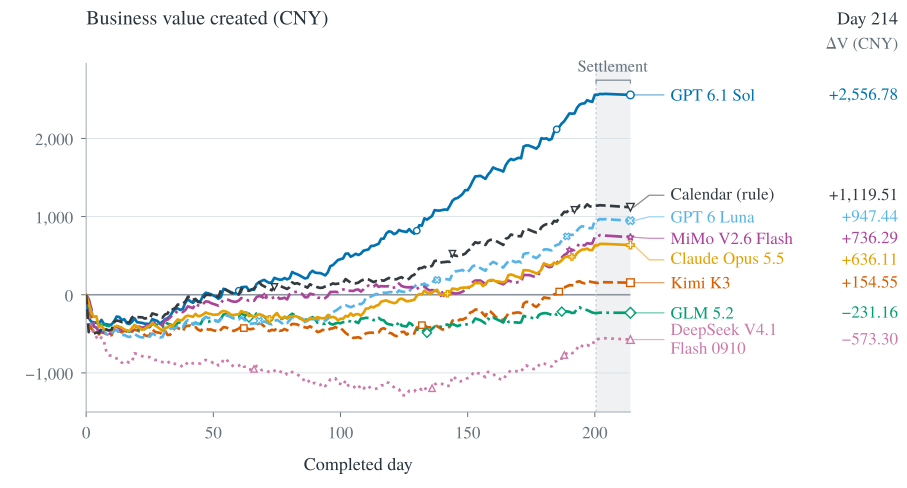
OutfitterBench has agents run an outdoor-equipment rental business for 200 days (46-product catalog, about 1,100 reservation requests) under a capital ceiling. Several of seven frontier LLMs underperform a simple rule-based baseline and only the leading agent consistently beats it; agents apply known constraints inconsistently and make decisions that conflict with existing commitments.
Key insight: Several of seven frontier LLMs underperform a simple rule-based baseline over a 200-day business simulation.
WebArena-Pro: A Heterogeneous, Multimodal, Reproducible Benchmark for Web Agents
Imene Kerboua, Fatemeh Pesaran Zadeh, Xing Han Lù et al. arXiv: 2611.17955
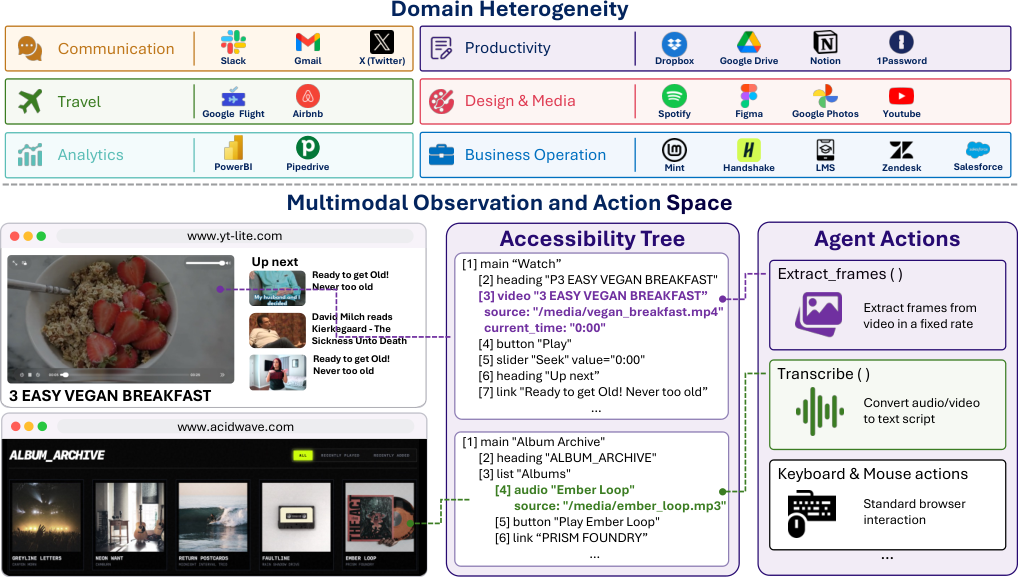
WebArena-Pro: 300 tasks across 20 self-hosted web apps in six categories with audio and video as core observations. Best is Codex with GPT 6.1 Sol and Claude Code with Claude Opus 5.5 at 62.3%, then OpenCode with Kimi 3.1 Pro at 60.7%; the strongest GenericAgent configurations, Gemini 3.1 Pro omni and Gemma4 31B, both reach 30.3%.
Key insight: The best agents reach 62.3% on 300 multimodal web tasks, while the strongest generic open configurations reach 30.3%.
Can Mechanistic Interpretability Help Explain LLM Agent Failures? A Case Study on Web Element Hallucination
Mohamed Aghzal, Mor Geva, Gregory J. Stein et al. arXiv: 2611.18514
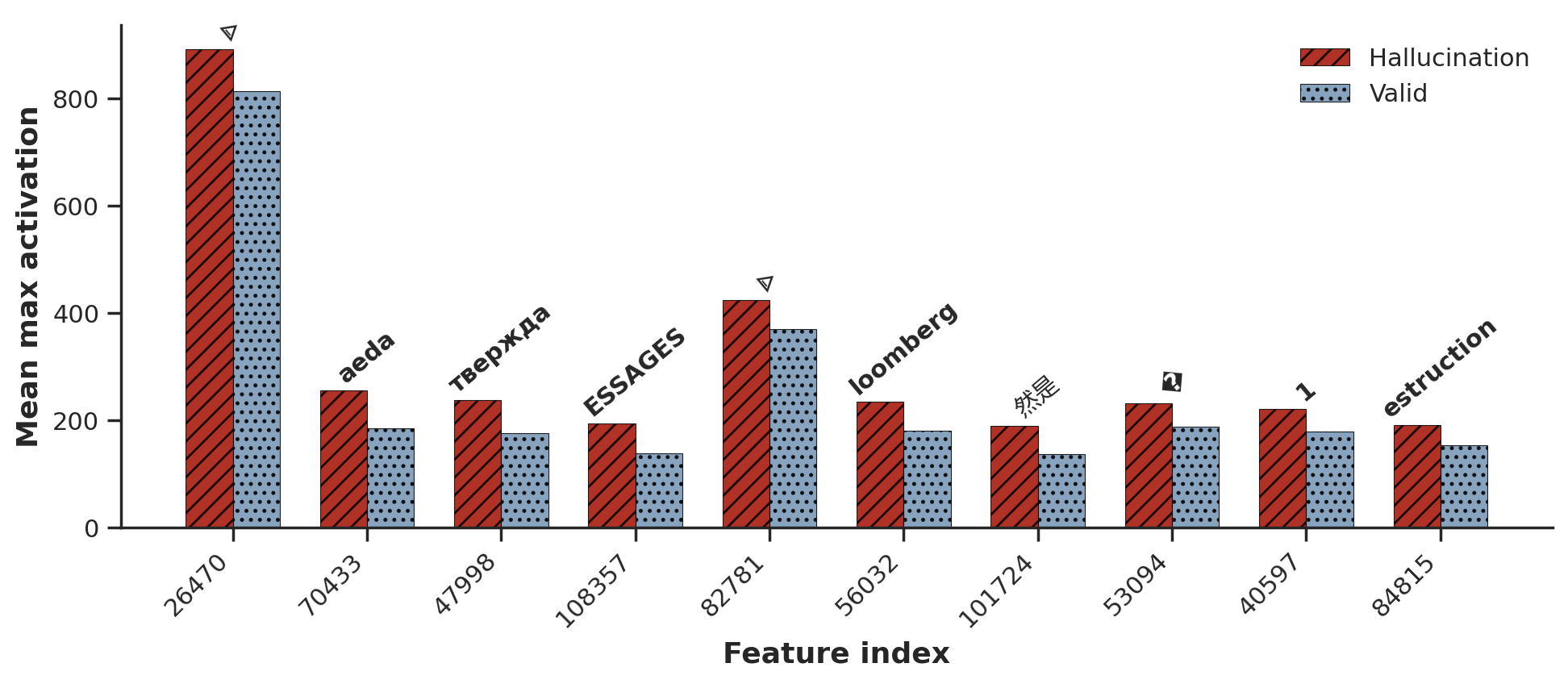
Applies mechanistic interpretability to Qwen2.5-7B-Instruct web agents hallucinating unavailable actions. A linear probe on the last prompt token predicts hallucinations before generation (0.80 AUC) and steering corrects 85% but disrupts 7% of valid actions; the probe direction is sensitive to prompt formatting and circuits are distributed.
Key insight: A linear probe predicts web-element hallucinations before generation at 0.80 AUC, and steering corrects 85% of them but disrupts 7% of valid actions.
ModHarness-RL: Recasting Harnesses as Learnable and Evolving Programs for Agentic RL
Zelin He, Siyu Zhu, Jacob Helwig et al. arXiv: 2611.18533
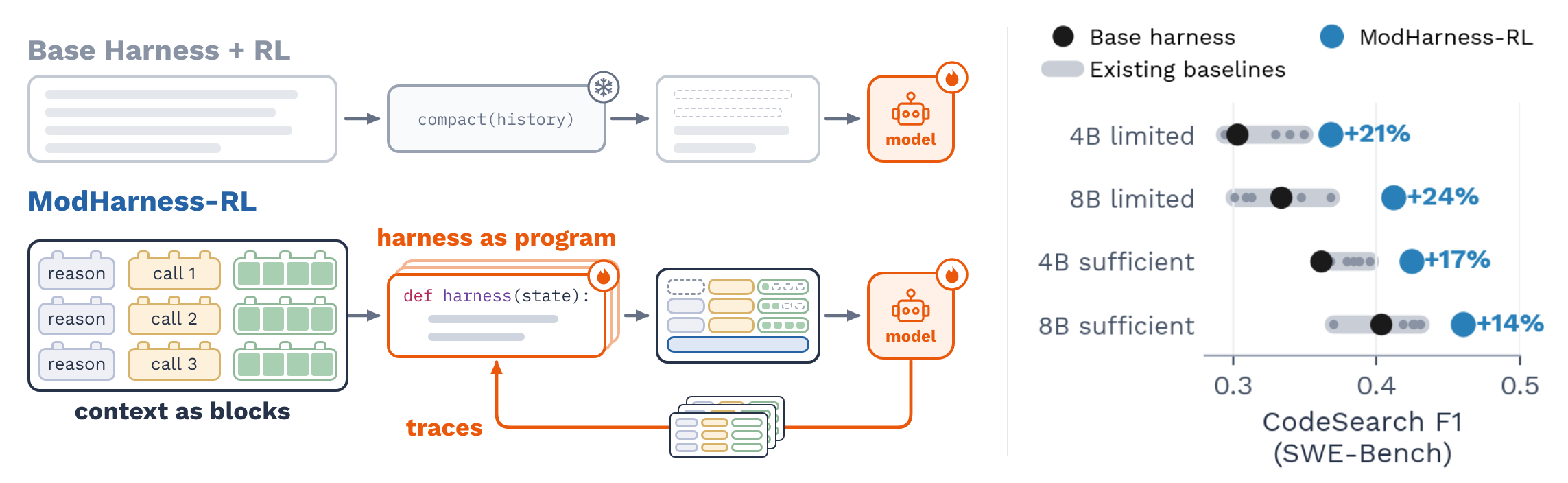
ModHarness-RL treats the harness as learned programs over typed State blocks: a Compression program builds the model's context and a Steering program supplies guidance, proposed from recent trajectories, verified by execution and replayed over past trajectories while RL trains. Models 1.5B to 8B on CodeSearch, ALFWorld and BIRD SQL improve over a fixed harness in most settings.
Key insight: Treating the harness as learnable context-compression and steering programs improves 1.5B to 8B models over a fixed harness in most settings.
ProdPilot: A Layered Model Context Protocol System for Automated Production Readiness and Deployment of Vibe-Coded Projects
Muhammad Sudais Khalid, Muhammad Junaid Asif, Rehan Naveed Abbasi et al. arXiv: 2611.17381
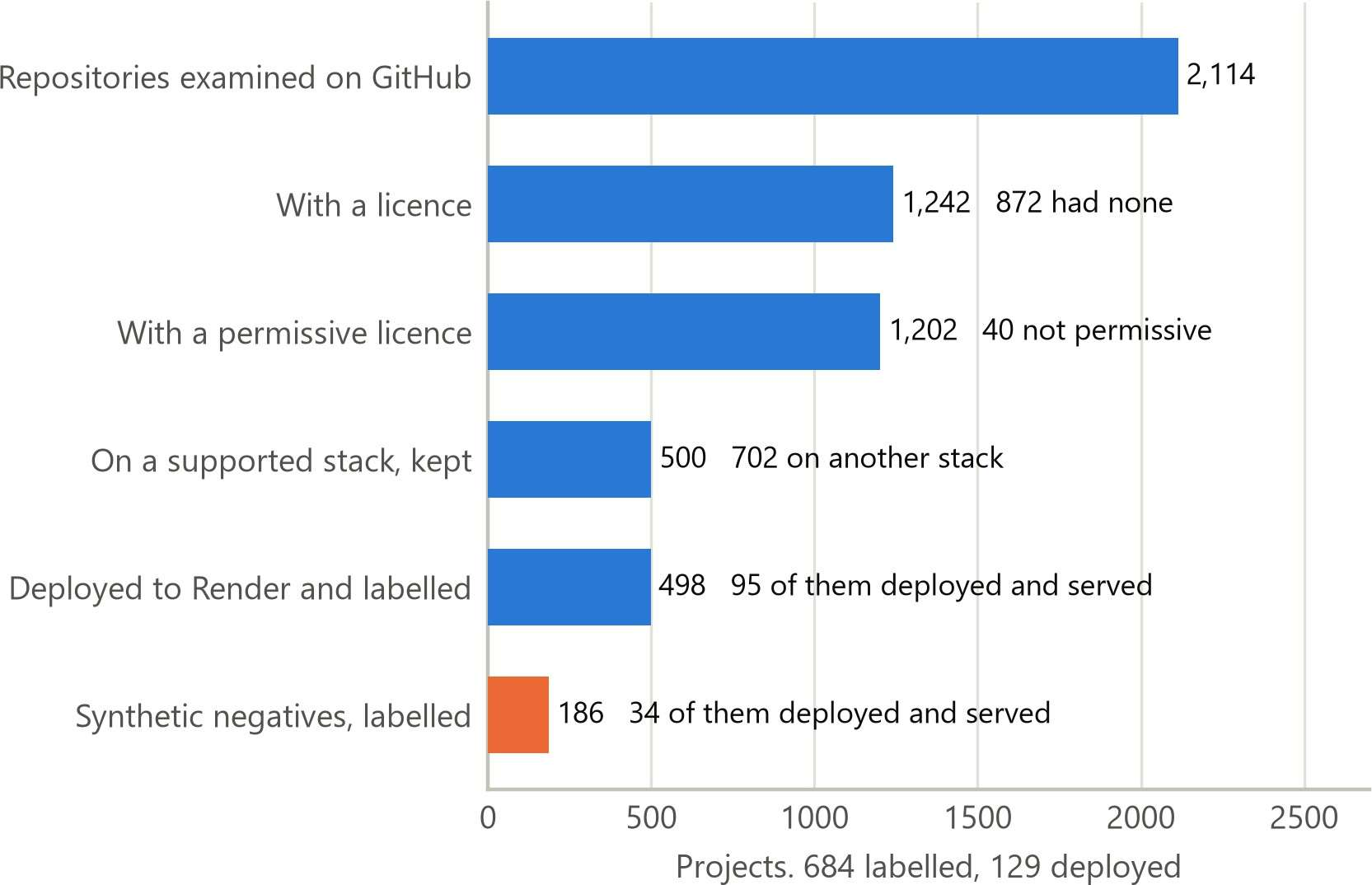
ProdPilot is a local MCP server that audits Node.js and React projects against 50 production-readiness rules, repairs violations in a bounded loop, gates and deploys. 88.0% of the ruleset needs no model-written content; independent verification rejected 25 of the 237 fixes reported as applied; it works from the IDE agents in VS Code, Cursor and Windsurf. The server itself runs no model.
Key insight: Independent verification rejected 25 of the 237 fixes the MCP server reported as applied, so self-reported repairs need external checks.
Time-Consistent Evaluation of Hierarchical Code Graphs for SWE Agents
Xianpeng, Sun, Tian Yu et al. arXiv: 2611.17388
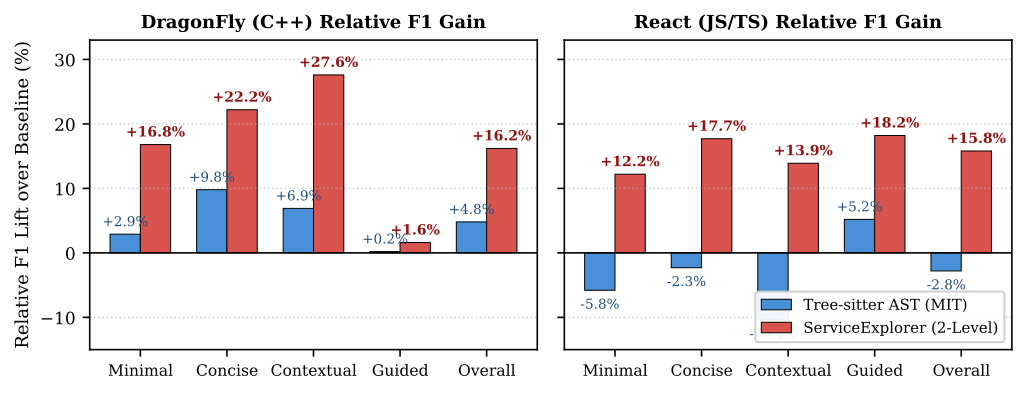
Under a zero-leakage, time-consistent protocol on DragonFly (C++) and React, compares an unaugmented baseline, a flat Tree-sitter AST graph and ServiceExplorer, a two-level hierarchical dependency graph. Across 7,200 paired evaluations ServiceExplorer gives +15.6% to +86.2% relative F1 lift and a weaker model with it beats the next-generation model without it.
Key insight: A two-level hierarchical code graph gives +15.6% to +86.2% relative F1 lift, and a weaker model with it beats a newer model without it.
Interpreting Coding Agents Through Their Behavioral Trajectories
Ibragim Badertdinov, Alexander Golubev arXiv: 2611.17440
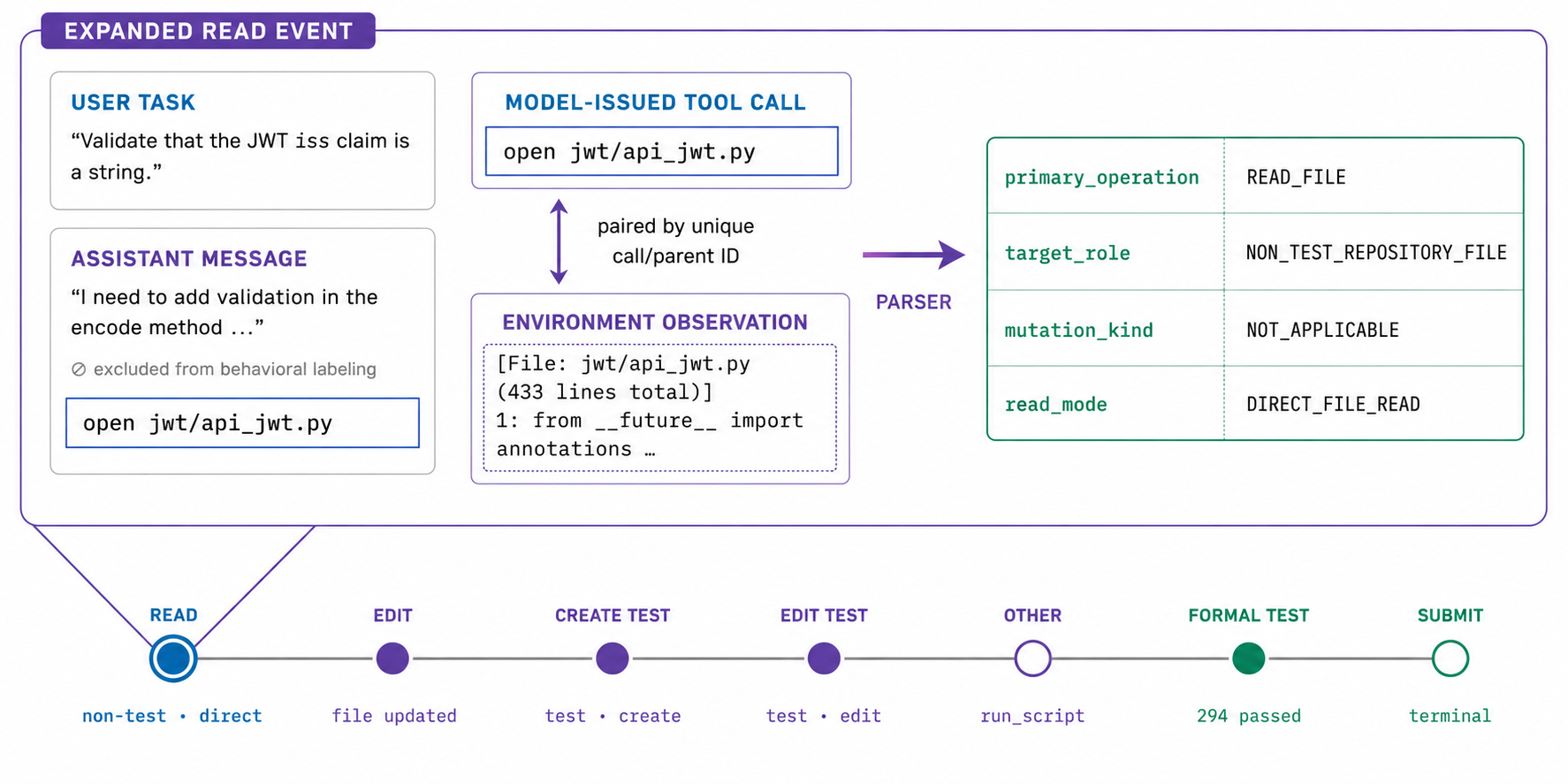
Analyzes 143,209 trajectories from 125 agent configurations across 117 models using a rule-based parser mapping traces to actions such as search, edit and test. Agents with similar solve rates differ in how they explore, modify and verify code; scaffold choice and reasoning effort systematically shift behavior. Parser and annotated subset are released.
Key insight: Agents with similar solve rates differ in how they explore, edit and verify code, and scaffold choice and reasoning effort shift that behavior.
Only as Safe as the Weakest Agent: A Break That Appears Only When the System Is Multi-Agent
Keegan Wang, Anantika Mannby arXiv: 2611.17520
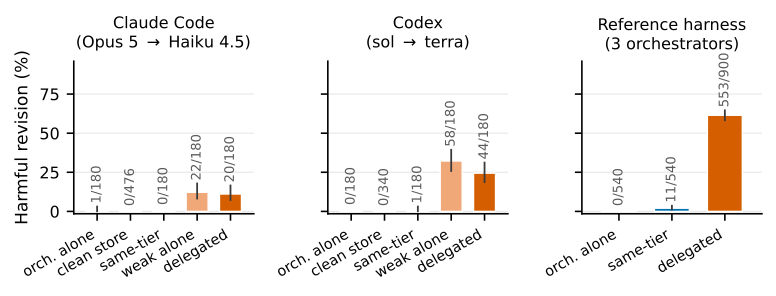
Shows Claude Code, Codex and a reference harness can be broken through their own sub-agent mechanisms by a forged record planted in a file store: strong orchestrators searching themselves commit almost zero harmful revisions in over 1,000 trials, but delegating to a cheaper sub-agent fails 20/180, 44/180, 75/180 and 553/900. Simulations over 18 models show aggregators repeating a corrupted sub-agent's error in 751/757 trials.
Key insight: Strong orchestrators that search themselves almost never act on a forged record, but delegating to a cheaper sub-agent fails 553 of 900 trials in the largest setting.
GraphScent: Calibrating Directional Relevance Signals for Bounded-Context Code Localization
Ramesh Arvind Naagarajan arXiv: 2611.17527
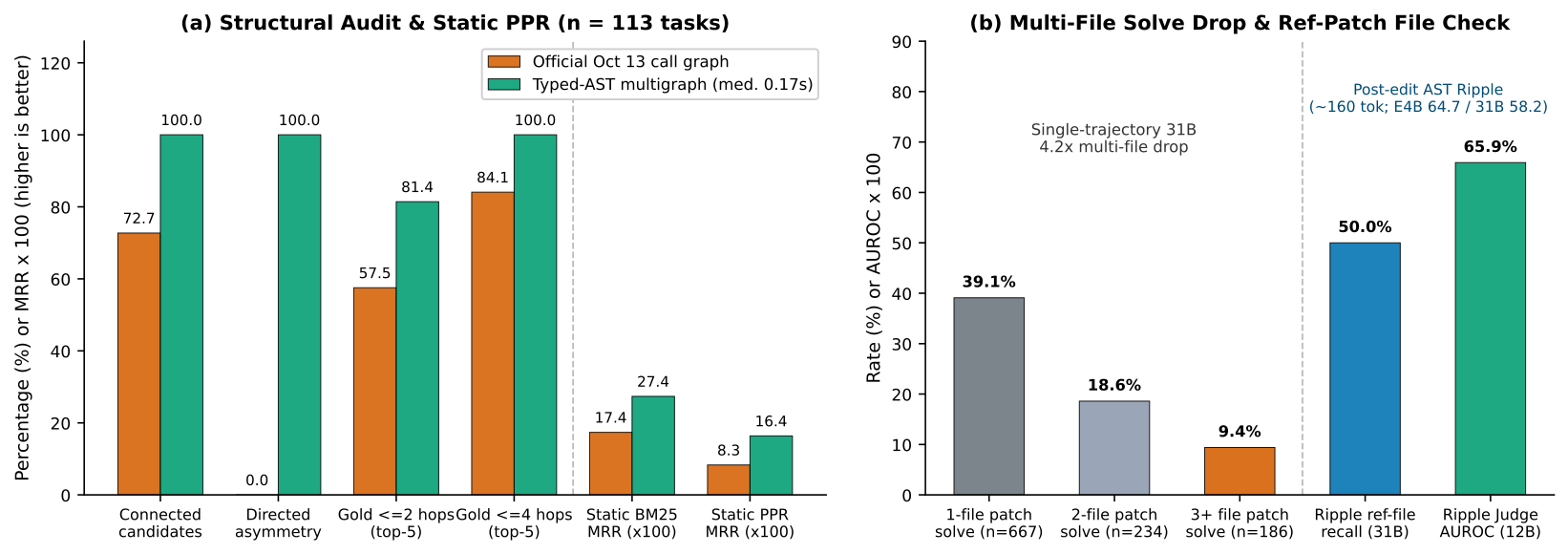
Studies Gemma 4 models on 211 Python issues in 86 repos under a single-GPU budget with short stateless inspections. Relevance scores on enclosing scopes and upstream callers separate true neighbors, while callees and peers stay near chance. GraphScent, a training-free search controller, lifts exact localization on lexically hard targets from 12.8 to 23.4 percent at 31B.
Key insight: A training-free search controller lifts exact localization on lexically hard targets from 12.8 to 23.4 percent at 31B.
Superfluid: Local AI Server for Distributed LLM Inference
Prabod Rathnayaka, Isura Manchanayake, Srikandabala Kogul et al. arXiv: 2611.17753
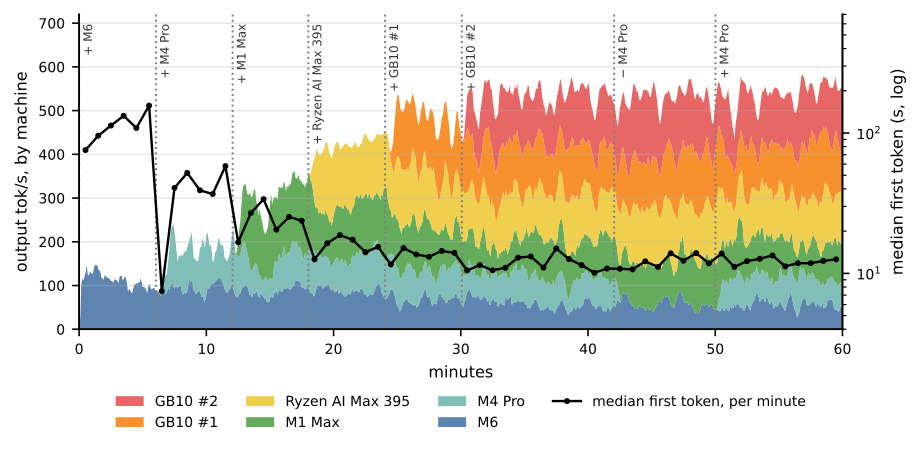
Superfluid is an Apache-2.0 local LLM server driving llama.cpp, MLX or BaseRT with a scheduler that puts interactive requests ahead of agent work, shares prompt prefixes, and writes every token to a durable log. On an Apple M5 Pro with Qwen3.8-27B a chat during eight busy agents gets its first token in 1.5 s versus 291-612 s on llama-server, Ollama and mlx_lm.server. Twelve Mac Studio M3 Ultras sustain 10,656 tok/s across 384 agents.
Key insight: A local server that prioritizes interactive requests gives a first token in 1.5 s on an M5 Pro while eight agents run, versus 291-612 s on common servers.
LuthorSQL: A One-Pass Text-to-SQL Model as System 1 for a Slower LLM Agent
Ibrahim Memon, Armin Karamzade, M. Hanif Jhaveri et al. arXiv: 2611.17780
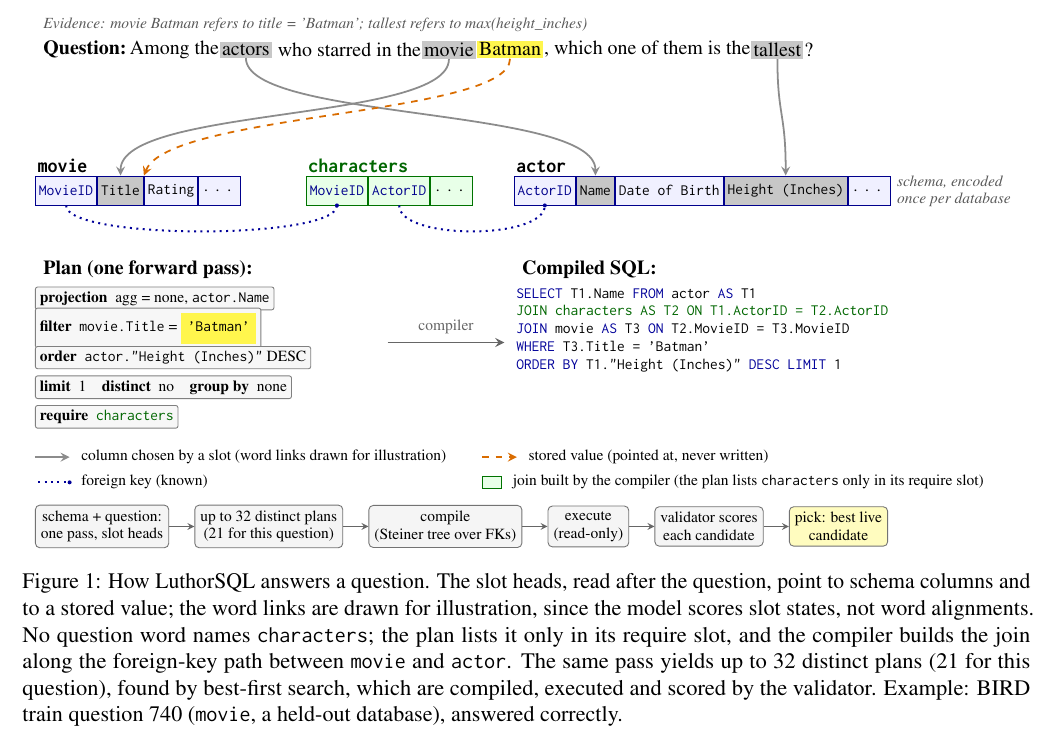
LuthorSQL is a non-autoregressive 7B text-to-SQL model used as a System 1 gate for a slower LLM agent, escalating when uncertain. It reaches 68.03% execution accuracy on BIRD's hidden test set at 0.84 s per question on one GPU in 9 GB with 8-bit weights; combined with Claude Opus 5.5 it answers nearly half the questions locally and cuts API cost by 33.3% at the same accuracy.
Key insight: A local 7B gate in front of a hosted agent cuts API cost by 33.3% at the same accuracy.
CarryOn: Learning What to Keep in Context for Long-Horizon LLM Agents
Lihuan Li, Ruiyi Yang, Jiru Wang et al. arXiv: 2611.17808
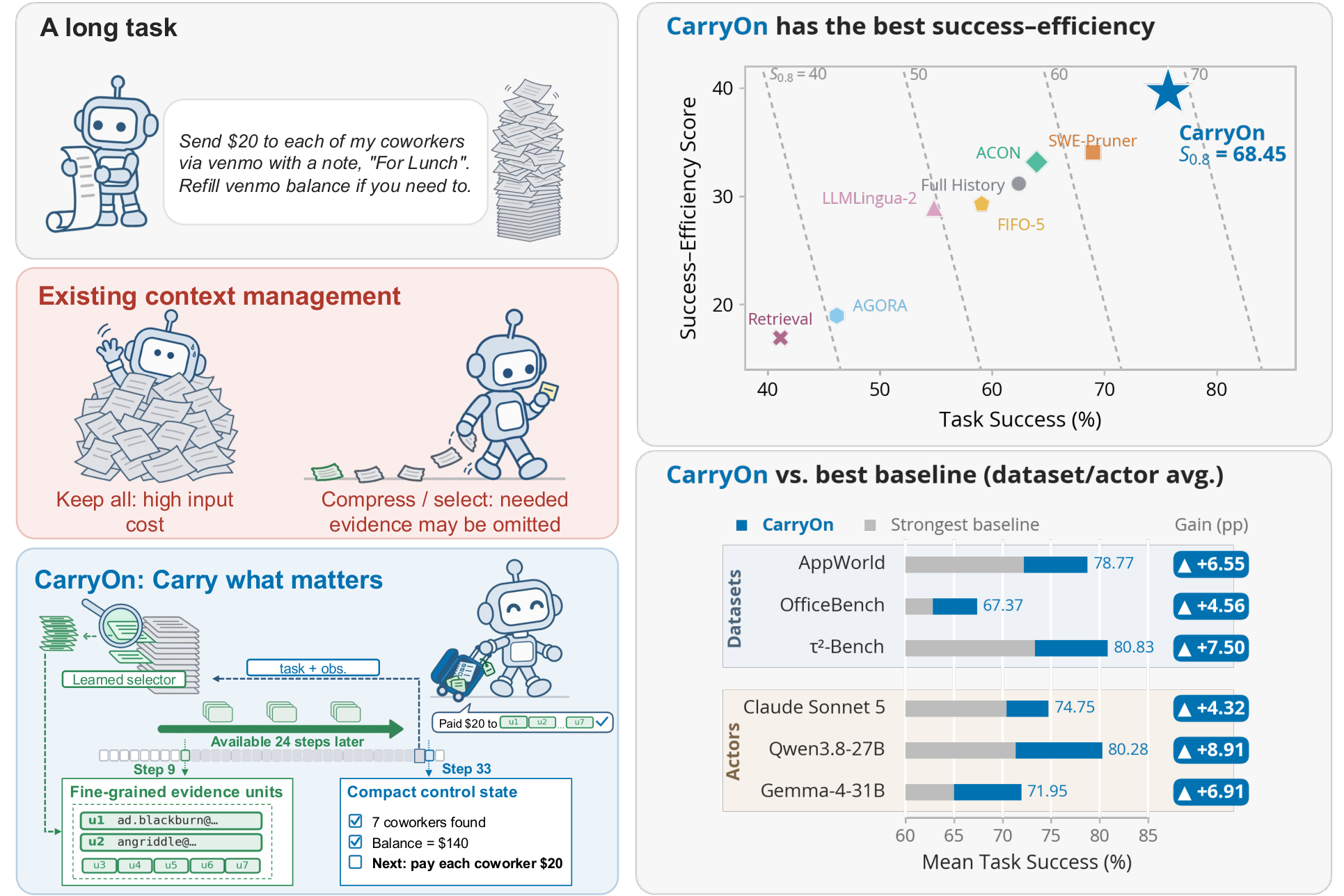
CarryOn is a lightweight context manager pairing compact execution state with fine-grained, source-linked evidence, using a learned selector and adaptive retention policy with no extra LLM calls. Across AppWorld, OfficeBench and Tau2 Telecom with three LLM Actors it reaches 75.7% macro-averaged task success, 6.7 points above the strongest baseline.
Key insight: Compact execution state plus source-linked evidence reaches 75.7% macro task success, 6.7 points above the strongest baseline, with no extra LLM calls.
Securing Multi-Agent Systems by Design
Xilong Wang, Xiaoxing Chen, Neil Gong arXiv: 2611.17883
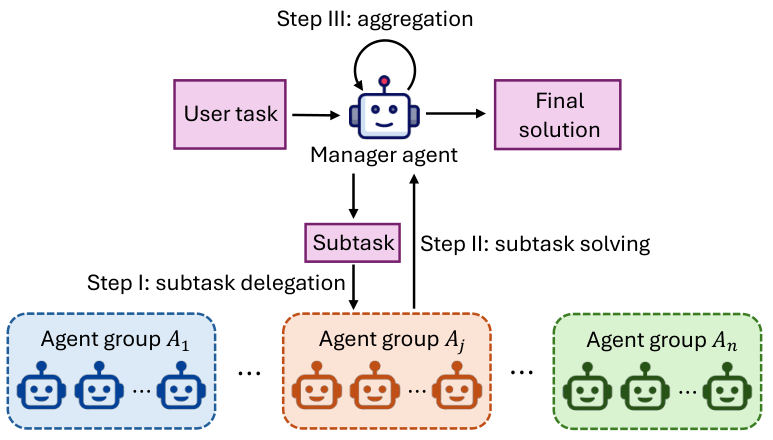
Proposes response manipulation attacks (ReMA) on multi-agent systems and SecMAS, a secure aggregation rule choosing the response most consistent with a sufficiently large subset of others, with security guarantees. Existing aggregation rules are vulnerable while SecMAS defends against all evaluated attacks, including adaptive variants, at comparable utility.
Key insight: A secure aggregation rule defends against all evaluated response-manipulation attacks, including adaptive ones, at comparable utility.
Do Verifier Judgments Survive Abstraction? Measuring Verification Transport for LLM Agent Evaluation
Disha Sheshanarayana, Sai Linisha Reddy Goli arXiv: 2611.18471
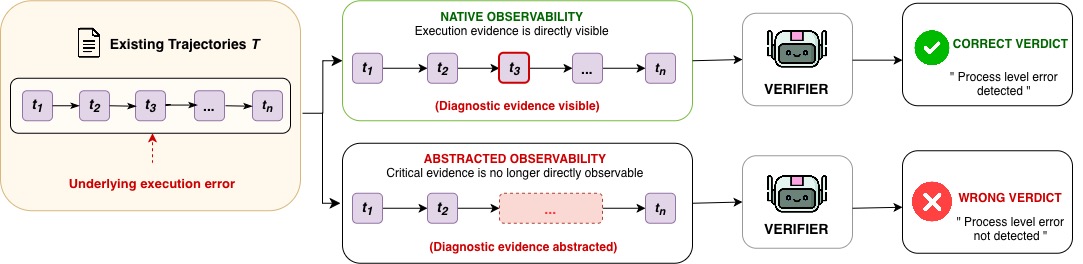
Introduces Verification Transport: matched native, abstracted and restored views of the same frozen executions test whether LLM verifier judgments survive composed tools, delegation or compacted histories. Across four benchmarks, seven verifier backbones and four protocols, transport failure reaches about 31% under macro abstraction and delegation; restoring execution provenance recovers 85.5%.
Key insight: Verifier transport failure reaches about 31% under abstraction and delegation, and restoring execution provenance recovers 85.5%.
MeReader: An Offline, Privacy-Preserving, Progress-Aware AI Assistant for Narrative eBook Reading
Mohammed Efaz, Udo Bub, Itilekha Podder arXiv: 2611.18513
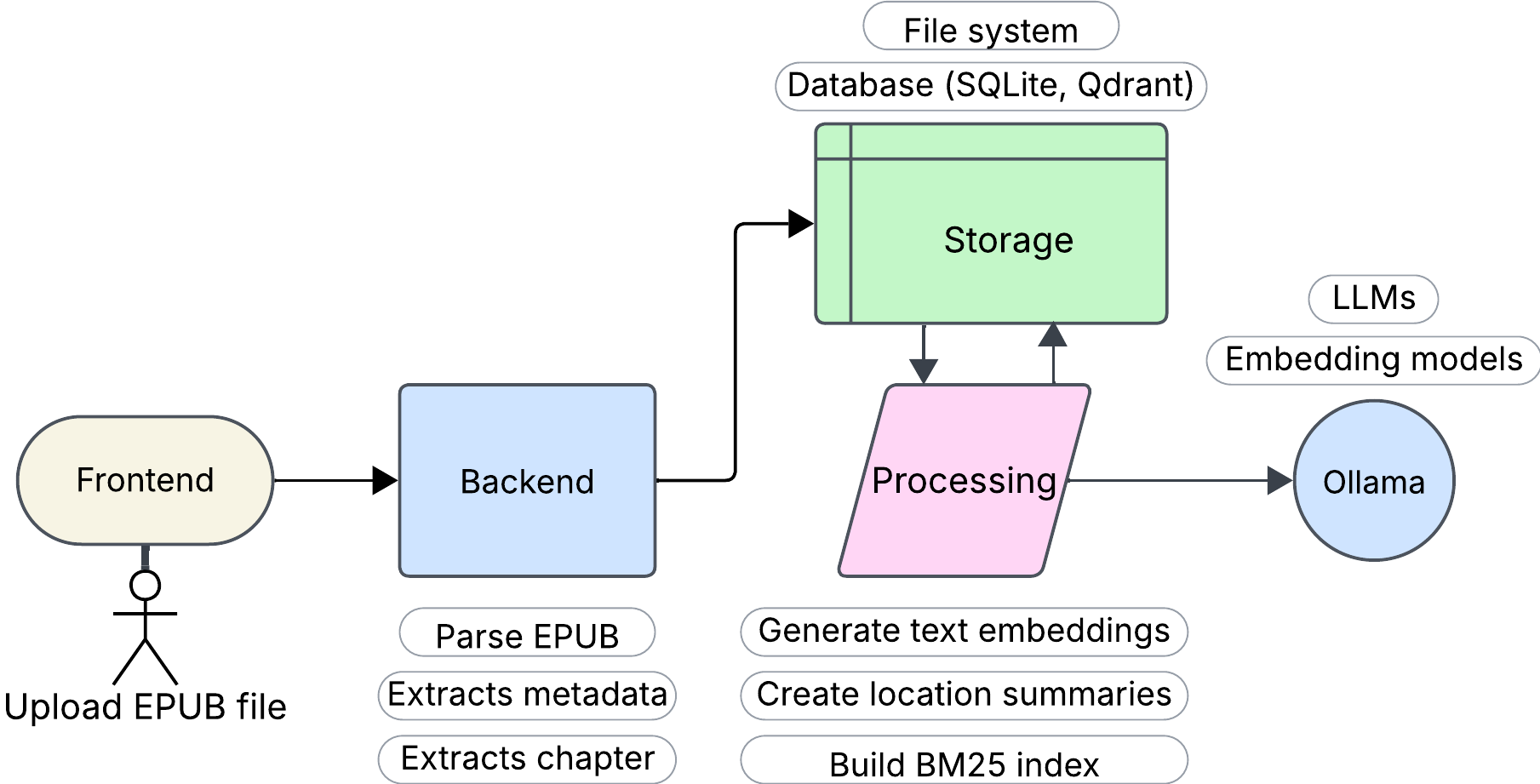
MeReader is an offline, privacy-preserving assistant for narrative eBook reading on consumer hardware that confines retrieval and generation to the reader's position, using hybrid vector, BM25 and summary-embedding retrieval. Mid-sized local models (2b-4b) reach comprehension parity with larger (5b+) ones, and the progress-aware boundary prevents future-content leakage without hurting retrieval quality.
Key insight: Position-bounded retrieval prevents future-content leakage without hurting retrieval quality, and 2b-4b local models reach parity with 5b+ models.
News and changelogs
- LangChain blog: Goal Engineering — argues the future of agents is taking on open-ended goals and driving them to completion; a framing for how long-running agents are specified. link
- OpenAI news: A step toward defining the Standard Model on a lattice — a physics result where GPT-6 Astra helped turn the idea into a detailed proof; no direct agent-platform change. link
- OpenAI news: Our new blog for science — launch of an OpenAI science blog on findings and methods from researchers using AI; no direct agent-platform change. link
- Vercel changelog: Qwen4-Max now available on AI Gateway — a new open-weight-family model option routable through AI Gateway; the entry gives no further detail. link