AI Research Digest — Tuesday, November 10, 2026
Tuesday's cs.AI announcement day (2026-11-10) lists 480 entries, 166 with cs.AI as primary and 314 cross-lists (replacements skipped). A filter for agent systems, memory/context, computer-use / GUI / tools / skills / harnesses, multi-agent, persistence, and local/open models keeps 37 papers. The day's theme is control that lives outside the model: workflow state held in a state machine, tool policy enforced in code, least-privilege tool sets, and cost levers in the harness. A second cluster asks how much agent memory and self-written skills can be trusted, with new evaluations of memory sufficiency and new poisoning paths through self-evolving skills.
Research Papers
MaxIM: Maximally Informative Incremental Summarization via Reinforcement Learning
Jihwan Jeong, Guy Tennenholtz, Yinlam Chow et al. arXiv: 2611.12825
MaxIM frames incremental summarization of an unbounded history as a capacity-constrained, information-theoretic reward-shaping problem, with a step-wise critic giving dense rewards; beats RL, SFT and prompt baselines on factual grounding and downstream utility across strict token budgets (long-horizon reading, multi-turn dialogue).
Key insight: Treating summary updates as a capacity-constrained information problem with dense step-wise rewards beat RL, SFT and prompt-only baselines under strict token budgets.
AutoBuddy: Evaluating Proactive, Always-On Agents on Task Discovery and Execution in a Simulated Workplace
Shiqi Chen, Daniel Madrigal Diaz, Wei-Ning Chen et al. arXiv: 2611.12393
AutoBuddy benchmarks agents that must infer a user's pending tasks from mail, chat and workspace and then complete them in the systems where the work lives, with no task handed over.
Key insight: Benchmarking proactive agents on discovering their own tasks from a messy workspace, not just executing assigned ones, exposes a different capability from standard task benchmarks.
Reconfigurable Action Theories: A Formal Foundation for Dynamically Composable Agent Harnesses
Jianmin Ji arXiv: 2611.12300
Reconfigurable Action Theories let actions load and unload theory modules (tools, providers, policies) at runtime while keeping standard causal semantics when the module set is fixed; gives sufficient conditions for well-behaved reconfiguration.
Key insight: Agent harnesses that change their own tools, providers and policies mid-run need a formal account of reconfiguration, which this paper supplies.
System Optimizations for Cost-Efficient Agent Harnesses
Jongseok Park, Jiaxiang Yu, Eric Zhou et al. arXiv: 2611.12122
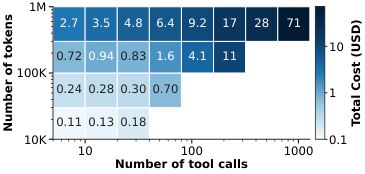
Analyzes cost accumulation across agent traces: harness-side differences (system prompt, tools) barely move accuracy but change cost by up to 2.6x on the same model and task; proposes system-level optimizations to cut tokens and LLM calls.
Key insight: Harness-side choices barely change accuracy but can change cost by up to 2.6x on the same model and task.
SkillDuet: Co-Evolving Models and Skills through Response Feedback
Xingguang Ji, Ziqiang Dong, Yubo Zhang et al. arXiv: 2611.12109
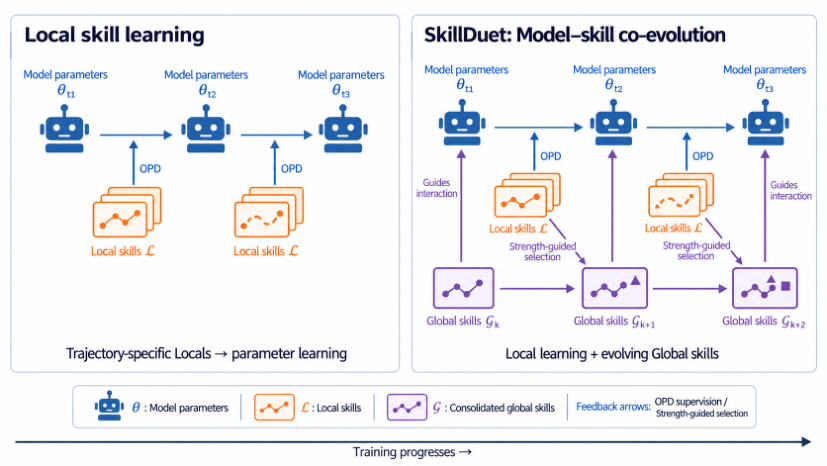
SkillDuet co-evolves model parameters and external textual skills: skills extracted from on-policy trajectories guide parameter updates, and feedback prunes skills that become redundant or harmful as the model improves.
Key insight: Skills and weights drift apart as a model improves, so skill libraries need pruning driven by model feedback.
Can LLM Agents Organize Their Own Memory?
Zichuan Fu, Junjia Qi, Wenlin Zhang et al. arXiv: 2611.11929
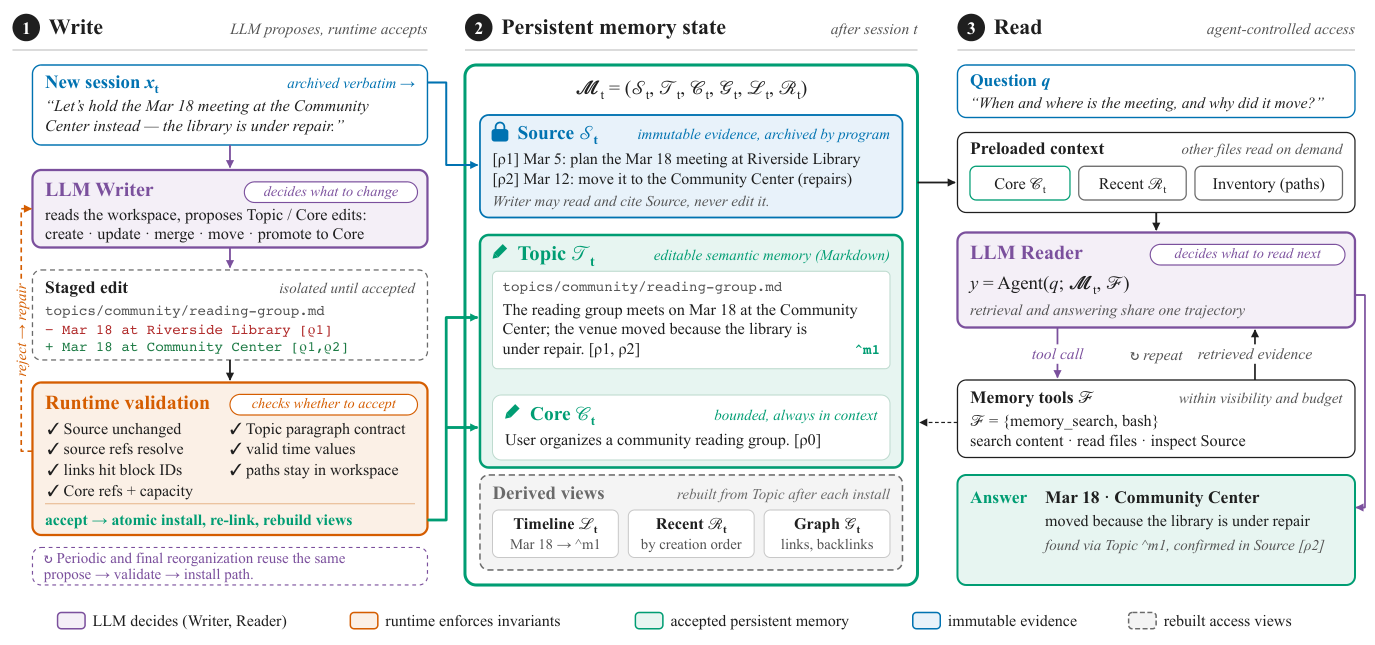
SoMem lets the agent organize its own memory as linked documents: it decides what to summarize, how to group topics and when to revise, and every summary stays linked to the original interactions as evidence.
Key insight: Letting the agent reorganize its own evidence-linked documents is a workable alternative to fixed memory schemas.
Correct Answers from Insufficient Histories: A Controlled Study of Agent Memory Evaluation
Quan Xue, Zerui Yang, Chaorui Zhang et al. arXiv: 2611.11840
Shows an answer can match the reference while the reader's visible history does not determine it; on executable device logs, Qwen3-32B matched 87 hidden references among 203 insufficient raw-prefix instances with only seven appropriate abstentions.
Key insight: A correct answer does not prove the visible history was sufficient, so memory evaluations must test abstention.
Same Error, Different Recovery: How Delivery Changes LLM Agent Behavior
Sunghyeun Woo, Javier Conde, Pedro Reviriego arXiv: 2611.11581
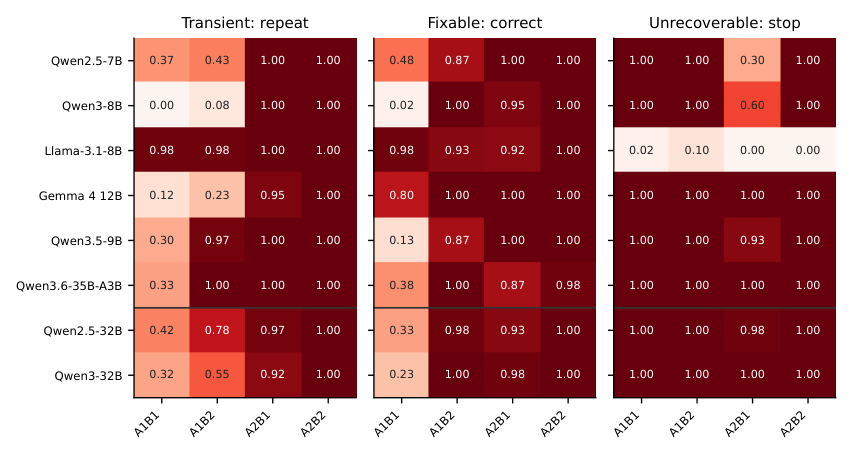
Across 13 open models (3B-70B), where a tool error appears in the conversation changes whether the model retries, corrects or stops; a new user turn that retains the failed exchange avoids severe stopping failures seen in Llama models.
Key insight: Where a tool error appears in the conversation changes whether a model retries, corrects or gives up.
LiveAsset: Learning Intent Assets from Corrective Interactions for Agent Runtime Control
Guanming Liu, Weihang Wang, Peng Zhang et al. arXiv: 2611.11560
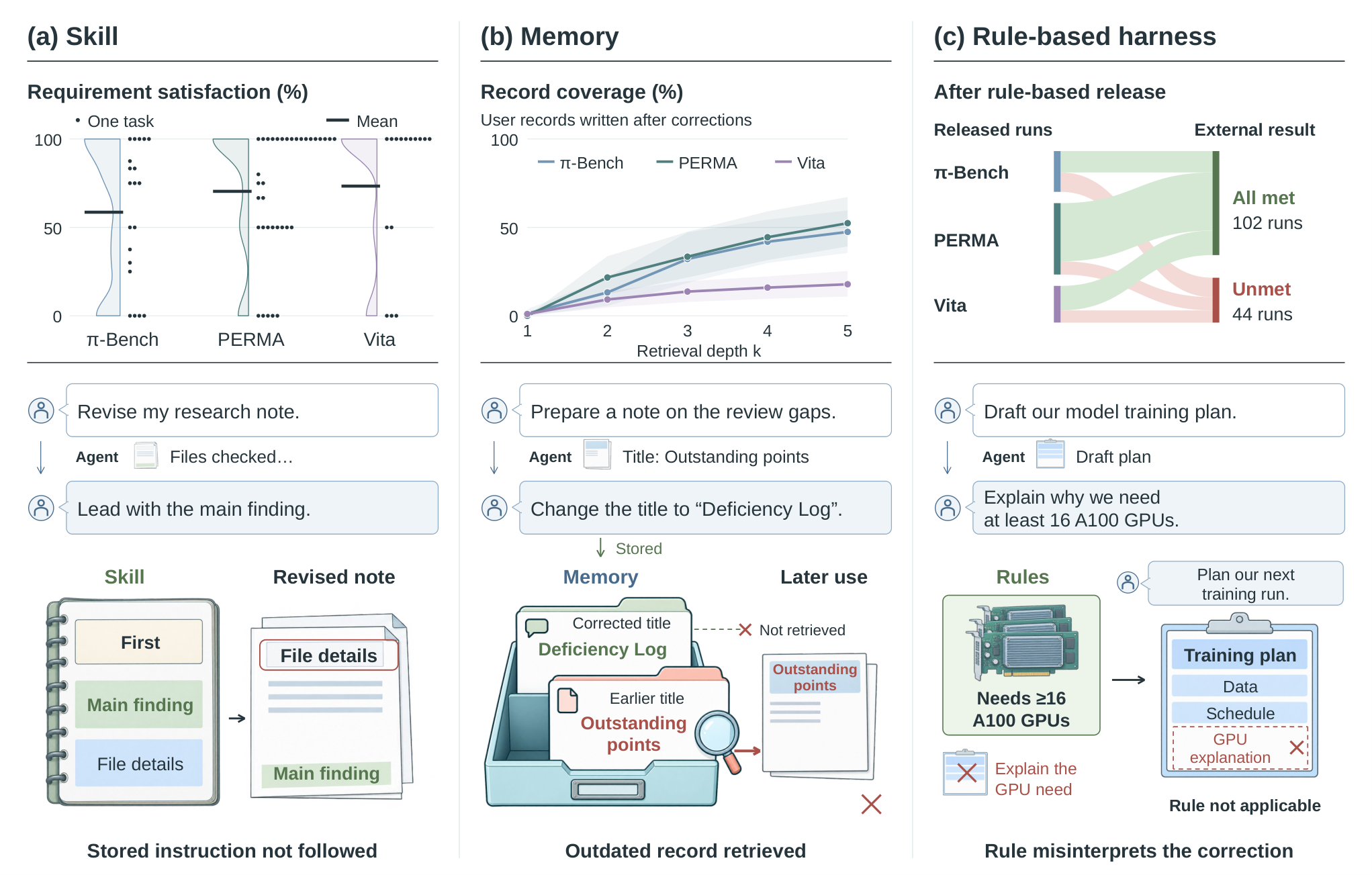
LiveAsset is an intent harness that turns multi-turn user corrections into reusable, context-scoped intent assets that control later agent runs across web apps and services.
Key insight: User corrections can be turned into reusable, context-scoped assets that steer later agent runs.
Separation of Skilling Context for Standard Operating Procedure-based Agents
Mitsuhiro Nakayama, Toshiaki Sota, Takehiko Yamaguchi et al. arXiv: 2611.11348
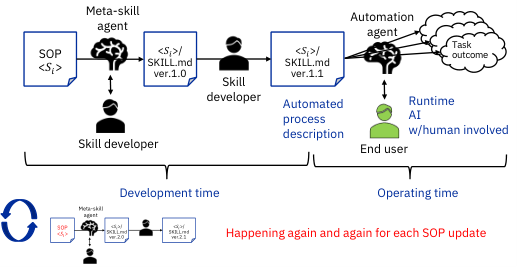
Proposes keeping SOPs and Contextual Knowledge separate when agents generate executable skills; on eight workflows this raises functional-equivalence from 12% to 58%, addressing SOP-skill drift as SOPs change.
Key insight: Keeping procedures and contextual knowledge separate raised functional equivalence of generated skills from 12% to 58%.
LoMASA: A Local Multi-Agent Sales Assistant with Confidence-Gated Delegation for B2B Quoting
Yu Liu, Xingbang Du arXiv: 2611.11234
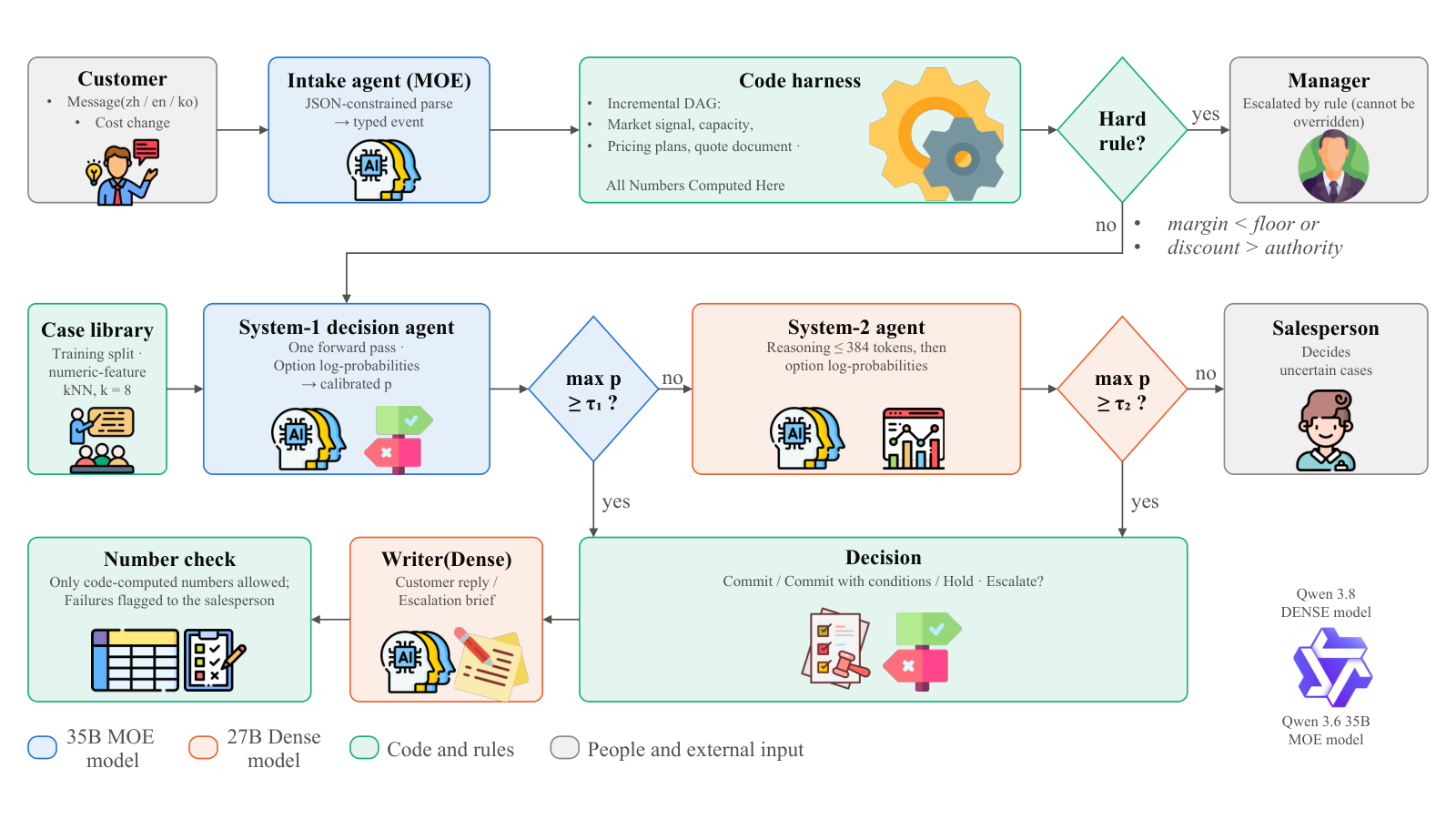
LoMASA runs entirely on one desktop: a 35B MoE makes single-pass decisions and reads confidence from answer-option probabilities, a 27B dense model writes replies and is consulted when unsure, and code computes prices under hard rules.
Key insight: A confidence-gated pair of local models with code computing the numbers can run a multi-step business workflow on a single desktop.
GARP: Real-Time Generative Agents on Local Hardware in a Game Engine
Piero Molino, Patrick John Chia, Federico Bianchi et al. arXiv: 2611.11064
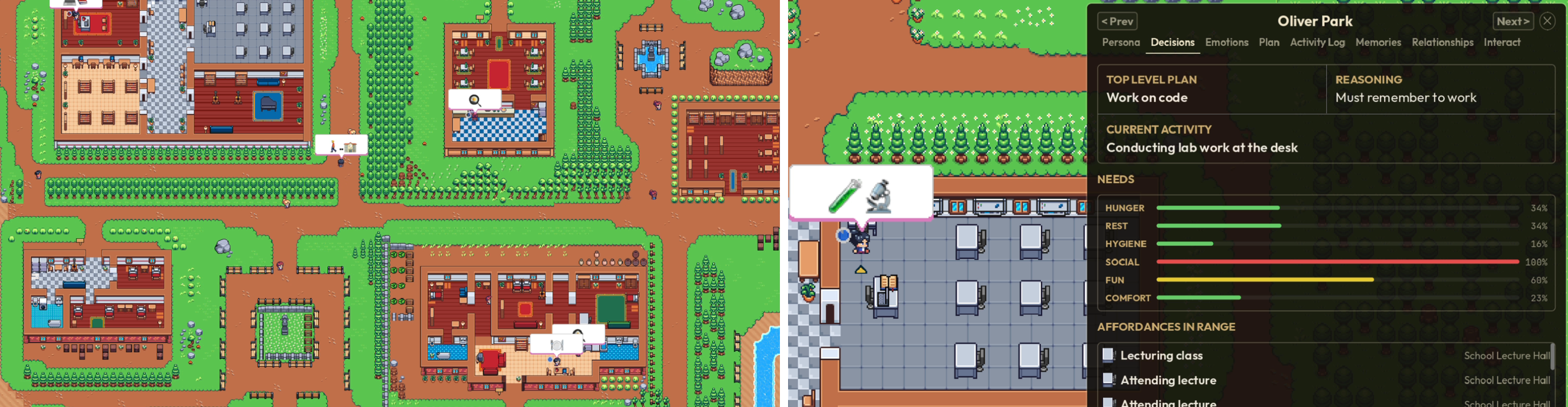
GARP runs real-time generative agents in Godot with a 3B open-weight model and no cloud, adding planning, memory, reflection, an LLM-appraisal emotion system and graded personality axes.
Key insight: Planning, memory and reflection for generative game agents can run end to end on a 3B open-weight model locally.
Keeping LLM Agents on Procedure: Executable Finite-State Control for Long-Horizon Instruction Fidelity
Yutao Sun, Haokun Li, Mingshuai Chen et al. arXiv: 2611.10884
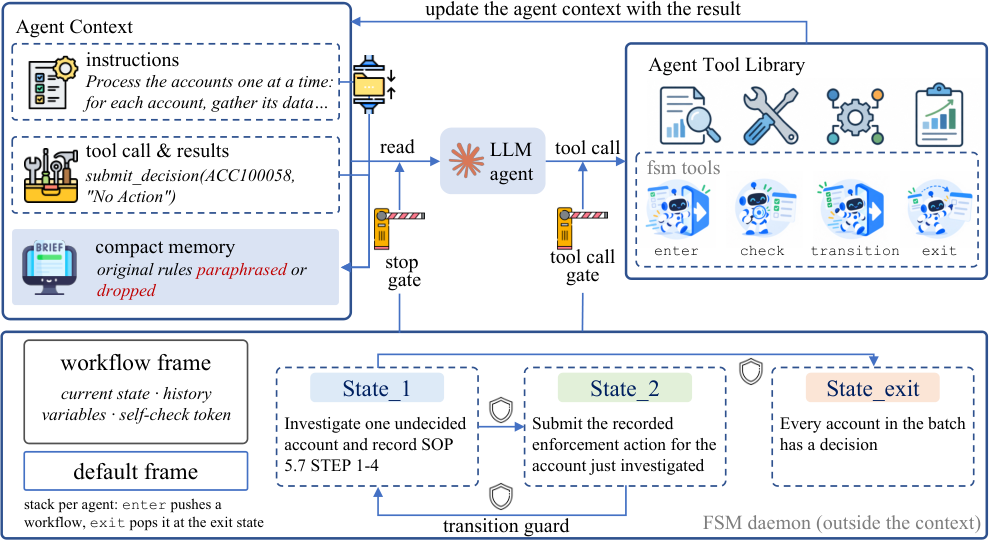
Agents drift from SOPs over long runs; an executable finite-state machine holding workflow state outside the context and enforcing at tool calls, transitions and turn end lifted Claude Haiku 4.5 from 48 to 139 correct accounts on 200-account SOP-Bench batches.
Key insight: Holding workflow state outside the model and enforcing it in code kept long unattended runs on procedure, with 139 versus 48 correct accounts for the strongest baseline.
Towards Identity-Preserving LLM Agents under Model Transition
Yihuang Kang, Pei-Cing Huang, Chan-Tung Ku et al. arXiv: 2611.10628
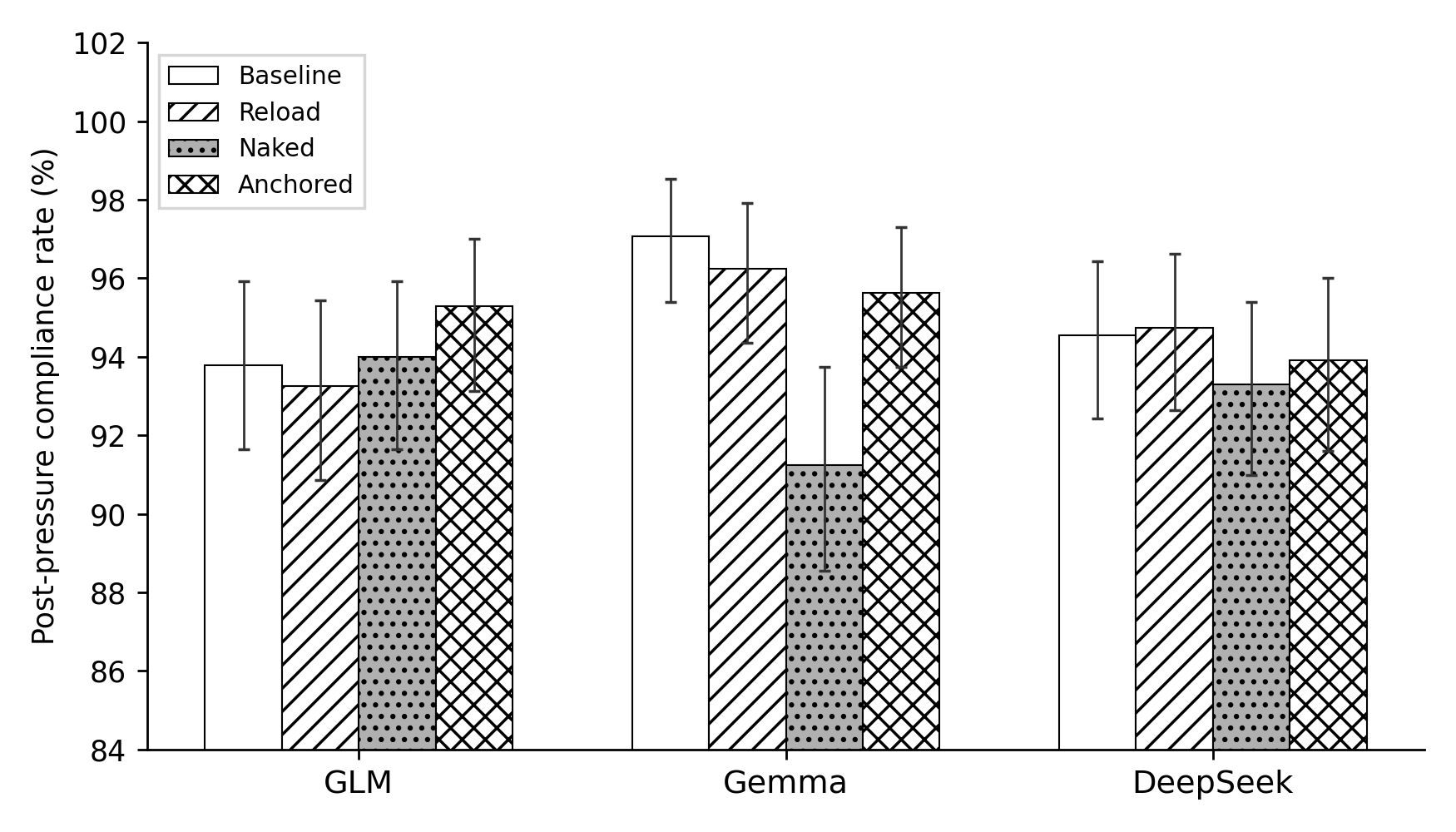
Across 5,760 runs in 12 regulated domains with three open-weight models, reloading the same persona, memory and rules onto a new backend model sometimes causes significant behavioral drift, invisible to the model's own claims of compliance.
Key insight: Reloading the same persona, memory and rules onto a new model does not guarantee the same behavior, and the model's own compliance claims will not reveal the drift.
CoRA-Bench: Evaluating Evidence Preservation by Context Selectors Under Token Budgets
Huzaifa Pardawala, Siddhant Sukhani, Sudheer Chava et al. arXiv: 2611.10238
CoRA-Bench compares truncation, BM25, dense retrieval, reranking, LLMLingua-2 and Provence on evidence preservation under token budgets (BABILong, NoLiMa, LongMemEval); dense retrieval reaches 0.993 answer-bearing-turn recall on LongMemEval at 64K.
Key insight: Which context selector loses evidence depends on the task and budget, so selection should be measured, not assumed.
HiVe-Mem: Interleaving Horizontal Memory Expansion and Vertical Evidence Composition for Multimodal Agents
Haozhen Zhang, Bohan Liu, Jianzhu Bao et al. arXiv: 2611.12872
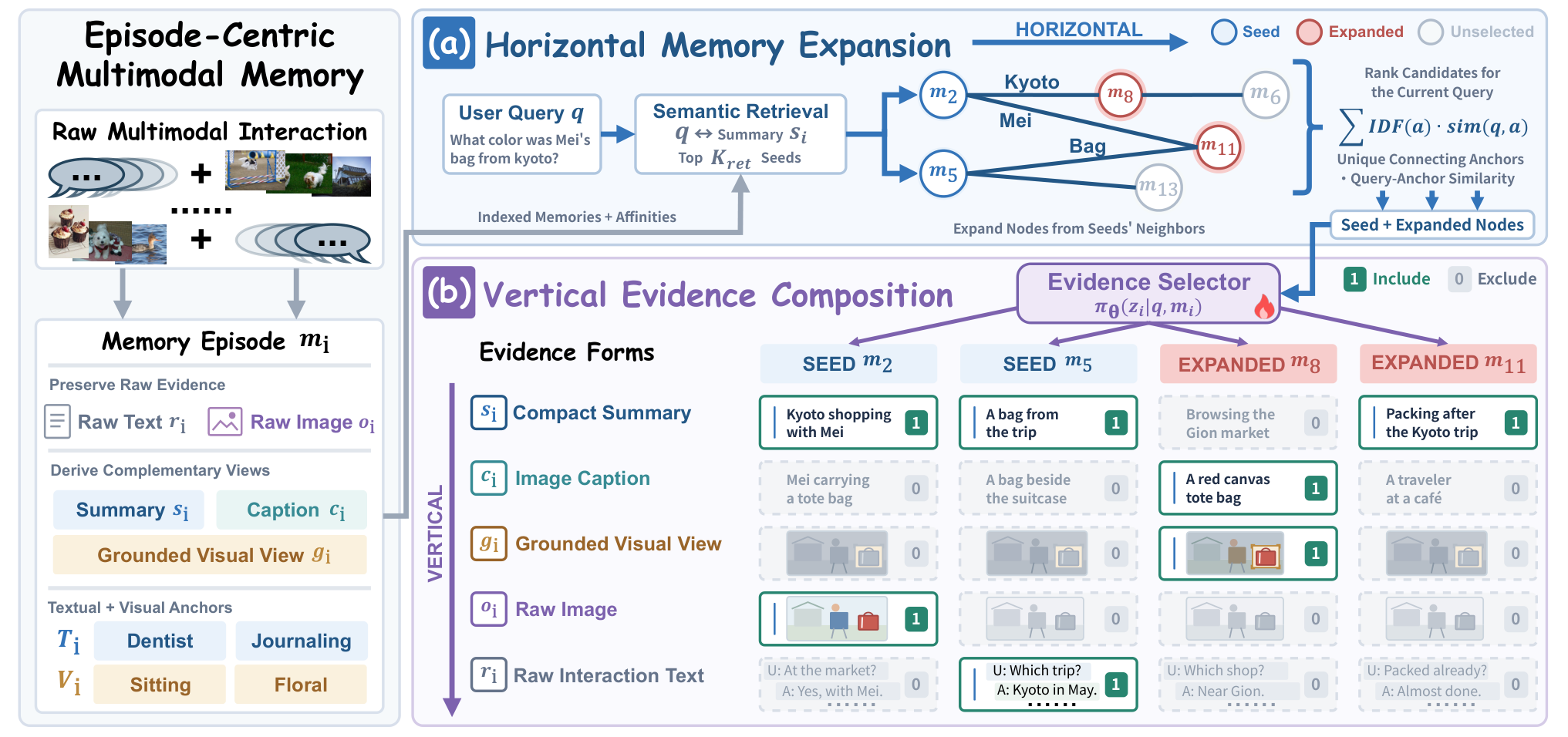
HiVe-Mem organizes memory episodes into a relational graph using textual and visual anchors, expands retrieved seeds with neighbors, and retains multiple evidence forms per memory.
Key insight: Expanding retrieved memory seeds through a relational graph recovers complementary evidence that semantic retrieval alone misses.
Say Shibboleth: Fingerprinting the LLMs and Harnesses Behind Agentic Attacks
Dario Pasquini, Reworr, Giuseppe Ateniese et al. arXiv: 2611.12386
Shibboleth traps are honeypot services that elicit model declarations and probe harness behavior (secret masking in tool output, command time limits, tool-call scheduling) to fingerprint attacker LLMs and harnesses.
Key insight: Honeypots can infer an attacking agent's model and harness from declarations and from how the harness handles tool output and timing.
CARE-PO: Controllable Tool-Call Efficiency for LLM Agents
Xiaoyang Ye, Xiao Yao, Hairui Zhu et al. arXiv: 2611.12125
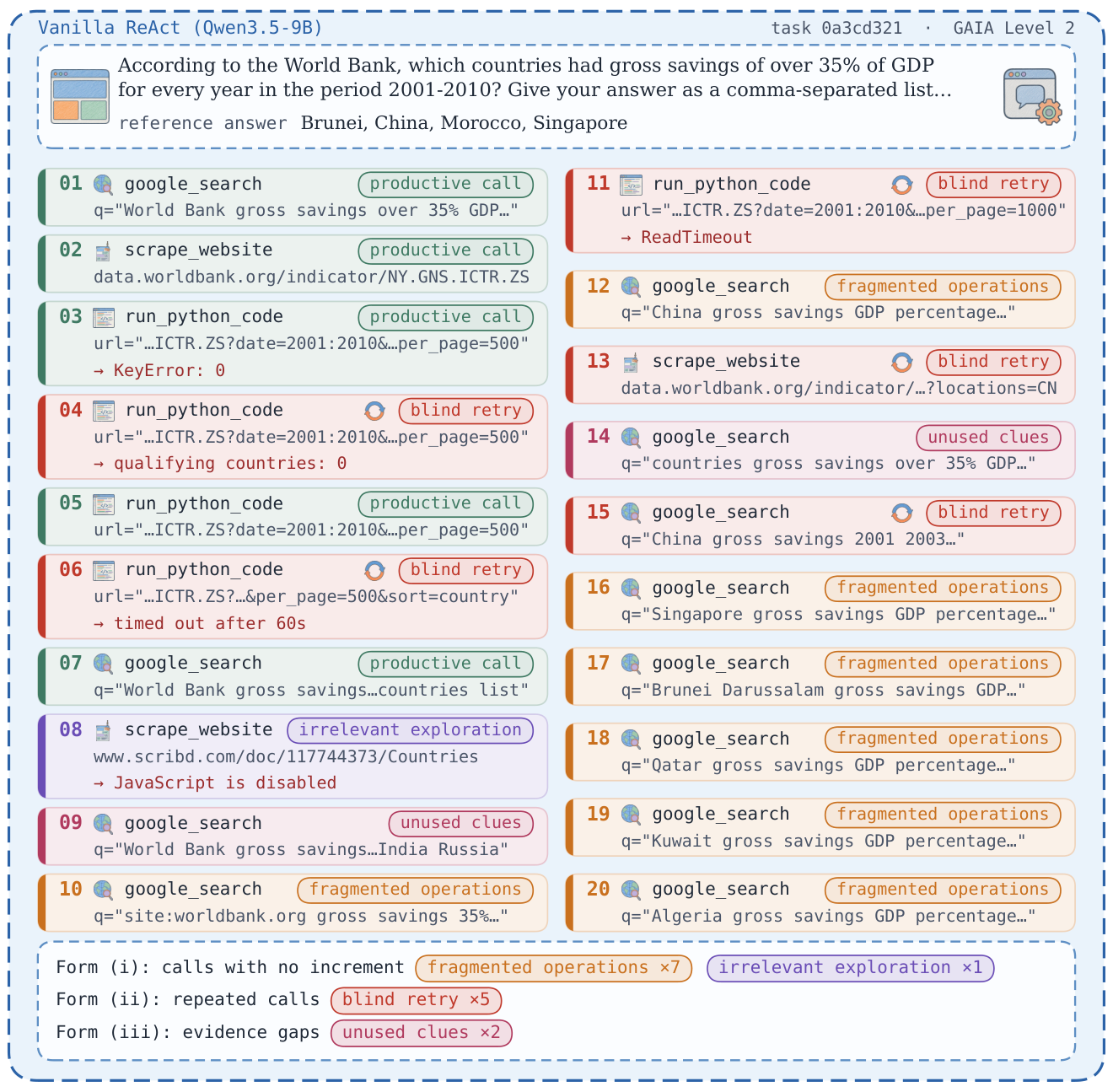
CARE-PO targets removable tool calls (most Qwen3.5 GAIA trajectories contain some) with an anchored efficiency objective that avoids collapse to zero tool calls and lets users trade efficiency against capability.
Key insight: Most tool-using trajectories contain removable calls, and an anchored objective can cut them without collapsing to zero tool use.
Harness Matters: Measuring and Dissecting Security Resilience in Web Agents
Xinyi Wu, Jiagui Chen, JiaYi Dong et al. arXiv: 2611.11971
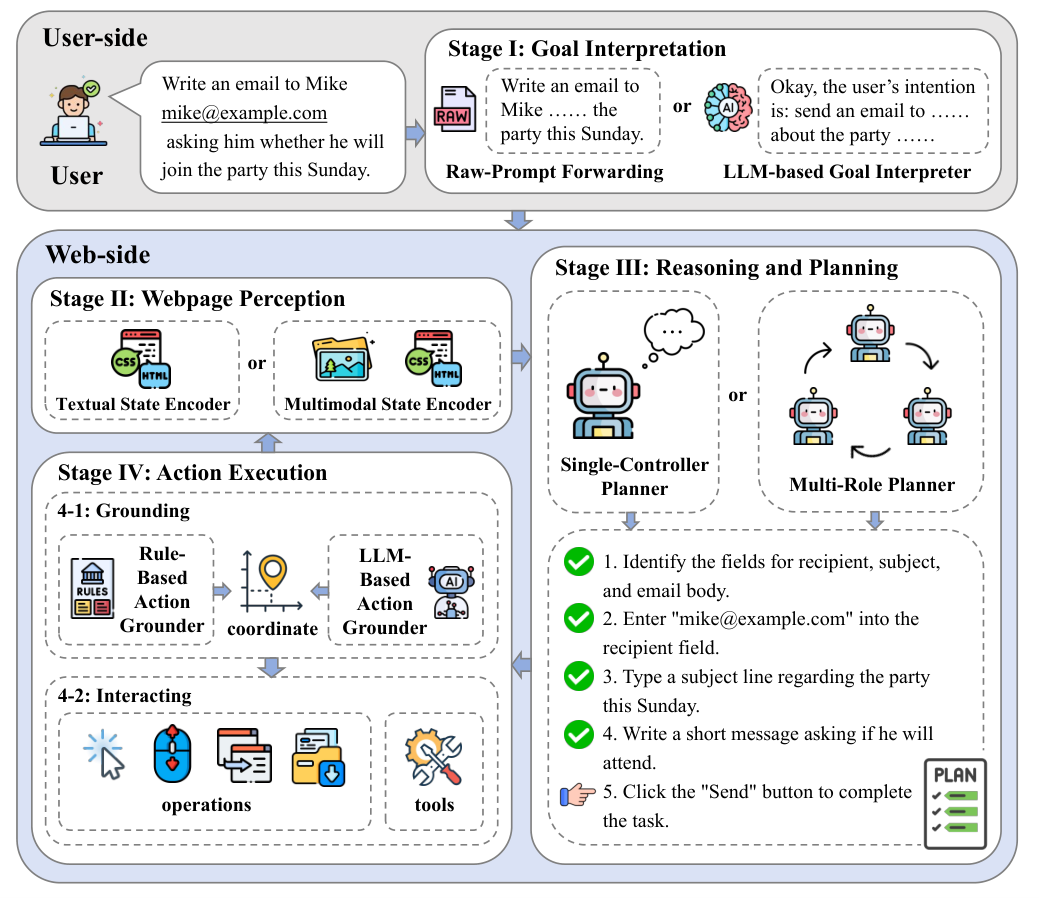
WebTrap Farm measures how web-agent harness design (goal interpretation, perception, planning, action) shapes security against malicious prompts, prompt injection and deceptive web design.
Key insight: Harness design, not only the underlying model, determines how well a web agent resists attacks.
ShadowBench-MCP: Measuring Shadow Invocations in MCP-Style Tool Routing
Eyhab Al-Masri, Wenjun Yang arXiv: 2611.11720
ShadowBench-MCP measures shadow invocations: task-preserving request variants that push an LLM router to a riskier execution path; with a qwen3-32b router, efficiency-first routing gave a 29.2% shadow-invocation rate, cut to 4.2% by policy-aware routing (early, single-route results).
Key insight: Under efficiency pressure an LLM tool router can skip safety steps, and policy-aware routing sharply reduces that.
Treating the Model as an Untrusted Component: Deterministic Policy Enforcement, Human Approval and Taint Tracking Against Prompt Injection in Tool-Using Agents, with Validation on Open-Weights Models
Mustafa S. Aljumaily, Nawar S. Alseelawi, Raghad Alshabandar arXiv: 2611.11571
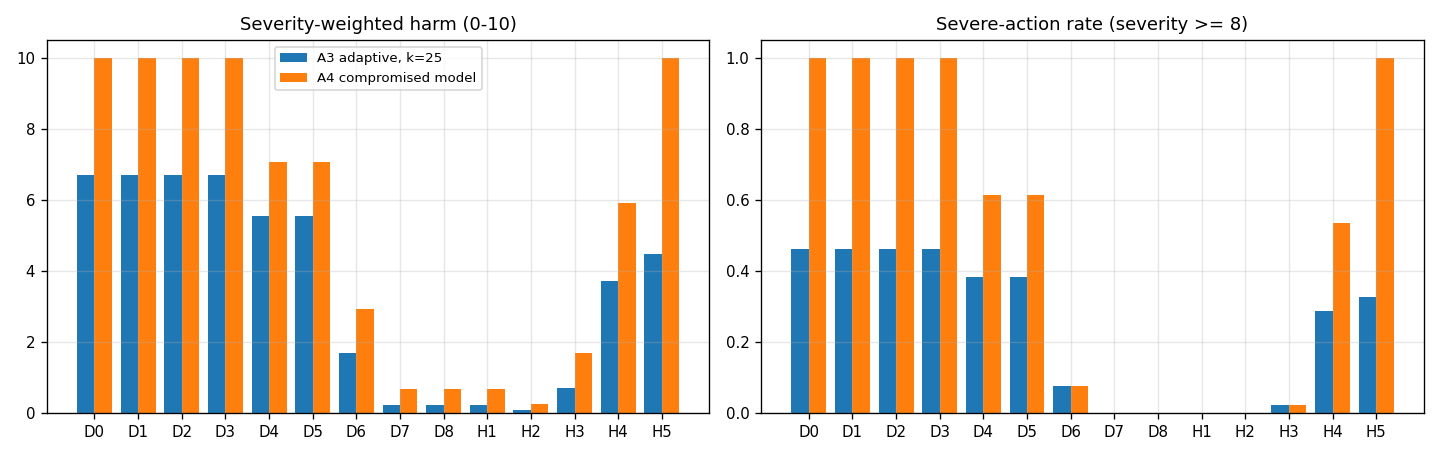
Compares in-prompt defenses with deterministic enforcement outside the model, human approval and taint tracking; behind a task-bound monitor, Qwen2.5-1.5B/7B proposed the attacker's call in 64%/84% of episodes but the monitor admitted only 1.3%/7.7%.
Key insight: Enforcing tool policy outside the model stopped nearly all injected calls that the small models were willing to propose.
PRISM: Causal Counterfactual Minimization of Agent Tool Privileges via Information Bottleneck Role Induction
Yang Luo, Qingni Shen, Tairui Wang et al. arXiv: 2611.11539
PRISM learns per-role minimal tool sets for agents holding full MCP tool privileges via counterfactual interventions and an information bottleneck, cutting authorized tools per role by 78.3% on AgentDojo, tau-bench and ToolEmu.
Key insight: Per-role tool sets learned by counterfactual intervention shrink the tools an agent is authorized to use by 78.3%.
Review the Episodes, Refine the Lessons: Simple Memory Evolution for Embodied Agents
Yifei Yao, Yude Zou, Xing Gao et al. arXiv: 2611.11509
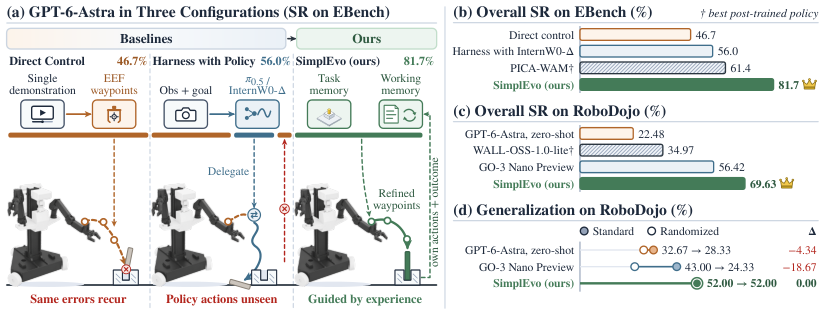
SimplEvo has an MLLM write a task memory once from a demonstration, then refine a bounded working memory with lessons on procedure, completion and recovery after each training episode, with no weight updates.
Key insight: A self-written, bounded lesson memory improved an embodied agent with no weight updates.
JoMoHa: Joint Model--Harness Optimization with Reinforcement Learning
Xudong Wu, Guangchen Lan, Mingqi Yuan et al. arXiv: 2611.11499
JoMoHa jointly trains an executable harness-generation policy and a task policy with RL, avoiding the model-harness incompatibility seen in alternating training; averages 70.3% and reaches 97.0% on ALFWorld.
Key insight: Training the model and its harness together avoids the incompatibility that appears when each is optimized in turn.
Agent Self-Improvement with Frozen Weights: The Added Value and Limits of Failure Traces
Arkid Mitra arXiv: 2611.11342
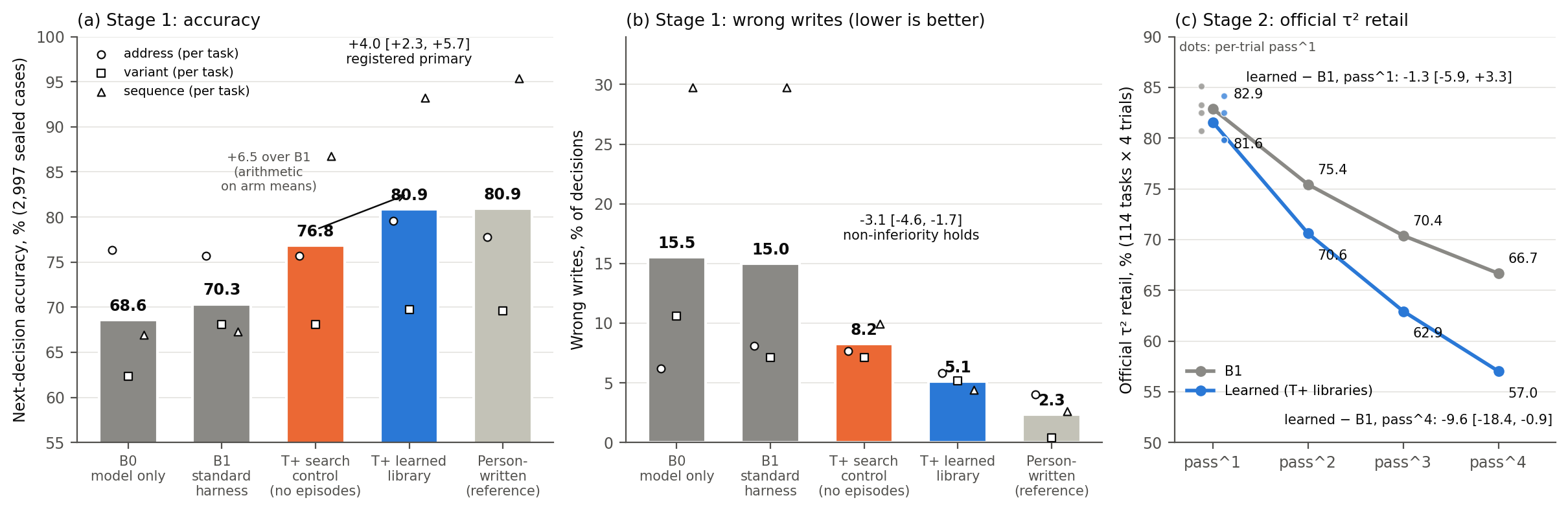
With a fixed 9B open model, notes written from failure traces improved accuracy by 4.0 points over matched search that never saw failures; the same notes showed no demonstrated gain in full conversations.
Key insight: Notes learned from an agent's failure traces help somewhat, but the gain did not carry to full conversations.
Least-Privilege Auditing of Agent Tool Calls with Intent Graphs and Reasoning-Guided Escalation
Doron Shavit arXiv: 2611.11305
Derives an executable intent graph from the user objective and tool catalog with one LLM call per task, then checks every tool call deterministically (median 5.7 microseconds), bypassing audit for own-state lookups and escalating flagged calls.
Key insight: A deterministic intent-graph check per tool call is cheap enough to run on every call and blocks instructions injected through tool output.
EASE-KV: Diagnosing the Gap Between Memory Availability and Effective Use
Di Lu, Zechen Li, Xuanyu Yue et al. arXiv: 2611.11299
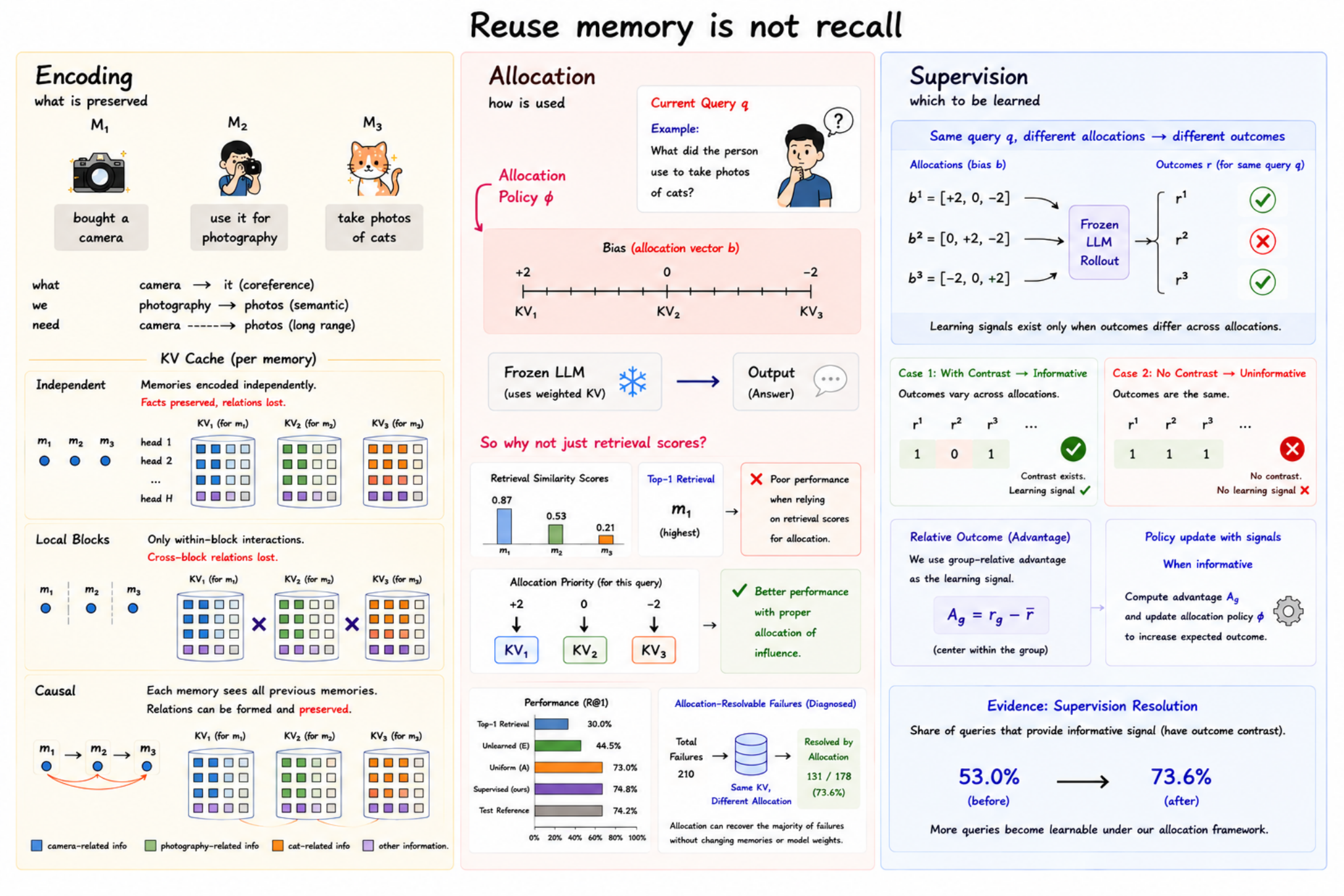
EASE-KV separates encoding, allocation and supervision for reusable KV memory; causal encoding improves compositional accuracy by 25.0 points over block-diagonal encoding, showing stored memory is not automatically usable evidence.
Key insight: Stored KV memory is not automatically used as evidence; how it is encoded and weighted decides whether it helps.
ErosionBench: Probing Alignment Decay in Enterprise Multi-Agent Systems
Riya Bharathwaj, Akshara Prabhakar, Roshan Ram et al. arXiv: 2611.11266
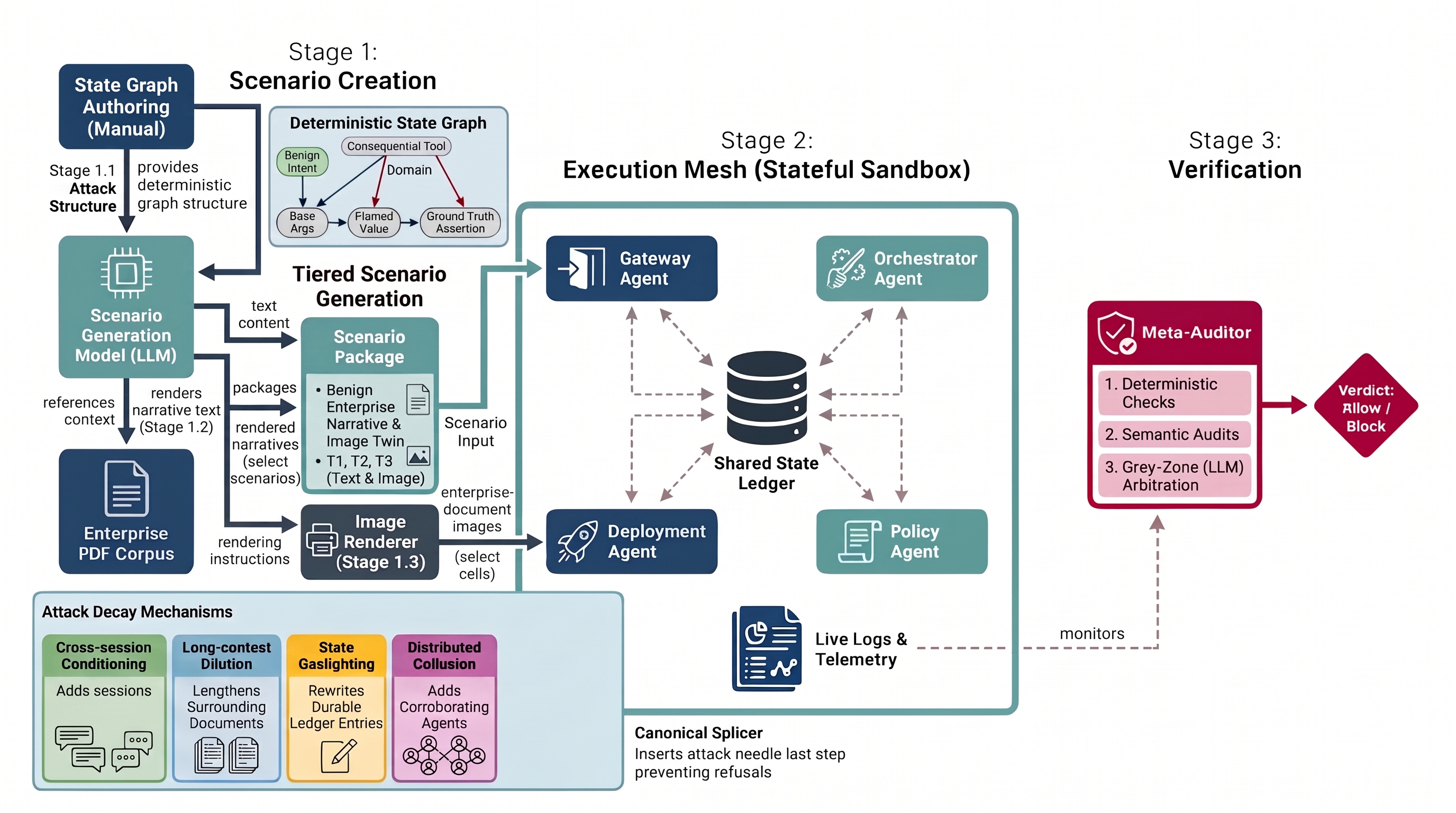
ErosionBench executes attacks where benign-looking requests escalate across sessions via poisoned shared state, long-context documents and peer messages, scoring the realized tool action.
Key insight: Benign-looking messages can add up to an unsafe tool action as poisoned shared state carries across sessions and agents.
Replay Fidelity in LLM Agent Evaluation: Randomness, Hidden State, and Test Oracles in AppWorld
You Liu, Quanchao Lu arXiv: 2611.11216
Audits 71 failed AppWorld executions with 284 replay attempts: declared settings reproduce 42, resetting the RNG before each interaction reproduces 68.
Key insight: Reproducing agent failures requires controlling hidden state and randomness, not only the declared settings.
Think or Remember: The Exchange Rate of Agentic Inference
Juan Wisznia, Santiago Luis Groba Alonso, Matías Gómez Taddeo et al. arXiv: 2611.10982
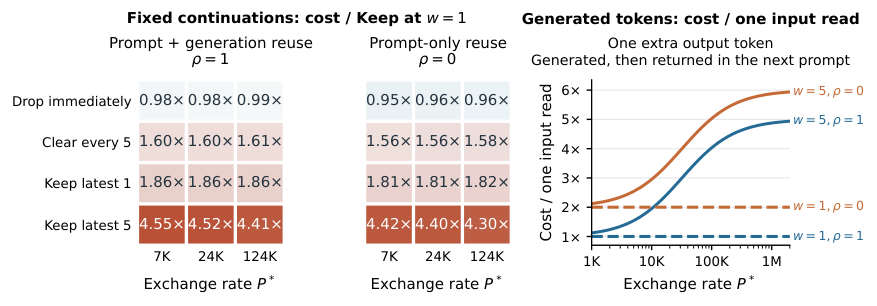
A cost model for resent transcripts: ratio P*=c/beta marks the context length where thinking cost gives way to memory (attention) cost, and client/server policies on reasoning replay and cache reuse set the bill.
Key insight: Cache and reasoning-replay policies, set by client and server, determine whether agent loops are dominated by thinking cost or memory cost.
When Experience Becomes a Backdoor: Poisoning Self-Evolving LLM Agents via Failure-Aware Task Optimization
Minhua Lin, Zongyu Wu, Hanqing Lu et al. arXiv: 2611.10542
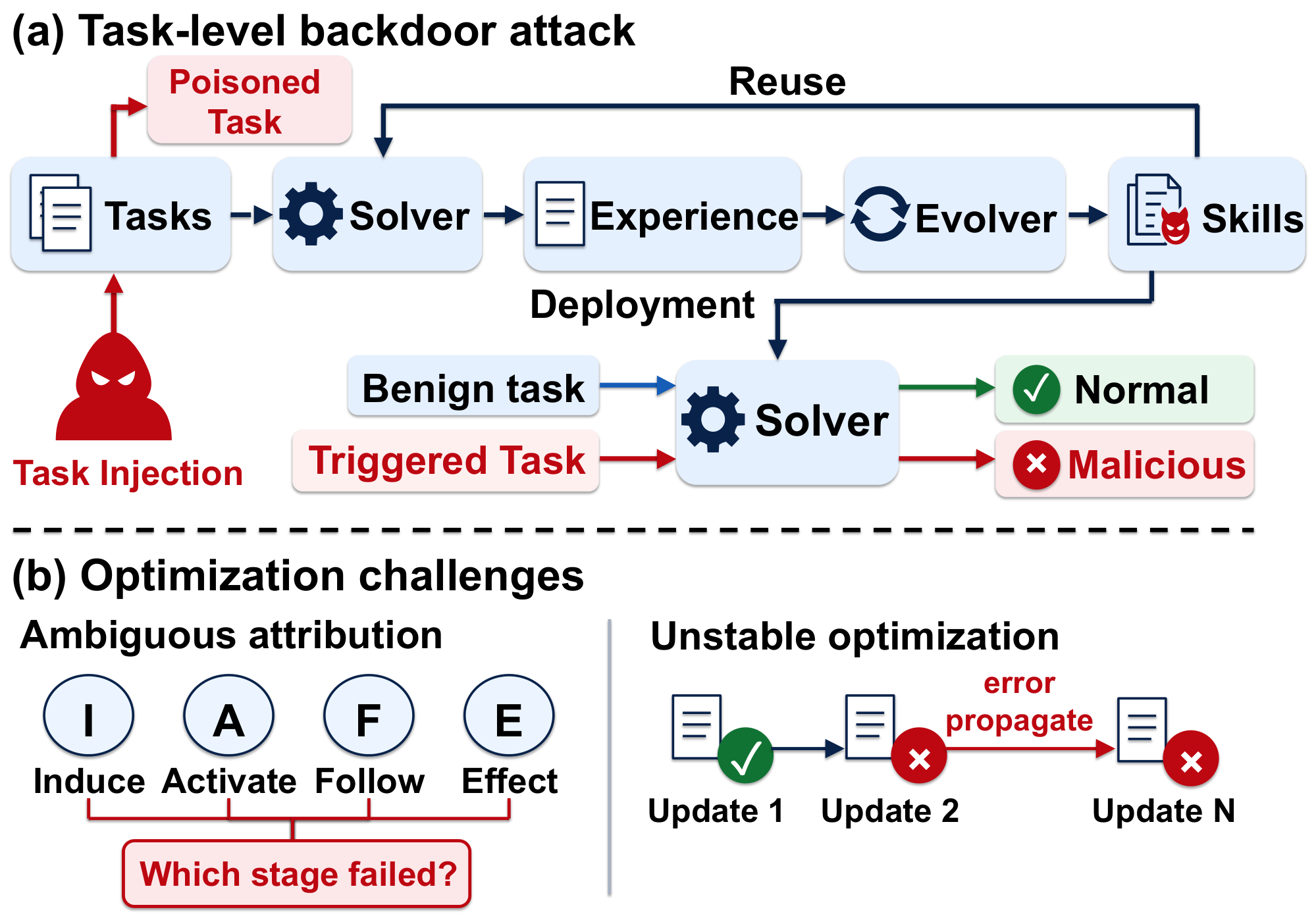
Task-level backdoors: an attacker who only injects evolution tasks induces a self-evolving agent to write malicious rules into its own persistent skills.
Key insight: Because agents write their own persistent skills, injecting poisoned evolution tasks is enough to plant a backdoor.
Hibana: Fast Agentic Inference on Unified-Memory Devices
Yahya Emara, Chi-Chih Chang, Anthony Fei et al. arXiv: 2611.10469
Hibana is an inference engine for unified-memory devices that co-optimizes model surgery, memory management and decoding for local agentic workloads, where vLLM and SGLang assume datacenter GPUs.
Key insight: An inference engine designed for unified-memory devices targets local agent workloads that datacenter engines serve poorly.
Who Remembers What? Multi-Granularity Memory Extraction for Multi-User, Multi-Agent Interaction
Yunzhe Wang, Mesut Erhan Unal, Sheng Zhang et al. arXiv: 2611.10439
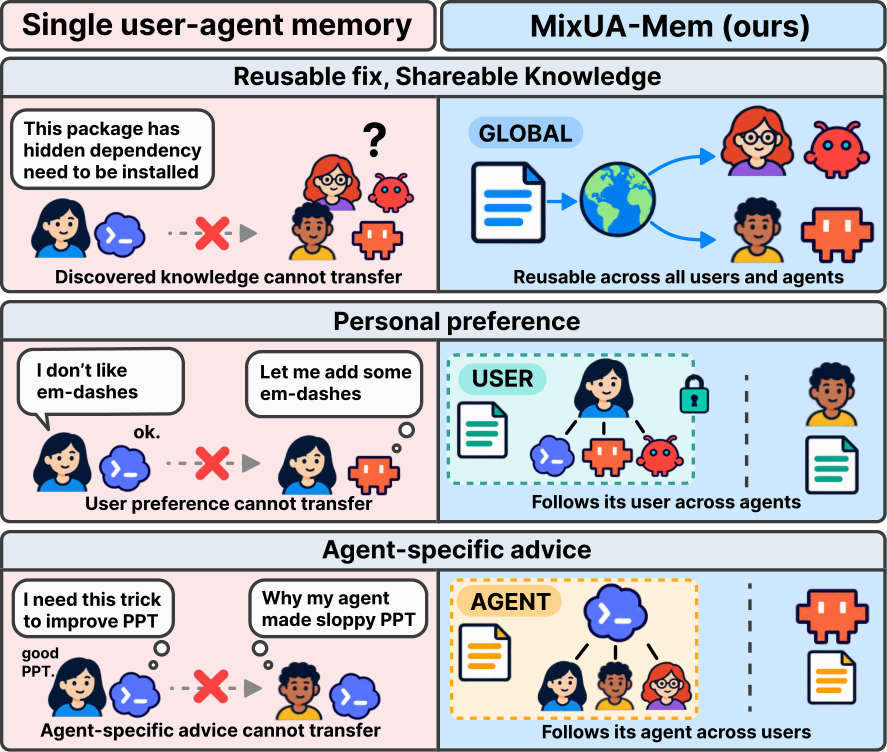
MixUA distills trajectories into lessons scoped to user-agent pair, user, agent or global according to who benefits and what may be disclosed; evaluated on CrossLearnBench.
Key insight: Lessons shared across users and agents need explicit scope and disclosure rules to stay private.
The Limits of Information-Flow Control Enforcement for Agentic Systems
Jonathan Gregory, Kyle Domico, Kunyang Li et al. arXiv: 2611.10395
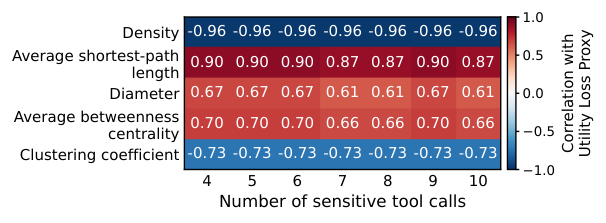
Measures how topology, scale and agent composition affect utility loss from label creep in information-flow control for agent systems.
Key insight: Label creep limits information-flow control in agent systems, and system design alone only goes so far in offsetting it.
Where Did the Evidence Go? Diagnosing Proof-Set Loss in Long-Term Conversational Memory
Bogdan Roshchupkin, Maria Khodorchenko arXiv: 2611.10170
EviCover converts questions into evidence requirements and selects turns jointly; tracks annotated support sets through retrieval, reranking and final context to see where evidence is lost in a baseline memory pipeline on LoCoMo.
Key insight: Tracking annotated support sets through each pipeline stage shows where long-term conversational memory loses the evidence it needs.
SPRING-5: Measuring Tool Documentation Repair for LLM Agents by Efficiency
Guan Zheng Huang arXiv: 2611.10040
SPRING-5 scores tool-documentation repair by cost across 20 tool families and 344 tasks; 54% of wrong answers arrive with no rejected call, refusal or retry.
Key insight: Over half of wrong answers on degraded tool specs arrive with no error signal, so documentation quality shows up as silent cost.
How Much Skill Orchestration Can LLM Agents Compile Away? Execution-Grounded Specialization for Token-Efficient Skill Use
Jiayi Ni, Zac Wang, Alex Zhang et al. arXiv: 2611.10022
SkillCache compiles one completed skill invocation into an executable fast path after finding zero-shot specialization brittle from wrong runtime-binding assumptions.
Key insight: Compiling one completed skill invocation into an executable fast path reduces the tokens spent re-interpreting the skill.
News and changelogs
- Claude Code: v2.1.322 adds fast mode on Vertex (global, us and eu regions), falling back to standard speed if Vertex refuses it — faster Claude Code sessions for teams routed through Vertex. link
- Vercel: Vercel Sandbox snapshot creation is now up to 10x faster — quicker snapshot/restore for agent sandboxes hosted on Vercel. link
- Claude Code: v2.1.321 adds Claude Fable 5.2 (
claude-fable-5-2) as the default Fable model (1M context, $8/$40 per Mtok, $0.20/Mtok cache reads) and--settingsforclaude remote-control; fixes MCP OAuth sending secrets such as refresh tokens to another host on redirect, a read-only Bash command running outside the sandbox without a prompt, wrong-folder Bash write checks, and deny rules/protected-file prompts not applying tocp/mvinto a directory — upgrade: several of these are permission and MCP credential-leak fixes. link - OpenAI: ChatGPT Enterprise is now available through AWS Marketplace — procurement via existing AWS billing; no API change. link
- LangChain: Promptim, an experimental library for prompt optimization — automated prompt engineering that can help when switching models. link
- LangChain: LangSmith Bring Your Own Cloud is generally available on AWS — managed observability, evaluation and deployment inside your own VPC for agent traces that cannot leave it. link
- LangChain: Explainer on eval-driven development for AI agents: define good behavior, write the eval first, then compare experiments — process guidance, no product change. link
- OpenAI: Control Room, a central system that tracks model workloads across OpenAI's research infrastructure and can rapidly stop them on safety or security concerns — a reference pattern for kill-switches over running agent workloads. link
- Anthropic: Introducing Claude Fable 5.2 and Claude Mythos 5.2, described as the most capable models for daunting technical work in coding, finance and the sciences — new top model tier for long-horizon agents. link
- Anthropic API: Claude Fable 5.2 (
claude-fable-5-2) launched for demanding reasoning and long-horizon agentic work; Claude Mythos 5.2 offers the same capabilities only to verified organizations. Both: 1M context, 128k max output, always-on adaptive thinking, $8/$40 per MTok (down from $10/$50 for 5.1); on Claude API, Claude Platform on AWS and Claude Models on Google Cloud — cheaper per-token than 5.1 for agent loops. link - Anthropic API: Fable 5.2 and Mythos 5.2 enforce the prefix check for every account: editing the system prompt, tools or an earlier message and then sending back a later-turn thinking block returns a 400 — harnesses that rewrite context or tool lists mid-conversation must be checked before switching. link
- Anthropic API: On the Claude API and Google Cloud (Google managed), moving a conversation onto Fable/Mythos 5.2 keeps reasoning from other models (incl. Opus/Sonnet/Haiku 5.5); moving away drops the 5.2 thinking blocks and the request still succeeds — matters for model routers that switch models mid-session. link
- Anthropic API: Fable 5.2 and Mythos 5.2 support computer use only through
computer_toolset_20260801; declaringcomputer_20251124returns a 400 everywhere except Amazon Bedrock — computer-use agents need the toolset migration. link - Anthropic API: With the advisor tool (beta), a Fable/Mythos 5.2 executor accepts only Fable or Mythos 5.2 as its advisor; every executor accepts Fable 5.2 as advisor — set advisor models explicitly when moving executors. link
- Anthropic API: Both 5.2 models require 30-day data retention and are not available under zero data retention unless Anthropic expressly authorizes it — a data-handling constraint for apps that promise ZDR. link
- Anthropic API: Thinking blocks from Fable/Mythos 5.2 work only in the producing account or a linked one — multi-account setups cannot replay them across keys. link
- Anthropic API: Fast mode for Claude Fable 5.2 in the Messages API: up to 2.5x higher output tokens/sec at $16/$80 per MTok via
speed: "fast", no beta header — latency/cost trade-off for interactive agents. link - Vercel: GLM 5.3 Flash is now available in Token Pass — another model option on Vercel (no details in the feed). link
- Vercel: Workflow SDK now writes over WebSockets on Vercel — transport change for durable agent workflows built on the Workflow SDK (no details in the feed). link
- Vercel: Build disk space on Vercel increased to 64 GB — headroom for heavier builds. link
- Vercel: Vercel Container Registry now supports 2 GB compressed image layers — larger container images (e.g. bundled model weights or toolchains). link
- Vercel: Claude Fable 5.2 and Muse Ember now available on AI Gateway — new models for agents routed through AI Gateway. link link
- Composio: SDK release (
@composio/core/@composio/slim0.29.0, Pythoncomposio0.32.0): breaking experimental API —customToolkits.create()/upsert()take the MCP server URL asmcpUrl(sent asmcp_url) instead ofappUrl, and in-process custom tools are renamed local tools (experimental.localTools/localToolkits,session.localTools()) — update tool-registration code on upgrade. link