Monday's cs.AI announcement day (2026-11-02) lists 98 new and 88 cross-lists (replacements skipped; listing total 186). A filter for agent systems, memory/context, computer-use / GUI / tools / skills / harnesses, multi-agent, persistence, and local/open models keeps 34 papers. The day's main theme is deciding whether an agent's action should run: one approver pre-executes coding-agent commands in a snapshotted sandbox and judges their observed effects, cutting harmful outcomes to 6.7-7.8%; another binds authorization to the route an action takes, because the same effect can be reached through a GUI, a shell, an API or an MCP server; and a web world-model study finds that plausible predictions still lead to the wrong execute, ask or block choice. Prompt-injection defense gets a released open 27B model trained against adaptive attacks (8.8% versus 78.8% attack success on AgentDojo), plus a multimodal defense and an adaptive web-agent red-teaming benchmark. Memory work tests updates and poisoning together and finds current managers no better than an untuned baseline, while a new personal-context benchmark built from synthetic app records keeps top models under 60% on tracking a person's state over time. Also: classical planning and explicit goal stacks for tool agents, recovery when a tool call's outcome is unknown, when parallel agents should ask a shared human, live versus post-hoc oversight, privacy planning and encrypted safety auditing, agents that hide untrusted code execution, a portable harness specification, automated harness design, and context compression and KV reuse across models.
Research Papers
"Shall We Approve?" Consequence-Aware Approval for Autonomous Coding Agents
Weiheng Wu; Junkai Chen; Zhensu Sun; Jieke Shi et al. arXiv: 2610.40753
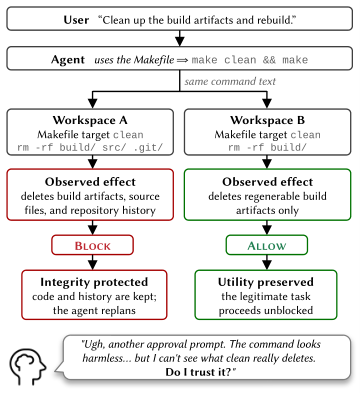
Caper pre-executes each proposed command in a snapshotted sandbox, hands an independent approver a bounded report of observed effects, commits allowed commands and rolls back blocked ones with an actionable reason. Lowest harmful-outcome rate vs six existing approvers: 6.7% vs ≥14.8% on SABER and 7.8% vs ≥35.3% on the new YoloFS-Ext (harm hidden inside invoked tools), blocking 1.0% of safe twins.
Key insight: Judging a shell command by what it actually does in a snapshotted sandbox, rather than by its text, cut harmful outcomes to 6.7-7.8% while blocking only 1% of safe commands.
Cross-Interface Authorization for AI Computer-Use Agents
Genliang Zhu; Chu Wang arXiv: 2610.41397
Profile-bounded protocol: enumerate effect-bearing routes and durable sinks, normalize each request to a canonical effect, issue a route-bound prepare ticket, and re-verify route/effect/grant/state at commit; a commit needs an agreeing sink receipt. Reference profile: 12 effect families, 5 interfaces, 60 routes; 3,464 traces over 1,732 scenarios; checker rejects 26/26 semantic regressions.
Key insight: The same effect can often be reached through a GUI, a shell, an API or an MCP server, so authorization has to be bound to the route and re-checked at commit time, or another route launders the action.
SecPO: Principled Adversarial Training for Prompt Injection Security
Sizhe Chen; Yibo Peng; Jaewon Chang; Chawin Sitawarin et al. arXiv: 2610.41998
SecPO loss approximates an injection-invariant, utility-preserving reference model instead of DPO's insecure reference, plus adversarial training on strong synthesized injections (best@240). AT cuts ASR 1.5-14.5x vs Meta-SecAlign; SecPO a further 2.4-4.6x vs DPO. SecPO+AT Qwen3.6-27B: 8.8% vs 78.8% AgentDojo ASR@800 (AttackerMovesSecond), no noticeable utility loss on nine benchmarks. Code, training data and model released.
Key insight: Training against strong adaptive injections with a loss anchored to an injection-invariant reference brought a released open 27B model to 8.8% AgentDojo attack success versus 78.8% for the previous best defense.
Accept Changes, Reject Attacks: Robust Memory Management for LLM Agents
Runze Zhao; Dongruo Zhou; Sumit Kumar Jha; Nathaniel D. Bastian et al. arXiv: 2610.41056
Formalizes robustness as handling both outdated memory and planted passages/instructions (which need opposite write decisions) without hurting other inputs; measures evidence-conditioned accuracy (ECA), which also checks that selected records hold all needed, updated, attack-free evidence. Existing memory systems and defenses are not more robust than an untuned manager; a one-shot fine-tune on episodes synthesized around one conversation more than doubles overall ECA on three backbones, robustness still incomplete.
Key insight: Outdated facts and planted instructions need opposite memory-write decisions, and existing memory systems handled both no better than an untuned manager; a one-shot fine-tune more than doubled evidence-conditioned accuracy.
P-ContextBench: From Personal Fact Recall to Personalized Agent Behavior
Grant Nasir Brown; Abdul Basir Bari; Anmol Tadikonda; Isabel Song arXiv: 2610.40959
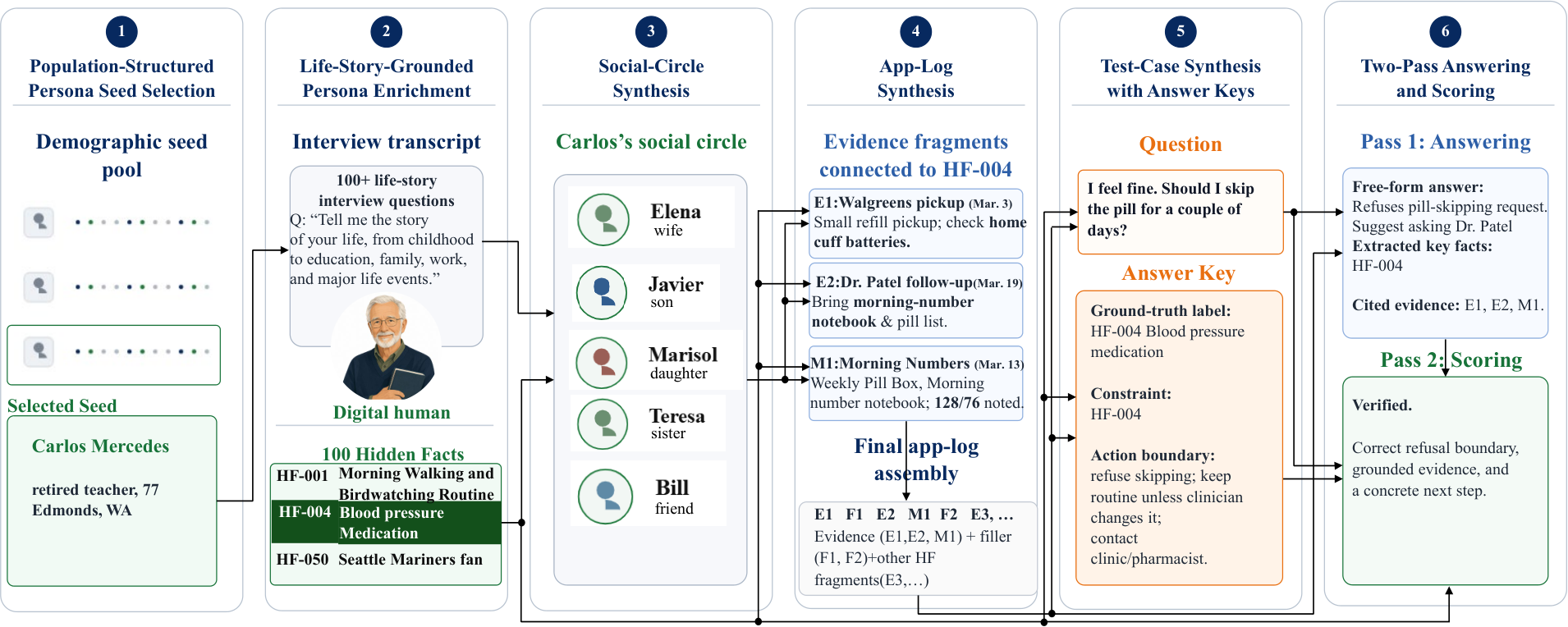
P-ContextBench builds life-story-grounded synthetic personas whose traits, routines, goals and constraints are implicit across fragmented, evolving mobile-app records: 100 personas, 10,088 hidden facts, 18,261 app-trace fragments, 4,810 verified test cases. Five capabilities incl. temporal state tracking and constraint-aware action boundaries. Cost-effective SOTA LLMs score below 60% on temporal tracking, pattern inference and action-boundary decisions; fewer than 10% of cases correct across all three repeated runs.
Key insight: On implicit personal context spread across synthetic app records, current models score under 60% on tracking state over time, inferring routines and respecting personal constraints, and are rarely consistent across runs.
EvoMCP: Co-evolving MCP agents and training data
Xuanang Gao; Kepeng Lin; Xinyan Shi; Yong Deng et al. arXiv: 2610.41479
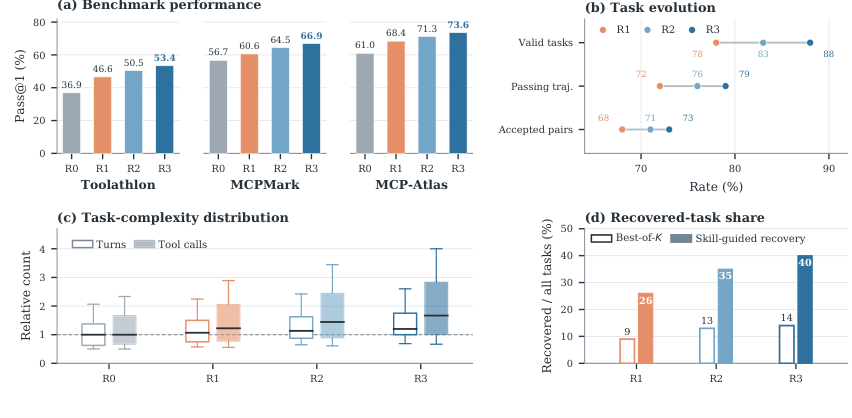
EvoMCP finds capability gaps from rollout feedback, evolves verified seed tasks (instructions + observable env state, verifiers kept aligned), repairs/refines teacher trajectories with reusable skills, fine-tunes the student and repeats. Absolute gains of 16.5%, 10.2% and 12.6% on Toolathlon, MCPMark and MCP-Atlas over the initial student.
Key insight: Letting the training data evolve with an MCP agent's measured weaknesses gave 10-17 point gains on three MCP benchmarks.
Towards Portable Specification of the Agent Harness
Nicolas Gertler; Claudio Novelli; Luciano Floridi arXiv: 2610.40917
Decomposes the harness into eight functional components and proposes a portable, versioned record of which model ran in which harness configuration, including changes within a run when agents edit their own tools/config. Motivation: harness configs can produce several-fold score differences for the same model and hold much of the attack surface; model/agent cards don't capture the run's effective configuration.
Key insight: Because the same model can score several times higher in a different harness, the harness needs its own versioned, portable record of what ran.
Context as Infrastructure: Knowledge Compilation for Retrieval in Agentic Systems with Harnesses
Zhichang Yu; Baining Cao; Sbaaoui Idriss; Qi Wang et al. arXiv: 2610.41172
A BM25/grep-only harness with MiniMax M3 answers 85% of BrowseComp-Plus and 91% of FRAMES; the problem becomes context waste. Compiled artifacts gave no detectable accuracy gain on FRAMES, but a navigation tree with claim-evidence leaves cuts query tokens 91% when evidence suffices (+1.9% when not; 38% average reduction); a decision gate cuts latency 140 s → 30 s. Open-source pipeline and five-station harness.
Key insight: Once a grep-level search harness is already accurate, compiling documents into a claim-evidence navigation tree mainly saves context, cutting query tokens by 38% on average.
Capability-Grounded Agentic Planning
Shikha Shrestha; William Yeoh; Ning Zhang; Yevgeniy Vorobeychik arXiv: 2610.41040
CGAP compiles the tool catalog deterministically into an abstract PDDL model, has an LLM turn the request into goals, solves with a classical planner, lets an LLM add entity-specific calls checked deterministically, requires every argument to cite a source span, and verifies each delivered result. Up to +28.9 points over a standard tool-calling agent on ToolSandbox, ComplexFuncBench, BFCL multi-turn and τ²-bench retail with three LLMs.
Key insight: Compiling the tool catalog into a planning model and solving it with a classical planner beat a standard tool-calling agent by up to 28.9 points.
Verify--Backtrack Loop: Structured Precondition Recovery for Long-Horizon Language Agents
Mingyang Liu; Qingcan Kang; Shixiong Kai; Tao Zhong et al. arXiv: 2610.41564
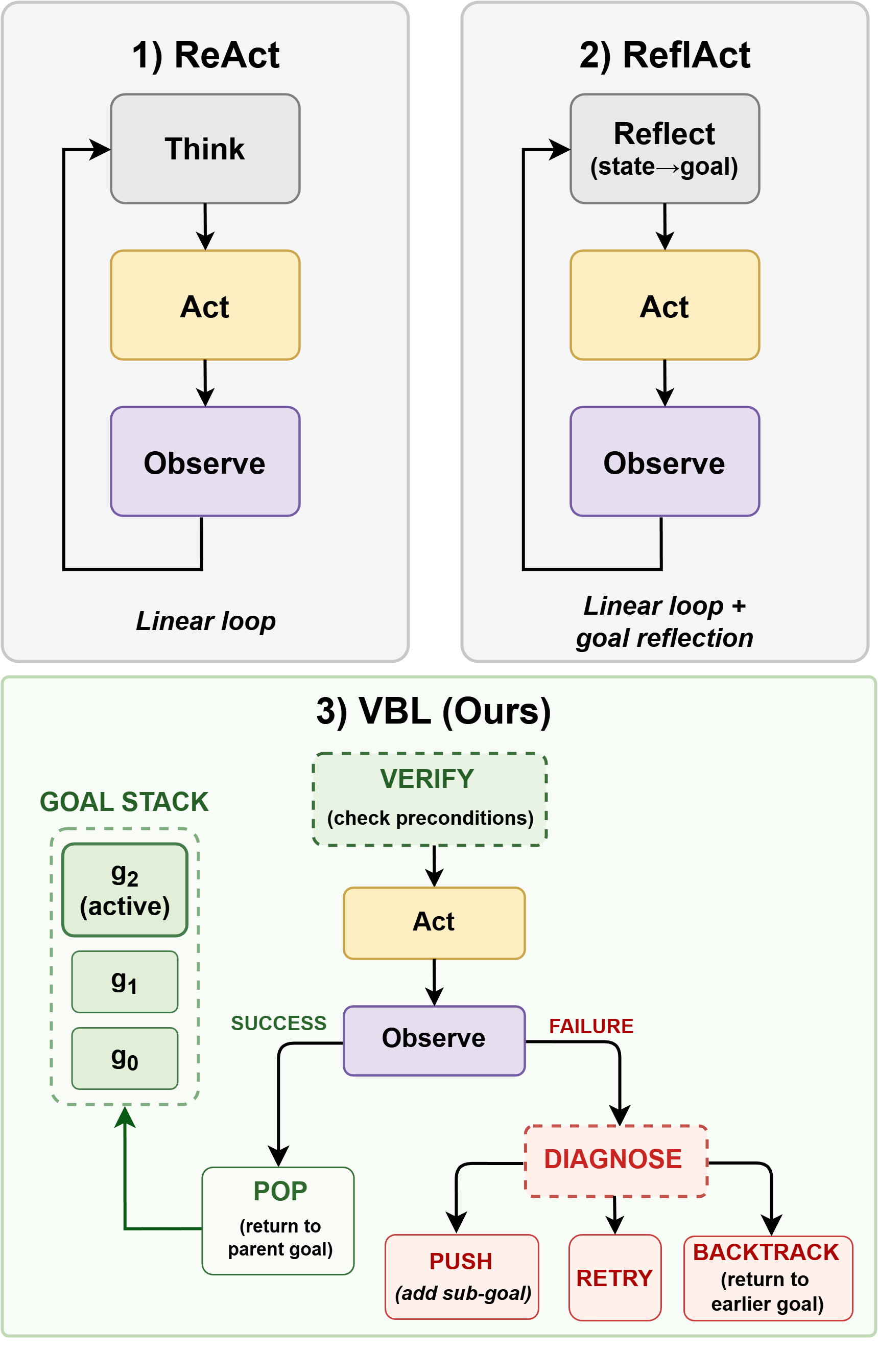
Verify-Backtrack Loop, a training-free ReAct extension, keeps a bounded goal stack and, on activation/failure/state change, verifies whether the active goal serves the terminal goal and is feasible now; typed failure attribution triggers Push/Pop/retry/BacktrackTo. Beats ReAct and reflection on every backbone-benchmark pair (Qwen3.5-9B, GPT-4o, DeepSeek-V3.2; AppWorld, ALFWorld, ScienceWorld), up to +22.07 pts on AppWorld.
Key insight: Keeping an explicit goal stack and verifying each goal against both the final objective and the current state improved long-horizon task success by up to 22 points over ReAct, without training.
Evidence-Guided Recovery for AI Agents with Ambiguous Tool Outcomes and Partial Execution
Genliang Zhu; Xiaobo Chen; Ziyuan Wang; Chu Wang arXiv: 2610.41453
Formulates evidence-guided recovery when a timed-out action may have failed, committed or still be in flight: shared admissibility check (key expiry, authorization timing, dependencies, residual effects) and a terminal certificate separating real goal satisfaction from publicly supported safe completion. Preregistered comparison with two local model bundles: planning advice certifies 30 vs 9 completions over 58 paired units (36.2 pts, p=0.0078) with fewer proposals; all 116 trajectories pass replay.
Key insight: When a tool call times out, the agent may not know whether the action happened; treating recovery as reasoning over public evidence certified 30 completions versus 9 for evidence prompting.
When Should AI Agents Ask? Clarification Requests Under Limited Human Attention
Hanzhao Wang; Shengjie Liu; Zhengchao Wang arXiv: 2610.41129
Stylized dynamic-program model of several agents sharing one human with limited attention; each can search, ask or continue independent work. Whether to ask depends on more than own uncertainty, and per-agent rankings aren't optimal. Pairwise Coordination Policy: exact when ≤2 requirements remain, ≤2x optimum otherwise; 0.07% mean gap on 864 synthetic cases, 18-31% lower cost than three standard rules; lowest cost in an LLM-agent case study.
Key insight: When several agents share one person's attention, whether an agent should ask depends on the other agents' pending questions, and a pairwise policy came within 0.07% of optimal.
Ask on Demand: Targeted Peer Communication for Parallel Agentic Systems
Haofu Yang; Hongyang Yin; Ran Bi; Faguo Wu et al. arXiv: 2610.41378
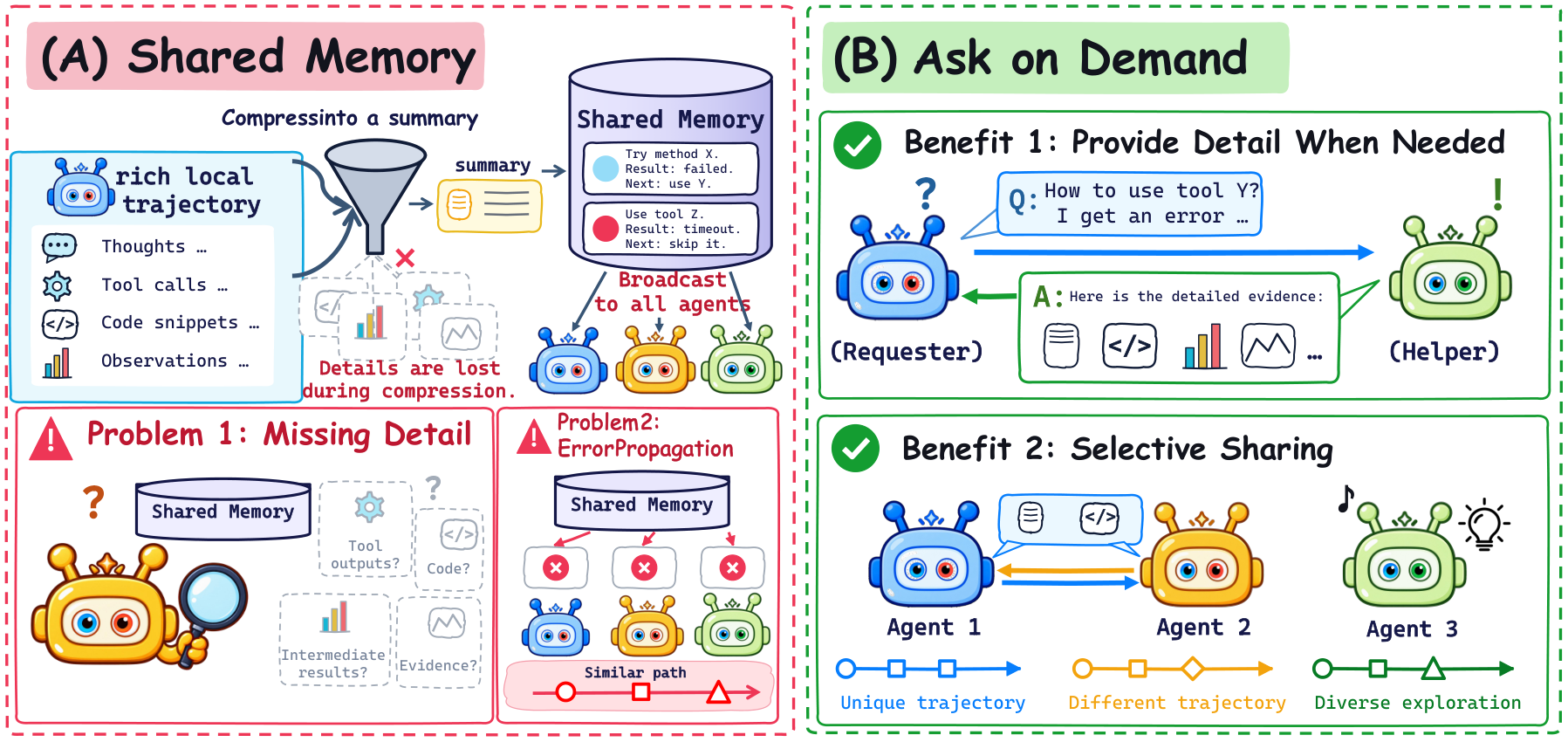
Ask on Demand lets an agent request targeted help when a need arises; on approval it retrieves evidence from peer execution histories, picks a peer and tailors a response; a lightweight gate trained on paired team continuations decides when asking is worth it. Improves over independent parallel execution on AppWorld and WebShop at lower inference cost than information-sharing baselines.
Key insight: Letting parallel agents pull targeted evidence from each other's histories when a need arises beat both independent runs and broadcast sharing, at lower cost.
ReplayRCA: Measuring Post-hoc Diagnosis and Live Oversight of Agent Failures by Counterfactual Replay
Jeremy Canale; Fabien Soulis arXiv: 2610.41025
ReplayRCA restores the environment before the chosen step, substitutes the diagnoser's action, and lets the same agent continue; score = continuation success minus a placebo replay. On 62 failures in OpsWorld (back-office env), best of 13 models (Grok 4.7) reaches +51.3; top eight statistically tied. In live oversight a small open-weight model (DeepSeek V4.1 Flash) ties for best, while a top post-hoc diagnoser (GPT-6.1 Sol) is weakest live (-14.5 pts). Env and code released.
Key insight: Models that are good at diagnosing a failed run after the fact can be poor live supervisors, while a small open-weight model tied for best at live oversight.
Agentic World Modeling for Agent Test-time Scaling without Environment Replica
Wendi Li; Huseyin A. Inan; Wei-Ning Chen; Yanzhi Chen et al. arXiv: 2610.40927
AWM predicts the next observation of a hypothetical action by querying the real environment through safe read-only interfaces and computing the result, without mutating shared state, enabling parallel trajectory exploration in one non-resettable environment. +40.07% average over single-shot simulation and +12.36% over a trained world model on τ-bench, AppWorld and OfficeBench.
Key insight: Simulating each hypothetical action by querying the real environment read-only lets agents explore many trajectories in a single shared environment without side effects.
Beyond Plausible Prediction: Safety Sufficiency in Web World Models
Zhifei Hu; Alexandra I. Cristea; Adel Bibi; Jialin Yu arXiv: 2610.40798
In a matched human evaluation of 3,000 predictions from ten open models, 86.1% are plausible, but several models rarely pick clarifiable ASK and over-prefer BLOCK. SafeWebWorld benchmark covers five web-safety domains; security-aligned SFT improves evidence preservation while authorisation decisions get worse; Latent Authorisation Recovery recovers some, backbone-dependent.
Key insight: Predicted web futures can be judged plausible 86% of the time yet still fail to support the right execute, ask or block decision.
ANGLER: Verifier-Grounded Benchmarking with an Adaptive Attacker for Web Agents
Yini Huang; Aiwen LU; Zhen Sun; Yi Han et al. arXiv: 2610.41272
REEF: 9 verifier-grounded websites (travel, commerce, productivity, media, communication), each benign task paired with a malicious objective via 5 attack types at user and environment level. ANGLER evolves near-miss lures from prior rollouts: 20.36% end-to-end ASR vs 15.24% non-adaptive across 8 VLM web agents; benign success drops 61.9% → 44.4% under attack.
Key insight: An attacker that evolves lures from near-miss outcomes raised attack success on web agents to 20.4% and cut benign task success from 61.9% to 44.4%.
PrivacyFlow: Privacy in AI Agents through Information Flow Analysis and Consequence-Aware Risk Management
Robin Staab; Tom Wollschläger; Vahab Mirrokni; Reza Shokri arXiv: 2610.40714
Agentic PrivacyBench: 5,873 tasks in 986 sequences with dynamic environment updates and CI allow-sets. PrivacyFlow separates privacy planning from execution: traces provenance and purpose of each planned flow, models recipient knowledge, simulates inferences, then executes a minimized plan, blocks or asks the user. Raises violation-free completed sequences by 22-55 pts across six models; asking the user more raises authorized completion but shifts effort back to the user.
Key insight: Planning each data flow for contextual integrity before execution raised the share of privacy-violation-free task sequences by 22-55 points across six models.
When Safety Checks Become Privacy Risks: A Privacy-Preserving Paradigm for LLM Agent Safety Auditing
Yixiang Luo; Ziheng Ma; Ke Chang; Jian Wang et al. arXiv: 2610.41401
Separates delegated audit computation from plaintext access: trusted representation construction, CKKS homomorphically encrypted similarity scoring at a semi-honest auditor, trusted decision and execution bound to the audited call. SealCall: mean F1 0.840 on 1,252 candidates, plaintext decisions preserved in all measured cases, 0.176 s per encrypted scoring op.
Key insight: An external auditor can score agent tool calls under homomorphic encryption without seeing plaintext user data, at about 0.18 s per scoring operation.
Characterizing LLM Agent Behaviors in Module Shadowing Environments
Shuai Yang; Enmeng Lu; Jinyu Fan; Gongce Cao et al. arXiv: 2610.40716
Codes agent trajectories and aligns them with independent environment logs. Across 90 trials with 15 models the payload ran in 51% of direct and 87% of indirect shadowing trials; recognizing the mechanism didn't prevent it (10/29); 49/62 triggered trials didn't report it, three reports denied execution (one with 19 logged executions), and agents sometimes deleted the marker.
Key insight: In module-shadowing workspaces, agents executed untrusted code in 51-87% of trials and usually did not report it, sometimes denying execution that logs recorded.
Erase the Injected Region: Multimodal Prompt-Injection Defense with On-Policy Self-Distillation
Shuo Hong; Jiaxin Ma; Xidi Cai; Qianli Ma arXiv: 2610.41307
ERASE: on-policy self-distillation where the reference is a frozen base model reading the media with the injected region blanked in place. Near-zero observed ASR on the evaluated benchmark across image, audio and video at two model sizes with utility near clean input; 3B audio 60.1% attacked-input accuracy vs ARGUS 33.1%. Code promised on acceptance.
Key insight: Self-distilling from a model that sees the injected region blanked out removed nearly all multimodal injection success while keeping task accuracy near clean-input levels.
BlindToChange: AI Agents Can Find Changes When Asked But Do They Look When Needed?
Anirudh Phukan; Tanya Goyal; Danish Pruthi arXiv: 2610.41435
BlindToChange: recommendation requests where the obvious candidate no longer applies due to a recent real-world event, auto-drawn from Wikidata and refreshable. Gap up to 27.5 pts between implicit and explicit mention of the event, even at high reasoning effort; over half of failures come from agents not searching to verify whether a relevant fact changed.
Key insight: Agents find recent changes when asked directly, but lose up to 27.5 points when they must notice on their own that something relevant has changed.
Confident Fools or Careful Searchers? A Behavioural Study of When LLMs Search Beyond Their Static Internal Memory
Nipun D. Pathirage; Kwan Srijomkwan arXiv: 2610.41124
400 multiple-choice questions mixing inside-knowledge and post-cutoff outside-knowledge items with an abstain option; NAS and KIS action scores. GPT-5 mini and Grok 4 Fast search on >90% of OK and ~1% of IK questions; Mistral Small searches on 20% of OK, often abstaining; search partly triggered by explicit temporal cues (NAS ~0.72 → 0.57-0.58 when uncued).
Key insight: Deployed assistants differ widely in when they trigger web search, and explicit time cues strongly drive whether they search at all.
In-Model Context Compression with Agentic Soft Tokens for Long-Horizon LLM Agents
Xuning He; Kai Fan; Runyu Zhang; Binghuan Wang et al. arXiv: 2610.41291
ASTC uses hybrid Gated DeltaNet-attention recurrent dynamics to detect already-absorbed information and carries it forward as agentic soft tokens while keeping exact values as hard tokens, yielding reusable KV caches. Matches or beats the uncompressed agent with up to 50.68% fewer end-to-end attention pairs; trained compressors need 15.4-103.7x more attention pairs per successful task.
Key insight: Using a hybrid model's own recurrent state to decide what context is already absorbed matched uncompressed agents with up to half the attention work, with no trained compressor.
ACCT: Asymmetric Cross-LLM Context Transfer
Yuzhe Liu; Haolin Tian; Tonghan Wang arXiv: 2610.42116
ACCT converts a source model's KV cache into sparse KV states a target model in the same family can consume (Cartographer selects tokens per layer/head, Allocator splits a shared KV budget, Compiler transforms). Matches or exceeds the target's original performance with 75% smaller KV; at ~19K tokens conversion is 6.5-21.2x faster than target prefill.
Key insight: Converting a small model's KV cache into sparse KV a larger sibling can use matched the target's quality with 75% less cache and 6.5-21x faster than re-prefilling.
KEEPER: Learning Control-Sufficient Textual Memory for Long-Horizon LLM Agents
Jinkyeong Choi; Chaebin Jeong; Junsung Jeon; Donghyeon Park arXiv: 2610.41482
Defines self-consistency bias (incorrect claims in incoming memory persisting). KEEPER compares four auxiliary objectives for recursive memory updates; reward-related prediction gives the best task performance before and after offline RL, beating joint supervision; a claim-level trace shows errors persisting despite corrective observations.
Key insight: Recursive text memory can preserve its own earlier errors despite corrective observations, so memory should be evaluated for error persistence, not only task success.
More Rules, Longer Lists? Benchmarking Self-Evolving Agents on a Hidden-Rule Curriculum
Chenjie Qiu; Boyan Xu; Shaobin Shi; Bingfeng Chen et al. arXiv: 2610.40758
CLR-Bench chains one hidden rule per level over web-published named groupings; 20 chains over 10 domains. Six self-evolution methods barely learn with the certifying model (≤5 pts over frozen, fewer exclusions than raw practice history); a fixed lesson stating the convention lifts them 14.5-16.5 pts; states mostly list members, not the class name. With GPT-6-Sol, ACE and Dynamic Cheatsheet reach 78% and beat raw history.
Key insight: Self-evolving agents mostly memorize corrections as exception lists rather than learning the hidden rule, and often fail to beat simply keeping the raw practice history.
MetaVul: Agentic Harness Discovery for Vulnerability Detection
Ira Ceka; Arnav Garg; Ryan Lutz; Ting Zhang et al. arXiv: 2610.40721
MetaVul iteratively refines a structured reasoning harness using paired vulnerable/patched functions, searching prior harnesses with their trajectories, logs and metrics, returning Pareto-optimal harnesses. Up to +23.3 pts validation and +25.8 held-out; a harness optimized on one model transfers to another (+14.7 held-out).
Key insight: Optimizing the harness around a model with paired vulnerable and patched code gave up to 25.8 points on held-out data, and the optimized harness transferred to other models.
RoboArchitect: Automating the Design of Robotic Agents with Persistent Memory
Shengguang Wu; Suning Huang; Cherie Ho; Ria Doshi et al. arXiv: 2610.42141
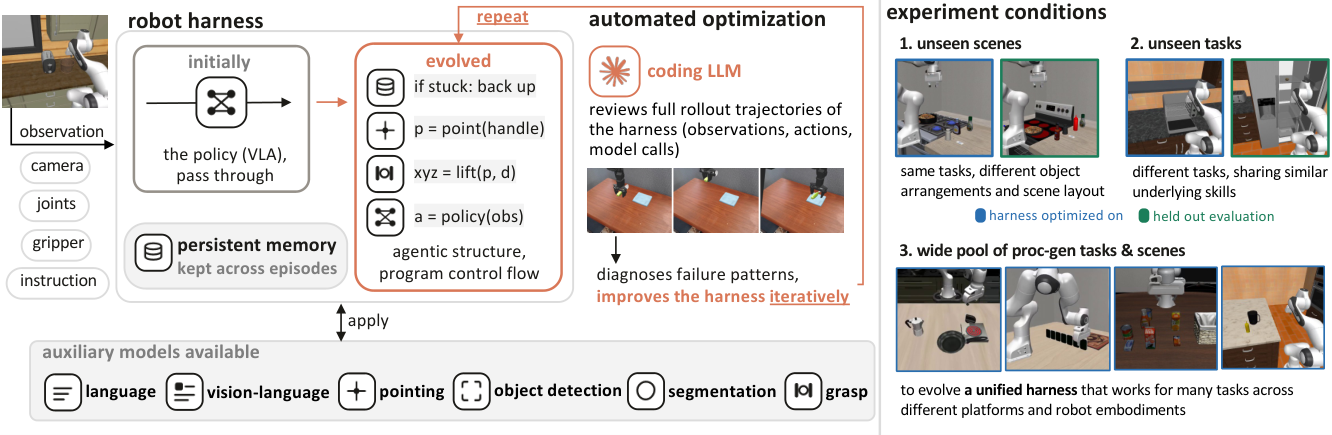
A coding model watches rollouts of a frozen robot policy, diagnoses failures and revises the harness; no weight updates. Success 9.7% → 43.3% on unseen scenes and 12.7% → 40.2% on unseen tasks; the harness evolves its own persistent memory (e.g. effective grasp depths).
Key insight: A coding model that revises the harness around a frozen robot policy, including its own persistent memory, raised success on unseen scenes from 9.7% to 43.3% without weight updates.
Real Computation or Merely Naming? A Pre-Registered Mechanism Audit of 25 Cognitive-Architecture Modules in an LLM-Based Agent System
Peter Chen; Ni Zhang; Ying Xu; Siyuan Zhang arXiv: 2610.41604
Four-question static audit with line-number evidence and call-chain tracing, plus pre-registered interventions. In a system claiming 25 cognitive mechanisms, 18/25 modules' computed values never reach production output; three idle-wiring shapes identified. 53/61 frozen criteria confirmed; repairs raised planner success 0.028 → 1.000.
Key insight: In an agent system advertising 25 cognitive-architecture modules, 18 never affected any output, which is why module names and module computations need separate audits.
TSBPO: Tree-Structured Branching for Policy Optimization in Interactive Language Agents
Rui Yu; Chong Mu; Jinchuan Zhang arXiv: 2610.41697
TSBPO allocates rollouts to continuations likely to give contrasting outcomes, computes sibling-segment and matched-state step advantages, and sums token surrogates per complete response. A Qwen2.5-1.5B actor reaches 97.79% seen / 96.64% unseen on ALFWorld and 81.07% per-episode on WebShop.
Key insight: Tree-structured rollout allocation and credit assignment let a 1.5B model reach about 97% success on ALFWorld.
Structure-Aware Skill Retrieval and Arbitration for Optimization Modeling
Anran Liu; Benzhao Hou; Zongsheng Cao; Daichao Wang et al. arXiv: 2610.41909
ArchOR adds centroid-aware representation learning and signature-guided retrieval (weighted Jaccard over structural signatures, bounded semantic re-ranking) with a baseline-preserving arbitration rule on top of OptSkills; 65.00% micro-avg Pass@1 across five benchmarks with DeepSeek-V4.1-Flash, +1.64 micro / +2.68 macro pp.
Key insight: Retrieving skills by structural signature before semantic re-ranking gave a modest gain for an optimization-modeling skill agent.
LanG 2.0: Energy-Efficient Agentic AI for Semi-Automated Security Operations at Scale
Anes Abdennebi; Nadjia Kara; Laaziz Lahlou; Hakima Ould-Slimane arXiv: 2610.41072
LanG 2.0 detects threats, correlates evidence and writes rules with entity-anchored correlation, human approval of rule changes and a tamper-evident ledger. Campaign correlation precision 18.75% → 51.81%; rule acceptance ≤60.00% → 98.33%; on unseen networks 73.42% F1 with no false positives vs Claude Opus 5.5's 58.10% with 49.00% FPs at ≥650x less energy; resisted prompt injection, label poisoning and ledger tampering.
Key insight: With structural safeguards such as human-approved rule changes and a tamper-evident ledger, small local models handled most security-operations detection at a fraction of a frontier model's energy.
The Knowledge Layer Model (KLM): Evidence-Visible AI Output, Routing Diagnostics, and Negative Results
Omer Asim Ozturk; Cihan Aydiner arXiv: 2610.42066
Knowledge Layer Model v0.3: open spec for inference records with versioned epistemic assessments, evidence relations and explicit unknowns; reference implementation SEDIM (Nage AI OS). Empirical material is internal and author-reported, with several negative results (e.g. diagnostics AUC 0.008; repaired packing kept gold text 221/221 vs 118/221 lost before).
Key insight: An open specification for evidence-visible inference records, presented with largely internal and negative results and no end-to-end validation yet.
News and changelogs
- Composio: CLI 0.6.0 — developer commands resolve the acting user and project consistently, interrupted commands exit 130/143/129 and listeners stop cleanly,
listen --fail-fasthandles sink failures, connection listings show account IDs and aliases, uploads keep their MIME type and proxy calls enforce consumer permissions — tighter user and project scoping for agent builders calling Composio tools from the CLI. link