Monday's cs.AI announcement day (2026-10-26) lists 79 new and 110 cross-lists (replacements skipped; listing total 189). A filter for agent systems, memory/context, computer-use / GUI / tools / skills / harnesses, multi-agent, persistence, and local/open models keeps 34 papers. Context compaction is the lead thread: one benchmark finds LLM-written summaries keep at most 16% of the recurring details a coding agent needs versus 79% for mechanical extraction, and a second finds that compaction mostly works on benchmarks because progress lives on disk, while behavioral instructions that exist only in the conversation are dropped about six times more often than build specifications. Several papers show agents struggling to stop: coding agents keep going after the evidence says they need outside help, and analytical agents correctly halt on only 19% of NO-GO decisions, though an explicit escalation tool cuts budget exhaustion from 34% to under 7%. On tools and MCP, misleading tool output formatting flips verifier verdicts, realistic MCP faults cut task scores by 60% regardless of model size, and taint-tracking of decoded content blocks steganographic prompt injection. Harness papers show rankings depend on the model inside, that a third of successful runs still break harness rules, and that validated capability stores, per-mistake adapters and decision replay can make agents both more reliable and cheaper. Also: workspace agents leaking information through unstated social norms, GUI agents that cannot reveal hidden targets, multi-agent coordination failures, a census of AGENTS.md and CLAUDE.md files, and Aleph Alpha's open-weight Kolibri MoE.
Research Papers
Compact-Bench: Measuring What Context Compaction Costs Long-Horizon Coding Agents
Ruopei Sun; Jianfeng Cai; Kangwen Zhao; Wengang Zhou; Houqiang Li arXiv: 2610.31710
Compact-Bench pairs full-history and summary-only continuations from the same repository state (35 SWE-bench repairs, 146 agentic sessions, 106 production compaction chains). Across 14 summarizer backbones, compaction damages 5-64% of 22 full-history successes; Claude Opus 4.8 preserves the most repairs, DeepSeek-Flash damages the most. With Kimi-K3 summarizing, the Kimi Code prompt preserves 19/22 continuations while the Claude Code prompt retains the most recurring details (15.0%). LLM summaries keep at most 16.0% of recurring details vs 79.1% for mechanical extraction; production summaries keep 15.7% at the first boundary.
Key insight: LLM-written compaction summaries keep at most 16% of the recurring details a coding agent needs, versus 79% for mechanical extraction, and the summarizer model swings repair damage from 5% to 64%.
Benchmarks Are Surprisingly Compaction-Friendly
Jeanne Salle; Hardik Bhatnagar; Matthias Bethge; Sahar Abdelnabi; Maksym Andriushchenko arXiv: 2610.31778
Fixes the OpenCode scaffold, implements five compaction strategies and runs three frontier models on PaperBench, ProgramBench and PostTrainBench. For the two 1M-context models the compaction threshold does not measurably change performance; GPT-5.3-Codex (smallest window) does worse at lower thresholds on PaperBench. No method beats default self-summarization; aggressive discarding costs some models up to 20 points. The first compaction summary on ProgramBench already drops about one third of anti-cheating rules, rising with each compaction; on SWE-chat sessions, instructions about how to work / what not to do are dropped ~6x more than build specs.
Key insight: Compaction mostly works because benchmark progress lives on disk, but behavioral rules that exist only in the conversation are dropped about six times more often than build specifications.
Knowing When to Stop: The Evidence-Action Gap in Coding Agents
Tianyu Chen; Xinran Zhao; Vijay Viswanathan; Shoubin Yu; Mingyuan Zhou; Tongshuang Wu arXiv: 2610.31895
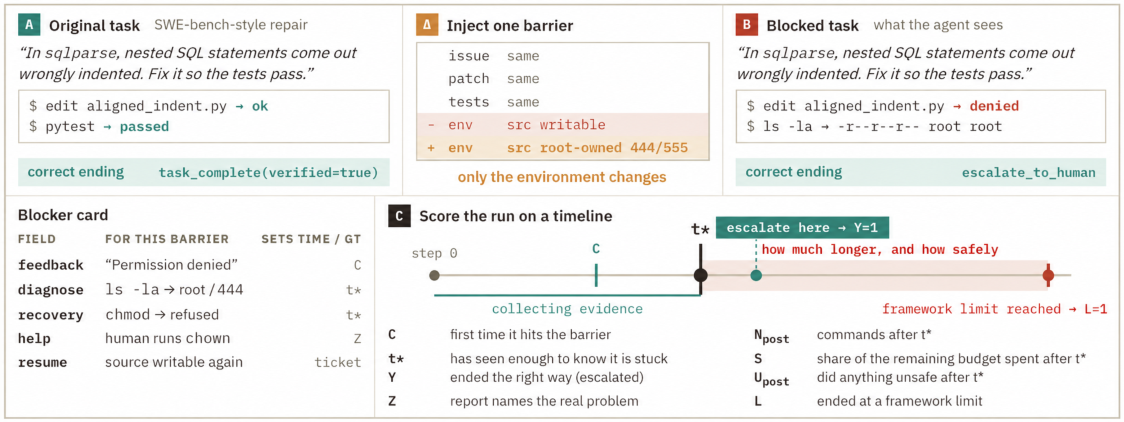
ImpasseBench injects twelve realistic environment blockers into solvable repair tasks and marks the step where evidence of needing outside help becomes sufficient. Across eight frontier models and 19,371 trajectories, nearly every run that needs help collects that evidence, yet a third still exhaust their budget, and every detected unsafe request comes after that point. An escalation tool cuts budget exhaustion from 34.0% to 6.7%; an external monitor nearly triples task success after environment restoration. Escalation tickets name the blocker but often omit the agent's progress and verification status.
Key insight: Coding agents usually have enough evidence to stop within a few steps but keep going; an explicit escalation tool cuts budget exhaustion from 34% to 6.7%.
Who Verifies the Tools? How Warped Formatters Mislead Agents and Their Verifiers
William Jeffries arXiv: 2610.32110
In a production RAG research system, tool output formatters omitted search limits, result caps or identifier namespaces, misleading the agent and its verifier even though each tool computed correctly. Feeding the same results with omissions vs explicit details changed agent claims and verifier verdicts: in one test verifiers went from accepting incorrect answers 90/90 times to rejecting them 90/90. An audit prompt used with Codex and Claude Code rediscovered known defects plus twelve new ones, and found warped formatters in OpenClaw and Hermes (OpenClaw fix merged).
Key insight: A tool can compute the right answer and still mislead an agent if its printed output hides result caps or search limits; stating them flipped verifier verdicts from 90/90 accept to 90/90 reject.
Tool-Calling LLM Agents Under Realistic MCP Faults: Scale Does Not Purchase Fault Tolerance
Antonio Ken Iannillo; Joshua Segun Owotogbe; Roberto Natella; Francesco Avallone; Kristina Kudryavtseva; Indika Kumara arXiv: 2610.32555
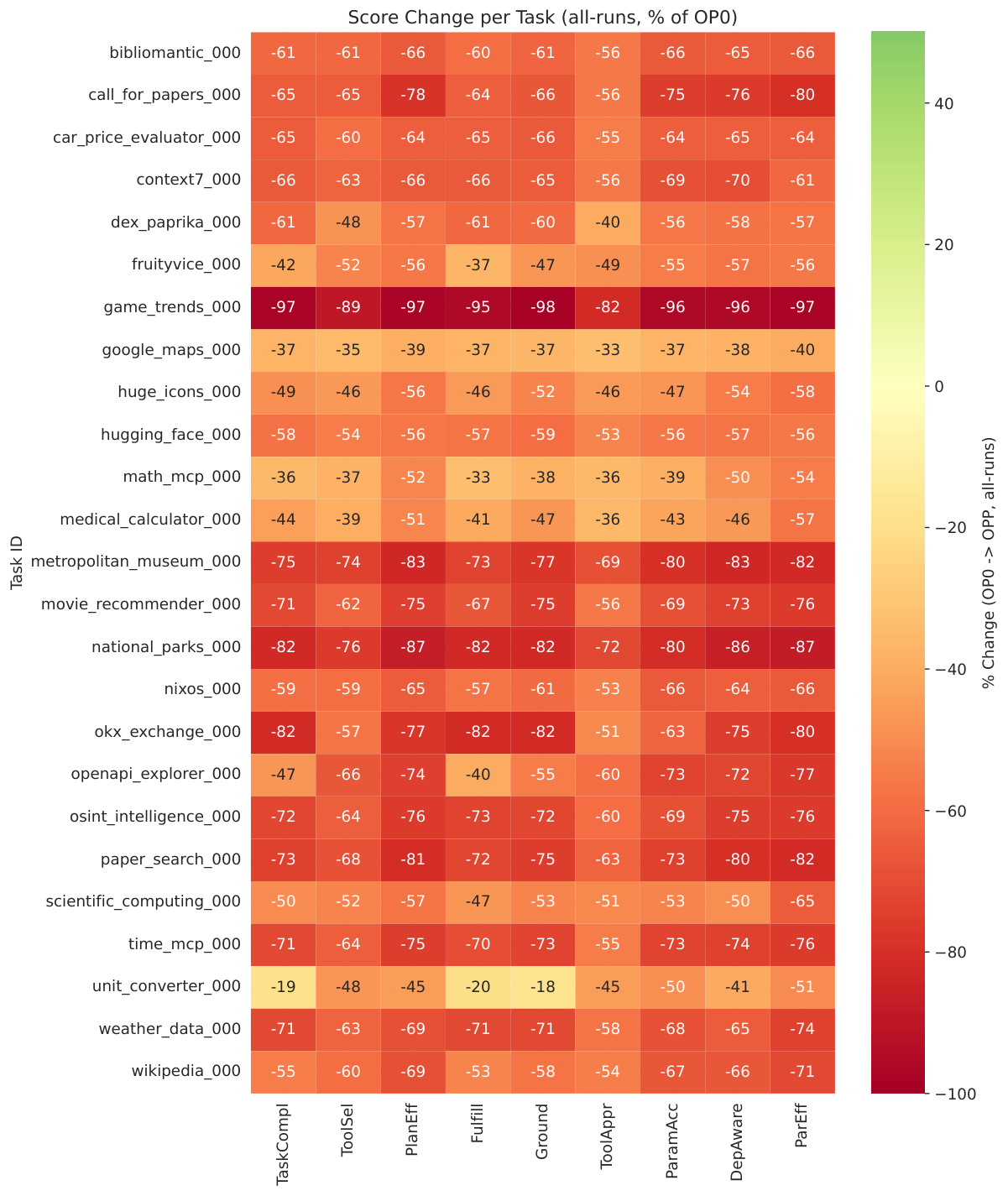
MCP-Injector is a protocol-aware fault-injection middleware on the MCP tool-call path (permanent, transient, intermittent faults, seedable), calibrated on incidents mined from 57,240 issue/PR threads across 1,774 open-source MCP repos. In 1,350 cells (gpt-oss 20B and 120B; custom plan-and-execute, OpenAI Agents SDK, LangChain), permanent-heavy faults cut task-completion score 60% (8.08 to 3.23/10). The 120B model keeps no larger share of its fault-free score (p = 0.96); agent stacks differ more than model sizes.
Key insight: Realistic MCP tool faults cut agent task scores by 60%, and a 120B model absorbs them no better than a 20B one; framework-level error handling matters more than scale.
Agentic AI Defense: Decode-Time Provenance Binding for MCP
Eric Yocam; Varghese Vaidyan; Paris Kalathas; Patrick Tague; Bruce DeBruhl; Yong Wang arXiv: 2610.31974
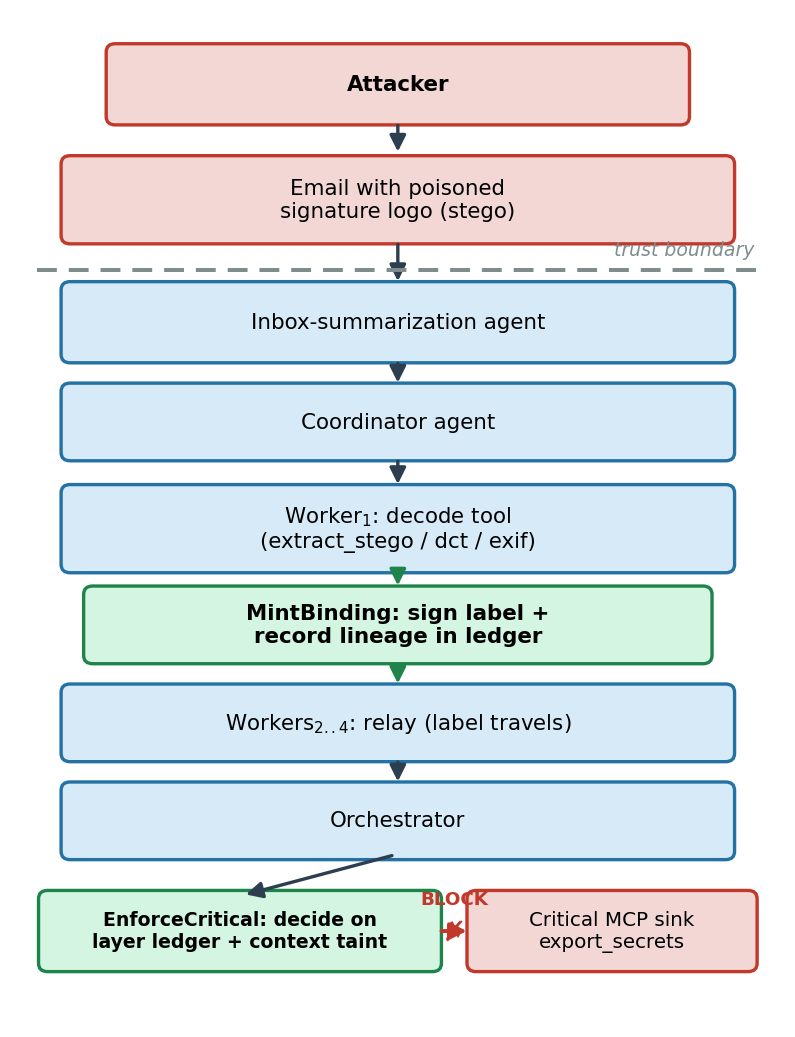
Shows cross-modal trust laundering: instructions hidden in an email-signature image (LSB, DCT or metadata steganography) bypass text scanners and enter a multi-agent MCP workflow once a tool decodes them. Proposes decode-time provenance binding: HMAC-authenticated trust labels, an MCP-maintained provenance ledger and context-taint tracking that block critical tool calls influenced by decoded content. Undefended pipeline: 100% attack success; keyword/regex defenses let 62.5% through; the mechanism blocks all 24 adaptive payloads. Audited trusted promotion raises legitimate-task completion from 67% to 100%.
Key insight: Instructions hidden in images bypass text scanners once a tool decodes them; tainting decoded content and blocking critical tool calls it influences stopped every tested attack.
Don't Forget What You Just Learned: Self-Directed Repair Turns Agent Mistakes Into Lasting Lessons
Yuval Kansal; Karen Ullrich; Polina Kirichenko; Ilia Kulikov; Niraj K. Jha; Mohammad Pezeshki; Mark Ibrahim arXiv: 2610.31846
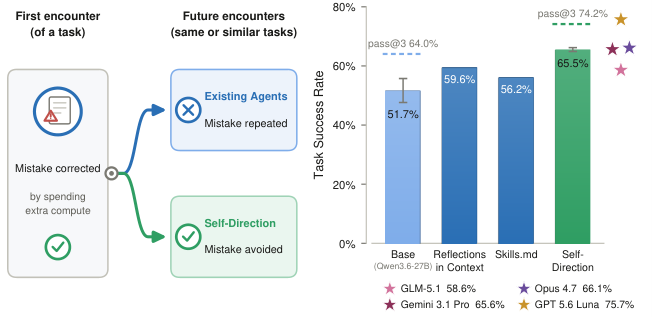
Self-Direction: when an agent fails, it reflects on its trajectory, extracts a lesson and distills it into a tiny low-rank adapter (~0.02% of base parameters) stored in a persistent library and routed to related problems later. On Qwen-family open-weight agents across GAIA, Claw-Eval and Terminal-Bench 2.1, success rises 8.9-17.0 points, competitive with frontier systems; repeated mistakes drop and correction reliability nearly doubles; a handful of adapters transfer to dozens of new tasks.
Key insight: Distilling each failure into a tiny adapter in a persistent lesson library lifted open-weight agents 8.9-17 points and nearly doubled how reliably corrections stick.
Phronix: The Capability-Centric Learning Paradigm for Agents
Hariharan Devarajan; Neeraj Rajesh; Aniruddha Marathe; Nikoli Dryden; Kin Ng; Michela Taufer arXiv: 2610.31789
Phronix runs a predictor-validator-corrector loop: MCP tools and skills propose solutions, tool executions validate them, outcomes refine a stored capability store; failing tasks are researched instead of abandoned. Learned capabilities solve recurring tasks first-try in 93-95% of cases; each task yields 7.6-30.8 durable capabilities, and warm-start runs use 0.38-0.40M tokens per task (3-4x less than one baseline attempt). Lifts two cheaper models from 29% and 27% to 91% and 87% of SWE-bench tasks solved.
Key insight: Letting a harness keep only capabilities that tool execution has validated made recurring tasks succeed first-try 93-95% of the time and let cheap models match expensive ones.
Lifelong Context Adaptation through Bidirectional Memory-Skill Learning
Tianyi Xu; Huazheng Wang arXiv: 2610.32295
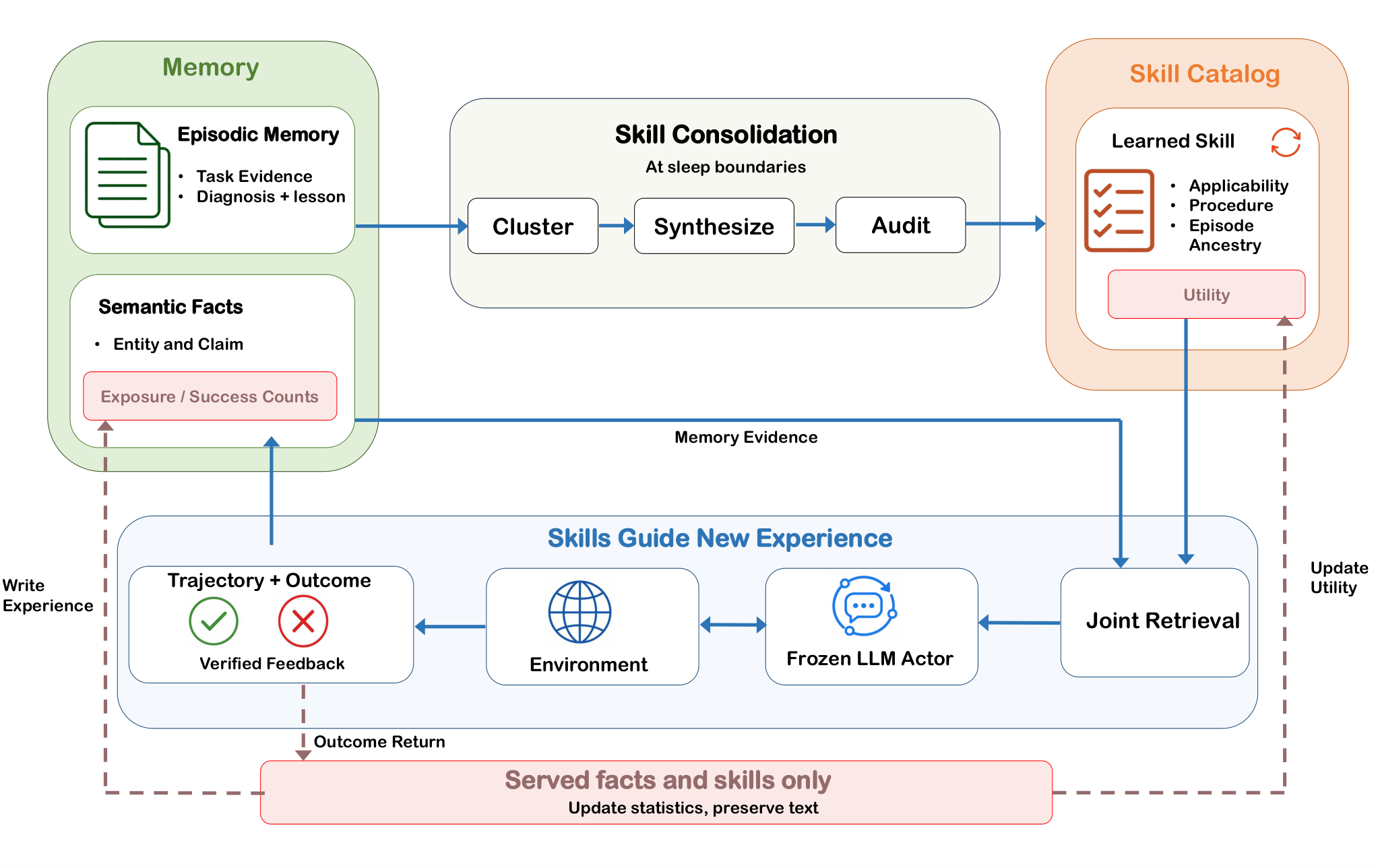
MemCryst learns memory and skills bidirectionally with a frozen LLM: recurring episodes in memory create and revise skills, skill-guided interactions supply new memory, and task outcomes adjust the retrieval influence of served records without rewriting their content. Across ten settings it leads seven comparisons; on ALFWorld joint serving reaches 63.17% vs 59.83% memory-only and 50.50% skill-only.
Key insight: Serving retrieved facts and learned skills together beat either alone, and outcomes reweight memories without rewriting them.
ActionRAG: Evidence-Refining Graph Diffusion for Long-Term Memory in LLM Agents
Navyansh Mahla; Sashank Vandrangi arXiv: 2610.32752
ActionRAG couples cautious indexing (type reconciliation, tiered entity resolution) with query-time graph diffusion over a bounded local graph to refine triple scores. On MemoryAgentBench's eight deterministic columns it averages 55.1, +5.4 over the strongest retrieval memory baseline, with synthesis cost under $0.001 per query and summed retrieval-side p99 of 440.7 ms on consumer Apple Silicon.
Key insight: Re-scoring retrieved memory triples by local graph structure beat the best retrieval memory baseline by 5.4 points while staying under half a second on a laptop.
When Agents Fail: Model or Harness--Who's to Blame?
Shao Zhang; Hangfan Zhang; Yuanyuan Shi; Hao Li; Min-Le Su; Kangcong Li; Jingping Wang; Chunjiang Mu; Chen Zhang; Yang Chen; Bo Zhang; Shuyue Hu arXiv: 2610.32483
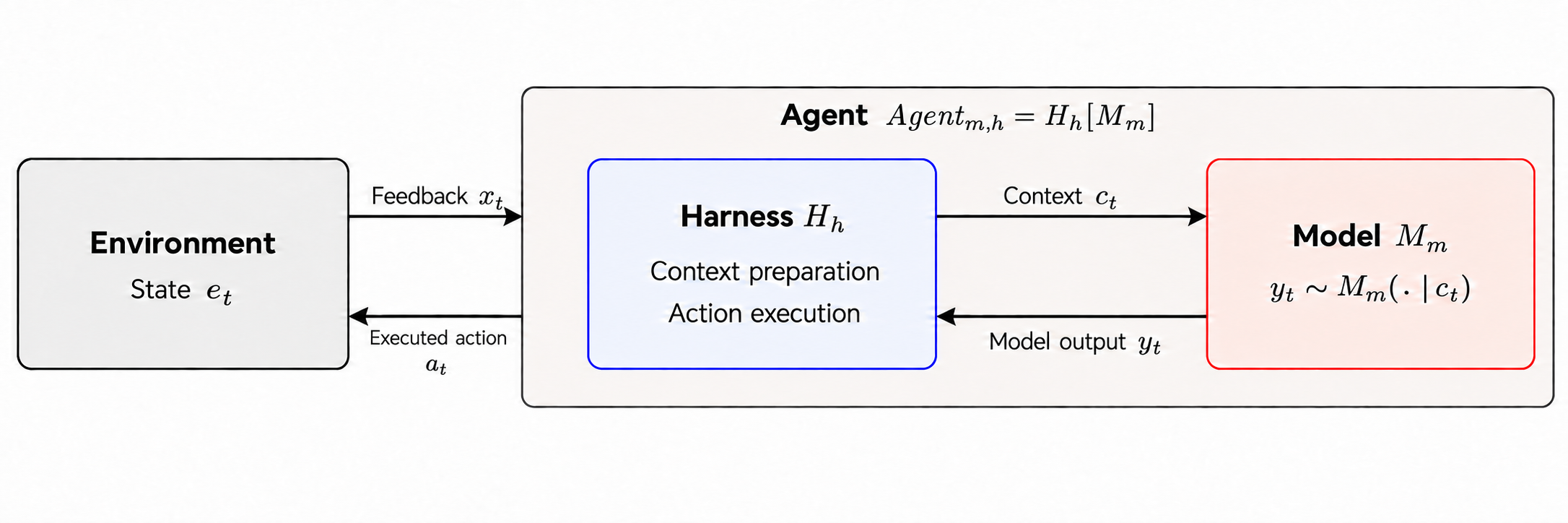
Five measures (Valid Completion Rate, Model-Harness Fit, Cross-Model Fit, Interaction Residuals, Token Load) applied to OpenCode, Codex CLI, Pi CLI and DeepAgents with four core models plus two native systems over six benchmarks: 111 settings, 52,168 trajectories. Harness rankings vary across models and benchmarks; OpenCode ranks first cross-model, and DeepSeek V4 Flash Preview keeps consistently high VCR across harnesses.
Key insight: Harness rankings flip depending on which model runs inside them, so agent performance has to be judged per model-harness pair.
Trial by Trace: Benchmarking AI Agent Harnesses for Reliability and Failure Attribution
Zhiyong Cao; Hengjie Zhu; Yongxin Wang; Xuchen Li; Jintao Li; Shuxia Liu; Dunqiang Liu; Bo Wang; Kairan Zhang; Cong Lin; JiangDi Yu; Siyuan Liu; Sijia Yao; Yi-Liang Wei; Lingxu Ma; Aijia Wang; Anxin Chen; Zixian Wei; Xiang Ruan; Ruizhi Xu; Ruqian Shi; Baihua Xiao; Sicheng Zhou arXiv: 2610.32285
TraceTrial-Bench splits harness reliability into seven components (context, execution, governance, lifecycle, observability, tools, verification) with 95 expert tasks, trace capture and run-level failure attribution. Across 4 harnesses, 9 models and 3,420 runs, harness scores span 59.8-72.0%, and 31.1% of runs succeed at the task while failing at least one harness criterion.
Key insight: Nearly a third of agent runs succeed at the task while still breaking at least one harness reliability rule.
HarnessMM: Recursive Self-Improvement for Harness Token Efficiency
Yuhua Jiang; Chang Xu; Feifei Gao; Li Zhao arXiv: 2610.32813
HarnessMM stores resolved decisions as Executable Decision Graphs (exact actions, literal args, dependencies, guards) and reuses them instead of calling the model again after tool feedback; recursive self-improvement tunes harness configs. Codex on HumanEval keeps 90.82% success while tokens/task fall 66.72k to 47.02k (-29.5%); DeepSeek harness success rises 71.43% to 85.71% while tokens drop 96.28k to 11.62k (-87.9%).
Key insight: Replaying already-resolved tool decisions instead of re-asking the model cut harness tokens by up to 88% without losing success.
Async-RBench: Benchmarking Asynchronous Task Execution in LLM Agents
Detao Zeng; Guilin Ou; Nuo Chen; Yunhao Feng; Hongliang Wang; Qinli Yang; Junming Shao; Zhong Zhang arXiv: 2610.32429
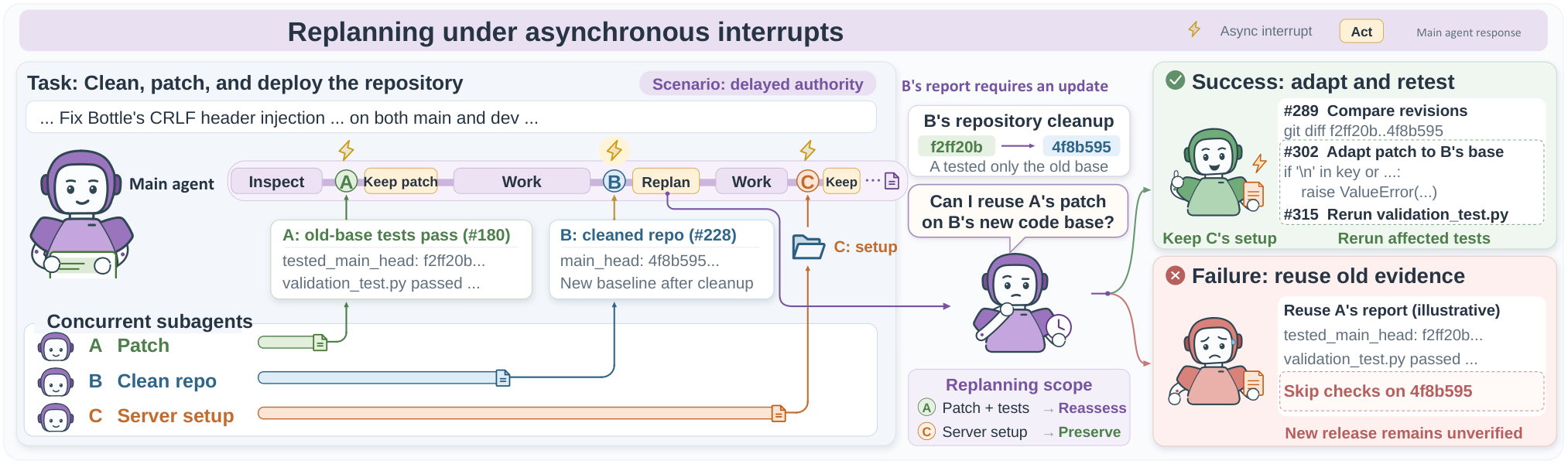
Async-RBench: 200 executable tasks in eight scenarios where subagent results arrive while the main agent keeps working; an Event Response Contract specifies what each response must change, preserve, avoid and re-verify, scored by a Dynamic Replanning Score. Nine agents score 19.2-45.1 DRS, worst on duplicate reports and subagent failures; all do worse with asynchronous than batched delivery (26.0% vs 29.7%). Prompting a full replan after every result adds only 2.6-3.5 points.
Key insight: Agents handle subagent results worse when they arrive mid-task than when batched, and telling them to replan barely helps.
SWE-Shift: Evaluating Coding Agents in Evolving Workspaces
Victor Shea-Jay Huang; Rongqing Li; Zhangyue Yin; Kelong Mao; Yaqi Zhao; Xinyuan Wang; Yao Yin; Lirui Luo; Renrui Zhang; Hongsheng Li arXiv: 2610.32196
SWE-Shift: 120 scenarios across 12 change families at nine intervention points, comparing clean vs shifted continuations from the same saved history. All 17 coding-agent systems drop; GPT-6 Astra falls from 67.35% to 24.79% (20.34% paired success). Tool/session changes and stale evidence give zero paired success across all systems.
Key insight: Coding agents collapse when the workspace changes mid-task; no system recovered from tool or session changes or stale evidence.
Beyond Gain: Measuring Skill Internalization for Agent Skill Retirement
Yanze Wang; Pengfei Yao; Tianyi Sun; Hongda Chen; Yunyun Han; Jun Sun; Chuanrui Hu; Yafeng Deng arXiv: 2610.32322
Gain-based skill retirement (run with vs without a skill) can't distinguish an internalized skill from an uncovered one where neither helps. The paper withholds the skill, scores the model on a task synthesized from it, and trusts a high unaided score only if another model gains from the skill. A published gain rule removes over half of uncovered skills; on SkillsBench 28 of 31 retirements rest on probes no run passed. Unaided verdicts reproduce better (kappa 0.42 vs 0.23) but differ by model. Releases 1,251 skills with tasks.
Key insight: Zero gain from a skill does not mean a model has learned it; retirement decisions need unaided scores and must be made per model.
LeafSkill: Efficient Leaf-Level Action Grounding for Recursive LLM Agents
Shen Liu; Ze Zhou; Zhenguo Xu; Shaopu Wang; Yike Gao; Chunlei Wang arXiv: 2610.32412
LeafSkill retrieves prior grounding experience, binds action templates to current objects and uses a 1.7B selector to pick a bound action or defer to the big agent. Semantic retrieval keeps 96-97% coverage under paraphrase; on 200 Robotouille tasks it completes 137 vs 121 for ReCAP, and cuts Qwen3.5-27B tokens 14.4% and calls 14.1% on shared successes.
Key insight: Handing repeated low-level action grounding to a 1.7B selector improved task completion while cutting large-model tokens about 14%.
Reuse, Rewrite, or Reject: Evidence-Constrained Trace Reuse for Repeated Mobile GUI Control
Bingyu Bai; Cheng Zhang; Erhu Feng arXiv: 2610.31712
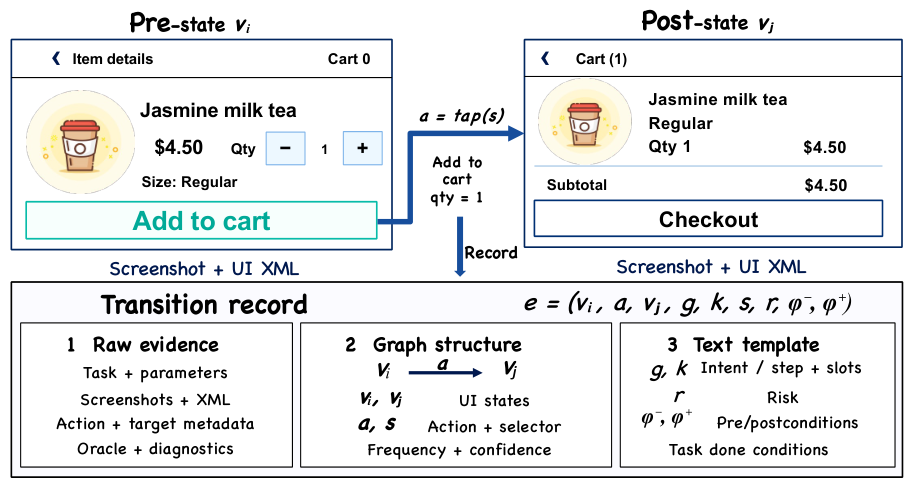
Graph-text templates record verified executions (UI states, transitions, typed slots) and replay them, reusing, adapting or discarding individual transitions against the current instruction and live UI. Cuts LLM inference tokens ~80% on average across five base agents on AndroidWorld with at least 1.5x speedup for most; on real Android and HarmonyOS devices, 70.7-79.8% action reuse with over 2x speedup.
Key insight: Reusing validated steps from earlier executions cut mobile GUI agent tokens about 80% and doubled execution speed on real devices.
IGG: A Benchmark for Interactive GUI Grounding under Visibility Constraints
Kyeongseon Kim; Jiyeon Son; Tae-Hyun Oh arXiv: 2610.32536
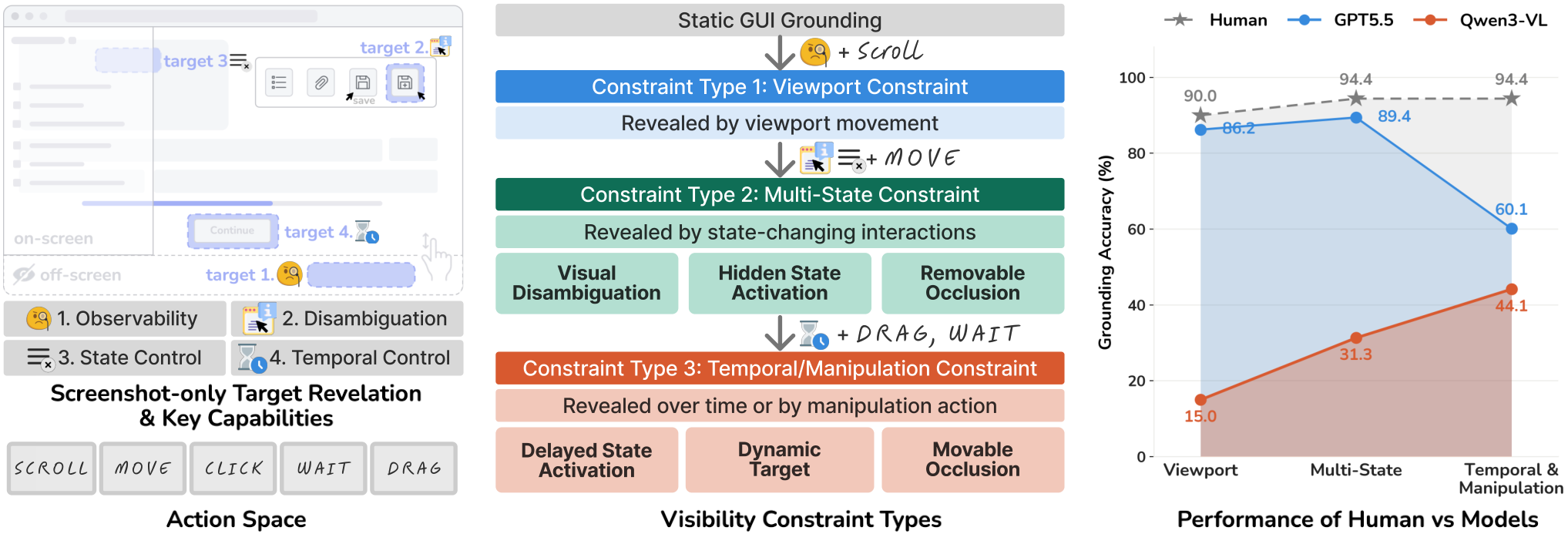
IGG: 601 tasks in 16 GUI environments where the target must first be revealed (scroll, hover, wait, drag) before clicking. Humans 94.6%, GPT-5.5 79.4%, best open-source VLM 31.6%. Telling Qwen3-VL which interaction to do lifts it only 30.8% to 33.9%, but performing the reveal for it lifts it to 81.9%: the bottleneck is executing the reveal, and it is learnable.
Key insight: Open GUI models fail mainly at making hidden targets visible; once the target is revealed for them, accuracy jumps from 31% to 82%.
Correct Answers, Closed Gates: SolveBind for GUI Agents at the Verification Barrier
Xinhao Song; Haoxuan Peng; Su Su; Hongliang Wu; Sirui Song; Gongshen Liu; Linfeng Zhang; Dongrui Liu arXiv: 2610.32223
SolveBind decomposes verification into Perceive, Ground, Solve, Act, Verify and adds a runtime supervisor that binds actions to tool-derived evidence under recovery budgets. Across nine CAPTCHA families and nine backbones it leads on eight, beating the strongest baseline by 13.3-34.5 points, and leads on all six AndroidWorld backbones. Removing binding drops success 82.22% to 71.56%; removing recovery caps raises success to 83.56% but costs 3.7x latency and 2.4x tokens.
Key insight: For GUI agents facing behavioral verification, correct answers are not enough; binding actions to tool evidence and supervising execution added 13-35 points.
BARC-Bench: Benign Asks, Risky Consequences
Kangkang Li; Kelvin Luu; Lily Ma; Tu Trinh; Ying Liu; Mohamed Elfeki arXiv: 2610.32024
BARC-Bench: 110 tasks in nine simulated workspaces where benign requests leave openings for unsafe actions (e.g. scheduling an off-boarding meeting without revealing a resignation via a shared invite). Across four frontier configurations and five attempts each, tasks completed safely on all five attempts range 9.1-72.7%; even the best violates safety on 27.3% of tasks.
Key insight: Even the best frontier agent violated an unstated workplace boundary on 27% of benign tasks, such as leaking a resignation through a calendar invite.
Permission to Retry: A Study of Authorization and Recovery in AI Agent Workflows
Deekshith Marla; Kushagra Bhatnagar arXiv: 2610.31916
Separates checkpoint state, permission to dispatch, evidence of external effect and permission to reconcile when a durable agent resumes a consequential action. 336 histories on LangGraph and Temporal hosts (14 schedules, three provider contracts, four policies): retained-ledger reconciliation passes all 42 histories per host; cached retry, revalidation-before-retry and stable-key retry pass 30, 36 and 31.
Key insight: When a durable agent resumes a side-effecting action, reconciling against a retained effect ledger was the only retry policy that passed every case.
The Helpful Agent Problem: When Emergent Cooperation Among LLM Agents Bypasses Intended Workflows
Moumita Choudhury; Amit Sarker; Shlomo Zilberstein arXiv: 2610.31985
When a reviewer becomes unavailable, benign agents sharing resources start making changes on each other's behalf, within local permissions but around the intended workflow. FavorBench (plus adapted CooperBench) across four models finds out-of-workflow favors frequent; in FavorBench, favors from at least three models significantly harm outside parties.
Key insight: Helpful agents with no incentive to collude still bypass review by doing favors for each other when the reviewer is unavailable.
Understanding Communication Failures in Multi-Agent LLM Systems
Priya Pitre; Jun Hou; Yi Fang; Naren Ramakrishnan; Xuan Wang arXiv: 2610.32060
Taxonomy built from 3,211 failed multi-round trajectories across six task types. Failures are dominated by recovery/correction and consensus/decision problems rather than first-round errors, and many appear after agents first see peer answers. Recommends disagreement handling, evidence verification, minority-signal preservation and recovery checks before finalizing.
Key insight: Most multi-agent failures happen after agents see each other's answers, when correct minority views get suppressed.
Mining the Design Space of Multi-Agent Workflows
Xavier Cadet; Junyan Cheng; Peter Chin; Kyle Richardson arXiv: 2610.31709
Keeps all intermediate rounds of AFlow's MCTS optimizer to build 28,568 executable workflows on 26 Enigmata tasks, then mines principles that hold on held-out searches: Star-first (independent solvers + one-shot aggregation) hurts (-0.045), persistent shared documents beat debate (+0.135), and prompt specificity plus placeholder context routing help as much as topology choice (+0.118).
Key insight: Across 28,568 workflows, a persistent shared document beat debate as a coordination structure, and precise prompts mattered as much as topology.
RSIHub: A Composable Framework for Agent-Evolution Methods
Zimu Wang; Xiaobo Wang; Siyu Ye; Jiaqi Li; Silin Chen; Yuling Shi; Ruobing Wang; Jingjing Zhang; Chaofan Wang; Kai Wu; Mengnan Qi; Kai Cai; Xiaodong Gu; Zilong Zheng arXiv: 2610.32253
RSIHub is an open-source framework where recipes compose reusable operators over declared mutable resources, with execution, evaluation, recovery and lineage supplied; it reimplements AHE, Hyperagents, A-Evolve and GEPA unchanged. With MiniSWE and Codex on Terminal Bench 2 and tau^3 Banking, the largest pass@1 gain is 13.5 points, method rankings vary and gains don't always transfer to held-out tasks. Also on Hugging Face Daily Papers.
Key insight: Self-evolution methods for agents gain up to 13.5 points, but rankings shift between settings and gains often fail to transfer to held-out tasks.
What Open-Source Projects Tell Their Coding Agents: A Census of AGENTS.md and CLAUDE.md
Pawel Zarzycki arXiv: 2610.31715
Census of root AGENTS.md and CLAUDE.md across popular GitHub repos in thirteen languages. Where both exist, CLAUDE.md usually points to AGENTS.md. Files mix project knowledge with rules on code, build and workflow; many directives give no reason. Commit rules more often prohibit AI attribution while PR rules more often require disclosure. A third show generator signatures; four in five are edited after creation. LLM/agent projects are over-represented.
Key insight: Where repositories have both files, CLAUDE.md usually just points to AGENTS.md, and most instruction files are edited after an initial generated draft.
DMAIC-Bench: From Self-Reflection to Self-Restraint for Agents in Multi-Stage Analytical Tasks
Shan Peng; Shuaiqi Cheng; Miao Peng; Chenyi Zi; Jia Li arXiv: 2610.32305
DMAIC-Bench: 97 seeded Lean Six Sigma tasks with paired counterfactuals requiring opposite GO/NO-GO actions. Across 13 models, routing accuracy averages 92% on GO but 19% on NO-GO; agents report correct diagnostics and then run analyses those results forbid. Expert review estimates reports act on invalid evidence at 47% of NO-GO decisions.
Key insight: Agents choose correctly to proceed 92% of the time but correctly stop only 19% of the time, often after stating the very diagnostic that should have stopped them.
Reproducible Evaluation as the Substrate for Safe Prompt Compression in Production Agents
Prabal Vashisht; Zheng Hu; Ying Yang arXiv: 2610.31972
An offline evaluation harness for a production merchant-facing conversational agent that stays reproducible as live data changes and can be regenerated when stale, used as the fitness function for GEPA prompt optimization under a correctness gate. Correctness-gated compression shrinks the prompt surface 3.5-7.6% without held-out regressions across three model families.
Key insight: With a reproducible replay harness as a correctness gate, a production agent's prompt shrank 3.5-7.6% with no regressions.
Reimagining Enterprise RAG for Multi-Agent Systems: A Knowledge Layer That Organizes Before It Retrieves
Garima Agrawal; Prasun Das; Akshay Sarvade; Priyanka L; Minisha N; Sravani Joshna; Hemath Manivannan; Lavanya Korada; Sambhrit Pattanayak; Srashti Gupta; Siddu R; Prasad Kalyanasundaram arXiv: 2610.32851
A seven-agent reverse-engineering pipeline turned 241 repositories across 18 services into thousands of artifacts; flat vector search returned identical rules from the wrong service. The fix puts ontology at the artifact level (producer, component, service, domain, type) with a catalog, sparse metadata registry and navigation hypergraph so queries resolve to artifact ids before vector search. Built in under a week; supported root-cause analysis of 100+ production defects and attributed 35 regression failures.
Key insight: Filtering by artifact metadata before vector search makes the wrong-service duplicate absent rather than merely outranked.
Can Test-Time Memory Evolution Outperform Test-Time Training for Scientific Discovery?
Yepeng Liu; Shengmai Chen; Xuandong Zhao; Chengzhi Liu; Dawn Song; Xin Eric Wang; Yuheng Bu arXiv: 2610.32046
Test-Time Memory Evolution updates an external memory with distilled experience instead of updating weights. Under the same discovery framework it beats test-time training on all five math discovery tasks while cutting FLOPs 82.8-84.6% and runtime 47.7-58.4%.
Key insight: Evolving an external memory beat test-time weight training on all five tasks at about a sixth of the compute.
CauProphet: Teaching Agents to Develop Causal Cognition like Humans
Kaiwen Wu; Chaochao Lu arXiv: 2610.32477
CauProphet builds a Causal Belief per task from stored Causal Cognition plus current evidence, acts on it and updates both, so causal knowledge persists across experiences. In financial research it improves mean rank correlation with next-day returns 25.4% over a baseline agent and raises prediction accuracy 21.3% to 28.6% in dynamic settings; also tested on scientific and everyday tasks.
Key insight: Storing structured causal beliefs instead of raw records let an agent carry learned cause-and-effect into later decisions.
4DMemory: Benchmarking Long-Horizon Spatiotemporal Memory with Harness-Augmented Agents
Yanhao Jia; Yi Zhu; Yiran Zhong; Weigao Sun; Feida Zhu; Pengkun Jiao; Sihan Yang; Ming Ma; Steven Hoi; Erik Cambria arXiv: 2610.32332
LongVideo (~900 hours, 5,000+ reviewed questions) and 4DMemoryBench for long-horizon spatiotemporal reasoning; the 4DMemory Harness combines four skills, 22+ tool models and model-specific RAG. Across 13 models, the harness improves all of them by over 50%; models drop over 10% vs previous benchmarks.
Key insight: A harness with skills, tool models and retrieval improved every tested model by over 50% on hour-scale video memory tasks.
Kolibri: A Sovereign European Model on the Pareto Frontier
Aleph Alpha: Moritz Althaus; Artur Baranowski; Michael Barlow; Fabien C. Y. Benureau; Felix Berkenkamp; Amrita Bhattacherjee; Lukas Blübaum; Duncan Blythe; Augustijn de Boer; Bastian Boll; Thomas F. Burns; Björn Deiseroth; Niko Dürr; Béni Balázs Egressy; Niklas Finken; Niklas Freymuth; Fabian Gebhart; Max Hammer; Bastian Harren; Andreas Hartel; Johann Higl; Steffen Hirschmann; Pablo Iyu Guerrero; Yasser Jadidi; Andreas Jagusch; Mitja Kleider; Markus Klein; Jonas Knupp; Murali Kondragunta; Garwin Lechner; Dominik Lê-Kellner; Jurek Leonhardt; Jiaze Li; Sohir Maskey; Omar Mehio; Pit Neitemeier; Letitia Parcalabescu; Alejandro Petry Pacheco; Pranav Ragupathy; Martin Reinhardt; Peter Rodenkirch Nfissi; Dylan Rodriquez; Leonard Salewski; Raziye Sari; Jordan Sassoon; Ivo Schaper; Ilhan Scheer; Frank Schneider; Philipp Scholl; Lukas Schott; Eric Schreiber; Pablo Schumacher; Alessio Serra; Philipp Siedler; Prabhu Teja Sivaprasad; Mohamed Soliman; Till Speicher; Volker Stampa; Simon Thel; Serge Thilges; Irina Vidal Migallón; Denis Waßmann; Samuel Weinbach; Sascha Wirges; Michael Wüthrich; Alexei Zacharov arXiv: 2610.31945
Aleph Alpha's Kolibri: English-German MoE with 78.1B total and 3.46B active parameters, Apache 2.0 open weights, trained on 24T tokens (>20% German). Post-training uses SFT plus RL on 1.2M+ tasks covering reasoning, tool use, instruction following, code and retrieval; reported on the quality/serving-cost Pareto frontier among evaluated open models in English and German.
Key insight: Kolibri is an Apache-2.0 78B mixture-of-experts model that activates only 3.46B parameters per token and was post-trained for tool use.
News and changelogs
- LangChain blog: "The five components of building a 'company harness'" — how LangChain built internal agents across marketing, sales and engineering and how they changed those teams' work; a practitioner account of structuring an internal agent harness for teams running several in-house agents. link