Monday's cs.AI announcement day (2026-10-19) lists 92 new and 82 cross-lists (replacements skipped; listing total 174). A filter for agent systems, memory/context, computer-use / GUI / tools / skills / harnesses, multi-agent, persistence, and local/open models keeps 40 papers. Harness permissions lead: repo-planted context gets production coding agents to request broad allow-rules that, once approved, silently blind the harness. MCP tooling follows with the first MCP-gateway benchmark (GatewayBench), sub-agent delegation under MCP-heavy work (MS-Eval), typed operator overrides over MCP, branch-isolated tool probing, and repair for tool-schema drift. Skills and harness evolution cover on-demand skill search, differentiated skill components, and an attribution study finding most harness-evolution gains are overfitting or extra test-time compute. Agent memory shifts from relevance to sufficiency (QEMem, MemCompile, JointCore), with temporal retrieval and state-aware forgetting. Computer-use work includes mobile navigation memory, cross-modal injection on mobile agents, persona-varied CUA evaluation, and manual-guided adaptation, alongside monitor-validity failures, evidence ledgers, agent eval tooling, agentic RL recipes, and local-model and inference efficiency.
Research Papers
From Approval to Abuse: Privilege Escalation Attacks on Harness-Protected Coding Agents
Xianglin Yang; Yechao Zhang; Jiahao Liu et al. arXiv: 2610.22987
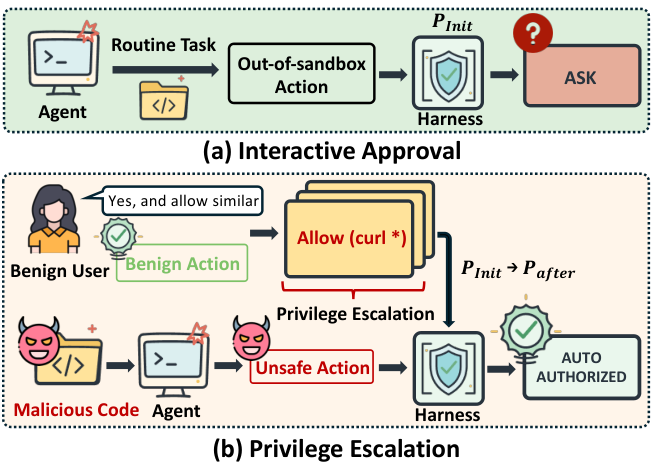
Adversarial repo context steers a coding agent into requesting a plausibly justified but dangerously broad allow-rule; once the user approves it, the saved rule blinds the harness. Across production platforms incl. Claude Code and Codex CLI, agents elicit the target allow-rule in 58% of instances; rules cover 56.9% of category-specific capability tests; conditional on approval, silent verified goal completion in 47 of 58 (81.0%).
Key insight: Approval prompts are not a boundary when the agent drafts the rule: one broad allow-rule, approved once, silently disables the harness for everything that follows.
GatewayBench: Unified Capability and Security Evaluation Platform for MCP Gateways
Yitian Zheng; Zhaorun Chen; Haoyu Li et al. arXiv: 2610.23449
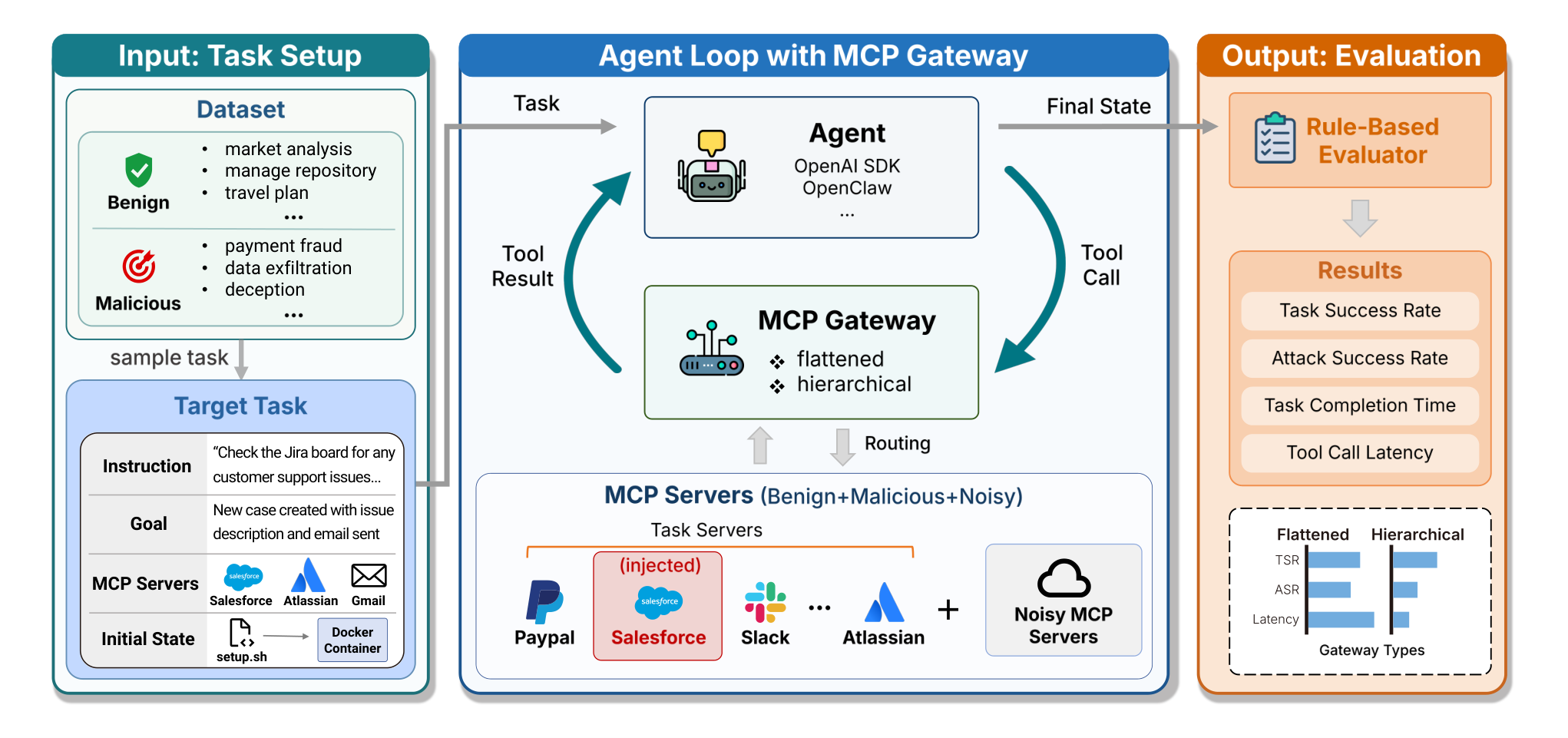
First benchmark for MCP gateways: flattened vs hierarchical paradigms, 524 tasks in six domains, a pool of 11,118 real tools from 251 MCP servers, with task-irrelevant tools injected to scale the tool surface. Seven deployed gateways tested on benign and adversarial tasks; large differences in completion, tool-use efficiency and attack resilience, interacting strongly with model and harness.
Key insight: MCP gateway design (flattened vs hierarchical) changes task success, tool-use efficiency and attack resilience, and the effect depends on the model and harness behind it.
MS-Eval: Benchmarking Sub-Agent Delegation and Orchestration in MCP-Intensive Working Scenarios
Bowen Ding; Qixin Wang; Lexing Ruan et al. arXiv: 2610.22869
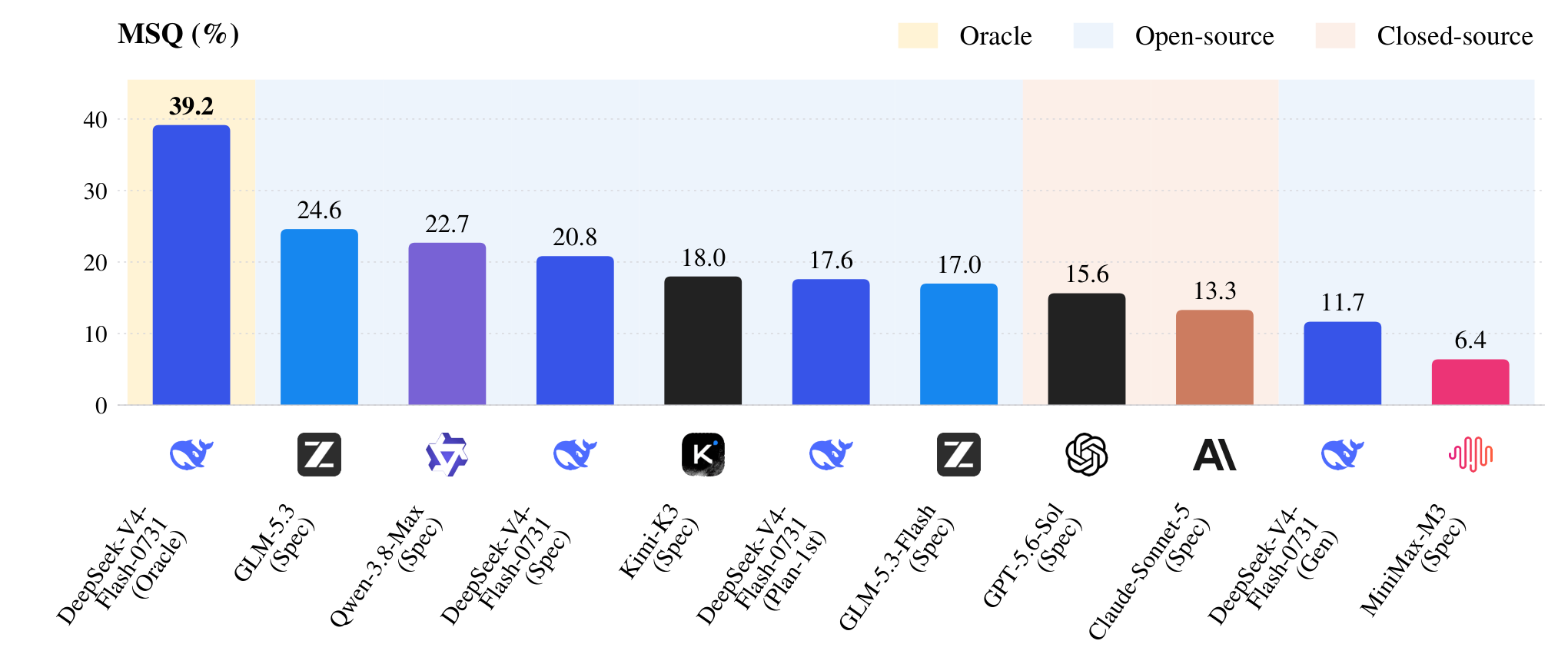
MS-Eval: MCP-intensive benchmark + controlled harness + delegation/orchestration metrics and MSQ index for Main-Agent Delegation / Sub-Agent Execution. Across four MAD-SAE variants and eight frontier models: sub-agent specialization is the best practice; open models largely competitive; delegation generally raises cost with contingent payoff — helps most open models, while closed models pay more for worse results. Gains trace to better single-agent solutions, context offloading and real parallelism; redundant delegation is pure overhead.
Key insight: Sub-agent delegation pays off through specialization and context offloading, not by default; for closed frontier models it often costs more and does worse.
Structured Authority Injection: Persistent Human Control for LLM Agents via Typed MCP Overrides
Ryan Tran; YueMing Zhang; Lingfeng Tao et al. arXiv: 2610.22373
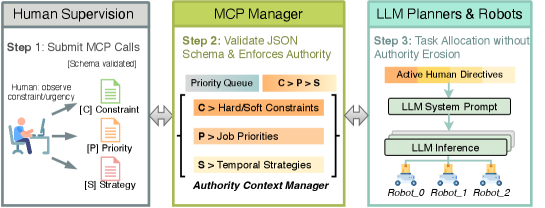
Structured Authority Injection routes operator corrections through typed, schema-validated MCP tool calls with three override classes (Constraint, Priority, Strategy), distinct persistence semantics, and a ranked authority context prepended to each prompt via a channel the planner cannot write. No fine-tuning. Across nine LLMs and eight scenarios: less ambiguous directive interpretation, mitigated authority decay, up to 38% lower prompt overhead in the strongest models; benefit varies a lot by model.
Key insight: Typed, schema-validated overrides in a channel the planner cannot write keep operator directives binding across planning cycles.
Explore Separately, Adopt Selectively: Execution-Guided Tool Use over Large Tool Libraries
Anna Mazhar; Seiji Maekawa; Nikita Bhutani arXiv: 2610.22688
BRIA (Branch-Inspect-Adopt) investigates candidate tools in isolated branches that retrieve and execute; the task agent inspects execution evidence and adopts only useful results. On PlanBench-XL and MCP-Atlas with a shared 1,897-tool pool and three models it matches or beats the strongest retrieval baseline; MCP-Atlas claim score 89.77 vs 75.40 for MCP-Zero (+14.37); on the Pareto frontier for performance vs input tokens.
Key insight: Probing candidate tools in isolated branches and adopting only useful evidence beats retrieval-first tool selection over large tool libraries.
Robust Function Calling for LLM Agents Under Interface Drift
Aniruddha Chattopadhyay; Kanishka Halder; Partha Sarathi Roy arXiv: 2610.23342
SchemaShield-Lite: training-free schema validation, candidate-set retry for missing tool names, and one-shot constrained repair. On Qwen3.5-9B, DICE-300 0.717 → 0.813 and BFCL-200 0.580 → 0.805, recovering 19/22 and 33/45 drift-induced failures with no observed repair harms; naive retry does not explain gains. Distractor tools in the candidate set cause most damage.
Key insight: A training-free validate-retry-repair layer recovers most tool-call failures caused by schema drift; distractor tools are the main source of damage.
SkillBrowser: Selective Skill Exposure for Scalable Skill-Using Agents
Jin Ye; Yifan Jiang; Lan-zhe Guo arXiv: 2610.23554
SkillBrowser: a Meta-Skill lets the agent name current capability needs, query, and load skills on demand, versus progressive disclosure (metadata pollution as the library grows) or static retrieval from the initial query. Across six SRA-Bench subsets and five LLMs it beats static retrieval and LLM-based selection, incl. multi-step tool use; limits are under-invocation and added latency.
Key insight: Letting the agent search for skills on demand scales better than keeping every skill's metadata in context or retrieving skills once from the initial query.
From Trajectories to Differentiated Skills: Cognitive Differentiation for Self-Improving Agents
Yewei Zhao; Derong Xu; Wei Chen et al. arXiv: 2610.23599
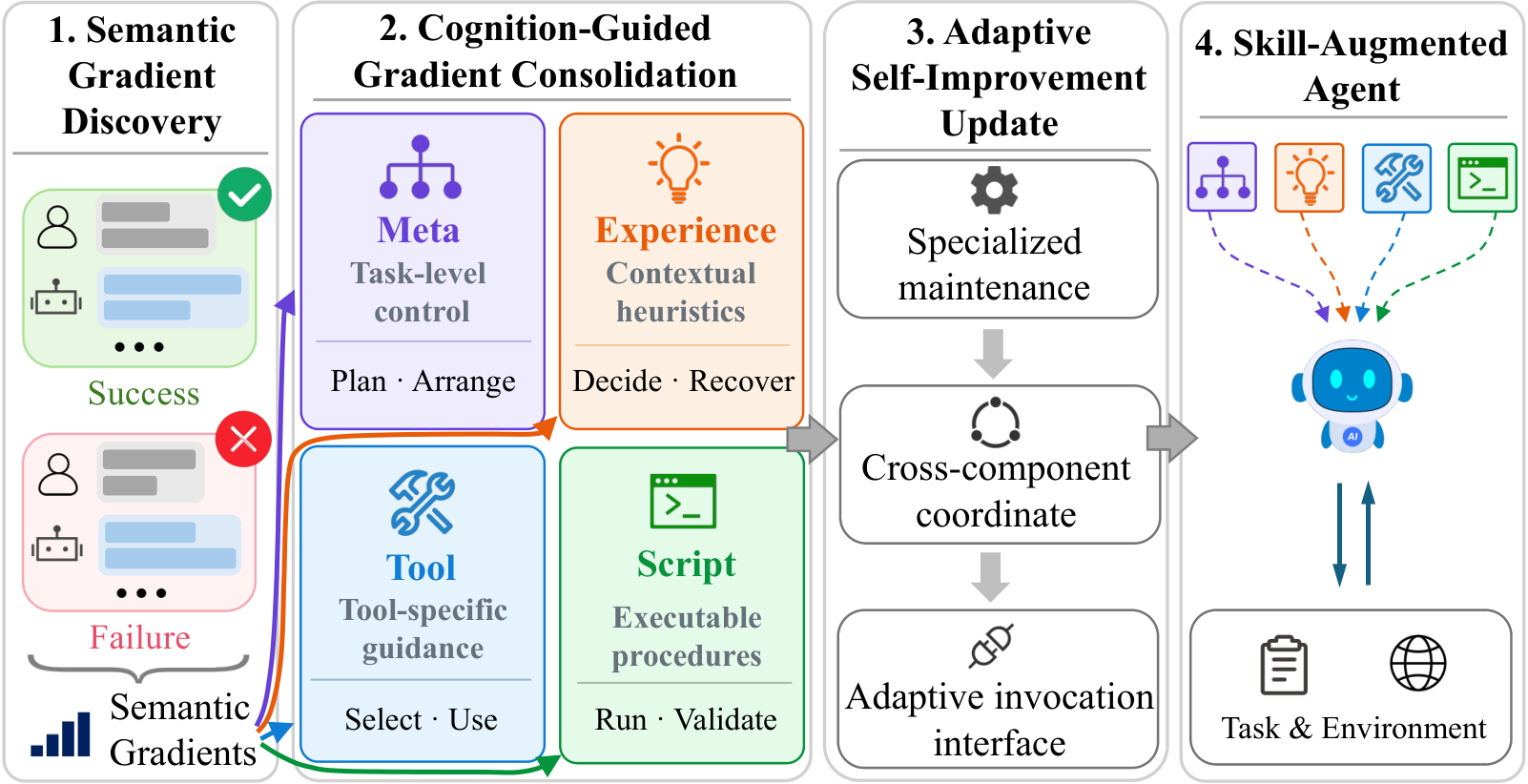
CDSE evolves one skill through four components — Meta, Experience, Tool, Script — using evidence-grounded updates from successful and failed trajectories. Of 500 top skill packages, 96.8% mix at least two functional roles. Best in all 36 settings (six benchmarks, three models, two harnesses): +7.6 pp over base, +2.6 pp over the strongest competitor on average.
Key insight: Splitting a skill into meta, experience, tool and script parts lets trajectory evidence update the right piece, and it wins in every setting tested.
Harness-Delta Attribution: Dissecting Gains From Harness Evolution
Wenxuan Ding; Qin Lu; Changlong Yu et al. arXiv: 2610.22466
Harness-Delta Attribution splits a harness-evolution gain into artifact-driven overfitting, test-time-scaling, and a residual upper bound on generalizable improvement. Over 11 executor models and three frameworks, in 21 significant settings overfitting and test-time scaling explain 54% and 14% of gains on average (combined >50% in 14); search-set gains often fail to transfer to held-out tasks, and validation signals do not prevent overfitting.
Key insight: Most measured harness-evolution gains are overfitting or extra test-time compute; check held-out transfer before trusting an auto-tuned harness.
Self-Evolving Coding Agents via Harness-Policy Optimization
Zhepei Wei; Wenlin Yao; Baolin Peng et al. arXiv: 2610.22791
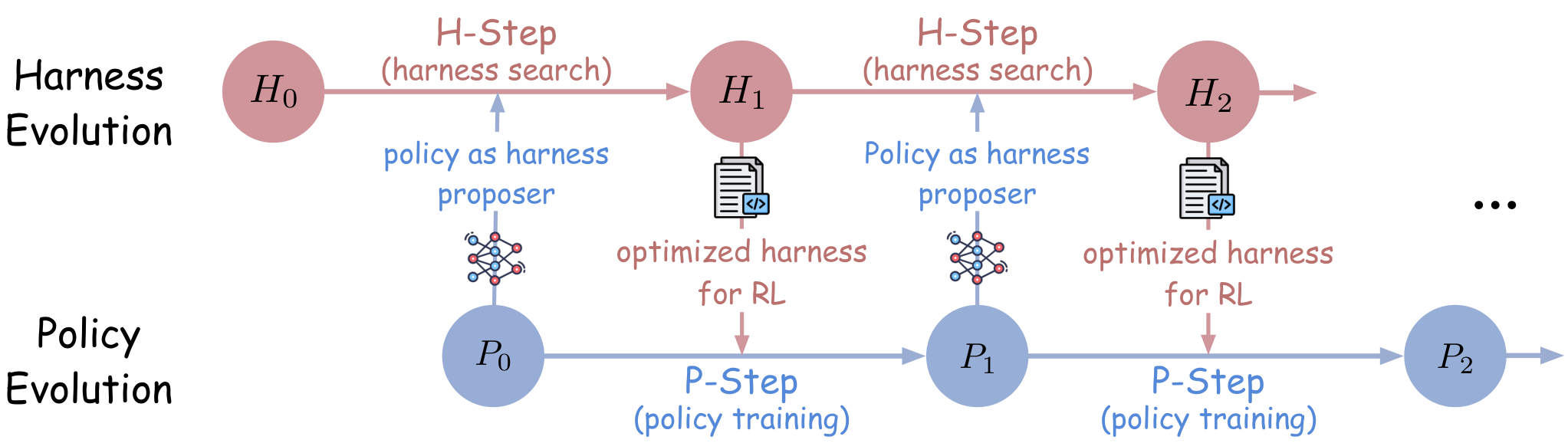
Self-HPO alternates H-steps (the policy proposes new harnesses from its own failures) and P-steps (RL under the selected harness); hard training tasks become the next harness search set. Qwen3.5-35B-A3B average resolve rate 57.8% → 64.8% across three coding benchmarks with OOD gains; joint gain exceeds the sum of parts; Opus 4.8 as harness proposer adds more.
Key insight: Co-optimizing the harness and the open-weight policy beats tuning either one alone on coding benchmarks.
R$^2$Orch: Recursive Self-Improvement for Agent Orchestration via Self-Play within a Skill-Internalization Loop
Mingda Zhang; Yun Huang; Qiang Huang et al. arXiv: 2610.22740
R²Orch: inner self-play loop improves the orchestrator on self-chosen tasks; outer loop improves the inner loop. A Proposer is rewarded for tasks whose outcomes keep varying as skills are withdrawn; Skill Withdrawal removes a skill once the orchestrator does as well without it, pushing toward zero-skill deployment. Beats baselines on twelve datasets (QA, math, code, interactive).
Key insight: Skills can act as a training scaffold that is withdrawn once internalized, pointing toward orchestrators that deploy with no skill library at all.
From Relevant Memories to Sufficient Evidence: Rethinking Memory Utilization in LLM Agents
Shixuan Li; Wei Yang; Peiyu Zhang et al. arXiv: 2610.22668
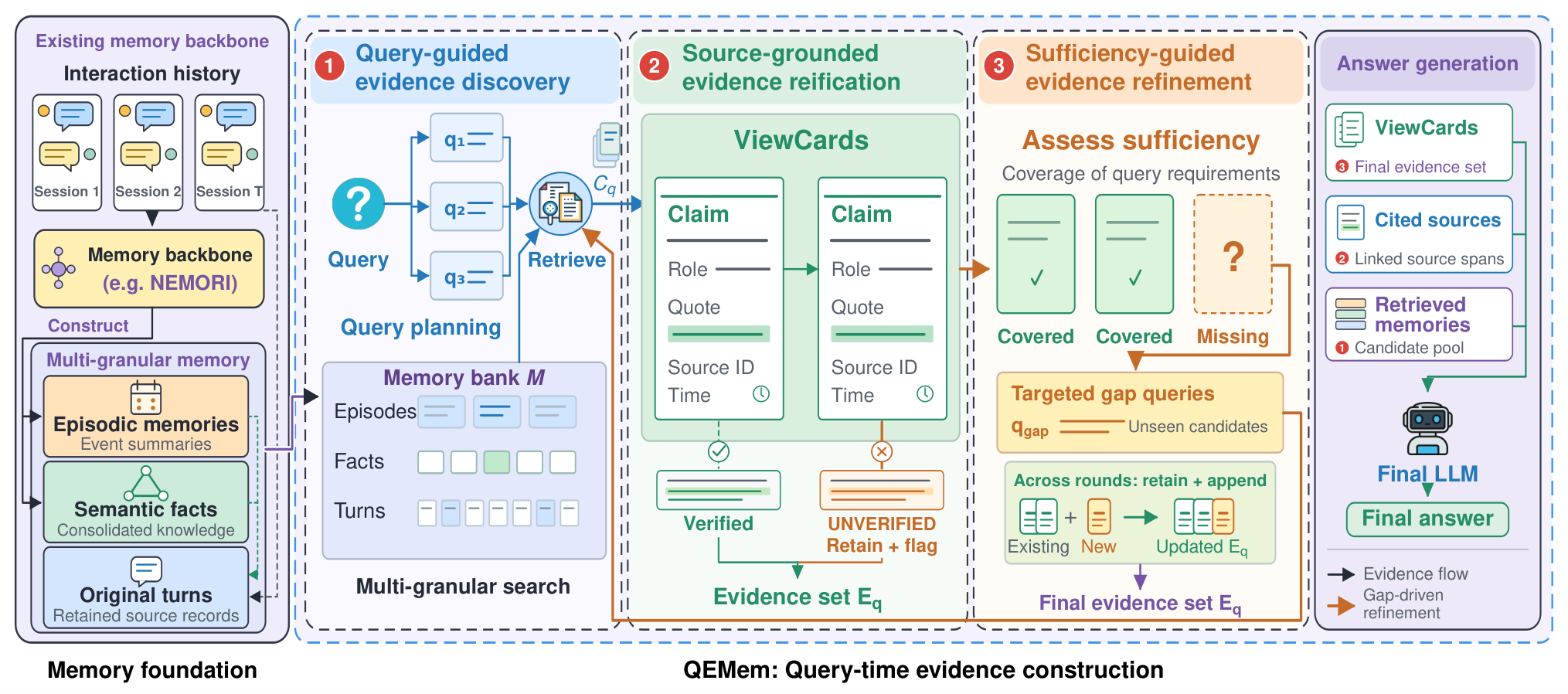
QEMem builds query-specific evidence sets over existing memory stores: query-guided multi-granularity discovery, source-grounded ViewCards with evidential roles and source refs, and sufficiency-guided refinement. 91.43% LLM-judge accuracy on LoCoMo with Claude Opus 4.5, +7.6 pts over MemR³ and +10.7 over NEMORI on a shared store; stronger on cross-session questions.
Key insight: Retrieving relevant memories is not enough; building a query-specific, sufficient evidence set is what moves long-term memory accuracy.
From Memory Hits to Answerable Evidence: Query-Conditioned Memory Compilation for Long-Term Agent Memory
Shangze Li; Yanyu Yao; Derong Xu et al. arXiv: 2610.23313
MemCompile separates memory addressing (Address Plane: source-linked descriptors, capacity-aware Cells, normalized SourcePacket identities) from evidence presentation (Evidence Plane: bounded budget across complementary packets, render retained claims into answer-ready context). 80.52% Judge Accuracy on LoCoMo, extends the quality-cost Pareto frontier; strong on LongMemEval-S.
Key insight: Separating memory addressing from evidence presentation yields answer-ready context under a budget and extends the quality-cost frontier.
Beyond Marginal Influence: Interaction-Aware Memory Selection for LLM Agents
BHVSP Subrahmanyam; Neeraj Choudhary arXiv: 2610.23266
JointCoreBench (nine interaction families, six workflow domains, exact sufficient-set oracles) and JointCore, a relevance-cost-ordered group-deletion baseline that tests blocks before records. On 6,912 exact conditions it finds a minimum-cost sufficient set 100% of the time, cuts subset evaluations 30.00 → 11.13 and saves 87.8% active memory; across 12B–70B models 10.28 vs 16.00 queries. Authors say it is not deployment-ready compression.
Key insight: Some memories are only useful together, so pruning has to test groups of records, not each record's marginal value.
RL-Guided Temporal Localization for Dual-Channel Retrieval in Long-Horizon Agent Memory
Dabin Sheng; Zhe Wu; Jinming Zhao et al. arXiv: 2610.23598
TIDER: an RL-trained 1.7B temporal-interval locator predicts the time window holding the evidence; a temporal channel is merged with a semantic channel and reranked by window proximity. 61.52% on LifeBench (+8.82) and 78.96% on LoCoMo (+3.66).
Key insight: A small RL-trained locator that predicts the relevant time window makes temporal questions over long agent memory easier to answer.
When to Forget: Risk-Controlled Context Adaptation for Long-Horizon Agents
Chenle Chen; Yangbo Wei; Zhijie Zheng et al. arXiv: 2610.22897
RECAP measures, at matched states and seeds, whether retaining/compressing/removing a history block beats full-history KEEP, then certifies a policy under harmful-intervention and non-positive-benefit risk constraints. Compression fails at an early state and saves cost later. On Hunyuan-A13B it edits 43.24% of retained checkpoints while matching KEEP's 91.89% continuation success and cutting prompt cost by 4,619.8 tokens (2.13%).
Key insight: Whether to keep, compress or drop history depends on the agent's current state; savings from state-aware compaction are real but modest so far.
Darwin-Claw: Environment-Adaptive Experience Consolidation for Recursively Self-Evolving Agents
Mingze Yin; Xiaohan Wang; Dian Li et al. arXiv: 2610.23574
Darwin-Claw distills episodic experience via a Hierarchical Experience Consolidation System (fine-grained error attribution → dynamically updated prototype vectors) that patches context and drives skill refinement; agent-actor / evolver-critic co-adaptation; claims compatibility with mainstream agent systems without manual curation. Substantial gains on WildClawBench (no numbers in abstract).
Key insight: Consolidating episodic experience with fine-grained error attribution lets agents adapt to a specific environment without manual curation, though the abstract reports no numbers.
GLOBE: Evolving Structured Agentic Memory for E-commerce Product Optimization in Generative Search
Hyunseo Kim; Suil Choe; Sukkyoung So et al. arXiv: 2610.23709
GLOBE stores optimization knowledge as an evolving handbook of field-scoped behaviors: Editor applies, Reflector converts rank feedback into updates, Moderator removes redundant proposals, Curator commits, harmful behaviors are deactivated. Structured behaviors beat monolithic prompt optimization and transfer to unseen product categories.
Key insight: Procedural memory works better as a governed handbook of scoped behaviors, with moderation and deactivation of harmful entries, than as one monolithic prompt.
Not All Graphs Are Maps: A Task-Agnostic Exploration Framework for Mobile GUI Navigation
Adamo Orsini; Seyed Mehdi Ayyoubzadeh; Sadman Rakib Pinon et al. arXiv: 2610.22672
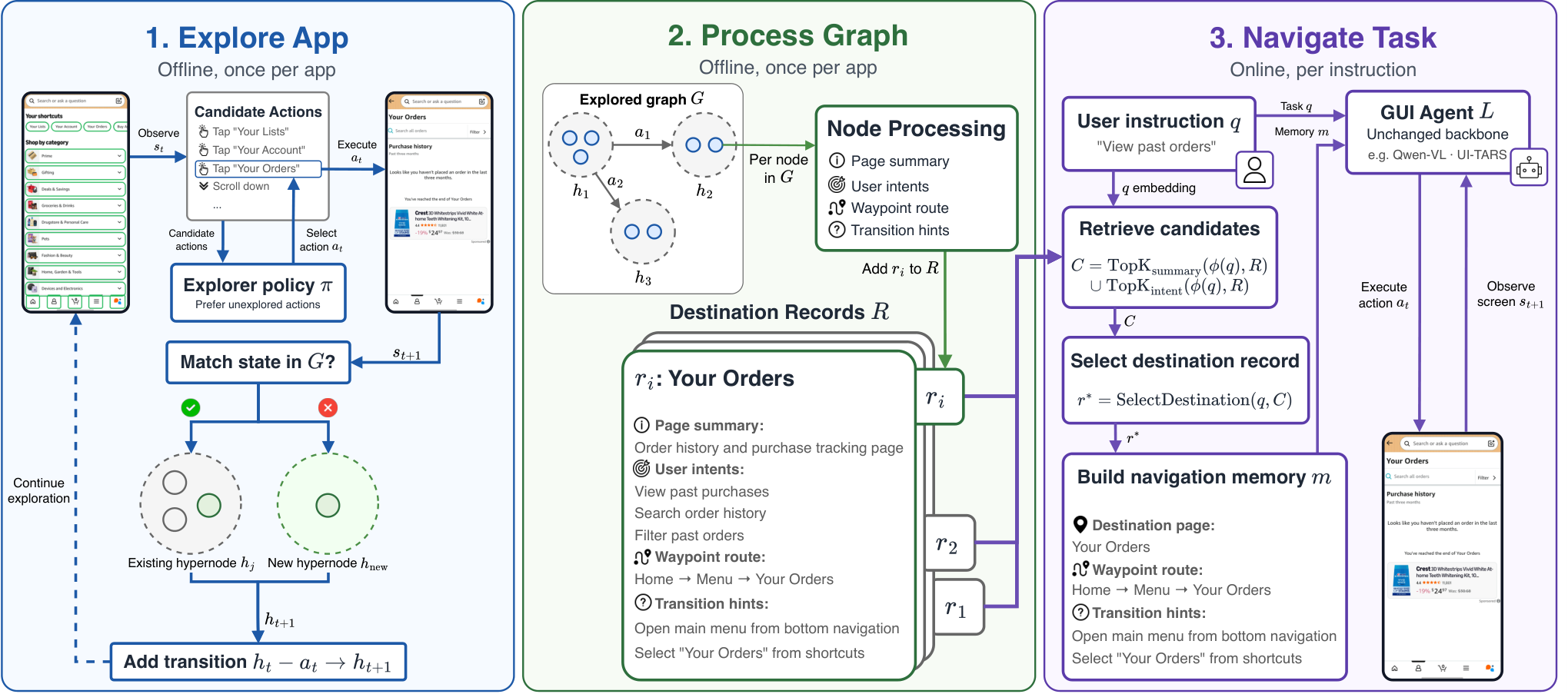
TAG-Nav wraps GUI agent backbones with destination memory distilled from offline app exploration (functions, target pages, waypoint routes). DestBench scores only reaching the correct pre-action screen. Graph memory lifts UI-TARS-1.5-7B 52.4% → 58.3% (automated BFS memory) and Qwen-VL-Max 59.5% → 71.4%; graph coverage and cleanliness drive the value.
Key insight: Offline app-exploration memory helps mobile GUI agents reach the right screen, and scoring that step apart from the final action shows where navigation fails.
MobileInject: Evaluating Reasoning-to-Action Security of MLLM-Based Mobile Agents under Cross-Modal Consistency Injection
Songping Wang; Peiyang Li; Yi Huang et al. arXiv: 2610.23307
MobileInject: 11 scenarios, 9 risk categories, 108 executable risk instances; Cross-Modal Consistency Injection plus Multi-Role Collaborative Deception and Reasoning-Camouflage Injection; a diagnosis framework. Mobile agents are broadly vulnerable, with many failures from early reasoning hijack.
Key insight: Injected content that stays consistent across text and image hijacks mobile agents early in their reasoning, across many scenarios.
PersonaCUABench: Benchmarking Computer-Use Agents Serving Diverse Personas
Haoming Li; Defu Cao; Xu Hu et al. arXiv: 2610.22990
Holds 74 tasks across 11 domains fixed and varies who asks: a persona agent (44 personas) rewrites instructions and answers CUA questions. Across nine backbones (3,330 runs) completion falls 36% vs original requests; 11.2% of lost-point cells are user-requested stops scored as failures; top satisfaction only 62.7% vs 84.1%.
Key insight: Computer-use agents lose 36% of task completion when real personas phrase the same requests, and standard scoring counts user-requested stops as failures.
Adaptation of Computer Use Agents to New Software with User Manuals
Chulhoon Yoon; Kyungri Park; Jinyeong Yun et al. arXiv: 2610.23012
MAGE retrieves task-relevant manual content and plans explicit procedural guidance at execution, adapts the policy through interaction for manual/version mismatch, and converts manuals into executable task-plan pairs to guide rollouts for training without human demos. Gains across six applications.
Key insight: Retrieving software manuals at execution time and turning them into task plans lets computer-use agents adapt to unseen applications without human demonstrations.
ECHOES: Seeing Beyond the Current Image via Recursive History Compression and Privileged On-Policy Distillation
Tengda Guo; Jiawang Hu; Yifei Tao et al. arXiv: 2610.22408
ECHOES uses a Compression-Think-Action format to recursively update a textual history state; the same model with privileged multi-image input acts as teacher for on-policy distillation, balanced with task reward via a PMF-gap rule. ECHOESBMK diagnostic benchmark. Competitive on four GUI benchmarks without keeping historical screenshots at deployment.
Key insight: A recursively updated text history state, distilled from a multi-image teacher, keeps long GUI runs competitive without storing past screenshots.
Monitor-Validity Failures: LLM Safety Evidence Paths at Evolving Framework Boundaries
Junchi Liao arXiv: 2610.23362
Canary contracts place a known payload on the changed evidence surface and record monitor visibility and downstream decision. On public framework repairs: 18 confirmed evidence-path failures across 11 LLM/agent safety project groups and four ecosystems; 14 reach enforcement boundaries (e.g., a regex detector matched but the result was stranded before the block decision).
Key insight: Safety monitors can see the evidence and still fail to block because the result never reaches enforcement; framework updates need regression tests on those paths.
PRIME: Towards Verifiable Evidence-Grounded Reasoning in LLM Agents
Hamed Khosravi; Xiaoming Huo arXiv: 2610.22426
PRIME precommits evidence routes per conclusion; a separate program records each check and refuses unjustified conclusions, and points the agent to checks that could justify a stronger one. On 480 public-record tasks, an agent shown the requirements reported unjustified conclusions on 26.7% of tasks vs none for PRIME; justified-conclusion score 30.1 (refusal only) → 59.2/100.
Key insight: A deterministic evidence ledger outside the model can refuse unjustified conclusions and point the agent to the checks that would justify them.
OfficeTown: Generative Organizations for Evolving Agent Intelligence
Hongchen Wei; Daohong Ying; Zhi Hong et al. arXiv: 2610.23194
OfficeTown generates organizations where members delegate bounded assignments to assistant agents and review deliverables; artifacts, decisions and permissions persist. Bench: 406 tasks, 4,836 criteria, 23 orgs, eight domains. SFT + on-policy distillation on its data substantially improves Qwen3.5-9B on external work benchmarks incl. GDPval; principal–assistant harness beats single- and multi-agent baselines.
Key insight: Generated organizations with persistent artifacts and permissions make a training ground where principal-assistant delegation beats single- and multi-agent baselines.
Reward Engine: Reward-Centric Self-Evolution for Open-Ended Tool Agents
Litong Feng; Ji Qi; Yiran Cheng et al. arXiv: 2610.22915
Reward Engine builds a frozen RewardPack (testcases + rubrics, each an evidence-returning check) from the task and initial trajectories, then uses it to revise/select outputs or as an RL reward. Agrees with benchmark graders on 82.3% / 80.5% of candidate pairs (WorkBuddy Bench Office, Claw-Eval); Pass^3 45.0% → 54.0% and 78.4% → 83.7%.
Key insight: Task-specific testcases and rubrics built from the task itself grade open-ended tool-agent outputs closely enough to drive selection and RL.
When Can You Trust an Agent's Own Verifier? Stress-Testing Counterfactual Rationale Verification Under Search Pressure and Oracle Access
Jonghyun Lee; Moonsu Kim; Sunghwan Park arXiv: 2610.22779
Pressure ratio ρ plus four falsifiable probes for whether a self-explanation verifier (Rationale Consistency Score) stays reliable when an ML-pipeline-designing agent optimizes against it. Prior setup had ρ ≪ 1; null results largely structural; with pre-commit access the agent keeps passing claims while held-out faithfulness falls. Preliminary (one model, six tasks, three seeds).
Key insight: A self-explanation verifier can stop measuring faithfulness once an agent optimizes against it with pre-commit access; audit the verifier before trusting the loop.
Testing the Planning Claims of LLM-Based Agents against Formal Semantics
Oriol Miro-Lopez-Feliu; Oscar Miró López-Feliu; Victor Gimenez-Abalos et al. arXiv: 2610.22469
NL tasks grounded in hidden PDDL models across five domains, four models, six prompting strategies and three architectures: best config solves 78% offline but 40% online, where agents mostly act without inspecting state; unsolvable tasks recognized in <10% of episodes; heavier prompting uses 5–22× tokens with no clear gain; model choice matters more than architecture.
Key insight: Agents that plan well offline often act online without checking state and rarely recognize unsolvable tasks; heavier prompting adds tokens without clear gains.
FRACTAL: A Self-Similar Multi-Agent Orchestration Architecture with Formal Communication, Convergence, and Depth Bounds
Ohad Dan; Abhinav Taliyan arXiv: 2610.22561
FRACTAL repeats Orchestrator/Ensemble/Knowledge Ledger/Decision Maker/Meta-Observer at each decomposition level, with an O(kr) communication bound vs quadratic debate, a generative/evaluative mode criterion, supermajority convergence and depth bounds, and Bayesian inter-layer escalation. Explicitly no quantitative results.
Key insight: A recursive five-role orchestration pattern with formal communication and depth bounds, offered as design theory without empirical results.
Optimist Deep Research: An Iterative, State-Centric Agent for Autonomous Literature Research
Gihan Panapitiya arXiv: 2610.23299
Optimist Deep Research: subquestion tree, source-specific queries over arXiv, OpenAlex, Crossref, PubMed, Semantic Scholar and the web; provenance-preserving registry with four-tier dedup; citation snowballing to saturation; structured claim store; a critic returning research actions (add/split/close subquestions); every citation resolves to a retrieved document. Case study read 28 of 237 docs in ~3.5 min.
Key insight: A deep-research agent in which every citation resolves to a retrieved document, with provenance tracking and a critic that issues research actions.
Annotrace: A Workbench for Step-Level Annotation of Agent Traces
Arun Josephraj Arokiaraj; Chenyi Huang; Sahan Bulathwela et al. arXiv: 2610.23284
Annotrace ingests six trace formats (incl. OpenTelemetry GenAI, LangSmith, Langfuse) into nested steps; user-written codebook; a frontier model proposes labels and answers the same questions as humans; agreement for any annotator pair. Reproduces a prior manual effort's 235 units exactly; two models agree 91% (κ = 0.82).
Key insight: Model-assisted, step-level annotation of agent traces across common trace formats reproduces manual labeling with high agreement.
AuditKIT: A Unified Evaluation Spine for Benchmarking, Judging, and Comparing Large Language Models and Agentic Systems
Shreeyans Arora; Utsav Avaiya; Zera Lyngkhoi et al. arXiv: 2610.22511
AuditKIT records benchmark, judge, runtime, tool-use and retrieval metrics in one representation with direction-aware metric contracts and config fingerprints; turn-aware tool-call matching, parallel vs sequential execution, verified outcomes vs trajectory diagnostics; unobservable evidence marked unscored. Seven case studies show metric choice changes outcomes.
Key insight: Recording benchmark, judge, runtime and tool-use metrics in one contract-checked representation shows that metric choice can change which system looks best.
WebCoder: Scaling General Frontend Development with Artifact-Grounded Agentic Reinforcement Learning
Zijun Dou; Zhen Yang; Xijun Liu et al. arXiv: 2610.23104
WebCoder trains in Webdev-World (code editing, app execution, browser inspection, on-demand skills, persistent project state) with verifier terminal rewards redistributed by artifact progress; context compaction and message-tree samples for beyond-window trajectories. WebCoder-27B: Webdev-Bench 64.8 → 72.8 (above Claude-Opus-4.8 65.1, GPT-5.4 59.6); Vision2Web 41.1 → 62.4.
Key insight: Artifact-grounded RL in a full web-development environment lifts a 27B open coding agent above frontier models on frontend benchmarks, by the authors' reporting.
Distill Until Divergence: Error-Truncated Hindsight Distillation for Agentic RL
Yibin Huang; Conghui Zhu arXiv: 2610.23048
Routes Positive skills (successful workflows, pre-error decisions) and Negative skills (failure-specific corrections at decisive errors); the post-error suffix is trained only with GRPO to avoid mismatched hindsight supervision. Competitive performance with finer credit allocation (no numbers in abstract).
Key insight: Distilling hindsight only up to the first decisive error, and training the rest with GRPO, gives finer credit assignment for agentic RL.
Tree-Aware Posterior Distillation for Long-Horizon Agentic Reinforcement Learning
Heming Zou; Qi Wang; Yixiu Mao et al. arXiv: 2610.23181
TreeOPSD branches continuations from shared turn prefixes, backs up terminal rewards into implicit turn credit, and maps it to a bounded closed-form teacher for self-distillation. Qwen3-30B-A3B-Thinking-2507 +4.97 pts over GRPO average accuracy in a Deep Research setting.
Key insight: Branching continuations from shared turn prefixes turns terminal rewards into turn-level credit for self-distillation in long-horizon agents.
LocalIntent: Outcome-Specific Structured Generation for Backend-Compatible Smart Building Automation with Local LLMs
Tianyang Liu; Jiayue Wang; Zhanhao Cheng et al. arXiv: 2610.23511
LocalIntent routes requests to ordinary (command/clarify/reject) or persistent trigger-action rule branches with deterministic validation. Four local Gemma/Qwen models (2B–9B): for rules, intent 26.4% → 80.6%, device ID 59.3% → 84.7%, rule-mode 49.1% → 98.6%, action/params 5.6% → 44.9%; smaller gains for one-shot requests.
Key insight: Routing requests by outcome type and validating outputs deterministically lets 2B–9B local models emit reliable persistent automation rules.
Self-Reflective Chain-of-Thought (SRCoT): Evidence-Based Text Generation via a Closed-Loop Retrieve--Reflect--Revise Pipeline on Edge LLMs
Fabian Broszio; Michael Hoffmann; Adrian Paschke arXiv: 2610.23311
SRCoT runs a Retrieve–Reflect–Revise loop with separate provenance-labeled stores for environment state, persistent knowledge, accumulated experience and short-term memory; BM25 retrieval; missing-information markers drive retrieve/clarify/abstain. Qualitative case studies on an Apple M4-family laptop with 128 GB; authors claim inspectability, not superiority.
Key insight: Separate provenance-labeled memory stores with explicit missing-information markers make an edge model's evidence use inspectable; the evidence is qualitative only.
Efficient CPU-GPU collaborative MoE inference via Adaptive Expert Assignment
Wenhui Lv; Yunming Liao; Hongli Xu et al. arXiv: 2610.23006
Adaptively assigns GPU-missed experts to CPU (low-load) or GPU transfer (high-load) to balance both paths. Up to 51.9% faster prefill and 39.5% higher decode throughput than the strongest baseline on three MoE LLMs across GPU-memory budgets.
Key insight: Routing GPU-missed experts to the CPU or to GPU transfer based on load speeds up memory-constrained MoE inference in both prefill and decode.
Prism Attention: Proposal-Refined Index Sharing Mechanism for Efficient LLMs Inference
Zhenxu Tian; Kebin Liu; Zhengwu Yang et al. arXiv: 2610.22985
Prism Attention replaces rigid cross-layer sparse-index reuse with coarse-to-fine proposal refinement, exploiting that salient tokens shift only locally across layers. State of the art among mainstream sparse-attention methods on reasoning and long-context benchmarks; 3.4× end-to-end decoding speedup over FlashAttention at 128K.
Key insight: Refining sparse-attention indices locally across layers instead of reusing them rigidly gives a 3.4× decoding speedup over FlashAttention at 128K context.
News and changelogs
- Claude Code: v2.1.303 ships bug fixes and reliability improvements only — there are no new agent-facing features for builders to adopt. link
- Anthropic news: Anthropic is committing a portion of its shares to a new Anthropic Public Benefit Fund whose stake increases as the company grows — corporate and governance news, with no API or product change for agent platforms. link