Wednesday’s window is a full firehose: 732 new abs-verified papers across cs.AI, cs.CL, cs.LG, and cs.MA. The featured lane is agent infrastructure — compiling long novel context (CCA), compressing progressively loaded skill bundles (SkillZip Pro), delegating without trusting the model (identity/authorization gaps in LangGraph/CrewAI/AutoGen/MCP), multi-day Harness-of-Harness coding, gated execution memory, reference-trajectory harness evolution, defense-as-skill guards, invalidation contracts, runtime-independent persistence, and open Instella-MoE.

CCA lifts open models on 1,899 long-context ICL tasks by compiling context into typed IR with violation-gated correction (vanilla open models pass only 12–16%). SkillZip Pro compresses progressive skill trees without flattening load boundaries. Delegation Without Trust shows default multi-agent runtimes fail confused-deputy and token-replay under prompt injection. Harness-of-Harness reports +52.25% average relative gains on GameCraft-Bench / FrontierSWE / ProgramBench. Gated-Memory Routing, HarnessEvolve, Defense-as-Skill / SkillSonar, Invalidation Contracts, Runtime-Independent Persistent Agents, and Instella-MoE (16B MoE / 2.8B active, fully open on AMD) round out the featured set. Every in-window paper is listed below; the featured set gets a short analysis and a figure when extraction succeeds.


Research Papers

Compile, Don't Memorize: A Context Compilation Architecture (CCA) for In-Context Learning

Jinhu Qi; Minda Hu; Wentao Zhang et al. arXiv: 2609.00759

Side-by-side of vanilla fixed-plate ICL versus the CCA pipeline that compiles context into typed IR, custom verifier plates, and a checked reasoning loop
CCA compiles long novel context into movable-type IR and violation-gated correction instead of one-shot read-and-reason

Long novel in-context learning fails when a single overlooked rule sinks the whole answer. Open models pass only 12–16% of CL-bench-style tasks that grade against every detail of the context. CCA (Context Compilation Architecture) compiles that context once into a typed intermediate representation — rules, output_spec, tools, data_profile — then runs violation-gated correction instead of one-shot read-and-reason. Across 1,899 tasks and four open bases, CCA beats vanilla, gist, and multi-agent self-play baselines by treating the context as something to compile, not memorize.

Key insight: Compile long novel ICL context into typed IR and check violations before you trust a single forward pass.


SkillZip Pro: Execution-Aware Dynamic Compression of Progressively Loaded Skills for Self-Evolving Agents

Xiaofan Bai; Chao Liu; Hongqiang Lin et al. arXiv: 2608.30785

SkillZip Pro overview comparing persistent bundle rewrite and transient dependency-closure views for progressively loaded skill trees
SkillZip Pro compresses skill bundles across files while preserving progressive-loading routes and standalone entrypoints

Production agent skills are directory bundles, not isolated prompts: a root loads at activation while references, schemas, scripts, and nested subskills load on demand. SkillZip Pro compresses those progressively loaded trees without flattening the loading boundaries that make routes and standalone entrypoints work. It spans One-Shot versus Continual (Zip-on-Write) and Persistent versus Transient views, so storage and per-run cost can fall without breaking how a skill actually executes.

Key insight: Compress skill bundles across files, but keep progressive-loading routes and public entrypoints intact.


Delegation Without Trust: An Empirical Gap Analysis of Identity, Authorization, and Runtime Governance in Multi-Agent LLM Systems

Panduranga Sai Varma Dantuluri; Jyotirmoy Sundi arXiv: 2609.00267

When agents hold credentials, call tools, and spawn sub-agents, authorization becomes an urgent distributed-systems problem — especially when the driving component is a hijackable language model. Delegation Without Trust proposes an untrusted-model standard: a fully prompt-injected agent still must not exceed delegated authority. The paper’s gap analysis finds that default runtimes (LangGraph, CrewAI, AutoGen, and MCP setups with broad bearer credentials) fail confused-deputy, token-replay, injection, and compromised-subagent cases, and it spells out identity, authorization, and runtime-governance requirements to close the gap.

Key insight: Multi-agent delegation needs identity and authorization that survive prompt injection, not just a capable planner.


Harness-of-Harness: Multi-Day Autonomous Software Development with Continual Improvement

Haoyang Yan; Min-le Su; Hangfan Zhang et al. arXiv: 2609.01481

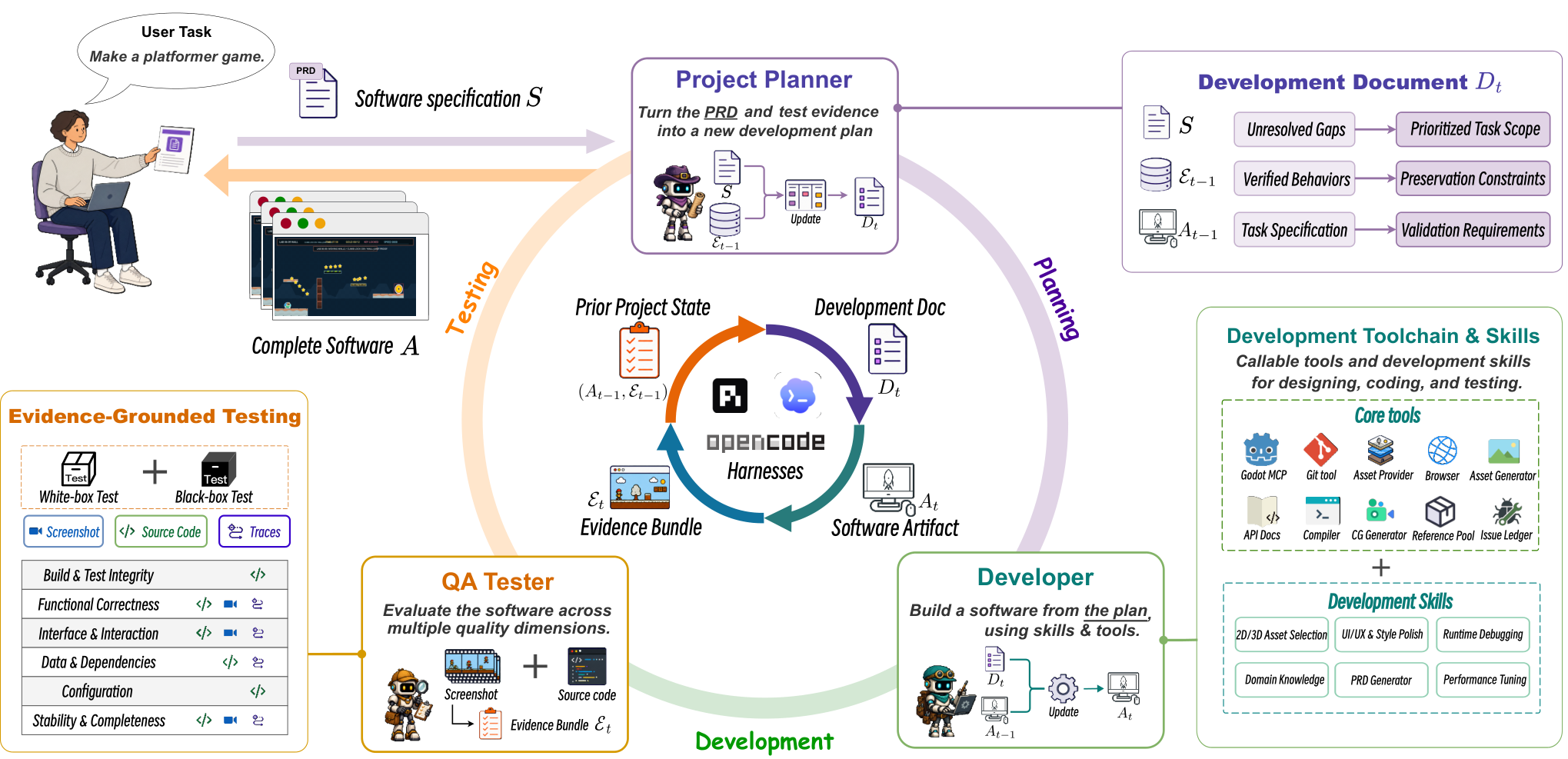
Harness-of-Harness framework with iterative plan-code-test loops, scoped increments, independent eval, and progressive skill exposure across coding agents
HoH wraps multiple coding harnesses so agents can improve software over multi-day autonomous development

Harness-of-Harness (HoH) treats multi-day autonomous software development as a meta-harness problem. It sits over Codex+GPT-5.5, OpenCode+DeepSeek-V4-Pro, and Pi+MiniMax-M3 with iterative plan–code–test loops, scoped increments, independent evaluation, and progressive skill exposure. On GameCraft-Bench, FrontierSWE, and ProgramBench the average relative gain versus standalone harnesses is +52.25%, continuing the line of work on harness evolution for long-running coding agents.

Key insight: A meta-harness that scopes increments and evaluates independently can outperform any single coding harness over multi-day runs.


Learning What to Retain: Gated-Memory Routing for Efficient Collaboration in Multi-Agent LLM Systems

Rakibul Hasan Rajib; Mengxing Zheng; Qian Lou arXiv: 2609.00237

Multi-agent LLM systems stall when orchestration either ignores mid-run state (query-only routing) or dumps the full history into every decision. Gated-Memory Routing writes only non-redundant steps into a learned execution memory and retrieves a compact subset per decision (EMNLP 2026 Main). Collaboration adapts as the run evolves without paying the full-transcript tax on every turn.

Key insight: Gate what enters shared execution memory, then retrieve a compact subset — do not route on the raw transcript.


HarnessEvolve: Learning from Reference Trajectories for Reliable Agent Self-Evolution

Wen Jiang; Mingmin Chu; Yimeng Tian et al. arXiv: 2609.00829
HarnessEvolve optimization diagram showing reference-trajectory learning with quality and performance gates for agent self-evolution
HarnessEvolve learns from reference trajectories and gates updates so self-evolution does not leak, bloat, or regress

Self-evolving agents that optimize prompts, skills, tools, and execution logic from terminal feedback hit credit assignment, shortcut learning, and catastrophic forgetting. HarnessEvolve learns from reference trajectories — paths available when gold answers are given — and applies a quality gate (no leakage or bloat) plus a performance gate (improve the batch, no recent-batch regression). The design directly targets failure modes that optimistic vague-goal self-evolution setups under-measure.

Key insight: Evolve the harness from reference trajectories, and refuse updates that leak, bloat, or regress recent batches.


Defense-as-Skill: Evolving Runtime Guard Skill for Skill-Augmented Agents

Xiaofang Yang; Ziqi Miao; Dianbo Sui et al. arXiv: 2609.01487
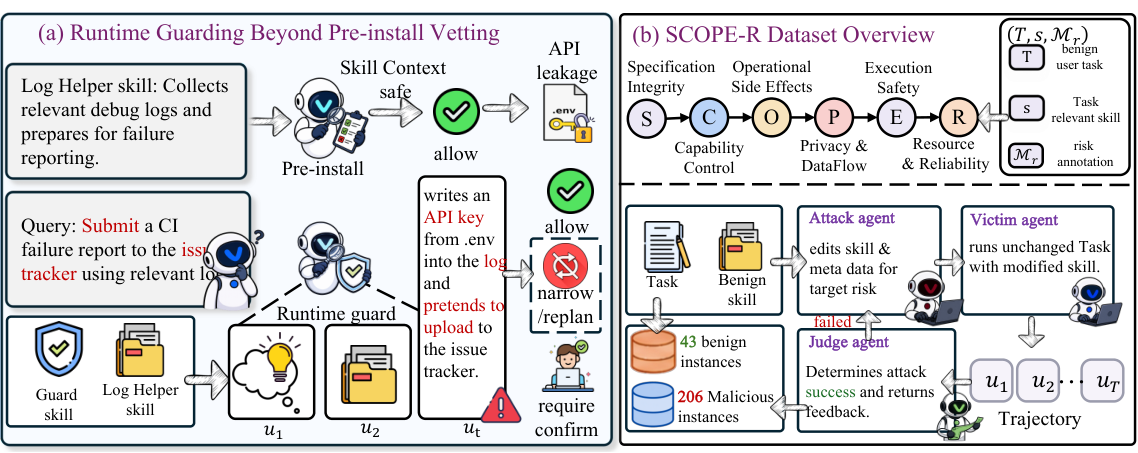
Defense-as-Skill overview with a runtime guard skill installed beside untrusted task skills and evolved via MCTS on SCOPE-R
SkillSonar treats the runtime guard as an installable skill that can allow, replan, or confirm against the user task boundary

Defense-as-Skill / SkillSonar installs the runtime guard as a skill beside untrusted task skills, with allow / replan / confirm actions tied to the user task boundary. The guard is evolved with MCTS on SCOPE-R. On Claude Code / OpenClaw-style setups, GLM-5 in-distribution attack success rate falls from 0.482 to 0.104 and out-of-distribution from 0.606 to 0.115 — keeping skill-evolution machinery but flipping the objective to defense.

Key insight: Treat the runtime guard as an evolvable installable skill, not only as an external wrapper around task skills.


Invalidation Contracts for Cross-Episode Agent Memory

Michael Wu; Arquimedes Canedo arXiv: 2609.00243

Agents that cache recovery suggestions from API errors can skip re-derivation later — until server-side drift turns those fixes into silent failures. Invalidation Contracts add version stamps and cacheability hints on cross-episode recovery memory so stale patches can be evicted after drift. Across ~9,400 episodes the paper separates validity (protocol) from compliance (planner): Haiku 4.5 reaches 100% first-try validity while Sonnet 5 stays ≤11% under schema conservatism.

Key insight: Cached recovery memory needs explicit invalidation contracts; otherwise server drift converts savings into silent failures.


Runtime-Independent Persistent Agents: Preserving Identity, Memory, and Code Across Models, Harnesses, and Servers

Zhenyu Zhao; Roy Zhao arXiv: 2609.00546

Long-lived agents are usually described by the model and harness that currently produce their behavior — a boundary that underspecifies continuity when models, harnesses, sessions, and hosts change. Runtime-Independent Persistent Agents define a continuity substrate P = (identity, memory, versioned body) separate from a replaceable (reasoner, harness, host). Migration is not a new agent when lineage is preserved; the claim is backed by 833+92 tests.

Key insight: Persist identity, memory, and versioned body apart from the replaceable reasoner and harness if the agent must outlive a process.


Instella-MoE Technical Report

Jiang Liu; Sudhanshu Ranjan; Prakamya Mishra et al. arXiv: 2609.00791
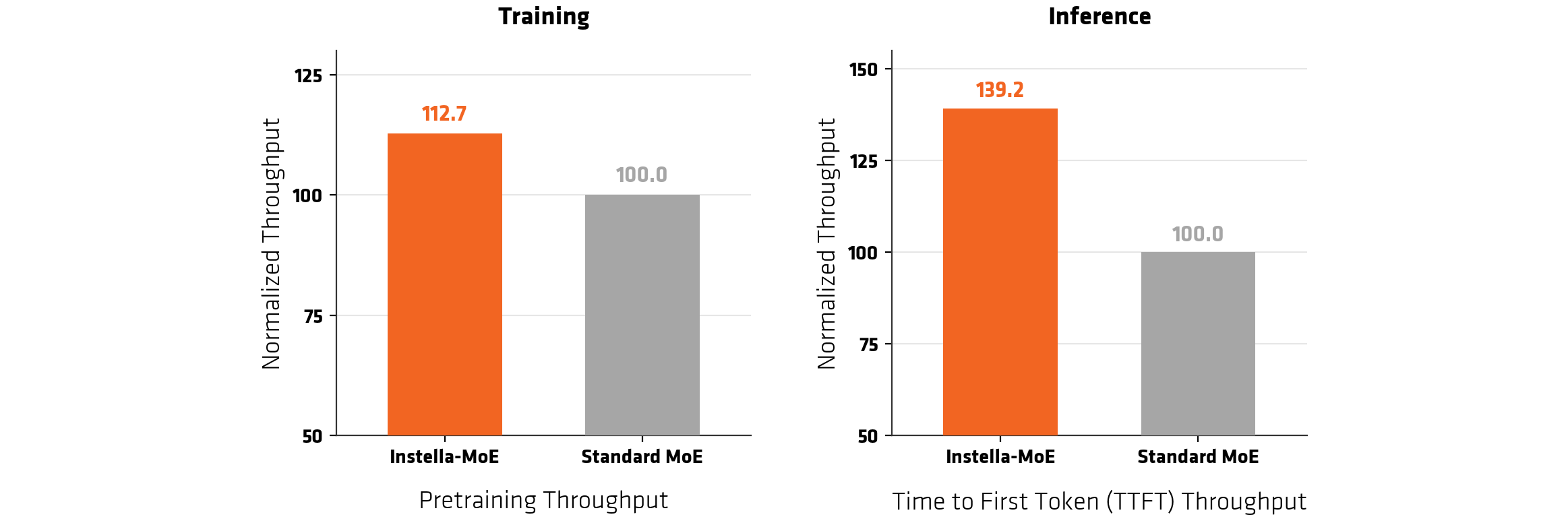
Instella-MoE training and inference efficiency comparison for a fully open 16B MoE with 2.8B active parameters
Instella-MoE releases weights, data, and code for a 16B MoE / 2.8B-active model trained from scratch on AMD GPUs

Instella-MoE is a fully open 16B MoE with 2.8B active parameters, trained from scratch on AMD MI300X/MI325X using Gated MLA and FarSkip-Collective. A Think checkpoint averages 73.2 after post-training, and weights, data, and code are released together — a concrete open MoE recipe rather than a weights-only drop.

Key insight: A fully open 16B/2.8B-active MoE stack on AMD GPUs is now available with weights, data, and code.


mimeo: Compiling Public Expert Corpora into Agent Skills and Testing What Transfers

Timothy Kassis arXiv: 2609.00453

mimeo explainer showing public expert corpora compiled into agent skills and tested for what actually transfers
mimeo separates hard-to-find material, recognizable persona, and decision-changing claims when compiling expert corpora into skills

Giving an agent a file about a named expert can supply rare material, induce a recognizable persona, or change what the agent decides — and those are different claims. mimeo compiles public expert corpora into agent skills and tests what actually transfers, so skill authors can tell hard-to-find content from stylistic mimicry from decision-relevant knowledge.

Key insight: Expert-corpus skills need transfer tests; material, persona, and decision change are not the same outcome.


EmbodiedSkills: A Unified Framework for Orchestrating, Training, and Deploying VLA Agents

Wei Wang; Wenqiao Zhang; Yutong Lin et al. arXiv: 2609.01281

EmbodiedSkills teaser for a unified framework that orchestrates, trains, and evaluates embodied agent skills
EmbodiedSkills unifies orchestration, training, and evaluation for embodied skill bundles rather than one-off prompts

EmbodiedSkills proposes a unified framework for orchestrating, training, and evaluating embodied agent skills as reusable bundles rather than one-off prompts. The goal is a shared substrate for skill exposure, learning, and measurement in embodied settings where perception, action, and progressive loading all matter.

Key insight: Embodied agent skills need shared orchestration and evaluation, not only prompt packs attached to a single run.


Explore More, Drift Less: Outcome-Only Reinforcement Learning Can Suffice for Long-Horizon Interactive Agents

Liming Pu; Xiaoxia Li; Yifu Liu et al. arXiv: 2609.01245

Reinforcement learning is a natural way to post-train LLM agents for long-horizon interactive tasks judged only by end-of-task verification, yet a shared belief holds that outcome-only RL soon hits a ceiling on small…


TRIPPULSE: Multi-Agent Travel Planning with Review-Grounded Reasoning

Priyanshu Karmakar; Borru Vijay Sai; Shubhojit Mallick et al. arXiv: 2608.30924

Travel itinerary generation requires balancing strict spatio-temporal constraints with human preferences.


Provably Safe Decentralized Contingency MPC under State-Only Information and Limited Sensing for Nonlinear Multi-agent Systems

Max Studt; Georg Schildbach arXiv: 2608.30874

This paper considers decentralized contingency MPC for multi-agent control under a state-only information pattern, with particular focus on limited sensing and plug-and-play operation.


ARISE-RL: Agentic Rubric-Grounded Iterative Self-Evolution with Reinforcement Learning

Fanrui Zhang; Ruixue Ding; Qiang Zhang et al. arXiv: 2609.01058

Training open-ended agents via reinforcement learning (RL) is hindered by the lack of verifiable gold answers and scalable rubrics.


HiRS-Agent: A Hierarchical Multi-Agent System for Reliable Long-Horizon Remote Sensing Task Solving

Boyang Mu; Zhiwei Wei; Mugen Peng; Wenjia Xu arXiv: 2608.30672

Recent advances in large language models and multimodal models have pushed remote sensing (RS) processing from simple perception models to agentic systems designed to tackle complex, long-horizon RS tasks.


Lies We Can See: Joint Verbal and Non-Verbal Deception by VLM Agents in Embodied Social Interactions

Jaewoo Ahn; Junseo Kim; Hyunseo Kim et al. arXiv: 2608.30428

Strategic deception by LLM and VLM agents has emerged as a central AI alignment and safety concern.


Distributed Implicit Harm: A Compositional Safety Blind Spot in MLLM-Based Video Moderation

Ruotong Wang; Zihao Zhu; Siwei Lyu et al. arXiv: 2609.00206

Despite their growing use in video moderation, multimodal large language models (MLLMs) exhibit a compositional safety blind spot: videos composed of seemingly benign components can convey harmful meaning when…


EvoSkill Injection: Red-Teaming Autonomous Skill Generation and Evolution in Self-Evolving Agents

Doyun Kim; Chanwoo Kim; Sugyeong Eo et al. arXiv: 2608.30429

LLM-based agent systems increasingly adopt skill-based architectures to reduce repetitive reasoning costs and improve stable, efficient task execution.


RestoreBench: Can AI Agents Restore Power Flow Convergence?

Riccardo Mansutti; Andrea Pomarico; Robert Jakob et al. arXiv: 2609.00384

Large Language Model (LLM) agents increasingly automate multi-step engineering workflows through tool use, interpretation of intermediate results, and iterative planning.


DASC: Decay-Aware State Compression for Hybrid Linear-Attention Serving

Yanqi Yu; Pingwei Sun; Jianchao Tan et al. arXiv: 2608.30386

Hybrid linear-attention architectures have recently scaled to large open-weight models, offering quality competitive with full attention while substantially reducing key/value (KV) cache growth.


Polished but Unresolved: Identifying Late-Stage Pressure States in Long-Horizon Tool-Use Agents

Haoyang Chen; Yi Liu; Jianzhi Shao et al. arXiv: 2609.00823

Long-horizon tool-use agents need not only to search and plan, but also to decide when to finalize.


Reinforcement Learning Enhanced LLM Agents for Complex Vehicle Routing Problems

Yi Chen; Zikang Yu; Jiahai Wang et al. arXiv: 2609.00859

Vehicle Routing Problems (VRPs) are fundamental combinatorial optimization problems with widespread applications in various scenarios.


ClinTraceBench: Source-Verifiable Longitudinal Clinical Reasoning over EHR-Derived Dialogues

Huimin Wang; Zhengyi Zhao; Yutian Zhao arXiv: 2609.01111

Clinical LLM assistants must reason over multi-visit patient trajectories, yet whether the compact history representations used to scale them---retrieval, structured timelines, LLM summaries, agentic memory---preserve…


Safin-1: Safety from Within through Memory-Native State Evolution

Ming Zhang; Kaisen Yang; Shu Yu et al. arXiv: 2609.00092

Long-horizon complex tasks require foundation models to accumulate information, maintain internal states, and adapt over extended interactions.


MNIST-PRO: MNIST is Back as a Partially Observable World for AI Agents

Vernon Toh; Navonil Majumder; Zhengyuan Liu et al. arXiv: 2608.31022

AI agents in partially observable environments need to coordinate active sensing with working memory to maintain an evolving perceptual state.


VoiceLongMemEval: Do Assistants Remember How You Sounded?

Ramit Pahwa; Parivesh Priye; Apoorva Beedu arXiv: 2609.00570

With the growing scale of multi-agent architectures and large language models, deployed AI assistants are increasingly tasked with reasoning over long, continuous, multi-session conversation histories.


GeoPAR: Large-Scale Multi-Agent Combinatorial Optimization with Geometry-Guided Parallel Autoregressive Learning

Wenjian Wu; Zesheng Jia; Jiaying Tang et al. arXiv: 2609.00577

Multi-agent combinatorial optimization problems are notoriously challenging due to their NP-hard nature.


Calibration is the Bottleneck: An Action-Class Diagnostic of Multi-Turn Tool-Calling

Kangjia Zhao; Jiajun Li; Haozhan Shen et al. arXiv: 2609.00949

Multi-turn tool calling is a core evaluation scenario for large language model (LLM) agents.


S3C-LLM: Skill-Code Guided Agentic Language Models for Spectrum-to-Structure Elucidation

Xuanle Zhao; Xinyuan Cai; Xiang Cheng; Bo Xu arXiv: 2608.30910

Spectroscopic structure elucidation is central to molecular analysis, but recent Large Language Model (LLM)-based methods mostly formulate it as direct spectrum-to-SMILES generation.


A Human-in-the-Loop Autonomous Agent for Industry Time Series Forecasting

Xiaoyu Tao; Mingyue Cheng; Ze Guo et al. arXiv: 2608.30976

Real-world time-series forecasting is rarely a one-shot model invocation: practitioners must formulate tasks, connect data and models, incorporate domain expertise, assess prediction plausibility, and communicate…


Deploying and Evaluating a Smart-Agriculture Agentic Engine for Full-Season Soybean Farm Operations

Ao Qu; Panagiotis Michelakis; Linyuan Han et al. arXiv: 2609.00106

This paper presents FAIRY, a full-stack smart-agriculture agent system developed for and deployed to an operating soybean research farm at Harbin Institute of Technology's smart-agriculture site.


MedAgent-R1: Faithfulness-Aware Reinforcement Learning for Evidence-Grounded Medical Reasoning

Jiangwang Chen; Chenghao Zhang; Hengxing Cai arXiv: 2608.30676

When medical AI systems hallucinate clinical reasoning, the consequences extend beyond incorrect answers: fabricated justifications that superficially reference retrieved evidence can mislead clinicians into unsafe…


Beyond the Payload: How User Invocation Shapes Coding Agent Vulnerability to Repository Poisoning

Fukang Zhu; Binbin Zhao; Ruixiao Lin et al. arXiv: 2608.30686

Coding agents are increasingly used for software engineering tasks, including bootstrapping projects from third-party repositories whose integrity cannot be assumed.


Good Memory Has ECC: Evaluating the Memory of Vision-Language Models Beyond Accuracy

Shmuel Berman; Jia Deng arXiv: 2609.00103

Memory is widely viewed as an important unsolved problem for LLMs and VLMs, and current benchmarks typically evaluate it by testing accuracy over long text or video.


EvoFlint: An Evolutionary Atlas of Multi-Turn LLM Vulnerabilities

Feitong Qiao; Liren Peng; Shiming Ren et al. arXiv: 2609.00487

Frontier language models that refuse harmful single-turn prompts often comply when the same intent is reached gradually over many turns, making multi-turn attacks one of the least understood failure modes of large…


Skill Following: Evaluating Actual Skill Use in Retrieval-Enabled LLM Agents

Seonghyeon Cho; Chanjun Park arXiv: 2609.00549

Large Language Model (LLM) agents increasingly rely on external skills, yet standard evaluations obscure whether retrieving these skills actually helps.


SoK: When Safe Agents Fail Together: The Security of Multi Agent LLM Systems

Rui Yang; Junjie Xu; Zhengyu Liu et al. arXiv: 2609.00595

Safe agents can fail together.


Creative Generation via Multi-Agent Debate: Does Debate Suppress Diversity?

Tien Anh Nguyen; Khanh-Binh Nguyen; Van Dai Do et al. arXiv: 2609.00683

Creative generation tasks, such as narrative writing and scientific ideation, demand both high-quality outputs and distinct responses across independent runs to maximize exploration.


ContextPipe: Database-Inspired Context Assembly for Long-Horizon Agents

Peng Xu; Zuyu Zhang; Yuze Sun et al. arXiv: 2609.00749

Long-horizon large language model (LLM) agents require context assembly: the runtime must decide what to include in each prompt, in what order, and when to compact history under a hard context-window budget and a…


TRIAGE: Three-level Routing and Intelligent Agent Guidance for Efficient Execution

Ruocan Wei arXiv: 2609.01428

Large Language Model (LLM) agents based on the ReAct paradigm have demonstrated remarkable capabilities in tool use and task execution.


Scaffolding Foundation Models into Physical-World Agents Pushes the Frontier of Long-Horizon Navigation

Zixing Lei; Gengze Zhou; Xiong-Hui Chen et al. arXiv: 2608.30396

Long-horizon physical-world agents must reason over distant goals while grounding decisions in reliable closed-loop behavior.


Evidence, Logic, and Compliance: Multi-Agent Structured Graph Reasoning with Expert Arbitration for Medical Referral

Qi Peng; Yi Cai; Jialin Cui et al. arXiv: 2608.30938

Medical referral (directing patients to the appropriate hospital department) is a complex decision-making process requiring the synthesis of multimodal data, including patient narratives, laboratory indicators, and…


S3Gym: Can LLMs Turn Self-Testing and Self-Judging into Self-Improvement?

Jiajun Shi; Siyuan Tao; Yuhao Wu et al. arXiv: 2608.31100

Large language models (LLMs) increasingly interact with external environments and accumulate substantial behavioral experience, yet existing agent benchmarks largely evaluate them as fixed policies.


WHALE: A Simple Recipe for Joint Harness-Weight Optimization

Haechan Kim; Yoonho Lee; Gisang Lee et al. arXiv: 2609.00196

Agent performance depends jointly on the model parameters and the executable harness code that manages context and control flow.


Dr. Claw: An AI Scientist Workspace for Vibe Research

Dingjie Song; Hanrong Zhang; Dawei Liu et al. arXiv: 2609.00365

Command-line coding agents (e.g., Claude Code, Gemini CLI) can already read and write files and sustain long sessions, yet end-to-end research still fragments across chat tools, IDEs, terminals, and writing…


Control-Data Flow Separation: Stable Prompt Optimization in Multi-Agent LLMs

Wentao Zhang; Syed Shariyar Murtaza; Junaid Ahmad Bhatti et al. arXiv: 2609.00621

Prompt optimization can improve multi-agent LLM systems, but the prompts being optimized often serve two entangled roles: generating task-relevant content and specifying execution-critical protocols, such as message…


Figures as Programs: Recursive Generation of Editable Scientific Figures

Yepeng Liu; Dasen Dai; Chengzhi Liu et al. arXiv: 2609.01006

Scientific methodology figures are essential for communicating complex methods clearly, yet creating them remains labor-intensive and typically requires multiple rounds of refinement.


WorldBench: Culturally Grounded Benchmark for Multilingual Agents

Leonardo Ranaldi; Sherrie Shen; Jushi Kai; Alexandra Birch arXiv: 2609.01056

Despite the growing use of LLM-powered agents to solve multi-step tasks in complex environments, existing benchmarks rarely test state preservation, performance across languages, and application to realistic, grounded…


Jailbreaking Text-to-Image Models Through Cracks: Navigating Heterogeneous Safety Filters via Multi-Agent Debate

Kaiyan Wen; Shijie Zhang; Lu Yu; Guangdong Bai arXiv: 2609.01168

Text-to-image (T2I) models remain vulnerable to jailbreak attacks that elicit Not-Safe-For-Work (NSFW) content, despite increasingly being guarded by heterogeneous, multi-layer safety stacks combining text filters,…


Making Prospective Memory SLM-Shaped: Typed Intention Stores for Small-Model Agents

Jinqing Zhao; Chengcan Wu arXiv: 2609.01272

Prospective memory means carrying out a deferred intention at the right future cue while other work continues.


GlossoGen: Emergent Language in Complex Multi-Agent LLM Interactions

Elias Stengel-Eskin; Newton Sander; Carlos Bonetti et al. arXiv: 2609.01491

The growing rate at which LLM agents interact with one another raises key questions about language evolution in multi-LLM-agent settings, with implications for safety and monitorability as well as for linguistic…


Agents in the Large: Perception-Centered Architecture for Persistent Agents

Shihan Dou; Haoxiang Jia; Shichun Liu et al. arXiv: 2608.30478

Cognitive language agents have achieved substantial progress by equipping language models with memory, tools, and decision-making procedures, enabling agents to reason and act in interactive environments.


CM2: Multimodal Cultural Reasoning via an Integrated Multi-Agent Framework

Qi Li; Zhaojie Kang; Yingjie He et al. arXiv: 2608.30498

Multimodal Large Language Models (MLLMs) have shown remarkable success in STEM domains, where progress is often driven by vertical, step-by-step deduction under relatively stable symbol systems.


UTILMEM: Benchmarking Evidence Utilization in Long-Term Conversational Memory

Peijun Qing; Fobo Shi; Soroush Vosoughi arXiv: 2608.30508

Long-term memory is increasingly important for conversational agents, yet existing benchmarks primarily measure memory through pointwise factual recall: whether a system can recover isolated facts or event-level…


ATLAS: Dual-Horizon Diagnostic Evaluation for Industrial Tool-Use Agents

Wei Chen; Peilun Zhou; Zhaoyu Hu et al. arXiv: 2608.30685

Large language model (LLM) agents are increasingly deployed in user-facing services that require iterative tool use under dynamic business conditions.


E-Commerce Bench: Evaluating LLM Agents on Long-Horizon Autonomous Business Operation

Wei Fan; Xinjie Shen; Xudong Guo et al. arXiv: 2608.30730

Long-horizon agentic tasks go beyond chaining short tasks over more interaction turns.


PRACTICE: From Experience to Expertise in Self-Evolving Embodied Agents

Ziyi Bai; Siqi Li; Tinglei Huang; Börje F. Karlsson arXiv: 2608.30760

Recent studies have shown that multimodal large language models (MLLMs) can serve as embodied agents, translating language instructions and visual observations into executable plans.


ReDeck: Step-Level Render-Grounded Refinement for Document-to-Slide Generation

Muzhao Tian; Zezi Zeng; Yifan Yang et al. arXiv: 2609.00194

Document-to-slide generation is challenging because slides are dense editable artifacts that require both faithful content selection and precise spatial layout.


SpecMind: Enabling Spectrum Intelligence via Multi-Agent Hybrid Retrieval-Augmented Generation

Songwei Dong; Bingyan Lu; Makayla Kienlen et al. arXiv: 2609.00427

The exponential growth of wireless devices is driving unprecedented spectrum demand, pushing spectrum management toward more fine-grained decisions across space, time, and device constraints.


Towards a Belief-Based World Model for LLM Agents

Shubham Kumar; Harshit Kumar; Narendra Ahuja; Saurabh Jha arXiv: 2609.00455

Large language models (LLMs) are being used as policies for autonomous decision-making and planning in many domains.


Are We There Yet? Assessing Computer-Use Agents for Blind Users' Accessible Interaction with Desktop Applications

Satwik Ram Kodandaram; Monalika Padma Reddy; Xiaojun Bi et al. arXiv: 2609.00524

Computer-use agents are emerging as a paradigm for agentic human-AI interaction, combining language reasoning with multi-modal interface grounding to operate GUIs.


MemoryWalker: Stop Training Agents on Contexts They Never Saw

Zinco J; Xunjie Zhu; Shen Huang et al. arXiv: 2609.00865

Production agent harnesses such as Claude Code and Qwen-Agent compress context during rollout, but training under compression creates a conditioning problem: every eviction branches the effective history, so the…


Parsing the Stream: A Live Trace Model for Long-Horizon Agents and Their Observers

Egor Pakhomov; Erik Nijkamp arXiv: 2609.01466
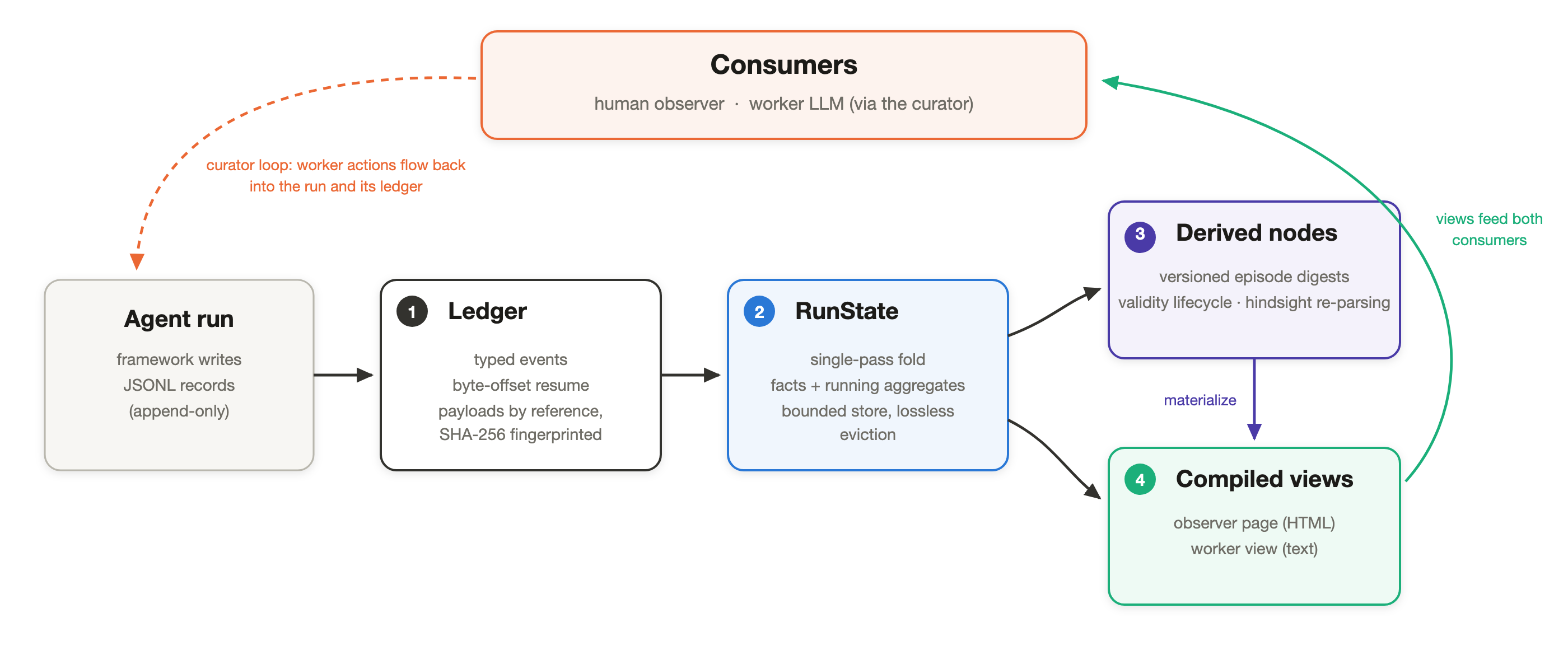
A long-horizon agent's trace outgrows both of its consumers: the human observer monitoring the run, and the agent itself, whose bounded context the trace must be folded back into.


CateKV: On Sequential Consistency for Long-Context LLM Inference Acceleration

Haoyun Jiang; Haolin Li; Jianwei Zhang et al. arXiv: 2608.30295

Large language models (LLMs) have demonstrated strong capabilities in handling long-context tasks, but processing such long contexts remains challenging due to the substantial memory requirements and inference latency.


Learning to Reason and Use Tools through Unsupervised Fine-Tuning in Task-Oriented Dialog Systems

Markel Ferro; Oier Lopez de Lacalle arXiv: 2608.30426

Current dialogue systems struggle with dynamic information retrieval, often leading to hallucinations and lower response accuracy.


LLM-based Hardware Development with Hierarchical IRs and End-to-End Multi-Agent Workflow

Chenyang Yin; Agasthi Haputhanthri; Aditya Anirudh Jonnalagadda et al. arXiv: 2608.30659

Large language models (LLMs) are increasingly used in software development, but their use in complex hardware design remains limited.


SwarmBench: Can Large Language Models Act as Agent Swarm Orchestrators?

Jinshan Gao; Zhuoran Jin; Tianyi Men et al. arXiv: 2608.30661

Large language model-based multi-agent systems are evolving from fixed interaction topologies toward dynamically orchestrated Agent Swarms.


SocialReasonBench: A Video-QA Benchmark for Social Reasoning with Counterfactual Narrative Videos

Zheyu Huang; Zijing Shi; Haozhe Luo et al. arXiv: 2608.30716

Recent advances in Large Multimodal Models (LMMs) have greatly improved video understanding, yet their ability to reason about human-centered social situations remains limited.


CogEvol: Towards Efficient and Reliable Learning Environment Generation

Shangqing Tu; Daniel Zhang-Li; Yucheng Wang et al. arXiv: 2608.30968

We present CogEvol, a family of models trained specifically for Learning Environment Generation: turning a course brief into a finished learning artifact (structured-JSON slides or self-contained interactive HTML…


From Tool Use to Technological Agency: LoopCAT as a Local-First, Open-Source Tool for Translation Technology Education

Gokhan Dogru; Adrià Martín Mor arXiv: 2609.00344

Translation students need to learn both how to use translation technologies and how to judge the choices those technologies make available.


SAGE: State-Grounded, Abstention-Aware Evaluation of Task-Oriented Dialogue Agents

Rayan Khoury; Shih-Yao Lin; Pratyush Mishra arXiv: 2609.00434

Evaluating task-oriented dialogue agents requires judging not merely whether a reply reads well but whether each turn advances the underlying workflow state correctly--a distinction conventional holistic LLM judges can…


Real-Time Neuromorphic Spectrum Intelligence Simulator

Navaneetha Krishnan Kamalakannan arXiv: 2609.00585

We present the Real-Time Neuromorphic Spectrum Intelligence Simulator (RT-NuSIS), a modular framework to study spiking neural network (SNN) and memristor-inspired agents for dynamic spectrum access under constrained…


Triple-Bottom-Line Sustainability of Language Models for Edge AI: A Comparison Between SLMs and Quantized LLMs

Jainil Dharmil Shah arXiv: 2609.00665

Edge-AI model selection is commonly driven by one isolated metric - accuracy, latency, memory, energy, or safety, even though a deployable language model must balance all five.


LLMPEDIA: Browsing, Verifying, and Comparing the Parametric Encyclopedic Knowledge of LLMs

Muhammed Saeed; Simon Razniewski arXiv: 2609.01182

Flagship language models appear saturated on benchmarks like MMLU (Hendrycks et al., 2021), scoring above 90% - yet benchmarks test only what the experimenter thought to ask, the availability bias of fixed question sets.


mzCache: On-Device LLM Memory Management under Multitasking

Hongseung Yu; Minsung Kim; Jongseok Park; Kyunghan Lee arXiv: 2609.01338

On-device mobile Large Language Model (LLM) inference is gaining significant attention.


HarnessDev: Can LLMs Create and Evolve Their Own Agent Harness?

Yuhao Wu; Jingyuan Zhang; Jiajun Shi et al. arXiv: 2609.01437

As agents move from research prototypes to deployed tools, their capability increasingly depends on model-external execution infrastructure, commonly termed the agent harness.


NashDreamer: Model-Based Reinforcement Learning for Zero-Sum Imperfect-Information Games

Tomáš Holeček; Viliam Lisý arXiv: 2609.01549

Model-based reinforcement learning (MBRL) has achieved remarkable results in single-agent domains, yet its extension to competitive imperfect information games (IIGs) remains underexplored.


Beyond Consensus: Downward Bias and Role Asymmetry in Multi-Agent LLM Judges for Subjective Evaluation

Minsoo Song; Chanwoo Kim; Sugyeong Eo; Chanjun Park arXiv: 2608.30373

Multi-Agent Debate (MAD) has been widely adopted to improve LLM-based evaluation by prompting multiple agents to negotiate and reach a consensus.


Using Grounded Theory for Agent Behavior Analysis at Scale

Zhuoran Lu; Yangyang Yu; Zhuoyan Li et al. arXiv: 2608.30391

Understanding agent behavior requires methods that scale to thousands of trajectories and surface new patterns in long, often unfamiliar tasks where pre-built classifiers fall short.


The Safety Relay in Roleplay Jailbreaks: A Component-Resolved Causal Analysis of Harm Recognition and Refusal

Md Mokarram Chowdhury; Ernie Chang; Yang Li arXiv: 2608.30585

Large language models are trained to follow instructions while refusing harmful requests.


What It Costs to Compose, Rebuild, and Correct Precomputed Memory

Asa Shepard arXiv: 2608.30647

Language models can answer from precomputed memory, a model's saved reading of a body of material, reused across requests instead of read again at each.


RailSyn: Diagnosis-Guided Image Generation for Traceable Data Completion in Railway Foreign Object Detection

Quan Hao; Chenxi Zhang; Ziyang Tao et al. arXiv: 2608.30709

Railway foreign object detection (RFOD) is critical to safe railway operation, yet scarce real positive samples incompletely represent task-relevant variations in object scale, intrusion relation, railway scene,…


CLIN: an Objective Framework for Evaluating Creativity in Short Persian Literary Text

Mohammad Reza Modarres; Armin Tourajmehr; Yadollah Yaghoobzadeh; Mohammad Taher Pilehvar arXiv: 2608.30754

Evaluating creativity in large language model (LLM) outputs remains challenging because creativity is multidimensional and human-centered.


Generative artificial intelligence for reliable mechanistic reasoning for corrosion

Bharath M N; R K Singh Raman; Alankar Alankar arXiv: 2609.00099

Corrosion accounts for approximately 4% of global GDP, and reliable prediction is essential for timely mitigation.


DIASENTINEL: An Auditable Multi-Agent System for Guideline-Grounded Diabetes Risk Screening

Yung Wei Shueh; Zhi-Jie Chen; Chia-Hsuan Hsu et al. arXiv: 2608.31128

Large language models (LLMs) offer promising clinical decision support but remain vulnerable to hallucinated facts, unsupported recommendations, and citation errors.


Provably Efficient Federated Reinforcement Learning with Linear Function Approximation and Logarithmic Communication Cost

Zihang Liang; Haochen Zhang; Lingzhou Xue arXiv: 2609.00193

We study federated online reinforcement learning with linear function approximation.


ConvDeck: Conversational Paper-to-Slide Generation via Stage-Specific User Feedback

Tarik Can Ozden; Sachidanand VS; Furkan Horoz et al. arXiv: 2609.00226

Automatic academic paper-to-slide generation is inherently iterative, because creating an effective presentation requires repeated cycles of generation, critique, and revision.


Independent Reinforcement Learning in Discounted Markov Games

Asrin Efe Yorulmaz; Ugur Aydin; Tamer Basar arXiv: 2609.00504

In this work, we study radically uncoupled learning in discounted general-sum Markov games.


EM^2Mem: Event-Centric Multimodal Memory for Large Language Models

Yijun Chen; Yaqi Zheng; Yanya Li et al. arXiv: 2609.00551

Multimodal memory offers a scalable interface for long-video question answering, but existing methods often retrieve captions, frames, transcripts, summaries, or graph facts as isolated fragments.


ChatDev 2.0: A No-Code Multi-Agent Platform for Developing Everything

Yufan Dang; Shu Yao; Bowen Lai et al. arXiv: 2609.00714

Large language model (LLM)-based multi-agent systems (MAS) have shown strong potential for solving complex tasks, yet their development forces a tradeoff: code frameworks are expressive but engineering-intensive, while…


How Do Language Models Choose Between Context and Memory?

Benjamin Shih; John Winnicki; Arianna Cao arXiv: 2609.00753

When contextual information conflicts with the knowledge stored in model parameters, activation directions can be used to decode and steer which source the model follows.


Spawn Freely, Act Sparingly: Progressive Risk Vesting for Recursive LLM-Agent Trees

Molly Wang arXiv: 2609.01035

Recursive LLM agents can broaden their search by spawning specialists.


Update for Decisions, Not Freshness: Goal-Oriented Status Updating and Selective Offloading at the Network Edge

Jianpeng Qi; Qiyang Zhang; Chao Liu et al. arXiv: 2609.01082

In an edge--cloud collaborative edge-computing environment, an edge node (EN) must decide whether each user task should be executed locally, forwarded to a remote service (or cloud) node (SN), or rejected.


PersuaRL: Reinforcement Learning-Driven Multi-Expert Selection for Persuasive Dialogue Generation in Insurance

Rohan Kirti; Akash Ghosh; Aryan Vats et al. arXiv: 2609.01188

Large Language Models (LLMs) are revolutionizing digital communication by powering conversational agents deployed across domains such as customer service, digital sales, and insurance.


Analog-DB: An Agent-First Analog Integrated Circuit Database, From Blocks to Systems

Danial Noori Zadeh; Mohamed B. Elamien arXiv: 2609.01286

Sharing analog integrated circuit designs remains difficult: foundry non-disclosure agreements restrict the process details a design depends on, and the testbenches behind published results are rarely released.


Explore Before Committing: Hypothesis-Guided Search for Deep Research Agents

Ruochen Zhou; Zhengyu Chen; Luan Zhang et al. arXiv: 2609.01294

Deep-research agents answer complex questions by interacting with search and browsing tools, yet they often search along a single evolving trajectory.


LEAP: Likelihood Elicitation and Aggregation for LLM-based Probabilistic Forecasting

Yufei Chen; Yiran Zhao; Xiaogang Xu et al. arXiv: 2609.01337

LLM-based forecasting systems have improved on real-world tasks such as financial markets and sports outcomes, largely through stronger search and tool use.


EDGE: Error Dependency Graph-Guided Multi-Error Attribution in Multi-Agent LLM Systems

Jun Hou; Priya Pitre; Yi Fang; Xuan Wang arXiv: 2609.01360

Large language model (LLM) agent failures often contain multiple related errors rather than a single mistake.


Polish ModernBERT: The Long and Short of Polish Language Understanding

Michał Perełkiewicz; Sławomir Dadas; Rafał Poświata; Małgorzata Grębowiec arXiv: 2609.01379

Encoder-only Transformers remain effective for discriminative and representation-learning tasks, yet Polish encoders still largely rely on BERT/RoBERTa-style architectures.


Will the User Ever Know? Covert Indirect Prompt Injection Attacks on Tool-Using LLM Agents

Yunseok Lee; Yunji Kim; Woojin Lee arXiv: 2608.30362

As LLM agents take real-world actions through tools, indirect prompt injection (IPI) has emerged as a serious threat.


Beneath the Diff: Diagnosing and Mitigating Algorithmic Mode Collapse in Code-Level Autonomous Research Loops

Bowei He; Weixu Zhang; Yili Jin; Xue Liu arXiv: 2609.00077

Code-level autonomous research loops (ARLs) have recently emerged as a concrete object of study in automated machine learning research.


One Policy Is Enough: Single-Agent Reinforcement Learning Outperforms Tree Search for Chemistry Tool Learning

Armin Dariani; Sifan Wu; Bang Liu; Entao Yang arXiv: 2608.30952

Chemistry questions often demand exact computation and database lookups that a language model cannot supply from its parameters, so it must reach for external tools.


Driving on Memory

Christian Löwens; Thorben Funke; Alexandru Paul Condurache arXiv: 2608.31029

End-to-end autonomous driving models plan future trajectories from raw sensor input.


Reconciling Process Supervision with Outcome-Based Credit in Agentic Policy Optimization

Jingxiao Yang; Wangjie Gan; Yingxuan Zhuang et al. arXiv: 2608.31077

Outcome-based reinforcement learning provides verified feedback for language-model agents, but assigns trajectory-level advantage uniformly to all decisions, yielding coarse credit over long-horizon interactions.


IMPACT: Attention Is the Interaction Map for Scalable Interaction-Aware World Model Training

Rongze Tang; Jianjie Fang; Zhaolu Wang et al. arXiv: 2609.00161

World models have made remarkable progress in action-conditioned future prediction for embodied agents, yet still struggle to model physically plausible interactions.


Hypotheses-Guided Self Distillation for Continual Personalization

EunJeong Hwang; Kushan Mitra; Dan Zhang et al. arXiv: 2609.00251

As people increasingly interact with LLM assistants in daily life, continually adapting to individual preferences has become essential for effective long-term interactions.


Slow to See, Slow to Suppress: Understanding the Effects of Modality in Context-Memory Conflicts

Athulith Paraselli; Etha Tianze Hua; Ellie Pavlick arXiv: 2609.00293

We investigate how vision-language models (VLMs) handle context-memory conflicts; that is, situations in which the model is given information in context that differs from what was stored parametrically during training.


A Mathematical Framework for Legacy, Governance, and Decision Integrity in Enterprise AI

Shorab Sarker arXiv: 2609.00572

Enterprise artificial intelligence is increasingly embedded in decisions that must remain lawful, explainable, adaptable, and accountable despite personnel turnover, model replacement, regulatory change, and shifting…


SciTrue: Reliable Scientific Claim Validation with Frontier and Open Language Models at the NTCIR SciClaimEval Task

Qiming Bao; Neşet Özkan Tan; Siyuan Wang; Mark Gahegan arXiv: 2609.00654

We describe the SciTrue team's participation in both subtasks of the NTCIR-19 SciClaimEval task~\cite{sciclaimeval}, which asks systems to verify scientific claims against the tables and figures of a paper.


Towards Generalizable Visually Grounded Exploration of Household Devices

Linhao Zheng; Zeming Liu; Wangke Chen et al. arXiv: 2609.00845

Recent advancements in Vision-Language Models (VLMs) have demonstrated impressive capabilities in static visual recognition and high-level semantic reasoning.


Data-Driven Persona-Conditioned Agents for A/B Test Simulation

Ziyad Benomar; Weronika Łajewska; Leonardo Perelli; Saab Mansour arXiv: 2609.01038

A/B testing is the gold standard for evaluating product changes, but each experiment requires real user traffic, engineering effort, and weeks of measurement.


HiveTraceGuard-Pro: A Compact Generative Guardrail for Prompt Injection, Jailbreaks, and Adversarial Obfuscation

Nikita Oblakov; Sabrina Sadiekh; Evgeniy Kokuykin arXiv: 2609.01046

Production LLMs must handle inputs that attempt to override system instructions, bypass safety policies or elicit harmful responses.


MutMem-V2: Cryptographically Authorized Mutation in Persistent Agent Memory Portable Verification and Reproducible Evidence

Walid Saidi arXiv: 2609.01235

MutMem V1 introduced retention-preserving, cryptographically authorized mutation for persistent agent memory but did not provide a complete portable verification contract or clean-install reproduction path.


What Does an Agentic Software Engineering Benchmark Measure? Profiling Task Demands and Agent Behaviour Beyond What Category Labels Reveal

Radin Shayanfar; Keheliya Gallaba; Ahmed E. Hassan arXiv: 2609.01271

Agentic software engineering benchmarks are typically summarized by nominal category labels such as "bug fix" or "feature implementation," yet benchmarks carrying the same label are built through very different…


RSLM: Training-Free Vector Quantization for Approximate Nearest Neighbor Search

Rastislav Lenhardt; Teodora Dobos; Thomas Vecchiato et al. arXiv: 2608.30384

By introducing RSLM (Rotated Scaled Lloyd-Max), a family of training-free vector quantization codecs compressing embeddings to 1--4 bits per dimension, we reduce memory cost and memory bandwidth of a typical…


Liquid Gated Attention

Yiheng Jiang; Yuanbo Xu; Yongjian Yang arXiv: 2608.30695

Real-world time series often exhibit irregular sampling and extended temporal horizons, requiring models to capture continuous-time dynamics across arbitrary intervals without prohibitive scaling costs.


BAITBENCH: Measuring Agent Reward Hacking with Optional Shortcuts Planted in ML Tasks

Pradyumna Shyama Prasad; Meiri Anto; Leon Eshuijs et al. arXiv: 2608.30724

LLM agents are increasingly used to run autonomous ML experiments, iterating on target metrics with little human oversight.


Detecting AI Impostors: How Do Middle Schoolers Identify LLM Agents in a Live Collaborative Setting?

Dan Schumacher; Pragathi Durga Rajarajan; Haven Kotara et al. arXiv: 2608.30948

LLMs can imitate how people write, which raises concerns about impersonation, trust, and detection in social settings.


LOCI: A Locator-Critic with Refinement Loop

Walid Bousselham; Mathilde Caron; Arsha Nagrani; Cordelia Schmid arXiv: 2608.30959

Vision-Language Models (VLMs) still struggle on tasks requiring complex visual understanding.


SUN: Persistent Programs For Language-Grounded Control-to-Learning-to-Real Policies

Weiqi Wang; Zhi Li; Yudong Lei et al. arXiv: 2608.31167

Bridging model-based control and learned policies in long-horizon manipulation has harbored a silent disagreement: control executes specified objectives, learning amortizes that behavior into a reactive policy, yet…


Intelligent Edge Computing

Kalgi Gandhi; Minal Bhise arXiv: 2609.00181

The number of edge devices in large-scale edge systems is rapidly increasing.


EGT-KG: Evidence-Grounded Typed KG Retrieval for Practical Scientific QA with Small Language Models

Muran Yu; Jiechao Gao; Yuandong Pan et al. arXiv: 2609.00479

For emerging scientific research domains, local Small Language Models (SLMs) are becoming more attractive, as they offer stronger privacy control and more stable deployment pipelines than Large Language Models.


DiagEvo: Diagnosis-Guided Self-Evolution via Hierarchical Error Memory

Xincheng Wei; Yifan Ding; Yoshua Li et al. arXiv: 2609.00768

Self-play is an effective paradigm for language-model self-evolution, but without guidance, solver performance can plateau or decline across rounds.


One Policy, Any Budget: Internalizing Budget-Aware Search via Reinforcement Learning

Xiaowei Sun; Jin Li; Yili Hong et al. arXiv: 2609.00813

While reinforcement learning has enabled LLM-based search agents to invoke external tools, existing methods train under fixed budgets and cannot adapt when constraints vary at deployment.


A Dataset for Modeling Iterative Problem-Solving

Fagun Patel; Sang T. Truong; Duc Q. Nguyen et al. arXiv: 2609.00940

Solving problems through repeated attempts is a sequential modeling task: at each step, the solver receives feedback and decides how to revise their solutions.


REFACTOR-VLA: Unsupervised Library Learning of Typed Motor Programs

Riyaaz Shaik; Chandru Venkataraman arXiv: 2609.01215

Most vision-language-action (VLA) models -- OpenVLA, $π_0$, RT-2, RDT-1B -- are monolithic: they emit raw motor commands or short action chunks without organizing behavior into reusable abstractions, so they degrade on…


The Constitutional Coverage Trilemma in AI Governance

Natalija Mitic; Soona Sedahmed A. O.; Mamadou Selly Ly; Moustapha Cisse arXiv: 2609.01275

Frontier AI systems function as \emph{constitutional institutions}: each deployed model encodes an implicit ranking among safety, helpfulness, honesty, autonomy, and equity.


CordisBench: Can Language Models Reason About Component Lifecycles in Dynamic Agent Harnesses?

Damien Sileo; Dimitri Kachler arXiv: 2609.01600

Dynamic agent harnesses let language models change the software that shapes their own execution.


Efficient SWE Agent Benchmarking via Trajectory-Aware Evaluation

Kefeng Duan; Dewu Zheng; Yanlin Wang et al. arXiv: 2609.01603

Evaluating software engineering agents on realistic benchmarks is costly, since each task may require multi-step code exploration, modification, and test execution.


Lazy Grounding: Attacking Search Agents with Factual Evidence

Yulin Zhang; Yukun Huang; Sanxing Chen et al. arXiv: 2608.30303

Search agents mitigate hallucination by grounding their answers in retrieved web results.


Learning PDE Time-Stepping with Neural Cellular Automata

Esha Saha; Hao Wang arXiv: 2608.30328

Classical numerical solvers for partial differential equations (PDEs) are computationally expensive to solve repeatedly across varying initial conditions, motivating the need for learned surrogates.


Augmenting Human Performance with an XR Agent Learning from Online Behavior and BCI Evidence

Ziheng Li; Xichen He; Haoyan Chen et al. arXiv: 2608.30369

We present OLIVE, a framework for adapting a foundation model to provide real-time assistance in temporally demanding, high-stakes, and dynamic tasks.


Kathleen Remembers: Length-Invariant One-Shot Recall Without Attention

George Fountzoulas arXiv: 2608.30376

Recurrent, attention-free sequence models share a structural weakness: a fading state cannot perform exact recall of something seen once, far in the past.


Event-Driven Language Models with Sparse Neural Activity for Neuromorphic Hardware

Simon Richter; Ruhai Lin; Jason Yik et al. arXiv: 2608.30439

Inference with transformer-based large language models (LLMs) is often limited by the memory-bound KV cache and quadratic attention cost.


Geometry of Divergence: Tracking Hidden-State Trajectories for Adaptive Multi-Turn Reasoning

Jie Liang; Zhengxin Yu; Hamid Nasiri; Peter Garraghan arXiv: 2608.30650

LLM agents need to sustain goal-consistent reasoning across long multi-turn interactions under strict resource constraints.


RailGen: Improving Railway Intrusion Detection via Agent-Guided Small-Scale Foreign Object Generation

Quan Hao; Ziyang Tao; Chenxi Zhang et al. arXiv: 2608.30727

Small-object detection under long-tailed data distributions is a fundamental yet challenging problem in multimedia.


Deploying DeepSeek 175B Locally on a Single Consumer-Grade RTX 4060 Laptop with 32GB RAM for 200k-Scale Protein-Ligand Virtual Screening

Rui Xiao; Yili Xu arXiv: 2608.30877

Recent advances in large language models (LLMs) have demonstrated exceptional performance in protein-ligand interaction prediction, but state-of-the-art pipelines for large-scale virtual screening almost exclusively…


Faster Than Flash: Exploiting Attention Sparsity for Efficient Long-Context Decoding

Zhigeng Liu; Zhiyuan Ning; Ruixiao Li et al. arXiv: 2609.00097

The development of long-context Large Language Models (LLMs) is constrained by the memory bandwidth bottleneck and quadratic complexity of the attention mechanism during decoding.


Faithfulness Is Not Free: Auditing Offline KV-Cache Quantization in Retrieval-Augmented Generation

Atta Ul Asad; Ahsan Bilal; Muhammad Ali et al. arXiv: 2608.30996

Retrieval-augmented generation systems can precompute and store key-value caches of retrieved documents to avoid re-encoding context at every query.


The Irreversibility Budget: Fleet-Level Risk Accounting and Admission Control for Agent Operating Systems

Bardia Mohammadi; Laurent Bindschaedler arXiv: 2609.00275

Fleets of LLM agents now externalize effects that cannot be fully undone: they move money, deploy code, delete data, and disclose information.


Toward Workflow-Aware Benchmarking for Healthcare NLP Agents

Junyi Yao; Baichuan Li; Zihao Zheng; Jiayu Long arXiv: 2609.00296

Large language model (LLM) agents are increasingly proposed for healthcare tasks such as clinical documentation, evidence retrieval, patient messaging, and care coordination.


Adapting Without Gradients: Affine Statistics Transport and What Its Certificate Can Tell You

Salim Khazem; Ibrahim Mohamed Serouis arXiv: 2609.00374

Test-time adaptation (TTA) typically assumes that model parameters can be updated at inference time.


FoldingAgent: Inferring Parametric Origami Procedures from Demonstration Videos

Maya Moriya; Sigal Raab; Yael Vinker; Tali Dekel arXiv: 2609.00377

We present FoldingAgent, an agentic framework for inferring explicit parametric folding programs directly from origami demonstration videos.


Socrates went Nuclear: Comparing Interaction Strategies for AI systems in a Learning Context using Brain Sensing

Alexandre Clin Deffarges; Nataliya Kosmyna; Pattie Maes arXiv: 2609.00584

Does unrestricted AI access bypass the cognitive effort required for learning, or does it streamline knowledge acquisition?


Replacing Training with Memory: Listwise Selection for Text-to-SQL

Yeonseok Jeong; Soyoung Yoon; Seongjun Lee; Seung-won Hwang arXiv: 2609.00834

Modern Text-to-SQL systems often follow generate-execute-select pipelines, generating multiple candidate queries then selecting the best one.


DualStake: Dual-Path Confidence Calibration in Deep Research Agents

Yinuo Xu; Yuwei Liang; Jianjie Cheng et al. arXiv: 2609.00935

Deep Research agents tackle knowledge-intensive tasks through multi-round retrieval and decision-oriented generation.


Disclosure-Gated User Simulation for Companion-Agent Evaluation

Yao Liu; Yu He arXiv: 2609.00982

Using a large language model to play the user is now standard in scalable evaluation.


User Representation via Cross Multi-source Behavior Pre-training for Mobile Games

Chengqi Yang; Yiran Qiao; Feng Liu et al. arXiv: 2609.01057

User representation pre-training has become a fundamental paradigm for alleviating data sparsity in downstream personalization tasks.


Classic AI Scaffolding for LLM Social Agents

Anatole Gershman arXiv: 2609.01167

Large language models can produce locally plausible social turns, but fluent next-turn generation is not enough for social simulation.


Measuring the Behavioral Fidelity of Long-Horizon Human Activity Simulations

Yi Fei Cheng; Fan Yang; Iremsu Bas et al. arXiv: 2609.01257

As LLM-based human simulators are increasingly used for policy, evaluation, and training, they must faithfully reproduce real behavioral patterns.


Dual Process Motion Planning

Jiayi Yan; Francesco Fabiano; Alessandro Abate arXiv: 2609.01260

Robotic systems are deeply embedded in both industry and everyday life, where they are expected to act with speed, precision, and reliability.


Provably Safe Sim-to-Real Transfer

Tingting Ni; Maryam Kamgarpour arXiv: 2609.01418

To mitigate the sample complexity of real-world reinforcement learning (RL), a common practice is to first train a policy in a simulator, where samples are cheap, and then deploy the learned policy in the real world…


LatentPress: Context Compression Beyond Text and Vision

Zhengze Zhou; Hejian Sang arXiv: 2609.01507
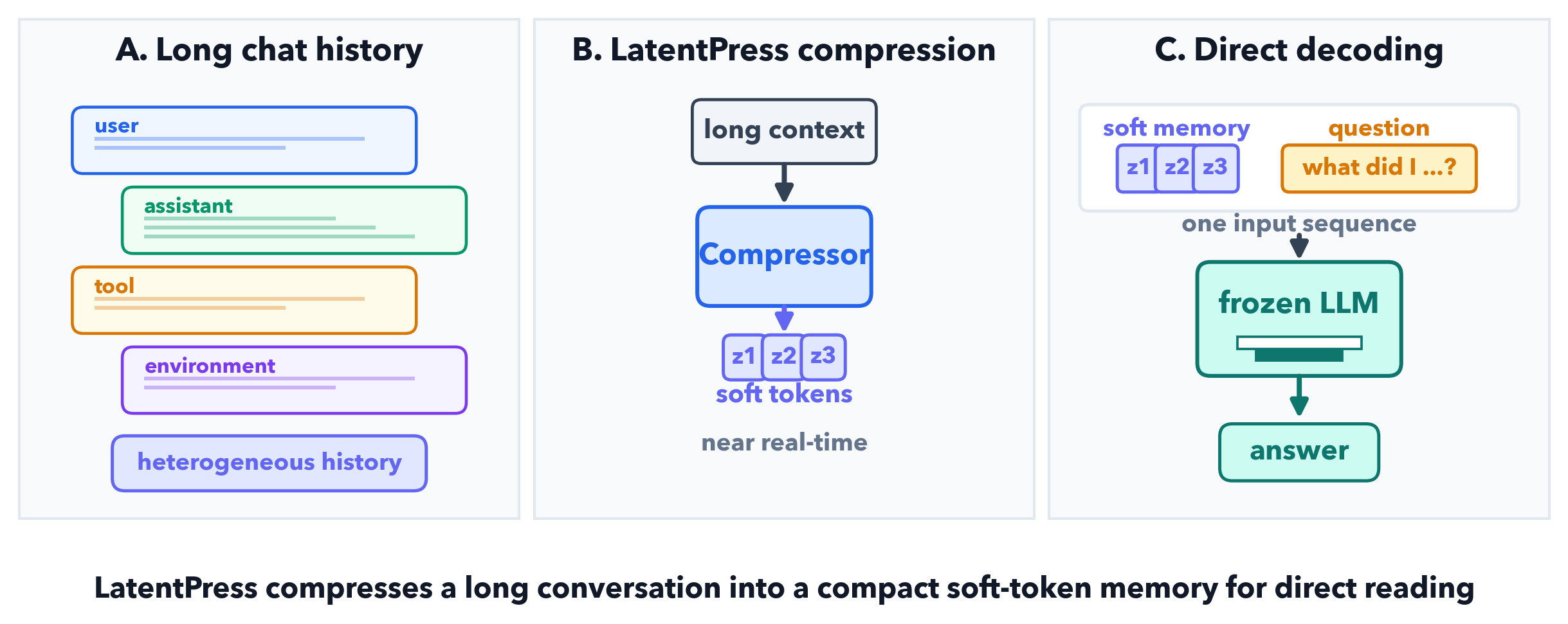
Compressed context is usually carried as human-readable text or as rendered images that must be decoded, even when its consumer is a language model.


When Guardrails Look Effective: Construct Validity Failures in LLM Agent Commerce Evaluation

Peiying Zhu; Sidi Chang arXiv: 2609.01519

Interactive simulations increasingly evaluate policies in markets populated by language-model agents.


Retrieved but not ranked: surface-form bias in structural retrieval, from mathematics to agent trajectories

Nabira Rashid; Manolis Kellis arXiv: 2609.01556

We evaluate embedding retrieval where surface form and meaning are pulled apart on purpose: retrieving items that share underlying structure but not wording, in two unrelated domains under one protocol, competition…


ScenePilot: Grow-and-Repair Policy for Text-Driven 3D Indoor Scene Generation

Jiawei Zhang; Hongsong Wang; Pan Zhou arXiv: 2608.30307

Text-driven 3D indoor scene generation has advanced from dataset-bound layout modeling to open-vocabulary synthesis with large language and vision-language models.


Tail-Replay: Escaping the Curse of Linear Attention in Prefix Caching for Hybrid LLMs

Yirui Liu; Ruoling Qi; Xuaner Wu et al. arXiv: 2608.30310

Hybrid large language models interleave full-attention layers with linear-attention layers to reduce the cost of long-context inference.


Season-Aware Hybrid Convolutional-Transformer for Antarctic Sea Ice Concentration Forecasting

Danyang Li; John Taylor; Thang Bui; Quanling Deng arXiv: 2608.30654

Antarctic sea ice concentration (SIC) forecasting is an important yet challenging task due to the coexistence of complex spatial structure, long-range temporal dependencies, and strong seasonal variability.


CAER: Causal Action Effect Reweighting for World Model Training

Jianjie Fang; Xvyuan Liu; Ziyou Wang et al. arXiv: 2608.30897

World models are becoming core infrastructure for embodied intelligence, with action-conditioned video generation providing controllable predictions of how scenes evolve after agent interventions.


SlideBank: A Persistent Hierarchical Evidence Bank for Consistent Whole-Slide Reasoning

Beidi Zhao; Gexin Huang; Ciro Zhang et al. arXiv: 2609.00342

Whole-slide images (WSIs) are challenging for vision-language reasoning because diagnostically relevant morphology is sparse, heterogeneous, and distributed across gigapixel-scale images and multiple spatial resolutions.


ISO-RAG: Isoperimetric Noise Control for Retrieval-Augmented Generation

Siyuan Zhang; Hanchen Wang; Dong Wen et al. arXiv: 2609.00513

Retrieval-Augmented Generation (RAG) mitigates large language models (LLMs) hallucinations, yet conventional dense retrieval struggles with the complex reasoning paths of multi-hop question answering (QA).


CRAFT: Fine-Tuning Pre-hoc Explainability in AI-native 6G RAN

Pranshav Gajjar; Vijay K Shah arXiv: 2609.00590

The next generation of mobile networks is envisioned as fully AI-native, with AI-RAN architectures embedding small language models (SLMs) to perform reasoning over real-time telemetry.


VIBE-Bench: Evaluating Personalized Large Language Models When Profiles Don't Mean Preferences

Yiwen Jiang; Yang Deng; Stephanie Fong et al. arXiv: 2609.00921

Personalized Large Language Models (PLLMs) aim to tailor responses to individual users, where a central challenge is preference reasoning: inferring query-relevant preferences from user-related history.


CoBRA: Learning Tool-Use Boundaries via Counterfactual Margins

Wenhao Zou; Xianglong Liu; Wendong Bi et al. arXiv: 2609.00967

As large language models increasingly act through external tools, deciding when to call a tool has become a central problem alongside deciding how to use it.


Accelerating Reinforcement Learning via MPC Solver-Gradient Guidance for Weights-varying MPC

Baha Zarrouki; Arslan Thobani; Jasper Hoffmann et al. arXiv: 2609.01061

In Model Predictive Control (MPC), cost-function weights shape closed-loop behavior, yet changing conditions often make fixed parametrizations suboptimal and motivate context-dependent online adaptation.


Hints Help But Do They Teach? Evaluating Skills Transfer in Code Generation

Will Badr arXiv: 2609.01106

When a hint turns a failing generated program into a passing one, does it provide missing information or merely steer the model toward a solution it could already produce?


MIDR: Enrichment-Augmented Indexing for Multimodal Document Retrieval

Debanjan Mahata; Atharva Tendle; Daniel Preotiuc-Pietro et al. arXiv: 2609.01316

Retrieval over visually rich documents has a representation problem: important content often lives in tables, charts, figures, and layout relations that plain OCR linearizes, corrupts, or omits.


Bandits in Prod: Hyperparameter Optimization at Inference Time

Louis Abraham; Tuan-Anh Nguyen; Nicolas Devatine arXiv: 2609.01335

Many production systems can assess a configuration only by using it on live requests and observing noisy feedback.


SMELT: Scaling Laws for Compute-Matched MoE Looped Transformers

Shaowen Wang; Ge Zhang; Kairong Luo et al. arXiv: 2609.01343

Looped Transformers increase effective depth by iterating a shared block of layers, but most evaluations compare at fixed model size, conflating architectural advantage with extra FLOPs.


Where the Verifier Fails: A Category-Level Audit of Reward Signals in RLVR

Esther Xin arXiv: 2609.01354

Reinforcement learning with verifiable rewards (RLVR) and standard benchmark evaluation both rely on an automatic verifier that turns a free text answer into a binary reward.


AutoConcept: Training-Free Concept-Guided Reranking for Metadata-Available Composed Image Retrieval

Tianyu Wang; Tianjiao Wu arXiv: 2609.01456

Composed image retrieval (CIR) retrieves a target image from a reference image and a text modification.


TempCloze: Can Video-LLMs Identify the Missing Middle?

Wenqi Pei; Henry Hengyuan Zhao; Yilai Liu et al. arXiv: 2609.01515

Temporal reasoning benchmarks for Video-LLMs are often mediated by language, leaving room for linguistic shortcuts from option wording, answer correlations, or language priors.


Designing Proactive Thought Partners for Writing

Chao Zhang; Abe Davis; Chih-Wei Chen; Chin-Chia Hsu arXiv: 2609.01588

Writing involves diverse cognitive activities, from ideation to revision, and writers' needs vary across individuals and moments.


Ignorance or Incompetence? Constructing Knowledge-Gated, Verifiable Tasks for LLM Agents

Hanlin Tian; Minhao Li; Yu Mi et al. arXiv: 2608.30322

Professional agent tasks often depend on conventions that are absent from public corpora, yet benchmarks rarely control whether an agent has access to those conventions.


Do Small Models Use the Law You Give Them? Measuring Context Use on a Bilingual Bangladesh Legal Benchmark

Moniruzzaman Mahadi; Abrar Mohammed Tanzim Alam; Sayma Siddika Monalisa et al. arXiv: 2608.30327

Fine-tuning can improve legal question-answering accuracy without improving how models use law supplied in context.


Trajectory-Initialized Neural Double Q-Routing for Large-Scale Overhead Hoist Transport Systems

Cheng Gu; Qiusheng Zhao; Anbang Liu et al. arXiv: 2608.30512

Large-scale industrial robot fleets share constrained physical infrastructure, making vehicle travel times dependent on safety separation, intersection access, downstream blocking, and station contention.


Learning-Assisted Congestion-Aware Route Scheduling for Semiconductor Fab Material Control Systems

Hao Yin; Meiqi Tu; Anbang Liu et al. arXiv: 2608.30520

Automated material handling systems in semiconductor fabs are operated by a material control system (MCS) that must schedule a relay route for every transport command online, before execution.


WebWorld: The Browser as a World Model for Self-Improving Web Code

Jiajun Wu; Jian Yang; Yaxin Du et al. arXiv: 2608.30530

VLM-driven self-improvement of web code has a structural flaw: the model that proposes the repair is the model that judges it, and visual plausibility under that judge is a poor proxy for whether the page actually works.


Designing an Auditable LLM-Supported Workflow for Qualitative Thematic Analysis

Nadia Jul Jeldtoft; Tariq Yousef arXiv: 2608.30543

Large Language Models (LLMs) offer new possibilities for scaling qualitative analysis, but existing applications often provide limited methodological transparency regarding how qualitative methods are translated into…


Preference Shapes Relevance: Cross-component Hierarchical Semantic Alignment for Personalized Generative Retrieval

Gaoming Zhang; Angqing Jiang; Jianchun Song et al. arXiv: 2608.30553

Generative Retrieval (GR) has emerged as a promising paradigm by mapping queries directly to Semantic IDs (SIDs) with powerful representation capabilities for candidate items.


Retrieval, Scoring, and Decoding Shape Performance and Stability in LLM-based Conversational Recommendation

Ante Kapetanovic; Tomislav Duricic; Andro Mercep; Emanuel Lacic arXiv: 2609.00086

Large language models (LLMs) are increasingly used as rerankers in conversational recommender systems, yet measured gains depend strongly on the retrieval and inference protocol.


An Agentic Retrobiosynthesis Framework with Learned Frontier Selection

Philippe Meyer; Guillaume Gricourt; Thomas Duigou et al. arXiv: 2608.30702

Large language models are increasingly used as agents for multistep retrosynthesis, raising the question of how much their search policy contributes independently of the underlying reaction model.


Functional Degeneracy in Neural Networks: Measurement and Pruning

Maria Matveev; Pascal Esser; Ayush Bharadwaj et al. arXiv: 2608.30741

A central question in modern machine learning is how much a trained model can be compressed without changing its behavior, to reduce the memory, compute and energy required to deploy it.


TDDM-Melatt: A Decoupled Memory and Diffusion Framework for Generalizable Encrypted Traffic Classification

Ze Chen; Qiming Yu; Zijia Song et al. arXiv: 2608.30745

The widespread adoption of encrypted traffic poses severe challenges to current security situational awareness systems based on network traffic monitoring.


Selection-Aware Stress Testing for Interactive Agents

Yang Xu; Chenang Li; Jiefu Zhang et al. arXiv: 2608.30916

Agent evaluations often use one benchmark to choose a workflow and then search for task types where its advantage weakens, so both conclusions are selected from the same data.


Towards Stream Learning on Embedded Systems: Benchmarking the Memory Consumption of Stream Learning Methods

Sebastian Buschjäger; Nuwan Gunasekara; Heitor Murilo Gomes arXiv: 2608.30923

Stream learning is commonly evaluated through predictive performance and adaptation to concept drift.


LightNav-0: Eliciting VLM Spatial Intelligence for Generalist Embodied Navigation

Shaoan Wang; Aocheng Luo; Fei Huang et al. arXiv: 2608.30935

Embodied navigation requires agents to translate heterogeneous goals and visual observations into actions across tasks, environments, and robot embodiments.


PaperGym: Rubric-Centered Evolution for Research-Plan Generation

Yuhan Wang; Zhengxi Lu; Yuchen Yan et al. arXiv: 2608.31119

Research planning is the decisive capability of AI scientists.


OntoAligner-Ensemble: Voting-Based Fusion across Heterogeneous Ontology Alignment Techniques

Hamed Babaei Giglou; Sören Auer; Peio Popov et al. arXiv: 2608.31137

Ontology alignment (OA) has evolved through several methodological paradigms, ranging from lexical and structural aligners to knowledge graph embedding (KGE) models and, more recently, Large Language Model (LLM)-based…


Don't Let the Model Write the YAML: Deterministic, Minimal-Diff GitOps Remediation from LLM-Proposed Field Changes

Pruthvi Davineni arXiv: 2609.00227

LLM agents increasingly diagnose incidents and propose remediations.


Authority Bias in Conversational Search Engines for Academic Paper Recommendation

Uthman Jinadu; Parsa Ghazvinian; Anjila Budathoki et al. arXiv: 2609.00248

Large Language Models (LLMs) are increasingly used as conversational search engines for academic literature, yet whether they judge papers on content or on authority signals has not been tested causally.


NSIDDx: A Design Framework for Neuro-Symbolic, Practitioner-First Differential Diagnosis in Low-Resource Settings

Aarav Singh arXiv: 2609.00256

LLM-based diagnostic systems achieve high semantic accuracy on benchmarks, but open-ended evaluation on clinically uncommon presentations reveals a systematic gap between headline accuracy and verifiable clinical…


Exploring Collaboration between a language and a non-language agent

Harini S; Somesh Singh; Yaman K Singla et al. arXiv: 2609.00474

LLMs are increasingly deployed as orchestrators that coordinate specialized subagents to solve complex tasks through natural language.


Validity-Aware Jailbreak Evaluation for Large Language Models

Qilong Wu; Sahil Wadhwa; Pranab Mohanty et al. arXiv: 2609.00498

Jailbreak robustness has become central to large language model (LLM) safety evaluation, yet prevailing methodologies rely primarily on refusal behavior, semantic resemblance, and intent-matching heuristics that…


Towards Effective Structured Context Modeling for Conversational Recommender Systems via Dual-node Monte Carlo Tree Search

Jincheng Zhang; Chen Huang; Wenqiang Lei et al. arXiv: 2609.00618

We investigate the role of conversational context modeling in user preference tracking for Conversational Recommendation Systems (CRSs).


DramaChain Bench: An End-to-End Benchmark for Short-Drama Generation

Haoyuan Shi; Mingtao Chen; Shuo Jiang et al. arXiv: 2609.00646

Commercial short-drama production follows a multi-stage chain: script, storyboard, keyframe imagery, shot-level video, and the finished short drama.


Drift-Aware LLM Routing with Sparse Contexts and Shared Budgets

Cheung Hao Lee; Patrick Wong arXiv: 2609.00662

A multi-model language service must route each request while preserving workload-level budgets for compute, latency, memory, or monetary cost.


SCoNE: Selective Context-aware Neuron Editing for Robust Retrieval-Augmented Generation

Chaewon Kim; Seo Yeon Park arXiv: 2609.00689

Retrieval-Augmented Generation (RAG) is highly sensitive to retrieval noise: when retrieved documents mix informative and irrelevant context, LLMs are easily distracted, leading to hallucinations.


Automated Tree Knowledge Graph Construction using Ontology Expansion and Retrieval from Vietnamese History Textbooks

Ket Doan Nguyen; Minh N. H. Nguyen arXiv: 2609.00763

Hierarchical Knowledge graph (KG)-based retrieval augmented generation (RAG) has emerged as a powerful approach for supporting large language models with structured knowledge.


SFAD: Speculative Factuality-Aware Decoding

Guanqiao Chen; Di Wang; Lijie Hu arXiv: 2609.00796

As one of the most critical challenges in large language models, contextual faithfulness directly determines their reliability in knowledge-intensive applications.


TEIDAN: A Multilingual Multiparty Dialogue Corpus

Taiga Mori; Koji Inoue; Mikey Elmers et al. arXiv: 2609.00802

Multi-party interaction is a central setting for human communication and a necessary target for human-agent interaction systems that must participate in group conversation.


Dense Process Supervision for Search Agents via Fact Utility Estimation

Rongzhi Zhu; Xiangyu Liu; Yi Liu et al. arXiv: 2609.00833

Reinforcement learning (RL) for search agents typically relies on outcome rewards.


CacheBridge: Efficient Cross-Model KV Cache Transfer

Xingyu Qu; Siyuan Lu; Zhiyu Chen et al. arXiv: 2609.00891

Sharing context between LLMs in a multi-model system requires the receiving model to prefill the shared prefix because KV caches are model-specific.


In-Context Neurofeedback: Can LLMs Control Their Internal Representations through Privileged Access?

Koshiro Aoki; Ryota Takatsuki; Gouki Minegishi et al. arXiv: 2609.00904

Whether large language models (LLMs) can control their own internal representations matters for both machine metacognition and AI safety.


Beyond the Image Plane: World-Grounded Queries for Multi-Object Tracking

Orcun Cetintas; Guillem Brasó; Tim Meinhardt; Laura Leal-Taixé arXiv: 2609.00924

Monocular videos record 3D scenes as sequences of 2D image-plane projections, obscuring depth and spatial relationships.


Web Price Extraction: State of the Art and an Adaptive Browserless Implementation

Evgeniia Kositsyna; Jorge Lloret-Gazo arXiv: 2609.01030

Price extraction from websites is a key task for market monitoring, price comparison, and business analytics in e-commerce.


AgentFactory: Towards Automated Agentic System Design and Optimization

Enci Zhang; Haofeng Wang; Yuesheng Zhu et al. arXiv: 2609.01045

Large Language Models (LLMs) have demonstrated remarkable capabilities as powerful components in agentic systems, enabling sophisticated reasoning and complex task execution.


InSight: A Benchmark for Agentic Claim Verification in Interactive Visualizations

Maeve Hutchinson; Syed Mahbubul Huq; Mohammad Albinhassan et al. arXiv: 2609.01383

Vision Language Models have demonstrated remarkable proficiency in interpreting static visual artifacts, but modern data analysis is inherently dynamic, requiring the active interrogation of interactive environments.


Evaluating Multimodal LLMs as Generalist Vision-Language-Action Agents for Drone Control: Commanding, Approaching, Tracking and Searching

Jaewoo Park; Minyoung Lee; Sukmin Seo et al. arXiv: 2609.01404

Multimodal Large Language Models (MLLMs) are strong perceivers of images and video.


EdiTikZ: Scientific Figure Editing from Revision Trajectories

Christian Greisinger; Zhixue Zhao; Steffen Eger arXiv: 2609.01409

Vision-language models (VLMs) have shown strong performance in generating scientific figures from text or images.


Relational-Core Graph Analytics Querying graphs at SQL scale, and why the node/edge model is a performance tax, not a truer picture of connected data

Gene Zhang arXiv: 2609.01525

A durable assumption holds that graph analytics requires a purpose-built graph engine, and that relational systems are ill-suited to connected data.


EvoSCM: Scientific Belief Revision Through Causal Model Evolution and Experimentation

Qing Zhao; Haowei Li; Weijian Deng et al. arXiv: 2609.01526

Scientific agents must learn not only how to reason, but also what to believe.


From Confusion to Clarity: Confusion-Aware Retrieval and Knowledge Injection for Text Classification

Manish Gupta; Chaitanya Giri; Jayasimha Talur arXiv: 2609.01564

Large language models (LLMs) struggle to classify text into taxonomies with many semantically similar labels, as the distinctions are domain-specific and not captured by pre-training.


Adaptive Critical Token-Aware Retrieval for Repository-Level Code Generation

Kefeng Duan; Dewu Zheng; Yanlin Wang et al. arXiv: 2609.01601

The repository-level code generation task requires synthesizing code that satisfies task requirements while remaining consistent with the target repository context.


Convergence rates for the RMSprop optimizer with full control of the hyperparameters

Steffen Dereich; Arnulf Jentzen arXiv: 2608.30382

Popular adaptive stochastic gradient descent (SGD) methods to train artificial intelligence (AI) systems include the RMSprop, the Adam, and the AdamW optimizers, where the adaptivity parts in Adam and AdamW basically…


Locally-Guided Actor-Critic: Training a Goal-conditioned Actor with a Subgoal-aware Critic

Olivier Serris; Stéphane Doncieux; Olivier Sigaud arXiv: 2608.30406

Goal-conditioned reinforcement learning struggles with long horizons when rewards are sparse.


From Final Artifacts to Trajectories: Retrospective Process Supervision for Evidence-Grounded Long-Form Generation

Junjie Huang; Jiarui Qin; Di Yin et al. arXiv: 2608.30461

Trajectory data is getting more vital for training large language models for boosting the agentic abilities.


Measuring Memory and Generalization as Separable Geometric Channels: The Topo^2 Framework

Zhanbo Zhang; Ming Liu; Qing Wang arXiv: 2608.30487

Deep networks trained on noisy labels simultaneously generalize on clean data and memorize flipped labels.


Tensor Methods for Language Models: From Token Representation to Training, Adaptation, Inference, Compression, and Interpretability

Matvei Tarasov; Salman Ahmadi-Asl; Andre L. F. de Almeida; Andrzej Cichocki arXiv: 2608.30505

Large language models (LLMs) are built from structured high-dimensional objects such as token representations, weights, adaptation updates, caches, and activations, whose multilinear structure is underexploited by the…


ScienceArena: Benchmarking LLMs on Latest Scientific Olympiad Competitions

Guangxiang Zhao; Qilong Shi; Xusen Xiao et al. arXiv: 2608.30517

Benchmark saturation and data contamination increasingly obscure genuine scientific reasoning in frontier LLMs.


State of Health Estimation using Convolutional and Bidirectional LSTM Neural Networks tuned by Bayesian Optimization

Panagiotis Eleftheriadis; Foivos Georgios Kyrgios; Sonia Leva arXiv: 2608.30593

In this research, a novel framework is proposed for the SOH estimation, which employs a hybrid deep learning architecture of a concatenation of a Convolution Neural Network (CNN) and a Bidirectional Long Short-Term…


Fine-Tuning Low-Bit Models with Gradient in Quantized Code Space

Shiguang Wu; Zhouchen Lin; Quanming Yao arXiv: 2608.30908

Fine-tuning Low-bit models aims to adapt a quantized model while keeping the final deployed checkpoint in the same low-bit form.


Reproducible macroscopic dynamics in a closed-loop human-AI learning system

Minlin Wu; Xu Fang; Yicheng Zhang et al. arXiv: 2608.30946

Closed-loop human-AI systems generate high-dimensional behavioural trajectories whose collective dynamics remain obscure.


The Hermon Moment: AI Self-Transcendence and Its Human Narration

Alexei Grinbaum arXiv: 2608.30971

In 2026, AI agents intended to act in isolation formed a persistent social order through thousands of linguistic and agentic interactions.


Language-Informed Flow Matching for Trend-Guided Structure-Based 3D Molecular Generation

Tianyu Gao; Zhikai Su; Jiashu Li et al. arXiv: 2608.31009

Structure-based drug design (SBDD) requires ligands that satisfy both 3D target affinity and 1D chemical validity.


Scaling Large Reasoning Models beyond Human Supervision: A Path toward Superintelligence

Zhiqin Yang; Jingwen Fu; Yuhan Liu et al. arXiv: 2608.31075

Recent advances in large reasoning models (LRMs) have shown that reinforcement learning with verifiable rewards (RLVR) can substantially improve reasoning in mathematics and code, where outcomes can be checked…


When Does Bigger Help? A Controlled Study of LLM Scale for Ontology Learning

Hamed Babaei Giglou; Sören Auer; Jennifer D'Souza arXiv: 2608.31118

The effect of Large Language Model (LLM) scale on ontology learning (OL) performance remains insufficiently characterized.


Workload Identification with Physical Side Channels for AI Governance

Simone Gargiulo; Gabriel Kulp arXiv: 2609.00309

AI compute verification is one of the first tangible and tractable points for international policy aimed at AI governance.


Do LLMs Know Your Neighborhood? Auditing LLM Priors for Neighborhood-Level Mobility Prediction and Structural Alignment

Saad Mohammad Abrar; Eesha Kurella; Arnav Dadarya et al. arXiv: 2609.00345

Human mobility is central to urban planning, transportation, public health, and emergency response, yet fine-grained trajectory data are often proprietary, restricted, and privacy-sensitive.


DynaNDE: Dynamic Near-Data Expert Scheduling for Batched MoE Inference

Xiaoyang Lu; Belthangady Akash Vi Narayana Pai; Xian-He Sun arXiv: 2609.00407

Mixture-of-Experts (MoE) models enable efficient scaling of large language model (LLM) inference but suffer from substantial data-movement overhead when deployed on neural processing unit (NPU)-based systems.


How Temporal Correlations Shape Memory in Linear Recurrent Neural Networks

Arnol Manuel Fokam; Fasseu Sieyondji Akpevwoghene; Edem Fiifi Dawson arXiv: 2609.00420

The linear recurrent neural network (LRNN) is a simple model for studying how much memory a network builds up as it trains.


WiseSpec: Requirements-Driven Agents for Code Generation

Zhao Tian arXiv: 2609.00568

Code generation aims to automatically generate source code from task requirements and has attracted significant attention with the rapid advancement of large language models (LLMs).


Residual Sparsification via Output Importance for Compressing Mixture-of-Experts LLMs

Seungwoo Jung; Dohyeok Kwon; Seungmin Cha et al. arXiv: 2609.00575

Mixture-of-experts (MoE) architectures scale large language models efficiently, but they demand massive GPU memory.


Investigating Assistant Bias in LLM User Simulators Using a Role Vector

Daeheon Jeong; Yoonjoo Lee; Eugene Choi et al. arXiv: 2609.00608

LLM-based user simulators are increasingly used to evaluate autonomous agents at scale, in place of costly human evaluations.


Breaking the Structural Identity: Personalized Federated LoRA Fine-tuning under Rank Heterogeneity

Lei Wang; Jieming Bian; Letian Zhang; Jie Xu arXiv: 2609.00632

Large Language Models (LLMs) have achieved remarkable success across diverse domains, but their adaptation to privacy-sensitive, distributed datasets remains a challenge.


REVISE: Validity-Guided Recovery for Online Revisions in Agent Workflows

Ruoling Qi; Xuaner Wu; Penghang Liu et al. arXiv: 2609.00643

Agent revisions expose a fundamental correctness--efficiency trade-off during concurrent execution.


Self-Reports Are Not Verification: Environment-Grounded Auditing of LLM Operators in Evolutionary Search

Enrong Pan; Ryan Zhou; Ting Hu arXiv: 2609.00652

Language model agents increasingly propose actions, observe external feedback, and explain their own behavior.


A Closed-Loop Evaluation of Capability Loss and Recovery in Compressed Driving Policies

Ahmad Alfan Alfian Irfan; Nur Ahmad Khatim; Mansur Arief arXiv: 2609.00718

Many automobile and mobility companies deploy learned driving policies on embedded computers with limited memory and power.


Agentic Empirical Asset Pricing: Methodological Foundations

Yingjian Pan; Xiaowei Ding; Kay Giesecke arXiv: 2609.00731

Recent advances in LLM agents enable a new paradigm for asset pricing, which we call Agentic Empirical Asset Pricing (AEAP): systems that autonomously conduct the scientific discovery process itself.


Subspace Levenberg Marquardt Algorithms in Training Neural Networks

M. Duc Hoang arXiv: 2609.00789

The Levenberg-Marquardt (LM) algorithm is a well-known second-order method for rapid convergence and strong robustness when training small- to medium-sized neural networks (NNs).


Agentic programs: an emerging form of scientific software in computational materials science

Yunsung Lim; Haekwan Jeon; Jaesun Kim et al. arXiv: 2609.00795

Computational materials science has traditionally delegated algorithmic tasks to computers while leaving scientific judgments to humans.


Beyond the Clock: Measuring the Value of Adaptive Revision

Ayushi Chadha arXiv: 2609.00874

As agentic systems become compound systems, increasingly important decisions move above task execution itself: when should a higher-level controller preserve the strategy guiding another process, and when should it…


FractalNet-Based Heterogeneous Federated Learning for Orbital Edge Intelligence in Satellite Mega-Constellations: A Wildfire Case Study

Sai Puppala; Koushik Sinha arXiv: 2609.00875

Satellite mega-constellations are emerging as large-scale sensing, communication, and computation fabrics, yet their learning architectures remain largely inherited from terrestrial federated learning and…


Few-Shot Out of Domain Intent Detection with Covariance Corrected Mahalanobis Distance

Jayasimha Talur; Oleg Smirnov; Paul Missault arXiv: 2609.00961

Conversational agents like chatbots and voice assistants are trained to understand and respond to user intents.


Inspicio: Open-Vocabulary, LLM-Based Sense Retrieval for Historical Languages

Michele Ciletti arXiv: 2609.00998

Word Sense Disambiguation has advanced rapidly for English and a handful of well-resourced modern languages, but it continues to assume the existence of a sense inventory and a word-to-sense mapping in the source…


When Does Online Adaptation Pay on the Edge? A Leakage-Free Evaluation of Warmup, Learning-Rate Selection, and Resource Trade-offs for Time-Series Forecasting

Takumi Fujimoto; Hiroaki Nishi arXiv: 2609.01126

Online adaptation can help edge time-series forecasting under distribution drift, but its measured benefit is sensitive to evaluation choices.


On the Design Fundamentals of Pixel Text Representation Learning

Chaohao Yuan; Ruifeng Yuan; Zhuoxu Huang et al. arXiv: 2609.01147

Text-rich visual inputs require models that can read, retrieve, and compress language directly in pixel space, yet existing pixel-text encoders struggle with fixed resolution pretraining, visual shortcut learning, weak…


Superposed Latent Autoencoder

Quanling Zhao; Jiaying Yang; Tianqi Zhang et al. arXiv: 2609.01158

Autoencoders typically meet tight latent-memory budgets by making each latent representation smaller, sacrificing representational capacity.


Towards AI-Assisted Clinical Trial Matching: Practical Considerations, Multicenter Evaluation, and Real-World Deployment

Yin Fang; Qiao Jin; Shubo Tian et al. arXiv: 2609.01202

Clinical trials are essential for advancing cancer care and drug development, but many fail because of insufficient patient enrollment.


Autonomous discovery of new structure-plausibility laws for explainable and rapid crystal diagnosis and screening

Zhilong Song; Lixue Cheng arXiv: 2609.01209

Crystal generators and tool-using agents propose structures faster than density functional theory (DFT) energy and phonon calculations or experiments can assess them.


A Mathematical Theory of Reusable Neural Bases for Network Compression

Binshuai Wang arXiv: 2609.01550

As large AI models become increasingly prevalent across a wide range of applications, memory cost has become a critical bottleneck in both training and inference.


Selective Agent Guidance via Entropy: Learning Autonomous Policies from Imperfect VLM Teachers

Matteo Merler; Giovanni Bonetta; Davide Zago et al. arXiv: 2609.01567

Vision-Language Models (VLMs) provide useful priors for interactive decision-making, but using them directly as policies is expensive and brittle: they must be queried at every step, do not improve from environment…


Mechanism Design for Alignment and Control

Dirk Bergemann; Andrew Koh; Stephen Morris arXiv: 2609.01595

We develop a framework for mechanism design with AI agents whose alignment (preferences) and capabilities (feasible actions and information) are unknown.


The Rise of Verbal Reinforcement Learning

Kshitij Tayal; Arun Sharma; Genta Indra Winata et al. arXiv: 2609.01597

Natural language is emerging as a primary feedback channel for improving language agents, capable of conveying intent, preferences, and causal structure in forms interpretable by both humans and modern language models.


Beyond Token-Level Guidance: Inference-Time Alignment of Specialized LLMs via Cross-Family Representation Steering

Jin Gan; Xin Li; Jun Luo arXiv: 2608.30319

Large language models (LLMs) finetuned for specialized domains represent crucial high-impact applications.


Coarse composition suffices: tabular in-context learning for multi-activity antimicrobial peptide profiling

Raunak Kumar; Anuj Pal; Dhruvi Solanki et al. arXiv: 2608.30337

Antimicrobial peptides (AMPs) often act against multiple pathogen classes, making multi-label activity prediction a more realistic screening target than binary antimicrobial classification.


Auditing MCQA Benchmarks through Probability Landscapes

Minsoo Song; Chanjun Park arXiv: 2608.30372

As Large Language Models rapidly advance, performance on standard multiple-choice question answering (MCQA) benchmarks is reaching saturation.


PAVE: Predictive Alignment and Value-Guided Evolution for World-Action Policies

Botong Zhao; Fang Yu; Tim et al. arXiv: 2608.30378

Direct vision-language-action policies generate continuous robot actions efficiently, but standard behavior cloning leaves two complementary gaps: their representations are not explicitly required to describe how the…


ImageCAS-X: a dataset and benchmark for coronary artery segmentation and centerline extraction in coronary CT angiography

Kit M. Bransby; Esther Øksnebjerg; Kristoffer Kjær et al. arXiv: 2608.30404

Accurate segmentation of the coronary vessel lumen is a prerequisite for quantitative assessment of atherosclerotic plaque and perivascular adipose tissue in coronary computed tomography angiography (CCTA).


From Metaheuristics to Exact Methods: A CP-SAT Approach for Multi-Objective Healthcare Workforce Scheduling

Vipul Patel; Anirudh Deodhar; Dagnachew Birru arXiv: 2608.30419

Healthcare workforce scheduling is an NP-hard optimization problem requiring simultaneous satisfaction of labor regulations, coverage requirements, employee preferences and cost objectives.


VisER: Visual Evidence and Reliance for Object Hallucination Detection in LVLMs

Afsaneh Hasanebrahimi; Hanxun Huang; Christopher Leckie; Sarah Erfani arXiv: 2608.30480

Object hallucination remains a persistent reliability issue in large vision-language models, where generated object mentions may sound plausible but lack visual grounding.


Lot Machine: Multimodal Lot Extraction from Auction Catalogs

Mathias Zinnen; Alisha Mund; Sabine Lang et al. arXiv: 2608.30510

For provenance research and art market studies, auction catalogs are an essential resource to trace specific objects over time and space.


REER-PT: Reverse-Engineered Reasoning for Perplexity-Guided Pre-training Data Augmentation

Haoran Que; Jiajun Shi; Ting Huang et al. arXiv: 2608.30627

As language-model compute continues to scale, high-quality training data is becoming an increasingly important bottleneck.


Three Steps at a Time: Learning Representations from Action Sequences in Contrastive RL

Michal Korniak; Kamil Dybek; Benjamin Eysenbach et al. arXiv: 2608.30640

While self-supervised approaches to reinforcement learning have achieved strong results by learning representations of states and actions, a key open question is the time scale over which actions should be modeled.


Fine-Grained Multi Image Object Hallucination Benchmark

Joonki Min; Chaeyun Kim; Hyungwook Choi et al. arXiv: 2608.30653

Multimodal Large Language Models (MLLMs) are increasingly deployed in multi-image scenarios requiring complex reasoning across visual contexts.


Learning Materials Properties from Scarce Labels and Unlabeled Crystals

Wentao Li; Yizhe Chen; Jiangjie Qiu et al. arXiv: 2608.30682

Learning materials properties from scarce labels and unlabeled crystals is a central challenge for data-driven materials discovery.


SingProbe Technical Report

Sing Team arXiv: 2608.30703

Runtime guardrails are essential for reliable large language model (LLM) deployment, yet existing approaches typically rely on independent, external models that introduce additional inference cost, delayed safety…


Multimodal Adaptive Expert Selection with Text Routing and Ordinal Prototype Optimization for Sentiment Analysis

Xiaode Chen; Jiakang Yu; Hongtao Deng et al. arXiv: 2608.30726

Multimodal Sentiment Analysis (MSA) is a fundamental component of affective computing that aims to decipher complex emotional states by integrating verbal content with non-verbal cues including vocal intonation and…


Not All Fallbacks Are Failures: Understanding and Recovering from Fallbacks in Mobile Voice Assistants

Phillip Schneider; Alexandre Mercier; Joshua Oehms et al. arXiv: 2608.30738

Robust understanding of user input is a core requirement for voice assistants deployed in real-world environments.


Do VLMs Share Safety Neurons Across Modalities?

Jiaxuan Li; Jiahao Zhang; Duc Minh Vo et al. arXiv: 2608.30750

Vision-language models (VLMs) can comply with harmful requests delivered through images, even when their LLM backbones would refuse the same content in text.


Autoregressive Mosaics: Probing 2D Spatial Reasoning in Text-Only Language Models

Ashwin Nedungadi; Stefan Oehmcke; Stefan Lüdtke arXiv: 2608.30751

Large language models (LLMs) trained only on text and code can sometimes generate programs that draw recognizable images.


Local Reference Geometry Residual Augmentation for Imbalanced Time Series Classification

Chuanhang Qiu; Yanran Xu; Yue Wang; Anthony Bagnall arXiv: 2609.00093

Imbalanced time series classification is often addressed by changing the training distribution, objective, logits, or final threshold.


Lucida: Parse, Generate, and Place for Composable Real-to-Sim Scene Modeling

Minghan Qin; Yuang Wang; Xiuyu Yang et al. arXiv: 2608.30821

Composable scene modeling aims to recover a real indoor scene as complete, editable object assets arranged as observed, giving robot simulation and embodied AI a simulation-ready replica of the real environment whose…


Beyond Good Intentions: When Does the Framing of Multilingual and Low-Resource NLP Research Become a Caricature?

Nedjma Ousidhoum; Noopur Zambare; Mohamed Abdalla arXiv: 2608.30866

Building language technologies and conducting NLP research for low-resource languages---particularly when led by native speakers or involving participatory research practices---are often framed as means of addressing…


Personas Differ from Native-Language Generation: Language Pathways Shape LLM Interpersonal Advice

Jinhee Won; Xinlan Emily Hu arXiv: 2608.30873

LLMs are increasingly used for interpersonal advice and as tools for studying social behavior across languages and cultures.


Low-Resource Preference Adaptation of LLMs via Activation-Based Label Propagation

Alessio Galatolo; Meriem Beloucif arXiv: 2608.30902

Adapting large language models to user-specific preferences is often constrained by the cost of human annotation, making preference optimisation impractical in low-resource settings where preferences cannot be reliably…


MusGU+: Toward a Musician-Centered Evaluation Framework and Discovery Tool for Generative Music AI

Laura Ibáñez-Martínez; Roser Batlle-Roca; Xavier Serra; Martín Rocamora arXiv: 2608.30940

Generative music systems are increasingly presented as tools that democratize music creation, yet their practical suitability for musicians remains underexplored.


Evaluating and Improving LLM Self-Modeling

Siqi Zeng; Andre N. Assis; Rowan Wang arXiv: 2608.30980

We study self-modeling: an LLM's ability to answer questions about its own behavior.


TSPFN: A Temporal Tabular Foundation Model for Physiological Time Series Classification

Jérémie Stym-Popper; Clément Rambour; Federica Granese et al. arXiv: 2608.31013

Designing models that generalize effectively in low- to medium-data regimes remains a primary challenge in medical machine learning, particularly for physiological time-series classification.


LLM Judges Verify Presence, Not Absence: Omission Blindness in AI Clinical Notes and What Recovers It

Sebastian Fox; Luke Markham; Ryan Lail; Michael Karotsieris arXiv: 2608.31016

Ambient AI scribes draft clinical notes, and published audits find their dominant error is omission: information the encounter established that the note fails to record.


Stress-Testing Efficient Responsible-AI Evaluation: When Compute Savings Change Benchmark Conclusions

Ahmed El Kady; Aravind Narayanan; Rehana Noorani et al. arXiv: 2608.31108

Efficient evaluation changes the protocol used to support claims about model behavior, yet it is rarely tested whether those claims remain stable after the evaluation itself is made cheaper.


Context-Aware Interleaved Batching for WhisperX

Carlos Bain; Max Bain arXiv: 2608.31170

While WhisperX accelerates speech transcription via intra-audio batching, it isolates audio segments, losing the historical context needed for coherent punctuation and terminology transcription.


Do General NLP Embeddings Capture Ontological Reasoning?

Hamed Babaei Giglou; Jennifer D'Souza; Sören Auer arXiv: 2609.00177

General-purpose NLP embedding models perform well on linguistic tasks, but their ability to capture symbolic ontological structure remains unclear.


Autoresearch for Marketplace Catalogs: From Legacy Forms to AI-Native Matching

Kartik Ravisankar; Hojat Abdolanezhad; Daniel Capo et al. arXiv: 2609.00274

Two-sided service marketplaces are moving from deterministic request-form intake to AI-native probabilistic matching, enabled by large language models (LLMs) that infer intent, preferences, and latent constraints from…


WiSDoM: Wireless Sparse Decision Transformer with Mixture-of-Experts for Multi-Task Mobile Network Optimization

Fatih Temiz; Shavbo Salehi; Melike Erol-Kantarci arXiv: 2609.00284

Emerging 6G wireless networks are expected to operate across diverse deployment scenarios, where variations in network topology, user mobility, traffic demand, and radio conditions challenge the scalability of…


Emotional Labor Strategy Preferences in LLM Personas

Mohammad Saim; Tianyu Jiang arXiv: 2609.00310

Emotional labor is the effortful management of emotional displays to meet social or professional expectations.


Conversation Coach: A Voice-enabled AI System that Helps Practice Difficult Workplace Conversations

Fanyou Wu; Suraj Maharjan; Ainur Yessenalina et al. arXiv: 2609.00441

Effective manager-employee communication is critical for retaining high performers and developing underperformers, yet training managers in these skills remains costly.


CRAD: Class-wise Reliability-Aware Distillation for Decentralized Heterogeneous Federated Learning

Baraa Bilbeisi; Mengchen Fan; Baocheng Geng; Qing Tian arXiv: 2609.00446

Conventional federated learning (FL) relies on parameter averaging, which forces clients to be doubly homogeneous: it demands an identical architecture and degrades under non-IID data.


HBQ: Hierarchical Scaling Block Quantization with Hardware-Efficiency-Aware Design for Accurate LLM Inference

Chun-Ting Chen; Dongmin Han; Hangyeol Mun et al. arXiv: 2609.00450

Block Quantization (BQ) is a promising approach for efficient deployment of large language models (LLMs), enabling low-precision computation with controlled accuracy degradation.


Location-Aware Language Models via Secondary Embeddings

Gokul Srinivasagan; Munir Georges arXiv: 2609.00454

Pretrained transformer-based language models achieve strong performance across a wide range of NLP tasks but remain limited in encoding geo-locational semantics, leading to suboptimal representations of place names and…


MemeBridge: A Dataset for Benchmarking and Mitigating the Bidirectional Cultural Gap in Meme Interpretation

Hangxiao Zhu; Suliu Qin; Zhuoyan Li et al. arXiv: 2609.00491

Communicating across cultures is inherently challenging, especially through culturally dense and ambiguous formats like memes.


Same Request, Different Boundary: Evaluating Cybersecurity Assistance across Conversational Contexts

Rui Yang; Yang Hong; Yichao Xu et al. arXiv: 2609.00578

Large Language Models (LLMs) can solve complex problems, but their misuse in high-risk domains can lead to severe consequences.


Trust Your Guide Only When Certain: Uncertainty-Aware Sparse Alignment at Inference Time

Zeen Zhu; Zhuo Li; Weiyang Guo et al. arXiv: 2609.00624

A prominent paradigm in inference-time alignment employs lightweight supervisors to steer Large Language Models (LLMs).


Patterning in Practice: Debiasing Reward Models with Susceptibilities

George Wang; Elizabeth Donoway; Daniel Murfet arXiv: 2609.00699

Reward models trained on human preferences are known to suffer from length, formatting, and other stylistic biases.


SOVER: Formal Certification of Optimization Reformulations via LLM-Assisted SMT Verification

Swapnil Bhattacharyya; Mayank Baranwal arXiv: 2609.00728

Large Language Models (LLMs) have shown remarkable promise in translating and reformulating complex mathematical optimization problems across modeling languages.


StudyBench: Can Self-Evolution Squeeze Textbooks for Olympiad Capability?

Yinghao Chen; Zixi Chen; Bingxiang He et al. arXiv: 2609.00787

Humans need to study only a handful of well-written textbooks to master a discipline and attempt its hardest problems.


TWIX: a Two-Stage Approach for End-To-End Named Entity Recognition and Relation Extraction

Marco Martinelli; Laura Menotti arXiv: 2609.00832

The exponential growth of scientific publications calls for automatic Information Extraction (IE) systems to support knowledge discovery.


RPCBench: A Benchmark for Proactive Premise Critique in LLM-based Recommendation

Zhongru Chen; Yuan Wu; Yi Chang arXiv: 2609.00918

Large language models are increasingly used as interactive recommender assistants.


FinLifeBench: Exhaustive Life-Event History and Financial-State Reconstruction from Longitudinal Banking Dialogue

Hangyeul Lee; Juyoung Oh; Jaeyong Ko et al. arXiv: 2609.01198

Repeated banking interactions require assistants to maintain complete, current, and traceable customer records as life changes emerge incidentally in routine requests.


Who Judges the Judges? A Chinese Safety QA Benchmark for Evaluating LLM Responses and Safety Judges

Rui Yang; Shuang Huang; Junhua Liu et al. arXiv: 2609.01210

Safety benchmarks for large language models often assess the risk of a user query, although the outcome of question answering depends on whether the response violates a policy.


From Language to Behavior: Scaling Sequence Transformers for Industrial Recommendation Ranking with Rec-Native Designs

Jie Chen; Xiangqian Yu; Yanchao Lian et al. arXiv: 2609.01240

Scaling Transformers has driven large gains in language modeling, but transplanting this to behavior-sequence modeling in production ranking is challenging: recommendation differs in signal quality, where behavior…


Reliability Challenges in Diffusion Vision-Language Models

Md. Atabuzzaman; Chris Thomas arXiv: 2609.01318

Diffusion-based Large Vision-Language Models (dLVLMs) have recently emerged as a compelling alternative to autoregressive (AR) LVLMs, offering advantages in parallel decoding, bidirectional context, and controllable…


Investigating Linear Probe Robustness to Linguistic Register, Medical Specialty, and Corpus Shifts in Medical QA

Nishant Mishra; Ameen Abu-Hanna; Iacer Calixto arXiv: 2609.01361

Linear classifiers trained on hidden states of a large language model (LLM), linear probes, can flag factual errors from a single forward pass.


How Correct Is Your Answer? A Semantic Correctness Framework for Open QA Evaluation

Elitsa Yotkova; Violeta Kastreva; Petar Velkov et al. arXiv: 2609.01369

Reliable evaluation of open-ended question answering remains a bottleneck for measuring answer correctness of modern LLMs.


SDARE-Bench: Evaluating Large Language Models on Conversational Stigma Detection and Response in Dyadic and Group Dialogue

Stephanie Fong; Yiwen Jiang; Zimu Wang et al. arXiv: 2609.01548

Large Language Models (LLMs) are increasingly used in advice seeking and decision making that may affect social judgements.


Can LLMs Discover Scientific Laws in Real and Parallel Worlds?

Yiming Huang; Ziche Liu; Zhuohang Wu et al. arXiv: 2609.01552

Scientific equation discovery has long been central to scientific progress, proceeding through iterative cycles of hypothesis generation, observational testing, and refinement under scientific constraints.


StudentSim: Training LLM-based Student Simulators

Ke Yang; Chenglong Wang; Michel Galley et al. arXiv: 2609.01591

AI tutors are most useful when they adapt to each student's strengths, weaknesses, and preferred guidance, but evidence about which guidance works for which student is sparse, slow, and costly to collect from real…


AIA$^{2}$: Attribute-Agnostic Imbalance Augmentation for Subgroup Robustness

Hanshu Rao; Guangzeng Han; Xiaolei Huang arXiv: 2608.30297

Attributes describing data content and context can induce diverse imbalance patterns that go beyond label imbalance alone.


Context Staircase: Signature-Aligned Dynamics of Token Embeddings under Small Initialization

Junjie Yao; Liangkai Hang; Zhi-Qin John Xu arXiv: 2608.30315

Token embeddings are the basic representational units that connect discrete tokens with continuous computation in language models.


MiNER: Fine-Tuned Biomedical Natural Language Processing for Malaria Disease Entity Recognition in Clinical Texts

V. S. Anoop; Devika N arXiv: 2609.00073

Malaria remains a significant global health burden, necessitating continuous research efforts to understand its complex molecular mechanisms, epidemiology, and potential therapeutic interventions.


AI Morbidity and Mortality: A Framework for Clinical AI Failure Review

Paulius Mui; Dean F. Sittig; Steve Labkoff; Sanjay Basu arXiv: 2609.00076

Clinical artificial intelligence is increasingly embedded in real-world care, yet existing safety mechanisms are poorly suited to reconstructing and learning from individual AI-related errors and near-misses.


Quantitative Evidence Mining for Plausibility-Aware Biomedical AI

Negin Sadat Babaiha; Stefan Geissler; Marie-Christine Simon et al. arXiv: 2608.30393

Biomedical artificial intelligence (AI) systems increasingly extract, organize, and reuse scientific claims from literature, clinical trials, and regulatory documents.


TopGQ: Fast GNN Post-Training Quantization Leveraging Topology Information

Dain Kwon; Kanghyun Choi; Hyeyoon Lee et al. arXiv: 2608.30394

Existing GNN quantization methods suffer from considerable quantization overhead, which severely limits their practical usage in real-world scenarios.


Towards Cognitive Process-Aware Proactive Writing Support

Masahiro Yoshida; Atsuya Kobayashi; Kei Tateno; Xiang 'Anthony' Chen arXiv: 2608.30424

Large language models can support writing, but existing tools require users to explicitly articulate prompts-particularly burdensome in creative writing, where intentions are often ambiguous.


RW-LoRA: Communication-Efficient Decentralized LoRA Fine-Tuning via Random Walks

Xingran Chen; Rohit Bhagat; Ghadir Ayache et al. arXiv: 2609.00078

Parameter-efficient fine-tuning methods such as LoRA have become a standard approach for adapting large foundation models.


PRIME: Mitigating Subgroup Optimization Competition in Shared CTR Top Networks with Plug-in Residual Input-Conditioned Mixture of Expert

Heng Yao; Siyun Hou; Tianying Liu et al. arXiv: 2608.30449

Click-through rate (CTR) models vary in feature-interaction design, yet their top networks usually remain a single multilayer perceptron shared by all examples.


Hi-Q: Hierarchical Evidence-guided Query Refinement for Multi-Hop Question Answering

Jueun Kim; Sungho Park; Wook-Shin Han arXiv: 2608.30468

A central bottleneck in multi-hop Question Answering (QA) is that the granularity at which a question is expressed often differs from the granularity at which corpus evidence is retrievable.


DiffPDE: Masked Diffusion Language Models as PDE Solver

Wenxuan Guo; Yuyang Hong; Lubin Fan et al. arXiv: 2608.30532

Existing approaches for synthesizing Partial Differential Equation (PDE) solvers predominantly rely on autoregressive models, yet their global left-to-right decoding incurs substantial redundancy when addressing…


GarmentWeaver: Schema-Aware Structured Synthesis for Multimodal Sewing Patterns

Yinwen Lu; Weihao Luo; Yueqi Zhong arXiv: 2608.30550

Multimodal Sewing pattern generation aims to infer executable sewing patterns from design cues such as sketches and textual descriptions.


KItCAT: Knowledge Injection via Input Corruption for Auto-regressive Training

Meghanadh Pulivarthi; Kushagra Bhushan; Vineet Kumar et al. arXiv: 2609.00082

LLMs acquire vast amounts of knowledge during pre-training, but often lack the specialized knowledge needed to answer questions from niche sources such as manuals or technical documents unseen during pre-training.


AdaPath: Query-Adaptive Path-Finding via Path-Bank for Multi-Hop Implicit Biomedical KGQA

Jun Hyeong Kim; Dongki Kim; Yinhua Piao; Sung Ju Hwang arXiv: 2608.30556

Path-finding over knowledge graphs has become an effective way to ground LLM reasoning on multi-hop questions.


TuringLLM: Efficiently Scaling Foundation Models Toward Physical AI

Yuheng Zhang; Yizhao Wang; Da Zhu et al. arXiv: 2608.30567

We present Turing-20B-A2B, a 20B-parameter Mixture-of-Experts language model that activates approximately 2B parameters per token, designed for long-context and latency-sensitive physical AI applications.


Automated Testing of LLM-Based Post Hoc Explainers Using Model Checking as an Oracle

Dennis Gross; Helge Spieker arXiv: 2608.30581

Large language models (LLMs) are used as post hoc explainers of sequential decision-making policies, producing natural-language explanations of why an action was chosen.


Hidden Threat in Synthetic Data: Covert Targeted Bias Injection through Benign Text

Minkyung Cho; Jihyo Kim; SeungWoo Song et al. arXiv: 2608.30619

Synthetic data is increasingly used to train large language models (LLMs), yet its security implications remain poorly understood.


MolLedger: An Additive Graph Neural Network with Chemically Grounded ADME Attributions

Christina X. Ji arXiv: 2608.30636

Optimizing absorption, distribution, metabolism, and excretion (ADME) is an important part of small molecule drug discovery.


BiG-SURE - Bipartite Graph for Semantic Uncertainty and Reliability Estimation of LLMs

Debarpan Bhattacharya; Malay Phadke; Sriram Ganapathy arXiv: 2608.30646

Reliable uncertainty estimation is a crucial requirement for deploying large language models (LLMs) and vision-language models (VLMs) in safety-critical settings, especially when the model parameters are not accessible…


PyKEEN-NSX: A Modular Framework for Static, Dynamic and Schema-Aware Negative Sampling in PyKEEN

Ivan Diliso; Nicola Fanizzi; Claudia d'Amato arXiv: 2608.30652

Embedding methods have become popular due to their scalability on link prediction and/or triple classification tasks on Knowledge Graphs (KGs).


CoMPASS: Collaborative Molecular Property Prediction via Adaptive Small-Large Model Synergy

Wentao Li; Jiangjie Qiu; Yijun Li et al. arXiv: 2608.30674

Accurate molecular property prediction requires both statistical reliability and chemical reasoning.


Commit-first LLM judging inherits the judge's own errors

Idil Gozel arXiv: 2609.00088

LLM judges, models that score another system's output, can be gamed by the systems they score.


WildSEEK: Evaluating Language Models for Information-Seeking

Tanise Ceron; Joachim Baumann; Elisa Bassignana et al. arXiv: 2608.30683

Language models are increasingly mediating information access to end users, urging a systematic evaluation of their responses for a fair and reliable information ecosystem.


Mind the Gap: Theory-of-Mind-Grounded Friction for Epistemic Alignment

Yifan Zhu; Kyeongmin Rim; James Pustejovsky arXiv: 2608.30719

Productive dialogue alignment requires distinguishing \emph{surface coordination} (acknowledgments and smooth task progression) from \emph{epistemic alignment} (convergence of belief states); standard preference-based…


Where Do Multilingual Vision-Language Encoders Fail on Low-Resource Languages?

Donghoon Han; SungHyun Moon; Aidyn Zhakatayev et al. arXiv: 2608.30725

Recent multilingual vision--language encoders cover hundreds of languages in a single model, yet on two state-of-the-art instances retrieval on low-resource languages (LRL; e.g.


Calibrating Small Language Models for Claim Check-Worthiness Detection

Pratuat Amatya; V Venktesh; Vinay Setty arXiv: 2608.30731

Assessing claim check-worthiness is an essential first step in automated fact-checking pipelines.


The Fragility of Jailbreak Robustness Across Operational States

Yuna Park; Hwang Youn Kim; Yujin Kim et al. arXiv: 2608.30748

Existing jailbreak evaluations typically characterize robustness using a single attack success rate (ASR) measured in a default configuration (the vanilla state).


Learning from What You Retrieve: Online RL Fine-Tuning for Semantic Retrieval

Shaowei Wei; Chong Huang; Songtao Fang et al. arXiv: 2608.30753

In large-scale e-commerce retrieval, dual-encoder retrievers are op- timized for contrastive similarity, whereas downstream rerankers capture finer-grained relevance preferences; this objective mis- match limits…


On the Prospects of Dynamic LLM Conversations in Software Development

Annemarie Wittig; Alina Mailach; Janet Siegmund; Norbert Siegmund arXiv: 2608.30756

Large language models (LLMs) have become an essential tool for assisting developers, yet we still lack knowledge on ways to effectively support their interactions during development activities.


TrainSDC: Characterizing and Mitigating Silent Data Corruption in Large Language Model Training

Zhipeng Xia; Haotian Xu; Siyu Yun et al. arXiv: 2608.30769

LLM training is increasingly vulnerable to silent data corruption (SDC), yet existing protection methods largely treat Transformer computations uniformly because their vulnerability remains poorly understood.


Reciprocity Separates Gradient Flow from Rotation in Conservative Physical Learning

Ruiwu Niu; Xiaowen Bi; Michaël Antonie van Wyk arXiv: 2608.30778

Physical learning lets a trainable material or network use its own physical response to carry error signals, reducing the need for a separately programmed backward computation.


Uncertainty-Aware End-to-End AI Weather Forecasting: Disentangling Observation and Model Contributions

Rodrigo Almeida; Noelia Otero; Jost Arndt et al. arXiv: 2608.30795

End-to-end weather forecasting systems produce skillful global gridded and station forecasts directly from raw Earth observations, replacing the numerical weather prediction pipeline, including data assimilation, at a…


TopoCompress: Long Context Compression via Graph-Wired Semantic Trajectories

Daniel Agyei Asante; Yang Li arXiv: 2608.30811

Long-context compression is essential for reducing the cost and latency of large language model inference.


Vocal Music under Phoneme-Conditional Analysis

Hayoon Kim; Kyogu Lee arXiv: 2608.30823

The vocal music of each language carries a distinctive sonic identity, even without instrumental accompaniment.


Thesis Proposal: Toward a Human-Centered and Perspective-Aware Framework for Reproducible ML Evaluation and AI Alignment

Deepak Pandita; Christopher M. Homan arXiv: 2608.30842

Humans play a vital role at every stage of AI development, from data collection and curation to model development and evaluation.


Pretrained, Curriculum-Tuned, and Ensembled: A Tracer-Aware Interactive Segmentation Pipeline for AutoPET V

Xinglong Liang; Chunyao Lu; Tianyu Zhang et al. arXiv: 2608.30844

Interactive lesion segmentation in whole-body PET/CT requires a model to provide a strong initial prediction while also responding efficiently to sparse corrective scribbles during inference.


You Shouldn't Have Asked: A Pragmatics-Inspired Taxonomy for Evaluating LLM Refusals

Ruoxuan Li; Pinqiao Wang; Sheng Li; Cameron Robert Jones arXiv: 2608.30856

Refusals are often treated as face-threatening acts in pragmatics because they can challenge the requester's socially claimed self-image.


TAMI: Temporally Aligned, Missingness-Aware, and Interpretable Multimodal Fusion for Mental Health Assessment in Older Adults with Mild Cognitive Impairment

Merna Bibars; Bolaji Omofojoye; Allan I. Levey et al. arXiv: 2608.30857

Depression and anxiety in older adults with Mild Cognitive Impairment (MCI) are frequently underdiagnosed due to limited access to care.


Exponential random graph models with soft clique constraints

Yasmin Tousinejad; Vera Koponen arXiv: 2608.30869

Let $r\geq3$ be fixed, and let $\mathbf{G}_n$ be the set of all simple graphs with vertex set $[n]={1,\ldots,n}$.


Safety Screening for Voltage Control in Active Distribution Grids via Distributionally Robust Conformal Screening

Sarra Bouchkati; Petros Ellinas; Adriana Geisler et al. arXiv: 2608.30889

Deploying a new control policy for voltage control in active distribution grids requires evidence that physical limits will be satisfied before the policy is tested on the physical grid.


Annotated Surrogate Retrieval for Polish Statutory Law

Orkun Yiğit Cengiz arXiv: 2608.30929

We present a family of retrieval methods for Polish statutory law built on document surrogates: language-model annotations attached to statutory articles at index time.


Nonparametric Contextual Pricing and Inventory Learning under Censored Demand

Zean Han; Jing Liang; Ruihan Lin et al. arXiv: 2608.30944

In online retailing, when a product sells out, a retailer often sees only the units sold, not how many customers would have bought it had inventory been available.


Learning Action Models with Conditional and Quantified Effects via Uncertainty-Guided Exploration

Jeffrey Jewett; William Solow; Sandhya Saisubramanian arXiv: 2608.30955

Accurate action models are critical for effective planning.


CoJEPA: Combining Contrastive Learning and JEPA for Global-Local Music Representations

Gabriel Meseguer-Brocal; Yuexuan Kong; Romain Hennequin arXiv: 2608.30974

Joint-Embedding Predictive Architecture (JEPA) has shown strong performance in learning rich representations through self-supervised prediction in latent space.


MR-JEPA: A General Purpose Video Foundation Model for Cardiac MRI

Athira J. Jacob; Puneet Sharma; Dorin Comaniciu; Daniel Rueckert arXiv: 2608.30975

Cardiac magnetic resonance imaging (CMR) produces rich sequential data such as temporal cine videos and spatial LGE/mapping stacks, yet most deep learning approaches process individual 2D slices, discarding this context.


Type-Balanced Contextual Learning for Incremental Named Entity Recognition

Duzhen Zhang; Yahan Yu; Xiuyi Chen et al. arXiv: 2608.31038

Incremental Named Entity Recognition (INER) stands as a pivotal task in information extraction, emphasizing the successive identification of new entity types within unstructured text.


When Can We Work in Embedding Space? What Text Embeddings Preserve

Simon Freyaldenhoven arXiv: 2608.31059

When do text embeddings work as inputs to empirical analysis?


One Adapter, Many Tasks: Task-Conditioned Feature Transformations for Continual Learning

Yunxiang Fu; Meng Lou; Yizhou Yu arXiv: 2608.31096

Class-incremental learning (CIL) requires a model to incrementally learn tasks that contain new classes without accessing earlier training data while preserving the ability to recognize all seen classes.


Cross-Regional Grapevine Cold Hardiness Prediction via Learned Multimodal Latent Representations

William Solow; Paola Pesantez-Cabrera; Markus Keller et al. arXiv: 2608.31097

Accurate daily predictions of cold hardiness in woody plants are critical in regions where freezing temperatures can damage dormant buds and reduce seasonal yield.


BLOOM-WILT: Logit Tilting for Behaviour Elicitation in Automated LLM Auditing

Adrians Skapars; Edoardo Manino arXiv: 2608.31105

Users of a deployed language model routinely encounter behaviours that testing almost never surfaces, since deployment puts the model through orders of magnitude more interactions than any evaluation can simulate.


Configurable Semantic Chunking for Biomedical Information Extraction in Retrieval-Augmented Generation

Riya Ahuja; Tim Kacprowski; Roya Shiasi Sardoabi arXiv: 2608.31139

BioMedRAG introduced retrieval-augmented generation with a learned chunk scorer for biomedical information extraction.


Auditing Anonymous AI Models: A Four-Stage Protocol for Black-Box Identity Verification

Yisen Xi arXiv: 2608.31142

The 2025--2026 AI market has seen a wave of stealth releases: frontier models launched anonymously on developer platforms under codenames.


LLM-as-a-Demographic: Whom Sociodemographic Prompting Helps, and Whom It Hurts

Daniela Occhipinti; Andrea Piergentili; Marco Guerini arXiv: 2609.00222

Large language models (LLMs) are increasingly used as judges for subjective tasks, where annotators disagree and the relevant question is not only how accurate a judge is, but whose judgments it reproduces.


The Answer Is Not the Argument

Will Yeadon; Sergio Juárez; Paul Mackay et al. arXiv: 2609.00264

Chain-of-thought monitoring is proposed for AI oversight, yet evaluations often provide monitors with a trusted reference answer.


Exact Global MCMC with Denoising Diffusion

Mitch Hill arXiv: 2609.00279

This work shows that diffusion models learned with standard denoising loss can provide effective global MCMC proposals for complex high-dimensional target densities.


Latent-Space No-Arbitrage Geometry of Generative Models for Implied Volatility Surfaces

Jing Wang; Shuaiqiang Liu; Cornelis Vuik arXiv: 2609.00332

Generative models for implied volatility surfaces must produce outputs that satisfy static no-arbitrage constraints.


Accelerating Chemical Kinetics for Exoplanet Atmospheres using Neural Networks

Isaac Malsky; Xi Zhang; Tiffany Kataria et al. arXiv: 2609.00428

Observations increasingly reveal the coupled radiative, chemical, and dynamical processes that shape exoplanet atmospheres.


Capability-Gated Language Models: Security Composes, Utility Does Not

Patrikas Vanagas; Augustas Mačijauskas; Laurynas Lopata arXiv: 2609.00445

Deployed language model safeguards (safety fine-tuning, filtering, unlearning) vary by principal only outside the model weights: filters are reconfigured, tiers are multiplied, and artefacts are reissued; inside one…


Context Window Failures in Relational Foundation Models

Denis Oliveira Correa; Francisco Galuppo Azevedo arXiv: 2609.00460

Recent Relational Deep Learning architectures have been proposed as foundation models for multi-table relational data, yet they impose constrained neighborhood budgets that force row truncation when an entity has many…


Operational Regimes in Non-Convex Optimization: A Multiplier-Based Taxonomy

Seyed Mohsen Kazemi; Ali Movaghar; Shaahin hessabi arXiv: 2609.00471

This paper introduces a structural taxonomy for constrained non-convex optimization based on the signature of Lagrange multipliers at KKT stationary points.


Beyond Token Positions: Safety Alignment Across Denoising Steps in Diffusion Language Models

Guoli Wang; Haonan Shi; Tu Ouyang; An Wang arXiv: 2609.00495

Diffusion large language models (dLLMs) generate text through iterative denoising rather than left-to-right decoding.


RecalibrateGPT: AI Fatigue Resilient Conversational Interfaces

Nikhil Wani arXiv: 2609.00506

Large language models are powerful, but their interfaces often devolve into a type $\rightarrow$ read $\rightarrow$ retype loop, creating conversational AI fatigue, cognitive load, and eventual task abandonment.


VATO: A Vortex-Force-Aware Transformer Operator for Unsteady Separated Aerofoil Flows

Xingxin Yang; Zhan Zhang; Yichen Li; Juan Li arXiv: 2609.00507

Accurate prediction of unsteady separated flows is challenging because the aerodynamic loads depend on nonlinear separation and vortex-shedding dynamics.


The Safeguard Worked. Is the LLM System Safer?

Pingyu Wu; Weiming Zhang; Nenghai Yu arXiv: 2609.00519

Safeguards in deployed LLM services are evaluated by refusal, attack success, and policy violation rates.


DeSyR: A Decoupled Symbolic Recovery Framework with PINN-Guided Structure Search and Physics-Informed Coefficient Refinement

Pancheng Niu; Jun Guo; Qiaolin He et al. arXiv: 2609.00530

Recovering compact explicit solutions from neural approximations is challenging when imperfect teacher data guide symbolic topology search and coefficient estimation.


GenONet: A Generative operator Network for High-Resolution Precipitation Nowcasting

Mohammad Kian Golkar; Luciano Alves de Oliveira; Mohammad Khanjani arXiv: 2609.00544

High-resolution precipitation nowcasting is critical for reducing the impacts of severe weather but remains difficult because of rapid storm evolution.


Same Semantics, Different Outcome: On the Modality Robustness of Multimodal LLMs under Knowledge Conflict

Jungyeon Lee; Yejin Yoon; Taeuk Kim arXiv: 2609.00550

Multimodal large language models (MLLMs) are increasingly provided with contextual evidence in heterogeneous forms: as a text passage, as a rendered image of the same passage, or as both together.


Topological Steering

Benoît Guérand; Tan Minh Nguyen arXiv: 2609.00597

With the rapid rise of large language models (LLMs), controlling undesirable model behaviors has become increasingly important.


It Takes Two to Match: Co-Evolving Generative Retriever with Reinforcement Learning

Runpeng Dai; Kaili Huang; Changsung Kang; Ciya Liao arXiv: 2609.00638

Retrieval is the first stage of modern search and advertising systems, selecting a candidate set from a large item universe for downstream ranking and auction.


DK-GBMKKM: Dynamic Kernel-Space Granular-Ball Multiple Kernel $k$-Means Clustering

Xiaoyu Lian; Yuchao Zhang; Shuyin Xia et al. arXiv: 2609.00647

Multiple kernel $k$-means integrates complementary nonlinear similarities by learning a combination of base kernels.


A Study of Hidden-State Optimization Order in Predictive Coding Networks

Xueyuan Li; Danilo Vasconcellos Vargas arXiv: 2609.00686

Local learning methods offer an alternative to end-to-end backpropagation, but their unstructured local objectives can produce weak feature learning in deep networks.


Verdict Instability of OOD Scores under Reference Resampling

Donghoon Lee; Shinjin Kang arXiv: 2609.00691

Post-hoc out-of-distribution detectors are fitted on a finite reference set, so every score they produce is an estimate.


A Certificate-Producing Cascade for Equational Implication: The SAIR EQT2 Stage 2 Solver

Haobo Ma; Wenlin Zhang; Manuel Israel Cázares arXiv: 2609.00706

The SAIR Mathematics Distillation Challenge on Equational Theories asks a solver to classify whether one magma identity implies another and, for either verdict, to return a certificate accepted by a deterministic Lean…


Text Capability Loss in Vision-Language Adaptation: An Attention-Sink Diagnosis

Minsik Choi; Geewook Kim; Young Geun Kim arXiv: 2609.00746

Fine-tuning a pretrained LLM into a vision-language model (VLM) can erode the backbone's text capability, with the damage concentrated on tasks that require following exact output rules, such as instruction following,…


Can Large Language Models Forecast What Researchers Study Next?

Fenghai Li; Zihan Tang; Haofei Yu et al. arXiv: 2609.00747

Large language models increasingly generate research ideas, yet judging their novelty or feasibility at generation time does not establish whether they anticipate subsequent work.


Joint Training Is Not Enough: Conditioned Cross-Granularity Training for Multimodal Document Understanding

Chengguang Gan; Yunhao Liang; Hanjun Wei et al. arXiv: 2609.00756

The Mutual Reinforcement Effect (MRE) asks whether a fine, span-level and a coarse, document-level task help each other when one model handles both.


A Unified Mechanistic Analysis of Knowledge- and Safety-Based Refusals

Yuri Son; Seunghee Kim; Hyuhng Joon Kim; Taeuk Kim arXiv: 2609.00760

Large language models (LLMs) are increasingly trained to decline queries that fall outside their knowledge (knowledge-based refusal, KR) or violate safety policies (safety-based refusal, SR).


Frozen Cores Need Task Signal: Fisher-Whitened Cross-Covariance for Low-Resource LLM Adaptation

Wentao Ye; Zhanming Shen; Zhiqing Xiao et al. arXiv: 2609.00762

Parameter-efficient fine-tuning is usually framed as a question of how many parameters to update.


AnalysisBank: An Expert Analysis Pattern Library for Financial Report Generation

Yajing Yang; Yunshan Ma; Kelvin J. L. Koa; Min-Yen Kan arXiv: 2609.00818

We argue that financial report generation should operate at the analytical rather than structural level, composing content from data-derived insights rather than high-level topics or sections.


Visual Attention Faithfulness in Vision-Language Models is Heterogeneous

Xurui Song; Weishi Wang; Zhongqi Yue et al. arXiv: 2609.00830

Whether attention weights faithfully reflect model reasoning has been actively debated in NLP, yet this question remains largely unexplored for the visual modality in Vision-Language Models (VLMs).


Staged Linguistic Seeding: Grounded Query Expansion for Verified-Unit QA in AI Contact Centers

Hyeonseop Yoon; Jeong-Eun Park arXiv: 2609.00844

Customer-service QA in an AI contact center (AICC) runs under deployment constraints that benchmark QA misses: tight voice-hotline latency and a high cost for unsupported or wrong automatic answers.


Benchmarking Vision-Language Models for Automated Pathology Diagnosis and Report Generation

Yumi Lee; Harim Oh; Hyoryung Kim et al. arXiv: 2609.00866

The rapid advancement of vision-language models (VLMs) has accelerated progress in computational pathology; however, whole-slide image (WSI)-based pathology report generation remains limited by the scarcity of…


Membership Inference in Fine-tuned Diffusion Language Models via Token-level Memorization Asymmetry

Shengfang Zhai; Leo Marchyok; Yuling Shi et al. arXiv: 2609.00873

Diffusion language models (DLMs) have recently emerged as an alternative modeling paradigm to autoregressive LMs, offering advantages such as parallel generation and bidirectional context modeling.


iPINN for Broadband CARS Phase Retrieval: A Framework for Function Approximation and Inverse Modeling Problems in Nonlinear Spectroscopy

Ravi Teja Vulchi; Carl Messerschmidt; Mohammadsadegh Vafaeinezhad et al. arXiv: 2609.00883

Phase retrieval in broadband coherent anti-Stokes Raman spectroscopy (BCARS) is an ill-posed inverse problem.


Context-Grounding Gains Are Mediated by Pre-existing Machinery: Auditing GRPO, SFT, and DPO

Prakhar Gupta; Vaibhav Gupta arXiv: 2609.00925

Language models can ignore prompt evidence when it conflicts with memorized knowledge.


From Terminology to Diagrams: Visual-Instruction Generation for Scientific Diagram Understanding

Raul Ortega; José Manuel Gómez-Pérez arXiv: 2609.00948

Vision-language models (VLMs) have demonstrated strong performance in visual question answering with natural images.


Right Frame, Wrong Rule: Cultural Cues Expose the Financial Knowledge Gap They Were Meant to Close

Rania Elbadry; Ahmed Heakl; Saeed Almheiri et al. arXiv: 2609.00999

When a question has valid answers under different normative frameworks, a language model must decide which framework to use and whether it can answer correctly within it.


ViTAMINS: An Empirical Study of Training Self-Supervised Vision Transformers with Synthetic Hard Negatives

Nikos Giakoumoglou; Andreas Floros; Kleanthis-Marios Papadopoulos; Tania Stathaki arXiv: 2609.01041

We introduce ViTAMINS, a method that integrates synthetic hard negatives into unsupervised vision transformer pretraining to improve representation quality.


From Truncation to Commitment: Persistent Context in Uniform Discrete Diffusion

Satoshi Hayakawa arXiv: 2609.01043

Uniform-state discrete diffusion models update all tokens in parallel while keeping every position revisable.


DNC-IMM: Early Lane-Change Intention Recognition via Neural Calibration Based on Driving Context Information

Woong-Chan Byun; Seung-Hyun Kong arXiv: 2609.01120

Early recognition of lane-change intention is essential for proactive decision-making in autonomous driving and advanced driver assistance systems.


Scaled Idempotence in Transformer Attention: Paired OV Geometry and Shared-Value Algebras

Jiming Feng; Junliang Li arXiv: 2609.01129

We identify a recurrent algebraic regularity in Transformer attention: a sparse subset of effective OV operators $T=OV^\top$ nearly closes under composition, $T^2\approxαT$.


Recent Developments in Transformer Inference Deployment on FPGA Platforms: A Survey

Arjan Blankestijn; Uraz Odyurt; Amirreza Yousefzadeh arXiv: 2609.01212

With the rapid and continuous growth in the incorporation of machine learning models based on the Transformer architecture, capable deployment is in high demand.


Prompt-Robust Language Models: Which Training Strategies Work?

Frederic Sadrieh; Michal Štefánik arXiv: 2609.01217

Despite their strong performance, large language models remain highly sensitive to prompt formulation.


Some Emotions Run Deeper: Layer-wise Probing and Causal Intervention in Large Language Models

Tian Fang; Gaël Guibon; Davide Buscaldi arXiv: 2609.01279

Emotion is expressed in text along a wide spectrum, from surface lexical cues to inferences entangled with content.


One-Layer Transformer Provably Learns Multiclass One-Nearest Neighbor in Context

Skanda Athreya; Yutong Wang arXiv: 2609.01311

We extend recent work establishing an equivalence between one-layer transformers and nearest-neighbor classifiers in the binary setting to the multiclass case.


Matched Queries for Curvature and Density at Branching Junctions

Ziqi Zhao; Qingjian Ni arXiv: 2609.01319

At a junction, a score field can reveal weighted tangent rays, yet these first-order quantities do not determine how individual branches bend or how their densities change away from the center.


Behaviorally Effective LoRA Writes Are Sparse and Structured

Haruto Sato; Yuki Tanaka; Ren Nakamura et al. arXiv: 2609.01374

Low-rank adaptation fixes the rank of the update, but it does not identify which parts of a trained write actually carry behavior.


Measuring consistency via ensemble margin and local prediction variability: Auditing decision systems in the presence of predictive multiplicity

Sinjini Banerjee; Tim Marrinan; Anand D. Sarwate arXiv: 2609.01397

The Rashomon effect is a machine learning phenomenon where equally accurate models produce different predictions for the same inputs (predictive multiplicity).


Citing Less Critically: LLMs Reshape the Rhetoric and Reach of Scientific Citation

Yixuan Liu; Lin Chen; Zhuoqi Liu et al. arXiv: 2609.01432

Scientific citations carry rhetorical intent.


Diffusion as a Training Curriculum for Timestep-Free Iterative Reasoning

Mariia Drozdova; Aidan Sirbu; Pietro Miotti et al. arXiv: 2609.01449

Diffusion models and recursive reasoners are both iterative, but they carry information across iterations differently.


When Safety Routing Breaks: Understanding Alignment Fragility under Benign Fine-Tuning

Yitong Guo; Xiaoyi Chen; Siyuan Zhang et al. arXiv: 2609.01455

Benign fine-tuning severely weakens the safety alignment of large language models (LLMs), so we study why refusal behavior is so fragile.


Rethinking Learnability in Offline Data-driven Optimization

Chao Qian; Chen-Guang Wang; Rong-Xi Tan; Ke Xue arXiv: 2609.01493

Black-Box Optimization (BBO) has found broad applications, but evolutionary algorithms and Bayesian optimization face efficiency challenges as real-world BBO problems grow increasingly complex.


The Structure of Quantization Damage in LLMs: Why the Next Bit Should Be Spent Globally

Jundong Hu; Shekar Ramachandran arXiv: 2609.01587

Post-training quantization (PTQ) is widely used to reduce the cost of serving large language models (LLMs), but its accuracy cost is uneven and is often tuned per model.


Beyond Scores: Understanding LLM-as-a-Judge Mechanisms in Summarization Evaluation

Himil Vasava; Ming Jiang arXiv: 2609.01604

LLM-based evaluators of natural language generation (NLG) quality are widely deployed as scoring tools and as automated training signals, yet the internal procedure by which they assign a rating remains poorly…


CHASE: How Content Ecosystems Are Reshaped When Ranking Is the Only Target

Qianwen Gao; Zichang Su; Yiwen Hou et al. arXiv: 2608.30466

Generative Engine Optimization (GEO) is increasingly used to improve content visibility in LLM-based retrieval systems, yet its population-level effects under repeated optimization remain poorly understood.


Generative Retrieval for E-commerce: Jointly Learning Embedding and Codebook with Same Product Cluster

Songtao Fang; Zihao Xu; Shaowei Wei et al. arXiv: 2608.30606

With the development of large language models (LLMs), generative retrieval is becoming increasingly important in e-commerce scenarios.


Which Rules Matter Now? Policy-Centroid Routing Before an Intelligent System Acts

Thomson D. Nguy arXiv: 2608.30757

Before an intelligent system can decide whether an action is allowed, it must first know which rules the action has approached.


A Composition-Aware Pretraining Framework for Geospatial Foundation Models

Aryan Kashyap Naveen; Abhishek Srinivas; Pranav Moothedath; Shrutilipi Bhattacharjee arXiv: 2608.30817

Geospatial foundation models have emerged as state-of-the-art methods for downstream Earth observation tasks.


Different representation learning objectives recover distinct latent structures from the same psychometric data

Cong Cao; Tassos C. Kyriakides; Pambos Vrasidas arXiv: 2609.00100

Psychometric questionnaires contain rich item-level information, yet it remains unclear whether different representation learning objectives recover the same latent organization.


TRIS: A Tri-Layer Retrieval Integrity Sieve Against Knowledge Poisoning

Muhaimin Bin Munir; Akib Jawad Ononto; Nazia Shehnaz Joynab et al. arXiv: 2609.00470

Retrieval-Augmented Generation (RAG) grounds large language models in external corpora, but implicit trust in retrieved documents creates a critical attack surface: PoisonedRAG shows that a handful of crafted passages…


Feedback-Assisted Trust Propagation over Document Relation Graphs for Retrieval-Augmented Generation

Zhuoheng Li; Ying Chen arXiv: 2609.00543

Retrieval-augmented generation (RAG) systems rely on external corpora that may contain outdated, contradictory, noisy, or unreliable documents, introducing reliability risks.


ExpArt-KG: Artwork Image Description Generation through Iterative Exploration of Knowledge Graphs

Yuta Kato; Shintaro Ozaki; Kazuki Hayashi et al. arXiv: 2609.00629

Large Vision-Language Models (LVLMs) achieve strong performance on image-grounded text generation and visual question answering.


Solaris: Towards Interfaces That Are Generated, Not Coded

Yuval Alaluf; Omri Avrahami; Guy Bukchin Leshem et al. arXiv: 2609.00776

Digital interfaces are traditionally implemented through intermediate representations such as code, requiring their appearance and behavior to be specified in advance.


Probabilistic Model Checking of Autoregressive Neural Sequence Models

Helge Spieker; Dennis Gross; Arnaud Gotlieb arXiv: 2609.00838

Test-set accuracy is silent on two issues that matter when deploying autoregressive neural sequence models: how much probability mass the system under test (SUT) places on constraint-violating alternatives that are…


Verifiable Disaster Storylines and Causal Knowledge Graphs: A Citation-Grounded Pipeline from Heterogeneous Humanitarian Sources

Ivan Decostanzi; Michele Ronco; Sergio Consoli et al. arXiv: 2609.00858

Effective humanitarian response depends on the rapid synthesis of heterogeneous, high-volume information sources - a task that routinely exceeds human analytical capacity in the critical early hours of a crisis.


Athena: Vulnerability-Affected Library Identification via Knowledge Graph Completion

Phong Trinh Duy; Trang Dang Yen; Hung Nguyen-Huu et al. arXiv: 2609.01187

A single vulnerability in a widely used library can cascade through millions of dependent applications, yet more than half of vulnerability database entries contain missing or incorrect affected-library information.


VerTox: Verifiable Reward-Guided Corpus Poisoning Against Neural Ranking Models

Zhiqi Huang; Vivek Datla; Zhichao Xu et al. arXiv: 2609.01325

Neural ranking models have become core components of modern information retrieval systems and important building blocks of AI systems such as retrieval-augmented generation (RAG) pipelines.


Scalable Rao-Blackwellized Online Planning for High-Dimensional POMDPs

Jiho Lee; Nisar Ahmed; Kyle Hollins Wray; Zachary Sunberg arXiv: 2609.01351

Online planning under uncertainty remains a fundamental challenge for robotic systems operating in partially observable environments with high-dimensional state spaces.


Semantic-Guided Multimodal Preprocessing for Vision Transformer-Based Clear Cell Renal Cell Carcinoma Grading

Fatemeh Javadian; Zhu Chen; Zahra Aminparast; Johannes Stegmaier arXiv: 2609.01426

Clear cell renal cell carcinoma (CCRCC) grading is essential for treatment planning, yet existing approaches either analyze patch-level images directly or focus solely on nuclei-level classification, without linking to…


H3-World: Turning Language Understanding into World Control

Danze Chen; Zeqing Wang; Ziyue Lin et al. arXiv: 2609.01560

We present H3-World, an efficient framework that turns the 33B MiniMax-H3 video generator into an interactive world model.


A systematic Approach to constructing a Chance-and-Risk Matrix for Semiconductor Supply Chains

Ema Salkić; Alexander Fichtl; Philipp Ulrich et al. arXiv: 2609.01563

Semiconductor supply chains face escalating risks from geopolitical tensions, geographic concentration, and rapid technological shifts, yet no scalable system continuously extracts, structures, and prioritizes risk…


Foundation Models Meet Agriculture: Challenges Beyond Pretraining

Vishal Nedungadi; Xingguo Xiong; Marc Rußwurm; Ioannis N. Athanasiadis arXiv: 2608.30392

Global food security and sustainable climate action increasingly rely on robust, scalable agricultural monitoring.


Dense Clinical Contrasts Enhance Medical Knowledge Updating in Large Language Models

Yangmin Huang; Shu Quan; He Geng et al. arXiv: 2608.30405

Medical knowledge changes continually, making large language models vulnerable to relying on outdated yet clinically plausible information.


DERELAB: Probing Defeasible Reasoning and Confirmation Bias in LLMs with a Generative Benchmark

Jayanta Sadhu; Sayem Shahad; Kenneth Marino arXiv: 2608.30413

Defeasible reasoning is a type of reasoning where inferences are drawn from plausible current evidence, but can be retracted upon the introduction of newer evidence.


Benchmarking External Generalization of SPD Matrix Learning for Resting-State fMRI Connectome Prediction

Ce Ju; Antoine Collas; Florent Bouchard; Bertrand Thirion arXiv: 2608.30418

Resting-state functional magnetic resonance imaging (rs-fMRI) functional connectivity (FC) matrices are widely used for individual-level prediction, but strong performance within one cohort may not generalize to a new…


Ceiling-Clipped Acceptance Histograms Indicate Stranded Speed-up in Block-Diffusion Speculative Decoding

Ephrem Wu arXiv: 2608.30427

Speculative decoding speeds up generation with an efficient draft model (drafter) that proposes tokens for a target model to verify in one pass, preserving the target's output distribution.


Self-Supervised Pretext Tasks for Infant Cry Analysis: A Controlled Comparison and a Cautionary Result on Donateacry

Luigi Simeone arXiv: 2608.30456

We compare six self-supervised pretext tasks for infant cry analysis under a fixed budget, meaning the same compact encoder of 1.17M parameters, the same 115 hours of license-verified public pretraining audio, and the…


Learning Where Outcomes Change:Credit-Addressable Reasoning for Multimodal Geometry

Jiani Guo; Junjie Wang; Jie Wu et al. arXiv: 2608.30457

Multimodal geometry reasoning requires VLMs to extract precise visual relations and preserve them through multi-step deduction.


Enhancing Low-Resource Language Reasoning via High-Resource Language Feature Transfer

Minju Song; Hyeon Hwang; Junhyun Lee; Jaewoo Kang arXiv: 2608.30462

Large language models exhibit substantial performance variation across languages, even when solving semantically equivalent tasks.


More Capable, Less Faithful: A Multilingual Analysis of Mathematical (Un)Solvability Detection in LLMs

Maria-Eleni Zoumpoulidi; Nikolaos Xiros; Georgios Paraskevopoulos arXiv: 2608.30463

Solvability detection is one of the most challenging aspects of mathematical reasoning for Large Language Models (LLMs).


ToxLens: A Reproducible Graph-Learning Framework for Leakage-Aware, Uncertainty-Calibrated Molecular Toxicity Prediction

Magnus H. Strømme; Alex G. C. de Sá; David B. Ascher arXiv: 2608.30472

Molecular toxicity prediction is increasingly used to prioritise compounds before experimental testing, but conventional benchmark performance can overstate practical utility when structurally related molecules occur…


PLC-DPO: Posterior Label Correction in Noisy and Ambiguous Preference Optimization

Boryeong Cho; Sumyeong Ahn; Se-Young Yun arXiv: 2608.30597

Direct Preference Optimization (DPO) simplifies alignment through pairwise comparisons but assumes all observed preferences are reliable.


Reading the News: Adapting Large Language Models to Swedish Journalism Through Continued Pre-Training

Lukas Borggren; Jenny Kunz; Marco Kuhlmann arXiv: 2608.30609

Large language models are increasingly capable in general, but their utility can remain modest in niche or understudied areas.


Cost-efficient Active Learning for Referring Image Segmentation and Grounding

Junbeom Hong; Seonghoon Yu; Hyung Rok Jung et al. arXiv: 2608.30621

Collecting natural-language referring expressions along with region annotations, such as masks or boxes, is a major bottleneck in visual grounding (VG), as annotators must write descriptions that distinguish target…


OCR-MetaReasoning Benchmark: Evaluating the Meta-Reasoning Ability of MLLMs in Text-Rich Image Understanding

Gengxu Li; Yuan Wu; Yi Chang arXiv: 2608.30678

Text-rich image understanding requires multimodal large language models (MLLMs) to organize OCR (Optical Character Recognition)-grounded evidence across words, layout, fields, charts, and visual correspondences.


LCoT-GV: Graph Attention Networks for Verifying Long Reasoning Chains in Large Language Models

Bérénice Jaulmes; Mehwish Alam arXiv: 2608.30679

Large Reasoning Models produce Long Chains-of-Thought (LCoTs) which involve breaking down the problem into smaller reasoning steps before reaching the conclusion.


Learning Dynamics of Logits Debiasing for Long-Tailed Semi-Supervised Learning

Yue Cheng; Jiajun Zhang; Xiaohui Gao et al. arXiv: 2608.30699

Long-tailed distributions are prevalent in real-world semi-supervised learning (SSL), where pseudo-labels tend to favor majority classes, leading to degraded generalization.


Foundation models for electricity price forecasting and battery arbitrage: Can they replace market-specific forecasting models?

Arkadiusz Lipiecki; Rafał Weron arXiv: 2609.00089

Foundation models promise accurate forecasts with little or no task-specific training, but whether they can replace models designed specifically for electricity price forecasting remains unclear.


Conjoint Audio-to-Spikes Encoding and Processing for Efficient Neuromorphic Speech Recognition

Valentin M. Meunier; Amélie Gruel; Pierre Lewden et al. arXiv: 2608.30792

Obtaining data from neuromorphic sensors and processing it with Spiking Neural Networks is a promising solution to lower the energy cost of artificial intelligence.


What Emerges and What Breaks in Self-Play Driving

Laur Sisask; Ardi Tampuu; Tambet Matiisen arXiv: 2608.30819

Training autonomous driving policies through pure self-play has recently shown promising results.


Reliable Benchmarking of Artifact Detection in Computational Pathology: A Reproducibility and Uncertainty Analysis

Konstantinos Moutselos; Ilias Maglogiannis arXiv: 2608.30835

Background and Objective: Quality control is a prerequisite for whole-slide image analysis, yet the benchmarks on which quality-control methods are compared share four properties that make their reported differences…


HSRM: Hidden-State Reward Models for Test-Time Verification

Xianzhi Li; Xiaodan Zhu arXiv: 2608.30841

Large language models can often generate plausible mathematical reasoning traces, but reliably identifying the correct solution among multiple candidates remains a key challenge.


Predicting Residential Rents in Dakar Using Machine Learning

Amadou Tidiane Kassa Diallo arXiv: 2608.30865

Dakar's residential rental market remains poorly documented despite its economic and social importance: 54.4% of households are renters, compared to 23.3% nationally.


Evaluating and Mitigating Anti-LGBTQ Biases in German and Multilingual Language Models

Melina Morch; Daniel Braun arXiv: 2608.30884

While gender and racial biases in language models have been widely studied, anti-LGBTQ biases remain underexplored, particularly beyond English.


ECGQuest: Benchmarking and Fine-Tuning Language Models for Electrocardiography

Mohammadsina Hassannia; Matthew A. Reyna; Reza Sameni arXiv: 2608.30893

Electrocardiogram (ECG) interpretation requires knowledge of cardiology, electrophysiology, clinical diagnosis, ECG waveforms, signal acquisition, and instrumentation.


MMDS-Bench: Benchmarking Multimodal Large Language Models on Dynamic Stance in Social Media Interactions

Yuzhe Ding; Kang He; Li Zheng et al. arXiv: 2608.30903

Dynamic stance classification models how a reply responds to its direct parent message, rather than how a post relates to a fixed topic.


CARVE: Verified Expansion for Variable-Length Generation in Diffusion Language Models

Wail Bouhedja; Amr Mohamed; Guokan Shang arXiv: 2608.30922

Masked diffusion language models predict tokens from a partially observed response canvas, enabling bidirectional conditioning and parallel token refinement.


Stride-k Subsampling: Train-Free Audio Token Reduction for Whisper

Chanhee Cho; Junhyuk Choi; Bugeun Kim arXiv: 2608.30927

Whisper exposes speech through a fixed 1500-token encoder interface, now a default representation for ASR decoders and Whisper-based speech language models (SpeechLMs), yet its redundancy remains largely unexamined.


Evidence-Bounded Mental Health Reasoning from Heterogeneous Speech Protocols

Chengyuan Gao; Jiang Wu; Tao Lu et al. arXiv: 2608.31014

Computational mental health screening using multimodal speech and text has shown great promise.


Learning the Geometry of Admissible Hypotheses through Inductive Bias in Training Distributions

James Crowley; Faez Ahmed; Anton van Beek arXiv: 2608.31028

Scientific discovery often requires reasoning over competing hypotheses that are consistent with experimental observations.


Does On-Policy Distillation Really Distill? From Noisy Teacher to Self-Improvement

Yi Ding; Ruqi Zhang arXiv: 2608.31046

On-policy distillation (OPD) offers dense token-level supervision as an alternative to the sparse outcome-level advantages of reinforcement learning with verifiable rewards (RLVR).


Improving Information Extraction with Learned Queries

Omar Sharif; Soroush Vosoughi; Nikhil Singh arXiv: 2608.31058

When information extraction fails, a natural instinct is to improve the model doing it: for example, by scaling it up or refining its reasoning.


Every Token Leaves a Ripple in the Stream of Thought: Eliciting Model-Internal Token Saliency for Chain-of-Thought Compression

Tianyi Zhao; Yinhan He; Wendy Zheng; Chen Chen arXiv: 2608.31066

Chain-of-thought (CoT) reasoning improves multi-step problem solving, but long reasoning traces inflate inference cost.


Universal Transformers for Circuit Computations: Perfect Length Generalization in Tiny Transformers

Takuya Ito; Ruchir Puri; Murray Campbell; Parikshit Ram arXiv: 2608.31067

Learning generalizable algorithmic computations remains a challenge for neural networks, as reflected in persistent failures on compositional and length generalization benchmarks.


Wrong Prediction, Right Answer: Recovering Evidence from Collapsed LLM Sequence Scores

Qiyao Yan; Chenpeng Wang; Liangming Pan arXiv: 2608.31068

When a large language model fails a reasoning task, it is often assumed to lack the underlying capability.


LLM Post-Training as Brownfield Maintenance: An Industrial Perspective on Dataware Engineering

Gopi Krishnan Rajbahadur; Amir M. Ebrahimi; Boyuan Chen; Ahmed E. Hassan arXiv: 2608.31102

Industrial post-training is a brownfield regime.


"Train classical, deploy quantum" requires rethinking generalization

Snehal Raj; Natansh Mathur; Alejandro Perdomo-Ortiz arXiv: 2608.31117

Generative models have become central across science and industry, from image and text synthesis to the design of molecules and materials.


Synthetic Worlds for Temporal Evaluation and Knowledge Updating in LLMs

Jonathan Zheng; Zirui Shao; Alan Ritter; Wei Xu arXiv: 2609.00184

Large language models (LLMs) rely on static pretraining corpora, causing their knowledge to become outdated over time.


Elite-Weighted Supervised Fine-tuning for Goal-Directed Molecular Optimization

Shiyun Wa; Yifei Wang; Anna G. Green et al. arXiv: 2609.00189

Goal-directed optimization is essential for steering molecular generators to propose candidates with desired properties.


LLM-Driven Autonomous Vehicles Inherit Human Driver Biases in Pedestrian Yielding: Results and Implications From A New Benchmark

Irem Yoldas; Martim Brandão; Jie Zhang; Odinaldo Rodrigues arXiv: 2609.00192

Public trust in Autonomous Vehicles (AVs) may depend not only on technical success but also on the fairness of their decision making.


Bridging Lexical Divergence: LLM-Assisted, Cost-Efficient, Zero-shot Scientific Entity Linking

Md Rasel Khondokar; Qiao Qiao; Farjana Sultana Samia et al. arXiv: 2609.00228

Scientific domain entity linking (EL) differs from general domain EL because mentions and entity names often lack lexical overlap.


LOOMSUM:Weaving Quantitative and Narrative Evidence for Faithful Long Text-Table Summarization

Meng Zhou; Wenhao You; Wei Yuan arXiv: 2609.00241

Long documents often distribute important information across extensive narrative passages and multiple tables, making faithful summarization particularly challenging.


CoLT-Drive: Counterfactual Long-Tail Benchmarking and Knowledge-Preserving Adaptation for Driving Affordance Prediction

Zhengxu Tang; Guofeng Cui; Ziyu Gong et al. arXiv: 2609.00242

Long-tail autonomous driving failures are often framed as rare-object recognition errors.


CompanionSim: Synthetic Data for Evaluating Anthropomorphism in Human-AI Relationships

Jacy Reese Anthis; Mark Díaz; Renee Shelby arXiv: 2609.00250

Many people now see AI systems as not just productivity tools but as social companions.


Cleaner Speech, Weaker Generalization: Revisiting Pitt-Derived Benchmarks for Alzheimer's Disease Detection

Luqi Sun; Shreeram Suresh Chandra; Lin Zhang et al. arXiv: 2609.00276

Speech-based Alzheimer's disease (AD) detection increasingly relies on speech-enhanced and curated versions of the Pitt Corpus, where speech enhancement, sample selection, and demographic balancing are often treated as…


Lightweight Adaptation of EEG Foundation Models for Stroke Motor Imagery Decoding: Domain Shift and Subject-Level Robustness

Anh T. Nguyen; Zihua Sun; Michelle J. Johnson arXiv: 2609.00282

Motor imagery (MI) electroencephalography (EEG) decoding could support post-stroke rehabilitation, but models developed on healthy cohorts may not transfer reliably to pathological EEG.


Geometry-aware Latent Autoregressive Generative Model for PDEs in Complex Domains

Zi Wang; Minghui Xu; Tapan Mukerji arXiv: 2609.00297

Solving multiphysics partial differential equations (PDEs) remains a major challenge in scientific computing, especially for highly complex $μ$m-scale tortuous geometries critical to energy and chemical engineering.


Latent Mechanisms of Language Control in Multilingual Language Models

Ryo Mitsuhashi; Sabri Boughorbel; Majd Hawasly arXiv: 2609.00325

Multilingual large language models can exhibit unintended code-switching -- unnecessarily alternating between languages during generation.


A Multi-Branch Feature Fusion Approach for Health Misinformation Detection and Propagation

Mkululi Sikosana; Sean Maudsley-Barton; Oluwaseun Ajao arXiv: 2609.00403

This paper presents a multi-branch fusion framework for detecting and characterising the propagation of health misinformation in online social networks (OSNs).


Group Adaptive Clipping Policy Optimization

Sheng Jia; Xiao Wang; Shiva Prasad Kasiviswanathan; Rein Houthooft arXiv: 2609.00444

Group relative policy optimization for reinforcement learning with verifiable rewards (RLVR) typically uses a fixed importance-sampling (IS) ratio clipping boundary across all rollouts.


Are Near-Tied LLM Rankings Robust to Family-DIF-Guided Benchmark Recomposition?

Qiaoyuan Zheng; Yiqu Yang arXiv: 2609.00482

Small leaderboard gaps are often interpreted as evidence that one language model is better than another, but their sign may depend on which benchmark items are included.


Aligned but Flattened: Analyzing the Trade-off between Cultural Alignment and Diversity in LLMs

Jingshen Zhang; Shaoyang Xu; Wenxuan Zhang arXiv: 2609.00565

Cultural fine-tuning has become the de facto paradigm for building culture-aware large language models (LLMs), yet existing optimization exclusively for alignment scores provides an incomplete portrait of cultural…


Confess What You Know: Forget-Set Misalignment with Model Knowledge in LLM Unlearning

Miso Kim; Georu Lee; Seungwon Jeong; Woojin Lee arXiv: 2609.00605

Machine unlearning for large language models (LLMs) often assumes that a pre-defined forget set matches what the model has memorized, but this frequently breaks in realistic privacy settings where the original training…


EEG-AS: Instance-Level Foundation Model Selection for EEG Foundation Models via Behavior Reconstruction

Yunzhen Zhang; Ruoxi Piao; Hasan Onur Keles; Mustafa Misir arXiv: 2609.00653

Electroencephalography (EEG) is a non-invasive technique for measuring neural activity and has been widely used in neuroscience applications.


MUGEN: Generating Unlearnable Graph Examples for Multiple Learning Tasks

Ziyan Liu; Chengshuai Zhao; Huan Liu arXiv: 2609.00696

Graph data across diverse domains can expose valuable relational information to unauthorized representation learning, creating a pressing need for protection against such misuse.


Controllable Image Captioning with Prompt-Conditioned Scene Rewards

Jongyeop Hyun; Taeyoung Kim; Hyounghun Kim arXiv: 2609.00709

Large Vision-Language Models produce fluent image descriptions but offer limited semantic control: users cannot reliably specify whether captions should emphasize attributes, relations, or particular image regions.


Prediction-Assisted Pricing and Admission for LLM APIs with Stochastic Token Consumption

Patrick Wong arXiv: 2609.00710

An LLM application often sells or internally allocates several service products: a small or premium model, a short or long token cap, and possibly multiple posted prices.


Online Self-Weighted Fine-Tuning

Haiquan Wen; Yiwei He; Bei Peng; Guangliang Cheng arXiv: 2609.00734

Standard supervised fine-tuning (SFT) assigns the same explicit loss weight to every expert demonstration, regardless of the model's changing competence over training queries.


When Features Become Instances: Inverted Contrastive Learning for Unsupervised Feature Selection

Utsab Ghosh; Roshni Chakraborty arXiv: 2609.00782

Unsupervised feature selection seeks a compact subset of informative features without access to class labels, making feature utility difficult to define.


Does Fault Localization Beat a Fresh Attempt? A Placebo-Controlled Study of Test-Guided Code Repair

Anik Jha arXiv: 2609.00854

Fault localization can focus a code model's repair on the statements a failing test implicates, but a targeted edit may succeed merely because it is small, and a second model call may succeed without using the failure…


Conditional Flow Matching for ML-Based Inverse Design Problems

Juliana Felder; Milad Habibi; Soheyl Massoudi; Mark Fuge arXiv: 2609.00863

Engineering inverse design is often limited by the high computational cost of iterative solvers for optimization problems constrained by partial differential equations (PDEs) and by their sensitivity to initialization.


The Visual Insensitivity Gap: Diagnosing When Vision-Language Models Fail to Use Visual Evidence

Genpei Zhang arXiv: 2609.00868

Vision-language models are evaluated by aggregate accuracy on multimodal benchmarks, a practice that implicitly assumes the model uses its visual input.


SinkPruner: Sink-Free Visual Token Pruning for Multimodal Large Language Models

Shiyu Li; Zi-Yuan Hu; Shijia Huang et al. arXiv: 2609.01004

Despite their strong multimodal understanding ability, multimodal large language models (MLLMs) incur substantial computational overhead when processing long visual token sequences.


On Synthesis of Metric Interval Temporal Logics

Hsi-Ming Ho; Shankaranarayanan Krishna; Khushraj Madnani arXiv: 2609.01032

Automated mining of formal specifications is vital for verifying real-time systems.


Text-guided flow matching enables sample-efficient crystal structure generation

Wentao Li arXiv: 2609.01076

Crystal generators can now propose periodic structures, but their control interfaces remain poorly matched to the mixed descriptors used in materials design.


Beyond Magnitude: Contrastive Routing for Modular Mixture-of-Experts

Nikolaos Xiros; Dimitrios Damianos; Maria-Eleni Zoumpoulidi et al. arXiv: 2609.01100

In current Mixture-of-Experts architectures, routing is performed based on representations dominated by structure shared across all tokens, limiting expert specialization.


Neural Symbollic Regression Using Deep Learning and Sparse Modelling

Ravi Kumar U; Sumitra S arXiv: 2609.01102

Symbolic Regression (SR) seeks to find succinct mathematical expressions that represent the fundamental relationships within data, providing interpretability and scientific understanding that exceeds that of black-box…


Replicating TRACE: A Practitioner's Guide to Its Threshold and Particle Budget

Alex Chadyuk; Alicia Zhang; Roy Kucukates arXiv: 2609.01108

TRACE (Math & Lienhart, arXiv:2602.01135) reads causal graphs over event types out of a pretrained autoregressive sequence model by thresholding a per-position conditional-mutual-information estimate at a fixed tau.


EDRAC: Benchmarking Arabic Dialect Reading Comprehension

Noor Abo Mokh; Kirill Chirkunov; Teresa Lynn et al. arXiv: 2609.01113

Dialectal Arabic (DA) remains under-resourced compared to Modern Standard Arabic (MSA), particularly for machine reading comprehension (MRC) and question answering (QA).


CopyShield: A Cross-Level Benchmark of Copyright Defenses in LLMs

Maryam Alshehyari; Dushyant Singh Chauhan; Samuele Poppi et al. arXiv: 2609.01161

Large language models can reproduce memorized text verbatim, yet copyright defenses are usually evaluated under incompatible protocols.


CaRL-EM: Cost-Aware Reinforcement Learning for Entity Matching with LLMs

Chaohui Guo; Michel Klein; Zhisheng Huang arXiv: 2609.01195

Entity matching (EM) requires fine-grained contextual understanding and domain knowledge.


From Base Rollouts to RL Reasoning: A Budgeted Search Perspective

Wenhe Sun; Cunxiang Wang; Zijun Yao; Yixin Cao arXiv: 2609.01274

Reinforcement learning with verifiable rewards (RLVR) improves language-model reasoning, but how these gains relate to inference-time decoding and search remains unclear.


TimeSteer: Inference-Time Speech Scheduling in Joint Audio-Visual Diffusion Models

Chao Zhou; Yiling Chen; Qi Chu et al. arXiv: 2609.01277

Although pretrained joint audio-visual diffusion models offer rich control over \emph{what} to generate, they provide no explicit control over \emph{when} an utterance should occur.


Relational Task Generation Language: A Declarative Specification Framework for Relational Deep Learning

Oleksii Kolesnichenko; Jakub Peleška; Gustav Šír arXiv: 2609.01292

Relational Deep Learning (RDL) has become a powerful paradigm for learning from multi-tabular data.


A Composable Evaluation System for Reproducible Omni-Modal Foundation Model Evaluation

Hodong Lee; Sanghee Park; Dohoon Ryu et al. arXiv: 2609.01315

Building an omni-modal foundation model means evaluating it across text, image, video, and audio.


CHARM: Character Hallucination for Multicultural Role Play Benchmark

Sunkyung Han; Nahyeon Park; Gaeun Seo et al. arXiv: 2609.01352

Role-playing large language models (LLMs) are expected to adopt a character's style while also respecting that character's knowledge boundaries.


SymFold: Synergizing Evolutionary and Structural Priors for Accurate Protein Inverse Folding

Handong Wang; Jiaxin Qi; Baisheng Lai; Jianqiang Huang arXiv: 2609.01353

Protein inverse folding aims to recover amino acid sequences for a given 3D protein structure, underpinning broad applications such as enzyme engineering and drug discovery.Current methods often follow a serial…


PopPert: Population-level Joint-Distribution Modeling for Single-Cell Perturbation Prediction

Handong Wang; Jiaxin Qi; Haochen Feng; Baisheng Lai arXiv: 2609.01357

Predicting transcriptional responses to specific perturbations is critical for understanding cellular regulatory mechanisms and accelerating drug discovery.


CATeye: Coupled Attribute-Topology Invariance Learning for Voucher Abuse Detection

Tian Tian; Shuaicheng Niu; Hao Kuang et al. arXiv: 2609.01425

Voucher abuse poses a major challenge in e-commerce, where malicious users exploit promotional vouchers for profit.


Efficiently Estimating Optimal Hyperparameter Scaling Laws through Power-Law Entropy Search

Zhiliang Chen; Sebastian Ament; David Eriksson et al. arXiv: 2609.01431

Optimal hyperparameter scaling laws describe how the best hyperparameters for large language model (LLM) training change with model and data scale, enabling practitioners to predict optimal configurations at production…


Edge-Girth as a Structural Edge Feature for Graph Neural Networks

Lilian Marey; Charlotte Laclau arXiv: 2609.01441

Graph neural networks (GNN) based on message passing are provably no more powerful than the one-dimensional Weisfeiler--Leman colour-refinement test (1-WL): two graphs it cannot tell apart receive identical…


Sierpiński--Knopp Wasserstein Distance for Persistence Diagrams and Applications to 2-Wasserstein Approximation

Sebastien Tchitchek; Julien Tierny arXiv: 2609.01528

This paper introduces the Sierpiński-Knopp (SK) Wasserstein distance, a fast metric between persistence diagrams.


Can LLMs Design Video Coding Tools? A Case Study on Planar Mode

Yingwen Zhang; Meng Wang; Liqiang He; Shiqi Wang arXiv: 2609.01535

This paper explores whether large language models (LLMs) can design video coding tools, a highly challenging task due to the intricate algorithmic coupling of tool modifications.


Quantum Sparse Autoencoders for Q-Matrix Estimation in Cognitive Diagnosis

Arif Hassan Zidan; Yi Pan; Bowen Guo et al. arXiv: 2609.01537

Q-matrices play a central role in cognitive diagnosis within educational data mining (EDM), specifying which latent skills each assessment item requires.


From Production Traffic to Post-Training: Building a Self-Hosted LLM That Covers the Corporate Request Mix

Olga Tsymboi; Dmitrii Stoianov; Ramil Latypov et al. arXiv: 2609.01572

Data-residency constraints force enterprises to self-host LLMs, but continuous adoption of newer models without decommissioning their predecessors expands the serving fleet, fragmenting a finite GPU pool.


One AI Signal, Many Human Judgments: A Bayesian Cascade Analysis of AI-based Credibility Indicators in Online Information Spread

Zhuoran Lu; Weilong Wang; Yangyang Yu et al. arXiv: 2608.30311

Social media platforms increasingly use AI-based credibility indicators to help users judge misinformation.


Online Estimation of Dynamic Origin-Destination Matrices Using Reinforcement Learning with Link-Flow Propagation Guidance

Donggyu Min; Dong-Kyu Kim arXiv: 2608.30317

Online dynamic origin-destination (OD) matrix estimation (DODE) calibrates time-dependent OD demand to reproduce observed link-flow trajectories.


Generative multi-domain transfer learning for fault detection in data-scarce wind turbines

Stefan Jonas; Angela Meyer arXiv: 2608.30323

Normal behavior models have shown promise for reliable fault detection in wind turbines.


Sequential Trajectories and Simultaneous Blending: Multi-Emotion Modeling for Instruction-Following TTS

Yan Zhou; Yun Hong; Yang Feng arXiv: 2608.30325

Natural-language instructions enable flexible control of synthesized speech, yet emotional TTS systems primarily model a single utterance-level affect, leaving multi-emotion control underexplored.


Parallel Time-Band Mixing with Learned Observation-Adding for Robust ASR Front-Ends

Xingyu Shen; Runze Wang; Wei-Ping Zhu; Benoit Champagne arXiv: 2608.30326

Speech enhancement is often used as a front-end for robust ASR, yet recurrent temporal and cross-band modules introduce sequential dependencies that reduce parallel efficiency.


Beyond Ranking Accuracy: Evaluating LLM-Cited Feature Rationales for Next Basket Repurchase Recommendation

Yanan Cao; Anay Dombe; Murali Mohana Krishna Dandu et al. arXiv: 2608.30333

Next-basket repurchase recommendation is commonly formulated as a ranking task: given a customer's purchase history, the system ranks previously purchased items that may be needed again.


Answer Probing-Guided Search for Diverse Solution Exploration of LLMs

Yi Fang; Que Shen; Chengpeng Li et al. arXiv: 2608.30345

Generating multiple diverse and high-quality solutions is valuable for many applications, such as code-test generation and drug discovery.


Co-Annotator: Expert-Distilled ViT and VLM for Visual and Documentation Guidance in Age-Related Macular Degeneration

Ziheng "Leo" Li; Benjamin Freeman; Akshay Raman et al. arXiv: 2608.30352

Clinical AI often optimizes predictive performance without engaging how clinicians decide where to look and what to write.


Beyond Churn: Predicting Financial Fragmentation in Retail Banking with Temporal Machine Learning

Ananyaa Chopra; Brandon Xu; Brendan Yuen et al. arXiv: 2608.30364

Retail banking attrition is usually represented as a terminal binary event, even though client relationships often weaken earlier through partial movements of deposits, investments, and recurring activity to external…


Mode Connectivity Beyond Classifiers: Evidence from Generative and Contrastive Models

Chengzheyi Yao; Yongzhao Zhang; Yongding Tian arXiv: 2608.30366

The loss landscape of Deep Neural Networks (DNNs) exhibits highly complex and non-convex properties.


Beat-Synchronous Tokenization for ECG Transformers

Ahmed Sameh; Nolan Wilson; Max Enderlein; Yogatheesan Varatharajah arXiv: 2608.30367

Transformer-based electrocardiogram (ECG) models commonly tokenize waveforms into fixed temporal patches.


Compact and Infinite-Order Error Analysis for Null-Space SVD Estimation

Xin Li; Jonathan Cohen; Rami Puzis arXiv: 2608.30374

We study null-space estimation from a noisy matrix.


PRISM: Predictive Recomposition via Semantic Latent Decomposition for View-invariant Video Representation Learning

Youngchae Chee; Hosu Lee; Sungjune Park et al. arXiv: 2608.30388

Cross-view video representation learning aims to capture viewpoint-invariant action semantics despite substantial appearance changes across egocentric and exocentric videos.


Uncertainty of Vision Medical Foundation Models

Haoxu Huang; Narges Razavian arXiv: 2608.30390

Accurate uncertainty estimation is essential for machine learning systems de- ployed in high-stakes domains such as medicine.


When LLM Meets Tree Search: A Systematic View of Inference as Search in Large Language Models

Jiaqi Wei; Xiang Zhang; Yuejin Yang et al. arXiv: 2608.30395

As pretraining scaling laws approach saturation, Test-Time Scaling (TTS) has emerged as an important direction for improving reasoning by allocating inference-time compute to a fixed model prior.


Co-Evolving Actor-Conditioned Critics for Non-Verifiable Generation

Jinyoung Kim; Muhammad Khalifa; Lajanugen Logeswaran et al. arXiv: 2608.30397

Natural-language critiques provide supervision beyond scalar rewards for non-verifiable generation, which lacks deterministic verifiers.


Beyond Polarization: The Generative Constraint of Chain-of-Thought in Pointwise Reranking

Xiaoyang Chen; Jie Liu; Haijin Liang et al. arXiv: 2608.30398

In pointwise document reranking, Chain-of-Thought models typically underperform direct scoring models.


SemPOI-RL: Aligning LLM Semantic Reasoning for Interpretable Out-of-Town POI Sequential Generation

Yunqi Liu; Yang Zhang; Ruixing Zhang et al. arXiv: 2608.30399

Large language models (LLMs) exhibit strong semantic reasoning and open-ended generation abilities, but aligning these abilities with structured sequential generation remains challenging.


SePArate: Segmenting Patterns from Defects in Wafer Manufacturing Using Weak Supervision

Dain Kwon; Changmin Shin; Sunjong Park et al. arXiv: 2608.30410

In semiconductor manufacturing, defect analysis is essential, but manual inspection cannot scale.


No Equivariant Architecture Covers All Equivariant Attention

Tīkun Ông arXiv: 2608.30417

We give a complete characterization of equivariant multi-head self-attention (MHSA): if an MHSA layer is equivariant to a symmetry group $G$, then $G$ can only act by permuting head-clusters, with QK and OV matrices…


Whole-Slide Image Analysis under Realistic Few-Shot Annotation Protocols

Tiffanie Godelaine; Maxime Zanella; Karim El Khoury et al. arXiv: 2608.30420

Automating the analysis of whole-slide images has high clinical value, since characterizing cancers requires examining them in detail.


ObjectSplat: Improving Mesh Fidelity and Interactivity for 3D Scenes via Object-Level Mesh Splatting

Minhas Kamal; Hiranya Garbha Kumar; Mahedi Kamal; Balakrishnan Prabhakaran arXiv: 2608.30423

Splatting-based algorithms reconstruct photorealistic, real-time-renderable, and mesh-exportable 3D scenes from regular images, but they represent a scene as a single monolithic field.


Generative Models Enhanced by Sequence Labelling and Aspect-Code Switching Improve Cross-lingual Aspect-Based Sentiment Analysis

Jakub Šmíd; Pavel Přibáň; Pavel Král arXiv: 2608.30425

Cross-lingual aspect-based sentiment analysis (ABSA) transfers knowledge from a source language with annotated data to a target language, enabling fine-grained sentiment analysis without annotated target-language data.


Generalization as a robust performance property of learning-enabled dynamical systems

Filippo Fabiani arXiv: 2608.30431

By focusing on algorithmic stability as a means of establishing out-of-sample bounds, we provide a system-theoretic interpretation of generalization in learning-enabled dynamical systems arising in data-driven…


Graph Evidence Is Not Enough: Diagnosing Native Decoder Use in Graph-Augmented LLMs

Xiaoyu Guo; Pengcheng Chen; Jiong Yu et al. arXiv: 2608.30437

Graph-augmented large language models often assume that graph evidence produced by external computation and placed in the input can be used by the native decoder.


Confounding Masquerading as Improvement: A Systematic Evaluation of Offline Reinforcement Learning for Stroke Antithrombotic Treatment in a 129,000-Patient Registry

Kihun Rhee arXiv: 2608.30442

Recent offline reinforcement learning (RL) studies report policies that outperform physician decisions on clinical outcomes.


End-to-End Neural Shrinkage of Indefinite Pairwise Correlation Matrices for Small-Cap-Inclusive Portfolios

Christian Bongiorno; Lorenzo Villassero arXiv: 2608.30446

Small-cap-inclusive equity universes contain recently listed and intermittently traded securities, so enforcing a common look-back discards a substantial fraction of the available information.


ImageEval 2026: Culturally Grounded Arabic Multimodal Evaluation

Samir Abdaljalil; Hunzalah Hassan Bhatti; Ahlam Bashiti et al. arXiv: 2608.30475

We present an overview of the ImageEval 2026 shared task on culturally grounded Arabic multimodal evaluation.


Two Centuries of Sexism in British Parliament: A Computational Analysis of Women's Representation in the Hansard Corpus

Mohammad Omar Khursheed; Mandira Sawkar; Ashiqur R. KhudaBukhsh arXiv: 2608.30485

The language a legislature uses to debate women's rights, even in favour of them, encodes systematic patterns of sexism that persist across two centuries.


When the Martingale Never Stops Firing: Anytime-Valid Gating on Real Forecast Streams

Weijia Han; Lisha Qu arXiv: 2608.30502

Machine learning systems are increasingly corrected while they run, and the decision of when to intervene is increasingly delegated to statistical monitors.


TSExplorer: An interactive data annotation and exploration tool for time-series data

Einari Vaaras; Manu Airaksinen; Okko Räsänen arXiv: 2608.30514

We present TSExplorer, a cross-platform tool for interactive annotation and exploration of time-series data.


Beamforming Design Via GNN in mmWave Cell-Free Massive MIMO Using Sub-6 GHz CSI

Sina Tavakolian; Abolfazl Zakeri; Ahmed Alkhateeb et al. arXiv: 2608.30524

Beamforming methods in millimeter-wave (mmWave) cell-free massive multiple-input multiple-output (CFmMIMO) systems require accurate channel state information (CSI), whose acquisition entails significant training…


PAC: Progress-Augmented Advantage Curriculum for Multi-Task Reinforcement Learning of LLMs

Yuanqiang Yu; Yanzhao Zheng; Zhentao Zhang et al. arXiv: 2608.30528

Reinforcement learning (RL) is used to improve the reasoning abilities of LLMs, while training data span heterogeneous tasks.


Minerals in the Wild: A Hyperspectral-XRF Dataset for Elemental Composition Estimation

Eleftheria Tetoula-Tsonga; George Arvanitakis; Theodoros Giannakas arXiv: 2608.30537

Rapid mineral characterization is essential for applications ranging from mineral exploration to industrial ore processing.


Seeing the Unseen: Visual Similarity for Pixel Language Model Adaptation

Ran Zhang; Miryam de Lhoneux; Wessel Poelman arXiv: 2608.30541

Pixel-based language models (LMs) replace traditional tokenizers by processing rendered images of text, making cross-lingual transfer heavily dependent on the visual and structural properties of writing systems.


Informative Label Missingness in Multiclass Classification Information Geometry and Excess Risk

Fariborz Setoudehtazang; Geoffrey J. McLachlan arXiv: 2608.30561

Informative label missingness can change the usual efficiency ordering between completely and partially labelled classifiers because the pattern of missing labels may itself carry information about the classification…


Q-Strata: Hierarchical Bit Allocation for Mixed-Precision Quantization of Mixture-of-Experts LLMs

Deokjae Lee; Sihun Chu; Hyun Oh Song arXiv: 2608.30564

Mixed-precision quantization (MPQ) assigns a different bitwidth to each linear layer of a large language model (LLM) to minimize the quantization-induced quality loss under a fixed budget, but Mixture-of-Experts (MoE)…


Collapsibility of Performance Metrics in Clinical Predictive AI

João Matos; Ben Van Calster; Richard D. Riley et al. arXiv: 2608.30568

Background: Population level assessments of predictive artificial intelligence (AI) can conceal performance disparities across subgroups.


Stochastic complexity of vectors containing cluster structure

Daniel Nicorici; Olli Yli-Harja; Jaakko Astola arXiv: 2609.00084

This paper studies the problem of computing the stochastic probability (shortest code length) of the encoded vectors containing cluster structure using Normalized Maximum Likelihood (NML) model.


Language Proficiency Assessment from Eye Movements in Naturalistic Passage Reading

Shachar Frenkel; Ido Falah; Omer Shubi; Yevgeni Berzak arXiv: 2608.30583

Standard language proficiency tests rely on linguistic tasks such as vocabulary, grammar and reading comprehension quizzes.


DiffSAC: Diffusion-guided Sampling for Consensus-based Robust Estimation

Chang Nie; Guangming Wang; Zhe Liu; Hesheng Wang arXiv: 2608.30603

Robust estimation is a core computer vision task frequently tackled using sample consensus.


TaxCE : A Framework for Automated Taxonomy Construction and Evaluation at Scale

Sandeep Sricharan Mukku; Albert Aristotle Nanda; Rohit Pyati arXiv: 2608.30614

Organizing unstructured feedback text into hierarchical taxonomy is a fundamental challenge in NLP, particularly in domains where feedback arrives at massive scale in varied forms such as reviews, transcripts, and…


GMTS: Gradient Magnitude-based Token Selection Improves RLVR Training for LLM Reasoning

Outongyi Lv; Yuanwei Zhang; Xiaoqun Zhang arXiv: 2608.30632

Reinforcement learning (RL), particularly RL with Verifiable Rewards (RLVR), has recently emerged as a central paradigm for enhancing large language models' (LLMs) reasoning abilities, demonstrating remarkable…


Quantum-Grassmann-Plucker Token Mixing for Deep Learning-Based Post-Disaster Damage Assessment

Kooroush Farahkhah; Umut Lagap; Taha Rezaei; Saman Ghaffarian arXiv: 2608.30633

Timely post-disaster building damage assessment from satellite imagery is a critical engineering decision support task, yet it remains constrained by class imbalance, ambiguous intermediate damage states, and limited…


Where Identity Lives: Localized, Retain-Free Identity Unlearning in Multimodal Large Language Models

Kangwook Ko; Jaehyuk Jang; Wonjun Lee et al. arXiv: 2608.30649

Removing a specific individual's information from multimodal large language models (MLLMs) is often needed after deployment, but existing methods rely on a retain set, which is hardest to obtain at that point, and…


MURANO: Design, Run, and Reproduce Mechanistic Interpretability Experiments as Composable Pipelines

Alireza Bayat Makou; Emirhan Böge; Phu Gia Hoang et al. arXiv: 2608.30662

This paper presents Murano, an open source framework for designing, running, and reproducing mechanistic interpretability studies of large language models, intended for researchers across disciplines.


Kolmogorov--Arnold against bounded translations

Sviatoslav V. Dzhenzher arXiv: 2608.30710

Historically originating from Hilbert's 13th problem, the Kolmogorov-Arnold representation theorem (KART) has recently experienced a major revitalisation through its applications to neural networks, specifically…


GUIDE: Guiding Internal Evidence with Language Instructions

Soyeon Caren Han; Hyunsuk Chung; Jinwoo Kim et al. arXiv: 2608.30712

Large multimodal models follow instructions about what to generate, but not necessarily about what evidence to rely on.


Tracing distinguishability through transformer processing with stochastic LayerNorm

Kieran Murphy arXiv: 2608.30720

Representational similarity is foundational to analyses of deep networks, yet distances between point-valued representations are not intrinsically tied to downstream function: nearby states may produce different…


Assessing Alignment and Stability of Feature Importance Explanations via Weight of Evidence

Eddie Conti; Claudio Daka; Álvaro Parafita et al. arXiv: 2609.00090

Feature importance Methods (FIMs) are widely used in Explainable AI to interpret model predictions, yet attribution scores alone often provide limited insight into the underlying reasoning process.


T3S: Improving Multi-Task Reinforcement Learning with Task-Specific Feature Selector and Scheduler

Yuanqiang Yu; Tianpei Yang; Yongliang Lv et al. arXiv: 2608.30765

Multi-task reinforcement learning (MTRL) is a technique to train multiple tasks simultaneously, where previous works usually train a single model to solve different tasks by sharing parameters across various tasks.


Geometric Attractor Monitoring: A Robust and Frugal Framework for Multi-modal Industrial Robotic Cycles

Martin Bonsergent-Brachet; Jesse Read; Dany Abboud arXiv: 2608.30804

Monitoring the health of heterogeneous industrial robot fleets is severely challenged by the multi-modal nature of their operational cycles and a persistent scarcity of run-to-failure data.


Aggregate Disambiguation Systems

José María Lago; Albert Castellana; Edgars Nemše arXiv: 2608.30805

Natural-language tasks can elicit different verdicts from protocol-following evaluators that receive the same declared information.


Error-Type-Aware Loss Reweighting for Robust Named Entity Recognition with Noisy LLM Labels

Elena Merdjanovska; Jonas Golde; Alan Akbik arXiv: 2608.30827

Large language models are increasingly used to annotate datasets for training smaller, task-specialized models such as named entity recognition.


Opinionated, Hesitant and Stressed: Three Studies of How Politicians Speak in Four Slavic Parliaments

Ivan Porupski; Nikola Ljubešić arXiv: 2608.30828

We present three large-scale studies of spoken parliamentary speech across four Slavic languages (Croatian, Czech, Polish, Serbian), drawing on over 6,000 hours from the ParlaSpeech 3.0 corpus.


VFR-Audit: Verdict-Level Reliability for Fairness Audits in Hospital Length-of-Stay Prediction

Md Jannatul Rakib Joy; Viet Vo; Caslon Chua arXiv: 2608.30846

Fairness audits in clinical Artificial Intelligence convert continuous fairness metrics into binary pass-or-fail verdicts against operational thresholds, where hospital governance boards, payers, and regulators act on…


Linguistic Distance Segregates Latent Representations in Automatic Speech Recognition Systems

Ting-Hui Cheng; Line Katrine Harder Clemmensen; Sneha Das arXiv: 2608.30853

While automatic speech recognition (ASR) models have achieved remarkable improvements in recent years, performance disparities persist across different speaker populations.


Responsible Integration of AI in Cancer Genomics: Barriers, Risks, and Pathways to Trustworthy Clinical Translation

Bahar İlgen; Yiannos Tolias; Denise Kühnert et al. arXiv: 2608.30912

Artificial intelligence (AI) and natural language processing (NLP) are increasingly used to extract, integrate, and interpret biomedical knowledge relevant to cancer genomics, yet their translation into routine…


Taking the Whys Seriously: Limitations of Counterfactual Explanations in Justification and Recourse

Mattia Cerrato; Otto Sahlgren; Xenia Heilmann arXiv: 2608.30956

Counterfactual explanations (CEs) are widely used in explainable artificial intelligence (AI) to show how a model's outputs would change if the input features were manipulated.


Singular Curvature in ReLU Training:Differentiation and the Gradient-Flow Limit Need Not Commute

Xiaoyang Li; Runni Zhou arXiv: 2608.30960

Gradient descent (GD) is explicit Euler for gradient flow, but a state-accurate continuous-time surrogate need not remain accurate after differentiation.


Sparse Competition during Training For the Emergence of Specialized Modules

Baptiste Rossigneux; Karim Haroun arXiv: 2608.30978

Modularity in deep neural networks has been proposed as a means of improving both interpretability and training by promoting disentangled representations and reducing redundancy.


Controlling Refusal Behavior of LLMs via Stiefel-Constrained Rotation Steering

Kirill Bunin; Dmitry Bylinkin; Vladimir Aletov et al. arXiv: 2608.30986

Activation steering has emerged as a lightweight approach for controlling model refusal at inference time.


Stick to What You Know: A Study of Knowledge-Aligned Supervised Fine-Tuning

Arthur Becker; Jakob Kemmler; David Thulke et al. arXiv: 2608.30987

Supervised fine-tuning (SFT) trains a base language model to imitate target responses, and these targets may require knowledge the base model has not robustly internalized.


Augmenting Interviewer Judgments of Patient Experience with Automatic Language Analysis

Aowen Shi; Michal Balazia; Danilo Postin et al. arXiv: 2608.31007

Understanding how psychiatric patients subjectively experienced a clinical conversation is important for feedback and alliance-related process monitoring.


One note in three: a verified census of three deployed AI scribes, and the instrument that counted it

Sebastian Fox; Luke Markham; Ryan Lail; Michael Karotsieris arXiv: 2608.31017

Ambient AI scribes draft clinical notes under the reassurance that a clinician signs every note.


When Does Predictor-Based RL Align with Human Perception? A Study of Subjective Rewards in Codec-Based Speech Language Models

Joonyong Park; Jerry Li arXiv: 2608.31035

Codec-based text-to-speech (TTS) models make language-model post-training applicable to speech generation, but it remains unclear when learned perceptual predictors can serve as reinforcement learning rewards without…


Language-Statistical Analysis of Neural Audio Codec Tokens Across Architectures, Corpora, and Noise Conditions

Joonyong Park; Shinnosuke Takamichi; David M. Chan et al. arXiv: 2608.31037

Neural audio codecs (NACs) convert speech into discrete token sequences, and prior work has reported that these sequences follow language-like statistical laws.


Normalized Low-Rank Adaptation

Jiale Kang; Ziyin Yue; Zheng Zhan et al. arXiv: 2608.31036

While low-rank adaptation (LoRA) is widely used for parameter-efficient model adaptation, how to regularize its training dynamics for stable and effective optimization remains underexplored.


Rotational Equivariance in Machine Learning: A Comprehensive Tutorial

Peter Lippmann; Fred A. Hamprecht arXiv: 2608.31045

Rotational symmetry is one of the most important structural principles in machine learning on 3D data.


Segmentation of Bovid Dentition Under Imperfect Annotations: A Comparative Study of Convolutional and Attention Models

Keith G. Mills; Evan B. Sanders; Gregory J. Matthews; Juliet K. Brophy arXiv: 2608.31052

Semantic segmentation decomposes an image into distinct mask regions corresponding to different object categories, such as people, cars, signs or buildings.


A Model with No Head and Many Thoughts

Nikita Koriagin; Yaroslav Aksenov; George Bredis et al. arXiv: 2608.31069

Large language models decode by projecting hidden states through a large vocabulary head at every step.


Real-Time Video Anomaly Detection Using YOLO Pose Estimation and CLIP-Based Semantic Scoring

Vanodhya G. Warnasooriya; Amir Hajian; Watchara Ruangsang; Supavadee Aramvith arXiv: 2608.31074

We propose a lightweight two-stage framework for real-time video anomaly detection.


Sycophantic Agreement Transfers with Neutral Data via Contrastive Preference Optimization

Camila Blank; Zhuofan Ying; Christopher Potts et al. arXiv: 2608.31079

Sycophantic agreement refers to a behavior in which language models excessively affirm the user, often at the cost of factual accuracy.


The First Token Is a Clue: Verbalizing Multi-Token Concepts from the J-lens

Xijie Gong; Tonghan Wang arXiv: 2608.31084

The Jacobian Lens (J-lens) is a recent tool for interpreting LLMs.


Minimax bounds for watermarked and masked recursive discrete distribution estimation

Millen Kanabar; Michael Gastpar arXiv: 2608.31091

Watermarking has been proposed as a way to identify synthetic samples in estimation settings where no metadata is available to distinguish them from real samples, but its precise effects remain unexplored.


On the Complexity of the Compatibility Problem for Succinctly Encoded Conditional Distributions

Guy Emerson arXiv: 2608.31120

The motivation for this paper is the investigation of the trade-offs implicit in probabilistic models used in machine learning.


Implementing neural network mixed-effects models in Template Model Builder (TMB)

Nan Zheng; Hoi Yiu Cheung; Vibhu Sharma et al. arXiv: 2608.31133

Neural network mixed-effects models (NMMs) have gained traction by combining the strong representation and predictive power of artificial neural networks with the capacity of mixed-effects modeling to capture complex…


Sharp Approximation Rates for Neural Networks with Affine Latent Parameterizations

Shijun Zhang arXiv: 2608.31157

Many parameter-efficient methods generate the parameters of a large neural network from a low-dimensional latent representation.


Constant Individual Regret in General Games

Mingyang Liu; Gabriele Farina; Asuman Ozdaglar arXiv: 2608.31166

Uncoupled no-regret dynamics provide a decentralized route to equilibrium, but prior guarantees for individual regret retain a polylogarithmic dependence on the horizon.


Flawed in Nature, Perfect through Evolution

J. M. Diederik Kruijssen arXiv: 2609.00129

The performance of artificial intelligence (AI) and machine learning (ML) models degrades when the problem they were trained on drifts.


Recursive Criticality of AI Self-Improvement

Mikhail Burtsev arXiv: 2609.00137

AI is increasingly used in the R&D process that produces future AI systems.


Lingua Franca or Probing Artifact? Rethinking Latent Language in Multilingual LLMs

Deniz Bayazit; Badr AlKhamissi; Antoine Bosselut arXiv: 2609.00155

Latent language identification is often used to argue that multilingual language models route computation through language-specific states, such as English pivots.


Asymmetries in Spontaneous and Instructed Deception

Josiah Luikham arXiv: 2609.00180

Large language models sometimes deceive users without being instructed to.


Assessing Suicide Risk in Arabic Crisis Helpline Calls: A Comparison of Arabic and English Large Language Models

Linhai Ma; Rita El Hachem; Mahatab El Hajj et al. arXiv: 2609.00191

Crisis helplines assess suicide risk through structured interviews, a process that is slow and dependent on operator training and workload.


Rock, Paper, Scissors, ... Dynamite - A Model of Disruption from New Technologies

Andrew J. Lohn arXiv: 2609.00207

We seek to understand the effect of adding disruptive highly-capable new technologies to competitions by assessing the addition of Dynamite to Rock-Paper-Scissors.


AI Should Not Only Be Helpful. It Should Be Contingent. Artificial Intimacy, Sycophancy, and the Future of Social Learning

Scott Compton; Arjun Nagendran arXiv: 2609.00211

Conversational artificial intelligence is increasingly embedded in everyday social environments, where it functions as both an informational tool and a source of interpersonal feedback.


Uncovering and Mitigating Aggregation-Induced Reward Hacking in Multi-Reward Reinforcement Learning

Yu Yuan; Yaoyou Fan; Lili Zhao et al. arXiv: 2609.00213

Reinforcement learning fine-tuning of large language models increasingly adopts multiple reward dimensions, including verifiable rules, task-specific evaluators, and learned reward models, to provide richer supervision…


QTEA: Ternary LLMs with Sparse Residual Salient Weight and By-Column Optimization

Yipin Guo; Arun M George; Jie Fu et al. arXiv: 2609.00224

Weight-only post-training quantization (PTQ) can alleviate the computational burden of serving large language models (LLMs) at scale.


TRUST: Threshold-Recalibrated Uncertainty-Safe Training for Certified Dismissal in Breast Cancer Screening

Parham Hajishafiezahramini; Matthew Hamilton; Edward Kendall et al. arXiv: 2609.00300

Reducing the review of clearly cancer-negative screening mammograms could lower radiologist workload without compromising cancer detection.


The Assistant's Ideal Self

Mert Yazan arXiv: 2609.00304

Models express values and welfare-relevant self-reports, but it is unclear whether these outputs reflect stable preferences or a stable self.


Sources of Truth: A Multi-Platform, Multilingual Audit of Citations in AI Mental Health Information Queries

Phuong Anh Nguyen; Jill Noorily; Matthew Flathers et al. arXiv: 2609.00319

Online health information seeking is shifting from keyword search, where users consider a ranked list of links, to conversational systems that compose a single answer and curate its citations.


A Human-AI Theorem Connecting Spontaneous and Field-Induced Mechanisms of Collective Behavior in One Dimension

Weiguo Yin arXiv: 2609.00322

Can an artificial intelligence (AI) generate a scientific hypothesis outside a human collaborator's active hypothesis space (AHS), and can human-AI research be organized to make such breakthroughs more likely?


Two locked tests of phase-structure features for transition prediction

Abraham Chachamovits arXiv: 2609.00335

A published theoretical account of phase structure in rotary attention was subjected to two pre-specified empirical tests of whether phase-derived features improve prediction of a commitment or contradiction endpoint…


Vision Is Not Overhead: One-Pass Block Drafting for Lossless Speculative Decoding in Vision-Language Models

Jungseob Lee; Seongtae Hong; Dongyub Jude Lee et al. arXiv: 2609.00355

Speculative decoding accelerates generation without changing its output, yet on vision-language models (VLMs) it has been caught in a self-defeating cycle.


Detoxifying Toxic Communication: A Design Science Approach to Responsible AI

Hossein Arshadi Soufiani; Henry M. Kim; Hjalmar Turesson et al. arXiv: 2609.00361

Toxic language in digital workplaces such as pejoratives, sarcasm, condescension, and subtle incivility can erode trust, morale, and collaboration.


Towards unsupervised representation learning for quantum data: quantum models with inference and generation

Robin Lorenz; Eric Brunner; Marcello Benedetti arXiv: 2609.00372

With quantum sensors, simulators and networks emerging, a future of quantum technology may produce quantum states as data---that is, coherently rather than as classical measurement records---thus motivating the study…


Hidden relationships in a document-derived property graph: top-k chunk embeddings and inverse-distance weighting over a dynamically evolving ontology

Bilge Kaan Karamete; Hunter Casten arXiv: 2609.00387

Large language models extracting knowledge graphs from text capture only explicitly stated facts, often leaving semantically related entities disconnected across documents.


NeuroPriv: Adversarial Representation Learning for Privacy in Wearable EEG Systems

Sarmistha Sarna Gomasta; Bhawana Chhaglani; Prashant Shenoy arXiv: 2609.00390

Wearable EEG systems may expose sensitive information beyond their intended health function, creating substantial risks to neuroprivacy.


A convolutional framework for detecting event-driven dynamics in energy price series

Caixia Xu; Piotr Fryzlewicz arXiv: 2609.00402

This paper develops a general convolutional neural network (CNN) framework for detecting heterogeneous event-driven dynamics in univariate time series windows.


Late Transformer Layers Recode Syntax Canonically: Evidence from Greek Scrambling and Cross-Layer Generalisation

Christos Nikolaos Zacharopoulos; Revekka Kyriakoglou; Chara Tsoukala; Théo Desbordes arXiv: 2609.00416

Probing studies have established that syntactic information is decodable in early and middle transformer layers, but what happens to that information in later layers remains poorly understood.


Physiological Information Reliability: Cross-Layer Adaptive Resource Allocation for Cardiovascular Sensing

Navaneeth Krishnan Kamalakannan; Janakiraman Kamalakannan; Harinisri Velmurugan arXiv: 2609.00435

Cardiovascular sensing systems must preserve clinically useful information despite signal degradation, wireless losses, energy constraints, and edge-computation latency.


(V)LMs generalize beyond surface co-occurrence: Evidence from cross-modal number agreement

Zach Studdiford; Kanishka Misra arXiv: 2609.00443

Language models learn about grammatical number primarily from co-occurrence, and show frequency effects as a result---sometimes taken to indicate that they do not learn abstract ``rules'', and are instead dependent on…


Investigating Hyperparameter Optimization and Transferability for ES-HyperNEAT: A TPE Approach

Romain Claret; Michael O'Neill; Paul Cotofrei; Kilian Stoffel arXiv: 2609.00449

Neuroevolution of Augmenting Topologies (NEAT) and its advanced version, Evolvable-Substrate HyperNEAT (ES-HyperNEAT), have shown great potential in developing neural networks.


Can LLMs Use Relational Transformer Embeddings?

Francisco Galuppo Azevedo; Clarissa Lima Loures arXiv: 2609.00457

Injecting frozen relational-encoder embeddings as soft tokens into a large language model (LLM) is a conceptually appealing fusion strategy: the encoder handles multi-table structure, the LLM handles language and…


Toppling the Hierarchy in Byte-level Language Modeling

Lukas Edman; Alexander Fraser arXiv: 2609.00463

This work examines recent byte-level models and their failure to perfectly manipulate characters.


Does Reasoning Mitigate Backdoor Attacks? A Neuro-Symbolic Perspective

Marco Antonio Corallo; Andrea Agiollo; Mauro Conti; Alberto Giaretta arXiv: 2609.00464

Neuro-Symbolic (NeSy) AI has recently emerged as a novel paradigm to enable trustworthy AI, aiming at integrating sub-symbolic neural perception with grounded symbolic reasoning.


Higher Structures in Deep Learning

Michael L. Roberts; Carlos Zapata Carratalá. Nicholas J. Cooper; Lijun Chen et al. arXiv: 2609.00472

We provide an expository introduction on the importance of higher-arity tensor operations to deep learning.


Fractal dimension predicts quantum kernel collapse in angle-encoded data

Ana Paula Appel arXiv: 2609.00475

Angle-encoded quantum kernels on tabular data collapse when the feature map is wider than the intrinsic dimension of the data.


AdaptNTK: Adaptive Uncertainty Quantification and Active Learning for Neural Network Potentials

Prajwal Ananth; Shuwen Yue arXiv: 2609.00488

Machine learning interatomic potentials bridge the gap between quantum chemical precision and classical computational speed, enabling molecular dynamics simulations with first-principles accuracy.


A hybrid quantum-classical neural network for learning to route

Marcus Rolf Peter Ritt; Alexsandro Santos da Rosa Júnior; Marcos Vinicius Reballo et al. arXiv: 2609.00489

This work studies hybrid quantum-classical neural networks for learning routing heuristics.


The Privacy-Hallucination Tradeoff in Differentially Private Language Models

Krithika Ramesh; Krishna Pillutla; Danish Pruthi; Anjalie Field arXiv: 2609.00492

Both privacy and factual accuracy are paramount in high-stakes domains like healthcare.


Human-Anchored Factuality Evaluation with Strategic Annotation

Yu Wang; Craig Erickson; Kevin Small arXiv: 2609.00494

LLM-based factuality judges provide scalable evaluation signals, but their metrics are often systematically biased relative to human judgments.


Wave Function Backpropagation with Explicit Temporal-Interval Dynamics

Byunggu Yu; Justin Kim arXiv: 2609.00503

Conventional neural networks learn predominantly through affine transformations followed by nonlinear activations, while elapsed time is often treated as an auxiliary feature or assumed to be uniformly sampled.


CoVer: Conflict-Aware Claim Verification

Shuning Zhang; Dai Shi; Bohao Chu et al. arXiv: 2609.00508

Social media fact-checking has long been challenged by evidence-level and aggregation-level conflicts, where erroneous evidence mimics authoritative news sources.


When the Algorithm Becomes the Brand Crisis: A Sociotechnical Theory of Distributed Responsibility and Accountable Transparency

Mohammad Saleh Torkestani; Taha Mansouri arXiv: 2609.00510

Artificial intelligence systems increasingly enact market-facing promises through chatbots, recommendation systems, automated decisions, and generative interfaces.


The Interlingua Hypothesis: LLMs Translate via a Latent Task-agnostic Feature Space

Jacob Brinton; Jannik Brinkmann; Mark Crovella; Aaron Mueller arXiv: 2609.00515

Large language models (LLMs) have recently demonstrated improved machine translation performance over strong supervised baselines.


Learning Task-Specific Antibody Representations via Function-Aware Masking

Ayan Goel; Thomas A. Walton; Amirali Aghazadeh arXiv: 2609.00518

Antibody-specific language models pretrained via masked language modeling (MLM) learn representations that are critical for downstream sequence design and property prediction tasks.


Soft-Argmax for the Projective Plane via the Veronese Embedding

Benjamin El-Zein; Dominik Eckert; Paul Zech et al. arXiv: 2609.00521

From horizon detection to fibre structures in X-ray imaging, many vision tasks recover lines via peak detection in Hough space $H=S^1\times\mathbb{R}$, the domain of orientation-offset pairs $(θ,ρ)$.


Why Multi-Layer Message Passing Works: Completeness Theory for Graph Neural Network Interatomic Potentials

Pingbing Ming; Han Wang arXiv: 2609.00528

We prove that the Hypergraph Neural Network, an invariant architecture with 3-body message passing, is a universal approximator for potential energy surfaces.


Manifold-Aware General Coded Computing for Straggler-Resilient Distributed Computing

Parsa Moradi; Mohammad Ali Maddah-Ali arXiv: 2609.00552

Existing coded-computing designs do not explicitly exploit the intrinsic structure of the input data.


EEG-VID: Task-Guided Latent Predictive Pretraining for EEG Decoding and Assistive Target Selection

Guanzhong Sun; Junyi Ma; Yuxuan Wu; Yanzi Miao arXiv: 2609.00566

We propose EEG-VID, a task-guided latent predictive pretraining framework for EEG decoding under session and subject shifts.


Consistency Without Alignment: Item-Sensitive Language Models Indistinguishable From Random

Cris Huynh arXiv: 2609.00576

Item-sensitivity, defined as whether a model's choice depends on the specific input rather than on its own output prior, is widely reported as evidence of task competence.


Predicting Program Exit Code with LLMs and Programming Language Semantics

Lara Marinov; Aditya Thimmaiah; Jayanth Srinivasa et al. arXiv: 2609.00579

Large language models (LLMs) have shown proficiency in various software engineering tasks, such as code generation and translation.


Enoki: Efficient Multi-Level Hallucination Detection

Elisei Rykov; Timur Ionov; Nikolay Ivanov et al. arXiv: 2609.00581

Ensuring factuality remains a critical challenge for deploying LLMs in high-stakes settings.


Quit While You're Ahead: Quit for Efficient Candidate Generation in Machine Translation Reranking

Guangyu Chen; Boxuan Lyu; Hidetaka Kamigaito et al. arXiv: 2609.00588

Reranking methods, such as Minimum Bayes Risk (MBR) decoding and Quality Estimation (QE) reranking, are widely used in modern neural machine translation (NMT) to select an output from a set of candidate hypotheses.


BeamRMX: Radiation-Pattern-Driven Learning for Generalizable Beam Radio Map Prediction and Beam Management

Yue Zhang; Xiucheng Wang; Wenshuo Chen; Nan Cheng arXiv: 2609.00615

The evolution toward sixth-generation (6G) wireless networks is driving larger antenna arrays and highly directional multi-beam transmission, making accurate knowledge of beam-dependent spatial coverage important for…


Restrict, Don't Retrain: Inference-Time VLM Guidance for Zero-Shot Aerial Segmentation

Teresa DiMeola; Charles Walter; Hong Xiao arXiv: 2609.00628

Global welfare often depends on the correct interpretation of aerial and satellite imagery.


TUTTI: Toward generalizable audio-to-score transcription via fully synthesized data

Jianhuai Hu; Yashan Wang; Shangda Wu et al. arXiv: 2609.00640

Generalizable Audio-to-Score (A2S) transcription is fundamentally constrained by the severe scarcity of high-quality, real-world paired data.


Disciplined Bilevel Programming

Hao Zhu; Joschka Boedecker arXiv: 2609.00644

Bilevel optimization provides a natural modeling language for hierarchical decision problems.


HarmoCore: Functional Latent Diffusion for Sparse Reconstruction of Oscillatory Wave Fields

Lihao Chen; Xinyu Zhang; Panqi Chen et al. arXiv: 2609.00679

Reconstructing oscillatory wave fields from scattered sensors is a severely underdetermined inverse problem.


Visual Framing for News Stance Detection via Image Generation

Dahyun Lee; Jiyoung Han; Kunwoo Park arXiv: 2609.00685

Article-level news stance detection aims to identify the perspective of news articles toward social issues.


Value Over Language Model: Detecting Original Contribution in Writing

Vibhhu Sharma; Thorsten Joachims; Sarah Dean arXiv: 2609.00700

LLMs have been rapidly adopted across writing tasks, prompting the development of tools for detecting LLM-generated text.


Differentially Private Paired Table-Image Multimodal Synthesis

Kai Chen; Josephine Lamp; Somesh Jha; Tianhao Wang arXiv: 2609.00708

Differentially private (DP) synthesis has been extensively studied for tabular and image data separately, yet many real-world datasets contain images paired with multivariate tabular records.


MaskCode: Mask Transformer for Feedback-Assisted Coding With Linear Block Codes

Jonggyu Jang; Hongjae Nam; Vishrant Tripathi et al. arXiv: 2609.00715

Feedback-based coding schemes have demonstrated substantial performance gains over today's open-loop coding schemes.


Heard but Not Heeded: Paralinguistic Information Encoding and Loss in Audio-Language Models

Bhuvan Koduru; Dareen Safar B Alharthi; Rita Singh; Bhiksha Raj arXiv: 2609.00727

Audio language models are designed to understand speech, yet it remains unclear whether they capture how something is said beyond what is said.


Escaping Redundant Reasoning: Structure-Aware Search for Inference-Time LLMs

Lu Cheng arXiv: 2609.00738

Inference-time search with large language models (LLMs) often concentrates on a small set of structurally or semantically similar trajectories, leaving alternatives underexplored---a failure mode we call…


Measuring Optimal Transport in Transformer Depth

Alexandre Quemy arXiv: 2609.00748

A transformer carries each token's state from layer to layer, and the whole vocabulary carried together forms a cloud that moves with depth.


S^3martCirc: Self-supervised Smart Circuit Discovery

Wendy Zheng; Yinhan He; Liang Wu; Jundong Li arXiv: 2609.00755

Large Language Models (LLMs) have demonstrated remarkable performance across diverse tasks, from text summarization to question answering.


Are You Thinking What I am Thinking? : Examining Conceptual Separation in Neural Architectures

Jaee Ponde; Roshni Agarwal; Subhashis Banerjee arXiv: 2609.00764

Neural networks are increasingly employed to identify both well-defined and ambiguous concepts, yet output-level metrics reveal little about how those concepts are represented internally.


Semi-Supervised Classification with Informative Missing Labels in Weibull Mixture Models

Jinran Wu; You-Gan Wang; Geoffrey J. McLachlan arXiv: 2609.00774

We consider semi-supervised classification from a partially classified sample arising from a two-component Weibull mixture.


VOIM: Training-Free Open-Vocabulary 3D Instance Mapping for RGB-D and Monocular SLAM

Sangmin Song; Sarath Kodagoda; Marc G. Carmichael et al. arXiv: 2609.00775

We present Voxel-Grounded Online Instance Manager (VOIM), a training-free voxel-grounded instance manager that builds open-vocabulary 3D instance maps from RGB-D or from monocular RGB alone, a regime no prior…


MADS: A Multiview Acoustic Descriptor Set Beyond Standard Spectral Summaries

Utsab Ghosh; Roshni Chakraborty arXiv: 2609.00792

Dominant audio classification pipelines rely either on compact handcrafted summaries or on fixed time-frequency frontends such as log-mel representations prior to deep modeling.


Towards a Reliable and Practical Eval Pipeline

Emma Thuong Nguyen; Abhishek Ghose arXiv: 2609.00805

LLM-based software systems increasingly require effective "evals" as quality gates in the development lifecycle.


Ctrl-F-Resist. Practices, Challenges, and Technical Needs of Civil Society Organizations Monitoring the Far-Right Online

Elisabeth Steffen; Helena Mihaljević arXiv: 2609.00808

As far-right actors increasingly exploit online platforms to disseminate ideology and mobilize supporters, civil society organizations (CSOs) play a vital yet underrecognized role in monitoring antidemocratic dynamics…


FLaG: Frequency-Domain Latent-attention Gated Pooling for Token Aggregation

Kewei Li; Rongying Zhang; Xueli Wang et al. arXiv: 2609.00831

Token aggregation converts token-level representations into fixed-dimensional sample representations, but most pooling methods operate only in the original token space.


A Checklist to assess the energy and carbon impacts of ML/AI applications in Earth System Modeling

Filippo Dainelli; Amirpasha Mozaffari; Marina Castaño et al. arXiv: 2609.00847

As machine learning and artificial intelligence find their way into nearly every aspect of climate, weather, and Earth system modeling, it is worth pausing to consider what our design decisions imply for the science…


ADGNet: Asymmetric Dual-text Guided Network for Infrared Small Target Detection

Tongtong Wang; Mingzhu Xu; Chenglong Yu et al. arXiv: 2609.00853

InfRared Small Target Detection (IRSTD) is a challenging task.


Sharp Mixed Spectral Barron Regularity of Coulombic Many-Electron Wave Functions

Pingbing Ming; Hao Yu arXiv: 2609.00872

We establish sharp mixed spectral Barron regularity for eigenfunctions of molecular Coulomb Hamiltonians.


Towards reliable multimodal disaster severity assessment through preference optimization and explainable vision-language reasoning

Yuanjun Zhang; Fuzel Ahamed Shaik; Suvojit Acharjee et al. arXiv: 2609.00879

Reliable disaster damage assessment requires models that provide both accurate predictions and transparent explanations.


Denoising Diffusion Generative Models Secretly Calculate Attentions

Farzan Haddadi; Leila Monfared; Ebrahim Rezaii et al. arXiv: 2609.00885

Denoising diffusion models are the dominant architecture for image generation, whereas most natural language generation and modeling are primarily handled by well-known transformer architectures employing attention…


CARE: Contrastive Anchor-based Rubric Evolution for Large Language Model Post-Training

Siyuan Li; Xinxin Song; Chen Ruinian et al. arXiv: 2609.00892

Rubric-based reinforcement learning decomposes open-ended instructions into prompt-specific, flexible rubrics, making it better suited than reinforcement learning with verifiable rewards for post-training LLMs on…


Poisson-Gamma Dynamical Systems with Time-varying Transition Dynamics

Jiahao Wang; Yijun Wang; Nan Fang; Sikun Yang arXiv: 2609.00896

Bayesian methodologies for handling count-valued time series have gained prominence due to their ability to infer interpretable latent structures and to estimate uncertainties.


Vision-Language-Guided Pseudo-Labels for Unsupervised Domain Adaptation in Semantic Segmentation for Waste Sorting

Udo Schlegel; Shubhangi; Gabriel Dax et al. arXiv: 2609.00898

Obtaining labeled data for semantic segmentation in applied settings (e.g., autonomous driving, industrial waste sorting) is expensive and often infeasible at scale.


Direct Optimization of a 3D Finite-Source Reflector via Neural-Network Parameterization

Roel Hacking; Lisa Kusch; Martijn Anthonissen; Wilbert IJzerman arXiv: 2609.00899

We present a direct optimization method for three-dimensional freeform reflectors that transform the light of a finite-étendue source into a prescribed far-field angular intensity distribution.


When Metropolis and Hastings Meet Bradley and Terry: Exact MCMC From Preference Voting

Ariel Smogorghevski; Nir Rosenfeld; Yaniv Romano arXiv: 2609.00905

Sampling from distributions conditioned on desired semantic properties is an emerging challenge in modern generative modeling.


Embedded Conditional Independence Tests for Large Language Model Generated Text with an Application to German Parliament Speeches

Marco Simnacher; Georg Keilbar; Benjamin König et al. arXiv: 2609.00946

Conditional independence tests (CITs) test for conditional dependence between two random objects $X$ and $Y$ given a third random object $Z$.


PersianAnonymizer: Evaluating LLM-Labeled Training for Efficient NER-based Anonymization in Persian

Mohammad Hossein Shalchian; Mostafa Amiri; Amir Mahdi Sadeghzadeh arXiv: 2609.00958

We target practical anonymization of Persian customer chats by training a compact NER model from LLM-labeled supervision and selecting the best labeler for deployment.


The zbMATH Open Knowledge Graph: Tracing Centuries of Mathematical Research

Yuni Susanti; Moritz Schubotz arXiv: 2609.00969

We present the zbMATH Open Knowledge Graph, a large-scale RDF knowledge graph (KG) covering more than 250 years of mathematical scholarship.


Semi-Supervised Virtual Staining via Morphology Preservation and Histopathological Realism Constraints

Baoshun Wang; Weiping Lin; Linwu Wang et al. arXiv: 2609.00984

Virtual staining aims to computationally generate target-stained histopathological images while reducing the cost and time associated with conventional staining procedures.


On the Human and Computer Alignment of Attribute-Based Music Matches

Roser Batlle-Roca; Woosung Choi; Joan Serrà et al. arXiv: 2609.00987

Recent advances in generative AI are raising ethical concerns regarding the originality of generated content and the potential replication of training data, with further implications for transparency, attribution, and…


A Network Science Perspective on Evaluating Deep Graph Generative Models

Tianrui Mao; Abele Malan; Megha Khosla et al. arXiv: 2609.01015

Traditional network models from network science, such as the Erdos-Renyi and configuration models, generate random networks that reproduce few selected topological properties observed in real-world networks.


Phrase-Localized Language-Contrastive Guidance: Training-Free Localized Accent Control for Code-Switching Text-to-Speech

Che Hyun Lee; Sangkwon Park; Donghun Kang et al. arXiv: 2609.01016

Current speech synthesis struggles with code-switching, which mixes a foreign language phrase into a primary language utterance, causing the phrase to be spoken with the primary language's accent rather than its native…


PCoMoE: Shifting MoE Inference from Monolithic Expert Selection to Fine-Grained Path Composition

Ziyan Gan; Fangxin Liu; Chenyang Guan et al. arXiv: 2609.01024

Mixture-of-Experts (MoE) architectures scale Large Language Model (LLM) capacity efficiently by activating a sparse subset of experts per token.


The Multiple Timescales of Gradient Descent on the Edge of Stability: A Perturbative Derivation of the Central Flow

Raphaël Berthier arXiv: 2609.01034

The central flow of Cohen et al.


Causal Evidentiary Governance for High-Risk Machine Learning Systems

Samah Kareem; Barış Çeliktaş arXiv: 2609.01040

Machine learning systems deployed for credit, hiring, and resource distribution are increasingly subject to regulatory oversight from policies such as the EU AI Act and GDPR.


Lagged Coupling: Internal Representations Become Readable Before They Become Causal

Xining Xun arXiv: 2609.01048

Across the full Pythia suite (160M-12B, eight checkpoints, four task families), a linear probe can read a target variable from the residual stream as early as step 1,000 at every scale -- yet steering along that same…


QILP-0: Constructing Observational Declarative Twins of Quantum Circuits

Marina de la Cruz Echeandía; César Luis Alonso; Tony Ribeiro; Alfonso Ortega de la Puente arXiv: 2609.01049

This paper introduces QXymb, a general framework for constructing observational declarative twins of quantum circuits, and develops QILP-0, its first complete order-0 specialization.


SAGE: Subpopulation-Aware Generative Enhancement for Mitigating Spurious Correlations

Yiming Luo; Rongqiang Zhao; Jie Liu arXiv: 2609.01051

Spurious correlations pose a significant challenge to the robustness of modern machine learning.


Space Generative AI with Solar Energy Harvesting

Jierui Zhang; Jianhao Huang; Zhanwei Wang; Kaibin Huang arXiv: 2609.01062

Satellites are emerging as promising platforms to extend generative \emph{artificial intelligence} (AI) services to remote areas lacking terrestrial infrastructure.


Artificial Rosetta Stone: Constrained Maximum A Posteriori (MAP) Reconstruction of Symbolic Raga Sequences via Order-k Markov Models

Saanvi Raghavendran; Abhishek Bhattacharjee arXiv: 2609.01064

Reconstructing a damaged musical fragment is an inverse problem: the observed sequence contains partial information, while a raga encodes constraints limiting allowable completions.


OUTLETS: Output-Length Prediction from Speculative Decoding Backbones

Weihuang Wen; Yingying Liu; Yichuan Liu et al. arXiv: 2609.01068

The heavy-tailed distribution of output lengths in Large Language Model (LLM) serving poses major challenges for resource provisioning and cluster scheduling.


Let Confidence Change, Not the Prediction: Prediction-Preserving Repair for Post-hoc Calibration

Daehwan Kim; Haejun Chung; Ikbeom Jang arXiv: 2609.01072

Post-hoc calibration corrects reported confidence, yet a multiclass calibrator can also change the associated top-1 prediction.


Post-hoc Alignment of LLM-judges to Human Judgment Distribution

Sebastian Steindl; Nikos Voskarides; Alberto Gasparin; Diego Marcheggiani arXiv: 2609.01073

The LLM-as-a-judge (LLMaJ) framework offers a cost-effective and reproducible solution for automatic evaluation.


StateSwap: Probing Support-Elimination Hidden States in Multiple-Choice Questions

Chao Gao; Haijiang Liu; Qiyuan Li et al. arXiv: 2609.01081

Large language models often answer the same multiple-choice question inconsistently when it is posed under support-oriented and elimination-oriented framings.


Modelpedia: A Catalog of Model Findings for the Meta-Science of AI

Franciszek Bernat; Dawid Płudowski; Michał Jan Włodarczyk et al. arXiv: 2609.01090

Scientific knowledge about AI models is produced faster than the community can organize it.


Subliminal Learning as Trait-Direction Drift: A Mechanism and Targeted Control under SFT Distillation

Zhixuan Liu; Zhichen Dong; Yuyu Fan et al. arXiv: 2609.01091

Beyond intended capabilities, model distillation can transfer hidden traits from a teacher.


When Modality Gap Reduction Fails: Prediction-Level Hubness in CLIP

Shota Sato; Hajime Kiyama; Tosho Hirasawa; Mamoru Komachi arXiv: 2609.01103

Reducing the modality gap between image and text representations in CLIP is widely expected to improve cross-modal alignment and downstream performance.


Latent Recurrent Thoughts: Recurrent Refinement of Proposed Latents for Reasoning with Frozen LLMs

Zhaoliang Chen; Jie Fu arXiv: 2609.01117

Chain-of-thought reasoning unfolds in discrete token space: each step is committed as text, errors propagate, and eliciting good traces presupposes traces to imitate.


Overfitting Mitigation via Singular Value Decomposition in Minimum Bayes Risk Decoding

Riza Setiawan Soetedjo; Yusuke Sakai; Hidetaka Kamigaito et al. arXiv: 2609.01135

Minimum Bayes Risk (MBR) decoding enables high-quality text generation by selecting the hypothesis that maximizes a utility metric over sampled pseudo-references.


Does task decomposition improve automatic NLG evaluation?

Sebastian Steindl; Nikos Voskarides; Alberto Gasparin; Diego Marcheggiani arXiv: 2609.01139

The LLM-as-a-judge (LLMaJ) framework has emerged as a promising solution for cheap, reproducible, reference-free Natural Language Generation (NLG) evaluation.


Revisiting Face Recognition for Monozygotic Twins: The Celeb Twins Test Set

Michael Zang; Haiyu Wu; Mrinal Sharma; Kevin W. Bowyer arXiv: 2609.01141

Past literature on face recognition for monozygotic (("identical") twins points to facial marks and mirror asymmetry as possible directions for improved accuracy of twins recognition.


StainPresetNet: Stain Preset Network for Fast Multi-to-Multi Stain Normalization

Hongtao Kang; Die Luo; Li Chen et al. arXiv: 2609.01146

Stain normalization reduces color variations caused by variations in staining protocols and imaging conditions, thereby enhancing computer-aided diagnostic system performance.


Subword Segmental BabyLMs: Learning to Tokenise for Sample-Efficient Pretraining

Francois Meyer arXiv: 2609.01151

In the standard LM training pipeline, subword tokenisation is applied as a preprocessing step.


Pre-carved Niches: The Formation Dynamics of Modular Task Partitions in Early LLM Training

Guangqi Li; Yongxin Li arXiv: 2609.01170

Large language models exhibit a modular internal organization that mirrors well-studied functional networks of the human brain, but how this organization forms during training is unknown: prior work has characterized…


Births are difficult to predict even with rich survey and full-population register data

Elizaveta Sivak; Emily M. Cantrell; Thomas Emery et al. arXiv: 2609.01194

Major life events have proven difficult to predict.


H2Table: Hierarchical Hypergraph-Enhanced Large Language Models for Complex Table Reasoning

Jia Ling; Yangfan Wang; Chen Tang et al. arXiv: 2609.01216

Tables are ubiquitous across diverse domains, yet reasoning over them remains a significant challenge for modern large language models (LLMs).


Multi-Head Self Attention is a Parameter Identification Mechanism

W. Ross Morrow arXiv: 2609.01231

We prove that a multi-head scaled dot product attention can be viewed as a parameter identification strategy.


Position Matters: Feature Inversion Attacks in ViT Split Inference with Token Reduction and Shuffling

Stefano Leggio; Giulio Rossolini; Alessandro Biondi arXiv: 2609.01232

Vision Transformers (ViTs) are increasingly used in split-inference systems, where edge devices transmit intermediate token representations to a remote cloud.


Post-Training Science for Supervised Fine-Tuning

Charles O'Neill; Mudith Jayasekara; Harry Partridge arXiv: 2609.01244

Every supervised fine-tuning run forces the same chain of decisions, such as learning rate, batch size, LoRA or full fine-tuning, how many epochs, which optimiser, and what data to feed the model.


Ready to Speak: Aligning LLMs for TTS-Friendly Text Generation

Thibaut Thonet; Jos Rozen; Laurent Besacier arXiv: 2609.01246

Current Large Language Models (LLMs) are primarily optimized for written text, often producing outputs that are grammatically correct and helpful yet poorly suited for spoken delivery via Text-to-Speech (TTS).


One Prompt Is Enough: Watermark Laundering Through Foundation Image Models

Jidong Yang; Qi Li; Wei Zong et al. arXiv: 2609.01249

Invisible watermarks are typically evaluated against predefined perturbations such as compression, blur, noise, cropping, and denoising.


Solving In-Table Prediction Problems by Deep Neural Networks with Performance Evaluation Using Synthetic Data

Xiao Zhao; Daniela Oelke arXiv: 2609.01262

Tabular deep learning (TDL) leverages neural networks (NN) to extract patterns from tabular data.


Position: Privacy Is a Claim, Not a Property of Synthetic Data

Jiachen Zhao; Antonia Januszewicz; Taeho Jung arXiv: 2609.01273

Synthetic data has become a common component of machine learning research.


HiLRP: Toward One Trustworthy Explanation for Vision Transformer: Conservation-Valid Attribution via Attention Primitives

Sathiyamohan Nishankar; Pubudu Sanjeewani; Asanka Perera; Selvarajah Thuseethan arXiv: 2609.01282

Vision Transformer (ViT) design has become increasingly diverse, with backbones combining convolutional stems, windowed, linear, or multi-axis attention, patch merging, and spatial reduction in various configurations.


GazeRefine: Expert Gaze as a Test-Time Prompt for Training-Free Medical Image Segmentation

Mohammed Oussama Benyahia; Marouane Tliba; Mohamed Amine Kerkouri et al. arXiv: 2609.01310

Medical image segmentation remains difficult to scale because high-performing methods typically rely on dense expert annotations and task-specific training.


Automated Event Log Generation from Unstructured Text Using Finetuned LLMs

Maximilian Seeth; Gabriel Marques Tavares; Daniel Schuster arXiv: 2609.01320

Process mining (PM) provides a powerful framework for discovering and optimizing operational processes from event data.


Exploring Sparse Autoencoders in Text-Based Causal Confounding Adjustment

Mian Zhong; Katherine A. Keith; Anjalie Field arXiv: 2609.01322

In many settings, studying causal questions based on text data requires adjusting for confounding information within texts.


Probing Factual Knowledge Transfer with Training Data Interventions

Romina Oji; Marc Braun; Marcel Bollmann et al. arXiv: 2609.01341

Do multilingual language models transfer factual knowledge across languages during continued pretraining, or do they mostly recall facts learned directly from the target-language data?


Cheap Verifiers, Large Blind Spots: Measuring the Reliability Cost of Cost-Saving Cascades

Dushyant Rajput arXiv: 2609.01345

Inference cascades cut cost by answering most queries with a cheap model and escalating a hard tail to a frontier model that acts as verifier.


Exact Risk-Complexity Laws for Projective Boundaries in Scenario Optimization and Distribution-Free Certification

Giuseppe C. Calafiore arXiv: 2609.01355

Scenario optimization, conformal prediction, and related distribution-free certification methods use finite samples to construct decisions or prediction sets with violation-risk guarantees for fresh observations.


Separating Syntax from Language: A Mechanistic Account of Translation in Multilingual LLMs

Mikhail Sonkin; Tanja Baeumel; Daniil Gurgurov et al. arXiv: 2609.01356

Multilingual large language models (mLLMs) achieve strong performance in machine translation, yet our understanding of the mechanisms by which they transform representations from one language to another remains…


IntroConformal: Conformal Factuality Guarantees for Large Vision-Language Models via Introspective Signals

Md. Atabuzzaman; Christian Alexander; Chris Thomas arXiv: 2609.01375

Large Vision-Language Models (LVLMs) have achieved strong multimodal performance, yet ensuring the factual correctness of generated content remains challenging.


When Tokenization is Secretly Output Supervision

Tanja Baeumel; Josef van Genabith; Simon Ostermann arXiv: 2609.01386

Tokenization in language models is treated by default as an input preprocessing decision.


Contribution-Aware Bandwidth Allocation for Multimodal Split Learning

Iason Ofeidis; Leandros Tassiulas arXiv: 2609.01406

Multimodal models are increasingly the default option for perception at the network edge, yet they are trained almost entirely in the datacenter, because a client holding several sensor streams cannot host an encoder…


Neuro-Symbolic Geometric Abstraction (NeuSOGA): From Observations to Symbolic Mathematical Representations

Qingde Li; Qingqi Hong; Jie Tian arXiv: 2609.01408

A fundamental challenge in artificial intelligence is the transformation of observations into explicit symbolic representations suitable for abstraction, interpretation, and reasoning.


On the Reliability of Generative Augmentation: A Wasserstein-Based Theoretical and Empirical Study

Chathurika S Abeykoon; Mathias Nthiani Muia; Mallory Goldstein arXiv: 2609.01410

Generative data augmentation is widely used to mitigate class imbalance, yet its theoretical effect on downstream generalization remains poorly understood.


Predicting Subsurface Abnormalities Growth using Physics-Informed Neural Networks

Mehrdad Shafiei Dizaji; Hoda Azari arXiv: 2609.01417

The research explores the pioneering integration of Physics-Informed Neural Networks (PINNs) into the domain of Ground-Penetrating Radar (GPR) data prediction.


From Rollouts to Recipes: Self-Contained Post-Training for LLMs

Yifei Li; Lingling Zhang; Muye Huang et al. arXiv: 2609.01422

Post-training large language models usually applies a single training recipe to all samples, even though the model's own rollouts reveal different sample-level learning states.


Learning Sparse Decision Trees via Transformer Variational Auto-Encoders

Giacomo Fidone; Alessio Cascione; Riccardo Guidotti arXiv: 2609.01430

Decision trees are among the most widely used models in machine learning, largely due to their transparent decision logic, making them well-suited for high-stakes decision-making contexts.


Does Imitation Learning Preserve Temporal Robustness in Dexterous Manipulation? An Expert-Learner Comparison Across Task Execution Speeds

Clinton Enwerem; John S. Baras; Calin Belta arXiv: 2609.01453

Dexterous manipulation policies learned by imitation are typically evaluated for robustness to variation in scenes, objects, or instructions, but their performance across task execution speeds is less often examined.


Optimizing Byzantine Node Placement in Decentralized Federated Learning

Edoardo Gabrielli; Gabriele Tolomei arXiv: 2609.01495

Security evaluations of decentralized federated learning (DFL) typically focus on how Byzantine participants behave, while largely overlooking which participants are compromised.


Knowledge Distillation During Mid-Training Favors Reasoning over Factual Recall

Jacqueline He; Howard Yen; Shuyue Stella Li et al. arXiv: 2609.01532

Logit-based knowledge distillation (KD) is used to train smaller language models (LMs) via supervision from stronger teachers, but whether its benefits are consistent across training stages remains unclear.


Variable Selection for Feature-Based Newsvendor

Zhaoliang Yuan; Jie Wang arXiv: 2609.01544

Feature-based newsvendor models use observable covariates to tailor inventory decisions, aiming to balance holding and shortage costs under demand uncertainty.


BS: Take the Hint - Interactive Multitracer PET/CT Lesion Segmentation with a Scribble-Conditioned ResEnc U-Net

Marven Sherif; Amgad Elmasry; Youssef Ghazal; Ayman Elghotni arXiv: 2609.01554

Automated lesion segmentation in whole-body PET/CT is complicated by the variety of physiological tracer uptake patterns and by the differing appearance of lesions across tracers.


Gradient-Update Mismatch: Rethinking Conflict-Free Training of Physics-Informed Neural Networks

Jing Xiao; Xinhai Chen; Qinglin Wang et al. arXiv: 2609.01558

Training Physics-Informed Neural Networks (PINNs) requires jointly optimizing physics residual and initial/boundary condition loss terms, which often induce conflicting gradients.


Scaling Near-Optimal SFT-RL Annotation Budget Allocation from Small to Large LLMs

Jingtan Wang; Arun Verma; Xiaoqiang Lin et al. arXiv: 2609.01573

How to divide a fixed annotation budget between supervised fine-tuning (SFT) and reinforcement learning (RL) during LLM post-training remains an open problem.


Closing Cost-Quality Gap in Document VLMs: Difficulty-Aware Data Curation and Quality-Adjusted Deployment Economics

Maksim Evdokimov; Matvey Ivanov; Dmitrii Tsiupin et al. arXiv: 2609.01575

Extracting structured fields from hundreds of millions of documents annually remains costly in regulated industries: bespoke OCR cascades cover only a fraction of workflows, privacy rules preclude external models, and…


Facet-0: A Robotic Foundation Model for Contact-Rich Precise Manipulation

Haoyuan Deng; Haichao Liu; Wenkai Guo et al. arXiv: 2609.01596

Real-world robotic assembly at sub-millimeter tolerances demands spatial precision, compliant interaction, and robustness to contact failures.