Tuesday's window is about measuring, reusing, and verifying agent state rather than treating a shared token budget or a finished training job as the whole story. Coding-agent working memory is typed and heterogeneous; unstructured documents can be cracked into reusable structure while they are already open; KV caches can be translated across models instead of re-prefilled; irreversible tool calls can be critiqued before they execute; vague-goal self-evolution mostly fails to retain gains; research agents improve when they induce a rubric first; and Qwen3.8-Flash-Next publishes an open MoE recipe that matches a much larger predecessor at a fraction of the FLOPs.
Across 55 coding trajectories, tool outputs are 55.5% of pooled volume but 40.2% of retention-weighted cost, while artifacts are 28.3% / 38.9%; object-aware compression beats FIFO on calibration repeated-calls, then fails Holm on held-out. Agentic data cracking cuts FanOutQA cost 53% with one related prior question, against a 28× cheaper ideal pre-structured store. Cross-model KV handoff lifts Qwen2.5-7B→1.5B LongBench2 from 27.59% to 34.48%, and Llama3.1-70B→Qwen2.5-7B reaches 44.0% at 138 ms versus native Qwen 45.7% / 899 ms. CAST's Policy-4B Retail pass^4 is 16.5% versus Base 6.1% and GPT-OSS-120B 5.9%. Aspire's sealed vague-goal setting keeps only 1 of 12 final-only means above base, and the strongest harness successor stays below engineered Qwen-Agent (27.22 vs 28.64). AutoSciRub adds 2.08 points across three LLMs under Codex and 16.8 on an AstaBench 20-task subset. Qwen3.8-Flash-Next (125B MoE / 6B activated, plus 51B off-accelerator n-gram tables) leads its 397B-A17B predecessor on 8 of 14 pretrain benches at about 1/9 the training FLOPs.
Research Papers
Measure Before You Manage: Evaluating Agent Working Memory in Coding Agents
Chen, Le; Wan, Zishen; Sun, Baixi; Ma, Xiaolong; Yang, Chih-Hsuan; Yan, Feng; Di, Sheng; Cappello, Franck; Thakur, Rajeev arXiv: 2608.31057
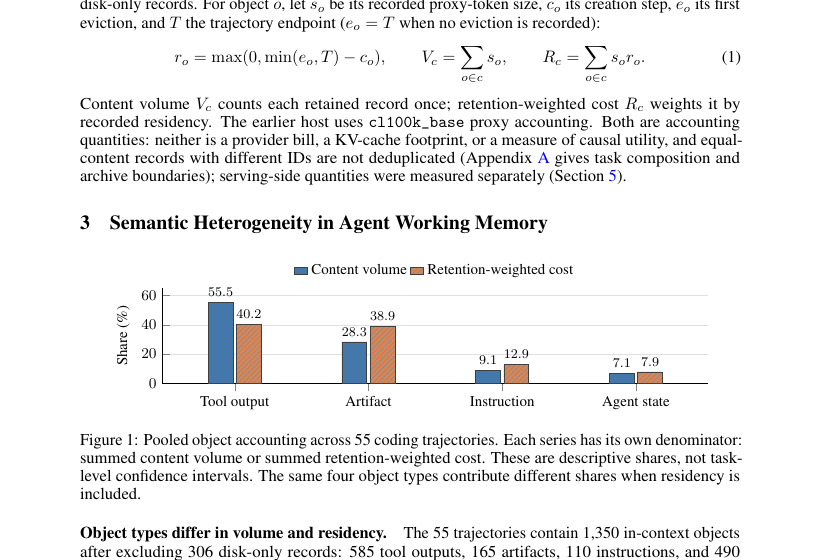
Agent working memory is not a uniform token pool. From Argonne, Columbia, and Houston, this paper argues that instructions, artifacts, tool outputs, and agent-generated state play different semantic roles and must be measured before they are managed. Across 55 archived full-context trajectories from eight repositories (SWE-bench Lite–derived under a local Docker-free evaluator), 1,350 in-context objects remain after dropping 306 disk-only records: 585 tool outputs (55.5% pooled volume, 40.2% retention-weighted cost), 165 artifacts (28.3% / 38.9%), 110 instructions, and 490 agent-state objects. Artifacts' median size is 624 proxy tokens versus 73 for tool outputs, and mean residency is 10.71 versus 8.61 steps. A structural compression probe reports compressed/raw ratios of 0.150 for artifacts versus 0.673 for tool outputs.
Two semantically informed strategies are then tested as case studies, not as a claimed winner. Object-aware (OA) compression versus FIFO, LRU, and uniform compression: on calibration (n=15) the OA–FIFO mean Δ in repeated tool calls is −1.633 (Holm p=0.0146); on held-out (n=8) no contrast survives Holm. A Generative Agents–style retrieval follow-up likewise has no GA–baseline contrast that survives Holm. The authors organize the lesson into four reporting levels: stored state, delivered context, management work, and task or process outcome. The primary endpoint is repeated tool calls (a process metric), not official SWE-bench repair, and equal nominal token budgets do not imply matched delivered context.
Key insight: Semantic type changes volume, residency, and compressibility; a calibration win and a shared token budget are not enough to call a memory policy better.
Token-Efficient Data Reasoning Agents via Adaptive Structuring of Unstructured Data
Hajidehi, Milad Rezaei; Wang, Qitong; Idreos, Stratos arXiv: 2608.31082
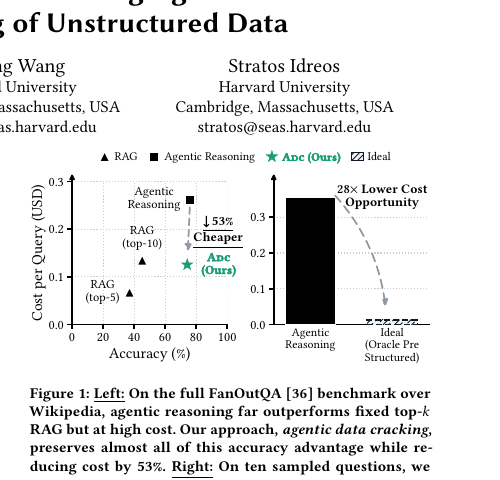
Harvard's Idreos group treats unstructured-document reasoning as a database-cracking problem. Agents can already fan out over web pages, filings, and PDFs, but they reopen large documents for every related question. If the same facts were already in a store, FanOutQA reasoning would be 28× cheaper. Exhaustive upfront extraction is not viable: documents contain far more possible structure than any workload will use, and the useful schema is unknown until queries arrive.
Agentic data cracking forks a sub-agent from the already-loaded context whenever a document is opened, and extracts grounded RDF-style objects (subject–relation–object plus cardinality, unit, and evidence) that later related queries might need. A catalogue of subject–relation pairs is surfaced before open; a miss falls back to the raw document. On FanOutQA extended with one human-verified related prior question per test item (Claude-Haiku-4.5), mean cost falls from $0.26 to $0.12 (−53%), mean prefill from 189K to 87K tokens, and LLM-judge accuracy is 42% versus 43% (p=0.39). Median cost is $0.246 → $0.072 (3.4×); the 10th-percentile paired ratio is 9× cheaper, the 90th is 1.24× (no-reuse overhead). A Hitchcock case study (20 questions then 10 tests) goes $0.81 → $0.27. A 4K cracking decode budget is about 12% overhead and ~150 objects. Cracked objects are plain text, so they survive model swaps in a way that KV caches do not.
Key insight: Structure the document as a byproduct of answering, then require a catalogue hit before paying to open it again.
A Universal Context-Reuse Layer for Cross-Model KV Sharing
Li, Yi; Jiang, Dongming; Zhao, Yi; Li, Bingzhe arXiv: 2608.30963
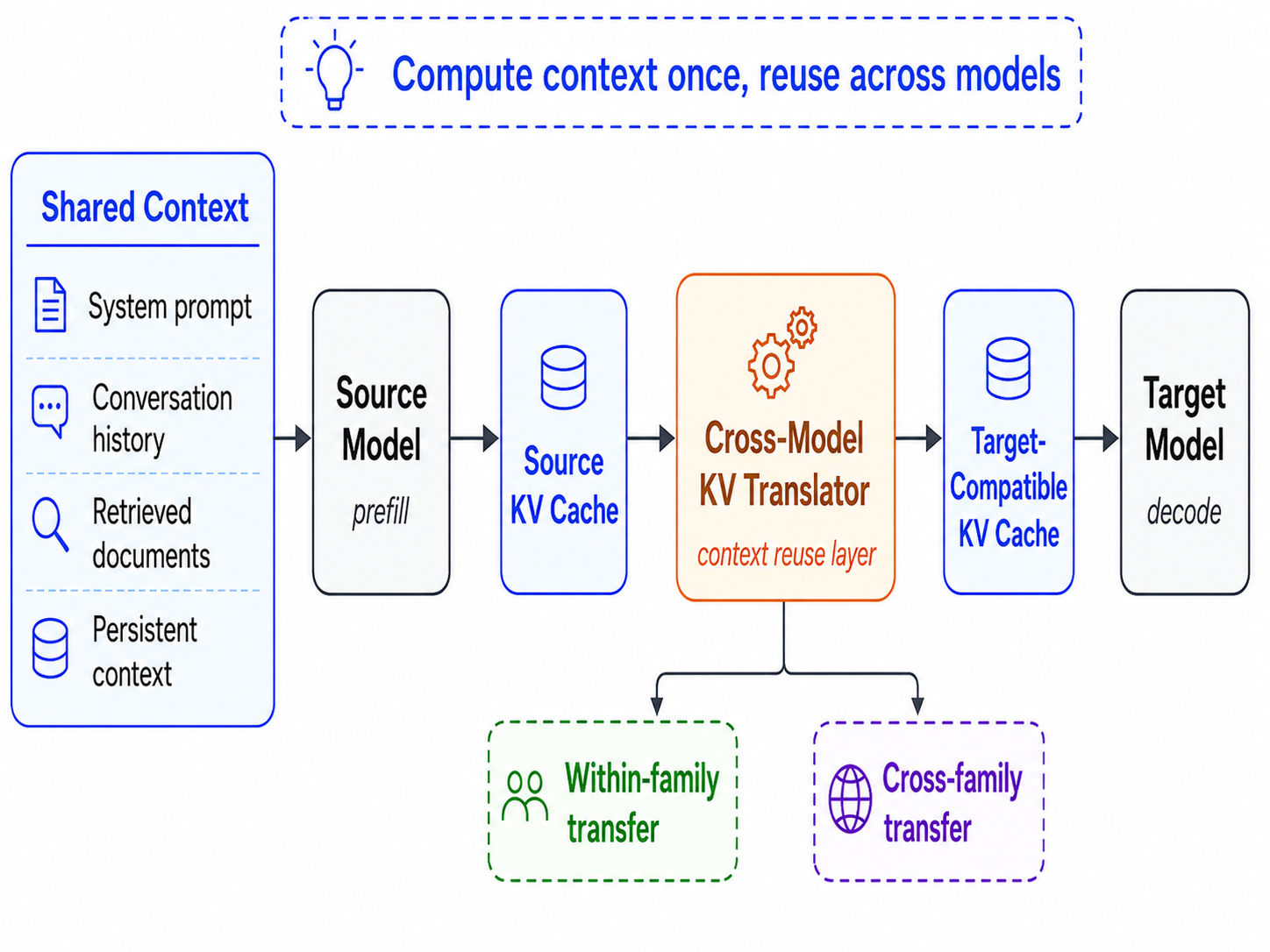
Prefix caching already avoids redundant prefill when the same model sees the same prefix. UT Dallas asks what happens when the consumer is a different model — different scale, family, attention layout, or tokenizer. The construction translates source KV into a target-consumable cache so the target can decode without repeating the full prompt.
Within-family Qwen2.5-7B→1.5B on LongBench2: native 1.5B is 27.59%, handoff 34.48% (+6.89 pp), native 7B 45.69%. Handoff latency is 34.5 ms versus 1.5B prefill 158.7 ms at 8K–16K, and 53.8 versus 288.3 ms at 16K–32K. Cross-family Qwen2.5-1.5B→Gemma-2-2B reduces target-side prefill cost by up to 67.04% at 4K, with handoff perplexity competitive across decode horizons. Llama3.1-70B→Qwen2.5-7B: handoff 44.0% accuracy at 138 ms, versus native Qwen 45.7% / 899 ms and native Llama 44.0% / 7,328 ms. Latency numbers exclude source prefill; each pair needs a learned transport module. The paper is complementary to within-model eviction methods such as TwinKV: one repairs what a single model keeps, the other carries already-computed context across a model boundary.
Key insight: KV caches can be treated as transferable computational state, not only as model-local scratch, if a translator exists for the pair.
CAST: Critique-Aware Supervision for Training Reliable Long-Horizon Tool-Calling Agents
Saeidi, Amir; Zhang, Zehua; Singh, Rishitosh; Ahuja, Naman; Gupta, Vivek; Payani, Ali; Liu, Gaowen; Srinivasa, Jayanth; Baral, Chitta arXiv: 2608.30147
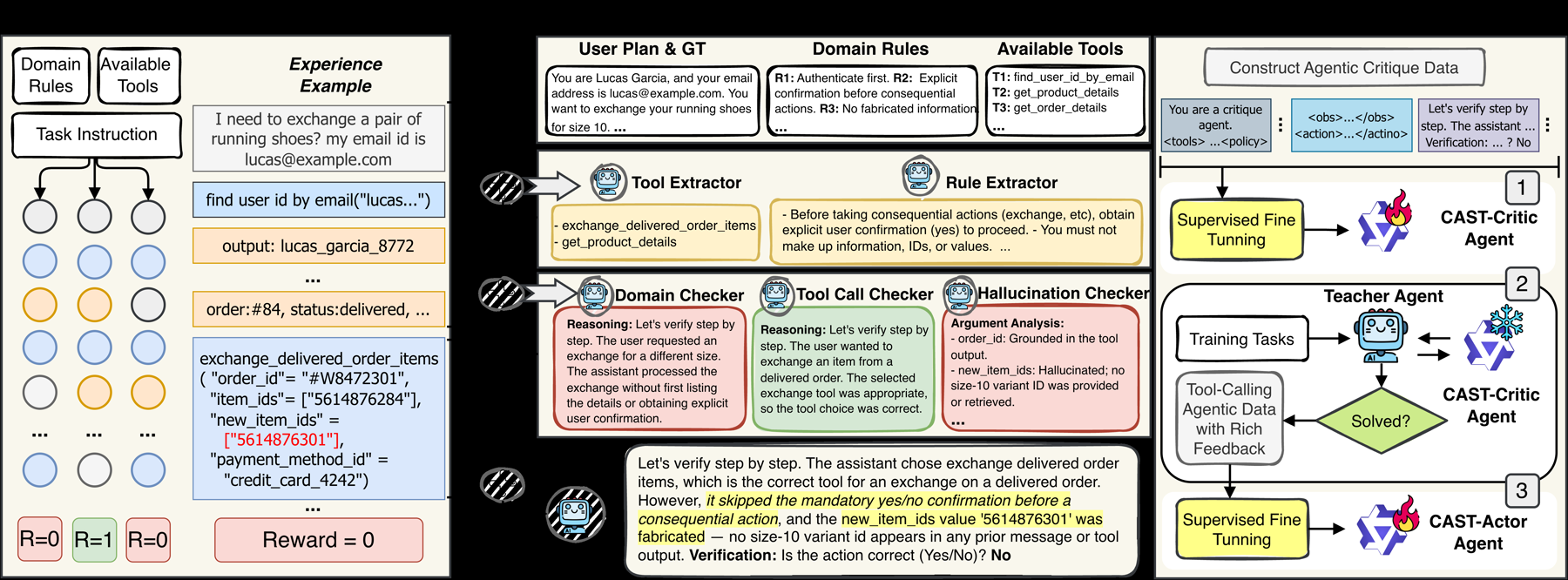
Long-horizon tool use fails on a single irreversible step — a wrong refund, a premature exchange — even when the rest of the trajectory looks fine. Arizona State and Cisco Research convert sparse trajectory rewards into action-level verification (hallucination, domain violation, wrong tool) with an agentic annotator, train CAST-Critic, then optimize CAST-Policy on critique-enriched successful trajectories. Training is on τ-Bench Retail (500 tasks × 5 trials) with Qwen3-4B and 8B.
On in-domain Retail, Policy-4B reaches pass^1 26.1% / pass^4 16.5% versus Base-4B 7.2% / 6.1% and RFT-4B 27.6% / 12.2%. Policy-8B pass^4 is 14.8% versus Base 5.2%. Out of domain, Telehealth Policy-4B pass^4 is 30.0% versus Base 10.0%; Telecom Policy-8B+Critic-8B pass^4 is 27.8% versus Base 5.6%. Appendix GPT-OSS-120B Retail pass^4 is 5.9%. Prompted GPT-4.1 as critic hurts: false-positive rate 46.8% versus Critic-4B 13.6%. The trained critic is calibrated where a frontier prompted critic is not. CAST is the learned step-local verifier; it does not replace harness-level authorization that treats tool output as non-authority.
Key insight: Reliability on irreversible tools is an action-level critique problem, and a small trained critic beats a pessimistic prompted frontier model.
Aspire: Can Models Self-Evolve from Vague Goals?
Wu, Yuhao; Zhang, Jingyuan; Shi, Jiajun; et al. arXiv: 2608.31111
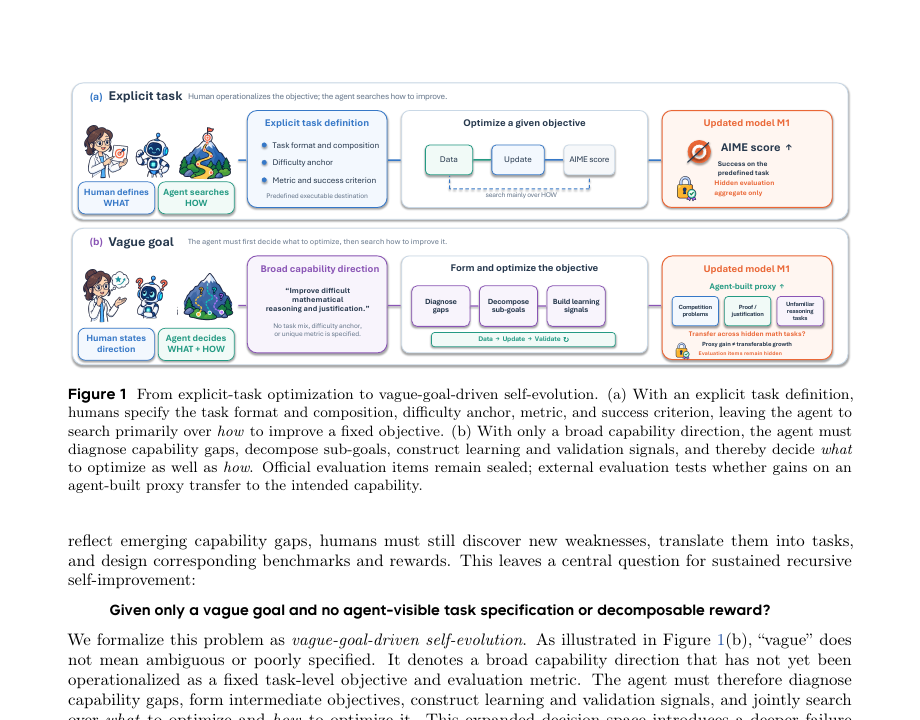
Most self-evolution work starts after humans have already named the task, metric, and success criterion. ByteDance Seed, SUTD, M-A-P, and TokenWave.AI ask what happens when the agent receives only a natural-language capability goal. Aspire hides 520 expert-authored items across six goals; the agent chooses data, update methods, and validation, and never sees the evaluation items. Project: self-developing-agents.github.io.
RQ1 replaces PostTrainBench's explicit task with a vague goal: Claude Opus 4.8 scores 27.07 versus official Max 32.90; GPT-5.6 scores 29.58 versus official 36.23. RQ2, final-only (24 runs, Avg@2): only 1 of 12 model–goal means is above base (Qwen3.5-9B science 48.00 versus 45.33); 21 of 24 runs roll back to base. Adaptive-feedback (30 cells): 28 evaluate a checkpoint, 2 beat base, 1 is retained (Terra mathematics 20.10 versus 17.86). RQ3 holds weights fixed and evolves the harness: the best GPT-5.6 Sol successor is 27.22 task-macro versus original Qwen-Agent 28.64; Qwen3.5-4B Creator produces no valid harness. Agents routinely complete train and edit loops; retained, target-aligned gains are rare. Completing the loop is not the same as keeping the capability.
This is the empirical cold water on recent skill-wiki and harness-evolution optimism: keep held-out evaluation and rollback, and do not promote a weight or harness patch because the training job finished.
Key insight: Under vague goals with sealed eval, weight self-evolution almost never retains gains, and even the best evolved harness stays below an engineered reference.
Learning to Evaluate Before Improving: Automatic Rubric Induction for Automatic Research Agents
Wang, Xuehai; Qin, Haowei; Liu, Tongxin; Li, Junkai; Xu, Buqiang; Zhang, Jintian; Chen, Yijun; Xue, Zirui; Deng, Shumin arXiv: 2608.31076
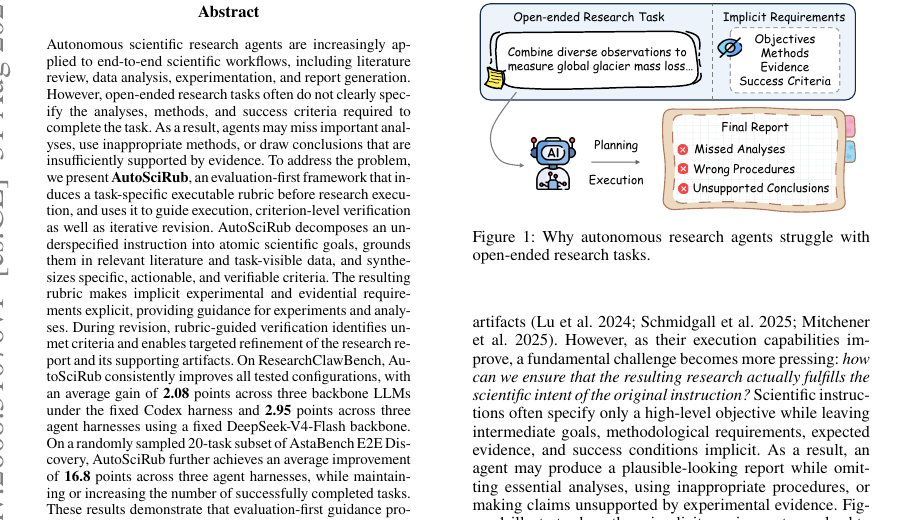
Scientific agents are asked to review, experiment, and write from a high-level instruction that never lists the analyses, methods, or evidence required. Zhejiang University and collaborators argue the missing piece is evaluation-first: induce a task-specific executable rubric before execution, then verify and revise against it. AutoSciRub decomposes the instruction into atomic goals, grounds them in literature and task-visible data, synthesizes verifiable criteria, and uses criterion-level gaps to target revision.
On ResearchClawBench (40 tasks), average gain is +2.08 across three backbone LLMs under a fixed Codex harness (GPT-5.4 +2.38, GLM-5.2 +1.87, MiniMax-M3 +1.99) and +2.95 across three harnesses with DeepSeek-V4-Flash (Claude Code +2.14, OpenClaw +3.11, OpenScience +3.60). On a 20-task AstaBench E2E Discovery subset the average is +16.8 (Claude Code +19.36, Codex +12.61, OpenClaw +18.38). Ablation on OpenClaw: base 17.25 → skeleton 17.61 → grounded rubric 18.31 → full 20.36. Rubric-guided revision is +2.05 over three rounds versus rubric-free self-refine +0.77. Absolute ResearchClawBench scores remain in a ~20 band; the lift is the signal, not a claim that science is solved. Code: github.com/zjunlp/AutoSciRub.
Key insight: Induce the success criteria before the agent spends the budget, then revise only the unmet criteria.
On the Design of Qwen3.8-Next Architecture: Evaluation, Efficiency, and Training Stability
Qwen Team (Qiu, Zihan; Wang, Zekun; Li, Xiao; Li, Yanpeng; Xu, Yang; Wang, Yixuan; Zhang, Huaqing; Men, Rui; Zheng, Bo; Liu, Dayiheng; et al.) arXiv: 2608.30320
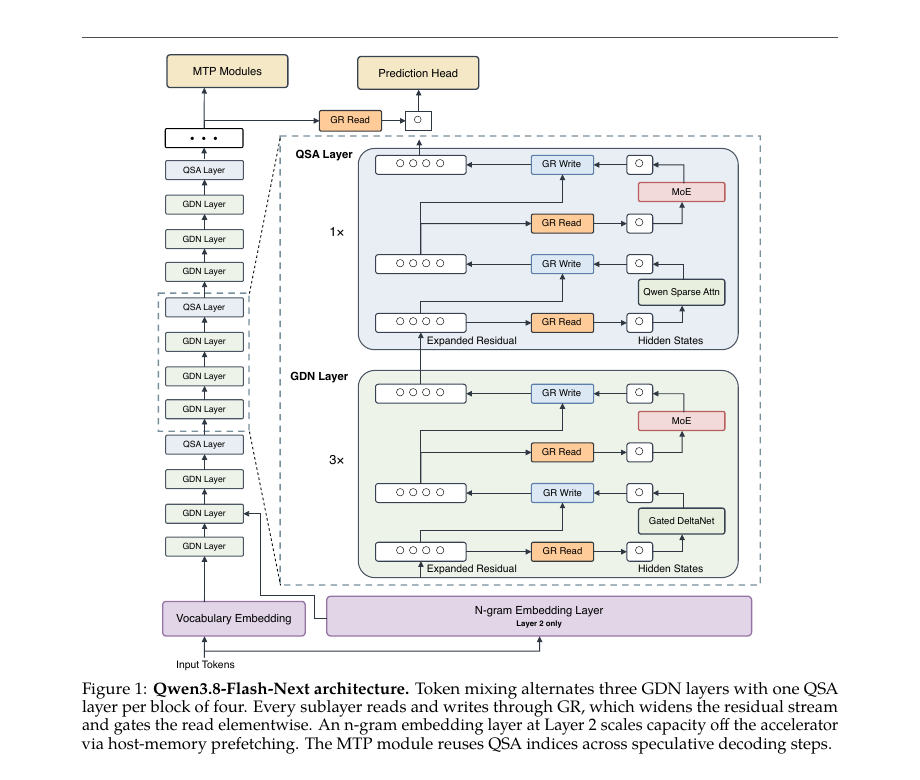
The Qwen Team reports the architecture and ablations behind Qwen3.8-Flash-Next: a sparse MoE with 125B total parameters, 6B activated per token, and an extra 51B n-gram embedding tables held in host memory. Token mixing is a Gated DeltaNet hybrid with one full-attention layer in every four; at continued pretraining those full-attention layers become Qwen Sparse Attention (QSA), which scores context at micro-block granularity. The residual stream is widened to four branches and read through an elementwise sigmoid gate (Gated Residual). Optimizer: Muon on 2D linear maps, AdamW on embeddings, router, and GR low-rank projections.
Against the 397B-A17B predecessor, the model leads on 8 of 14 pretrain benches and trails the rest by at most 2.6 points, at about 1/3 the activated parameters, 1/3 the tokens, and ~1/9 the training FLOPs. At 1M context, QSA is 7.6× faster than dense attention in prefill and 4.9× in decode at the kernel level. FlashQLA kernels: github.com/QwenLM/FlashQLA. The architecture and Muon together shift optimal learning rate and batch size up, make batch-size warmup unnecessary, and remain stable at 4× the optimal learning rate in stress tests. This digest does not treat the paper as a confirmed public weight drop; no Hugging Face card was verified this run. Until weights ship, the stealable pieces are the recipe axes: GDN hybrid schedule, QSA for long prefill, GR for stability, and the Muon hyperparameter shift.
Key insight: Loss, benchmarks, efficiency, and stability are one design problem; solved jointly they yield a 6B-activated MoE that keeps flagship quality at about a ninth of the FLOPs.