Chinese AI startup MiniMax has released its M3 large language model, which outperforms GPT-5.5 and Gemini 3.1 Pro on key benchmarks while costing just 5-10% of the price. Alphabet plans to raise $80 billion to fund its AI infrastructure expansion, reflecting the massive scale of investment required to support AI capabilities. GitHub Copilot transitions to usage-based pricing, causing user concern as many report quickly exhausting their monthly AI credit allotments.
MiniMax's M3 large language model represents a significant breakthrough in AI performance and cost efficiency, achieving superior results on key benchmarks while reducing computational costs by up to 9x. The model features a 1-million-token context window, native multimodality, and MiniMax Sparse Attention (MSA) technique that dramatically reduces compute demand. Meanwhile, Alphabet's announcement of an $80 billion investment in AI infrastructure underscores the industry-wide trend of substantial capital expenditure on AI capabilities, potentially setting a precedent for other tech giants. Additionally, GitHub Copilot's shift to usage-based billing has sparked user concern as developers discover that their previous usage patterns now cost significantly more, highlighting the economic realities of AI adoption at scale. Google Cloud's AlloyDB Remote MCP Server GA enables secure AI agent access to operational databases, addressing a critical gap in AI agent deployment by providing real-time data access for AI agents without relying on stale reports.
AI Model Releases
Chinese AI startup MiniMax has released its M3 large language model, which outperforms GPT-5.5 and Gemini 3.1 Pro on key benchmarks while costing just 5-10% of the price. The model features a 1-million-token context window, native multimodality, and MiniMax Sparse Attention (MSA) technique that reduces compute demand by up to 9x. It's available via API at discounted rates and will be released under an open source license with open weights in the next 10 days. M3 achieves 59.0% on SWE-Bench Pro, 66.0% on Terminal Bench 2.1, and 83.5% on BrowseComp, outperforming closed models like GPT-5.5 and Gemini 3.1 Pro in autonomous agent tasks.
Why it matters: MiniMax M3 represents a significant shift in the AI landscape by combining high-performance agentic capabilities with dramatically reduced costs, potentially democratizing access to enterprise-grade AI while challenging the dominance of proprietary models from OpenAI, Google, and Anthropic.
AI Tooling
Alphabet plans to raise $80B to pay for AI buildout | TechCrunch
Alphabet plans to raise $80 billion to fund its AI infrastructure expansion, with $10 billion to be sold to Berkshire Hathaway. The company cited strong demand for its AI solutions from enterprises and consumers as justification for the massive investment. Google's CEO Sundar Pichai noted that the company expects to spend between $180 billion and $190 billion on capital expenditures this year, with the AI infrastructure buildout being a key component of this spending. The investment will support scaling AI infrastructure and global compute capabilities.
Why it matters: This announcement underscores the massive scale of investment required to support AI infrastructure, with Alphabet's $80 billion plan reflecting the industry-wide trend of significant capital expenditure on AI capabilities, potentially setting a precedent for other tech giants.
AI costs how much? GitHub Copilot users react to new usage-based pricing system.
GitHub has transitioned from request-based to usage-based billing for its Copilot service, causing significant user concern as many report quickly exhausting their monthly AI credit allotments. Users are discovering that their previous usage patterns now cost significantly more, with some reporting that a single day of usage can consume an entire monthly credit allowance. The new system allocates credits based on actual AI usage, with one credit equaling $0.01 of usage, and pricing varies greatly depending on the underlying model chosen by users.
Why it matters: This pricing shift reflects the growing costs of AI infrastructure and the industry's move toward usage-based models, potentially changing how developers interact with AI coding tools and highlighting the economic realities of AI adoption at scale.
Firebase/GCP
AlloyDB Remote MCP Server GA: Secure AI Agent Access to Your Data
Google Cloud has announced the general availability of the Remote MCP Server for AlloyDB, enabling secure AI agent access to operational databases. The integration allows AI agents to connect to enterprise data through the open-source Model Context Protocol (MCP), providing a secure, consistent way for LLMs to access external data sources. The solution supports real-time data access for AI agents, enabling them to query operational databases like AlloyDB for up-to-the-millisecond views of delivery fleets or other real-time data without relying on stale reports.
Why it matters: This development addresses a critical gap in AI agent deployment by enabling secure, real-time access to operational databases, which is essential for reliable agentic outcomes and represents a significant step toward enterprise adoption of AI agents that can operate on live data.
Research Papers
MCP-Persona: Benchmarking LLM Agents on Real-World Personal Applications via Environment Simulation
arXiv: 2606.02470

The MCP-Persona benchmark addresses a significant gap in current agent evaluation by focusing on personalized tool use rather than generic information-seeking tasks. This shift is crucial because real-world personal applications involve complex interactions with individual accounts or local databases, which existing benchmarks largely ignore. The benchmark's inclusion of social media platforms like Reddit and Xiaohongshu, as well as enterprise tools like Lark and Slack, demonstrates the breadth of personalized applications that need robust agent support.
The experimental results showing that state-of-the-art agents struggle significantly with personalized tool use underscore the practical limitations of current approaches. This finding suggests that agent architectures need to be fundamentally rethought to handle the nuanced requirements of personalized applications, where tools interact with individual user data rather than generic information sources. The benchmark's public availability will likely catalyze new research directions focused on personalization in agent systems.
This work has implications beyond just benchmarking, as it points toward the need for more sophisticated agent architectures that can adapt to individual user contexts and account-specific tool interactions. The challenge of personalized tool use represents a frontier in agent development that requires integration of user-specific knowledge, context awareness, and adaptive reasoning capabilities.
Key insight: Current LLM agent benchmarks fail to capture the practical challenges of personalized tool use in real-world applications, highlighting a critical gap in evaluating agent performance on individual accounts and local databases.
SkillHarm: Lifecycle-Aware Skill-Based Attacks via Automated Construction
arXiv: 2606.02540

SkillHarm introduces a comprehensive framework for understanding and evaluating skill-based attacks across the entire skill-use lifecycle, revealing that current agents remain vulnerable to attacks with success rates up to 86.3% in fixed-payload poisoning and 69.3% in self-mutating poisoning scenarios. This demonstrates that the threat landscape for agent systems extends far beyond simple task execution failures, encompassing sophisticated attack vectors that can remain dormant and activate later.
The taxonomy of 12 risk types based on agent workflow components (data pipelines, system environments, and agent autonomy) provides a structured approach to understanding how attacks can compromise different aspects of agent functionality. This systematic classification is crucial for developing targeted defenses and highlights the need for comprehensive security frameworks that consider the full lifecycle of agent skills rather than isolated task-level vulnerabilities.
The AutoSkillHarm automated construction pipeline represents a significant advancement in attack generation, enabling large-scale evaluation of skill-based threats. However, the finding that many apparent attack failures stem from agents failing to engage with poisoned files rather than genuine resistance suggests that current defenses may be insufficiently robust. This insight points toward the need for more sophisticated detection mechanisms that can identify and respond to subtle attack patterns.
Key insight: Agent skills represent a critical attack surface that can be exploited through lifecycle-aware attacks, with both fixed-payload poisoning and self-mutating poisoning scenarios demonstrating significant vulnerability in current agents.
Unified Context Evolution for LLM Agents
arXiv: 2606.02304
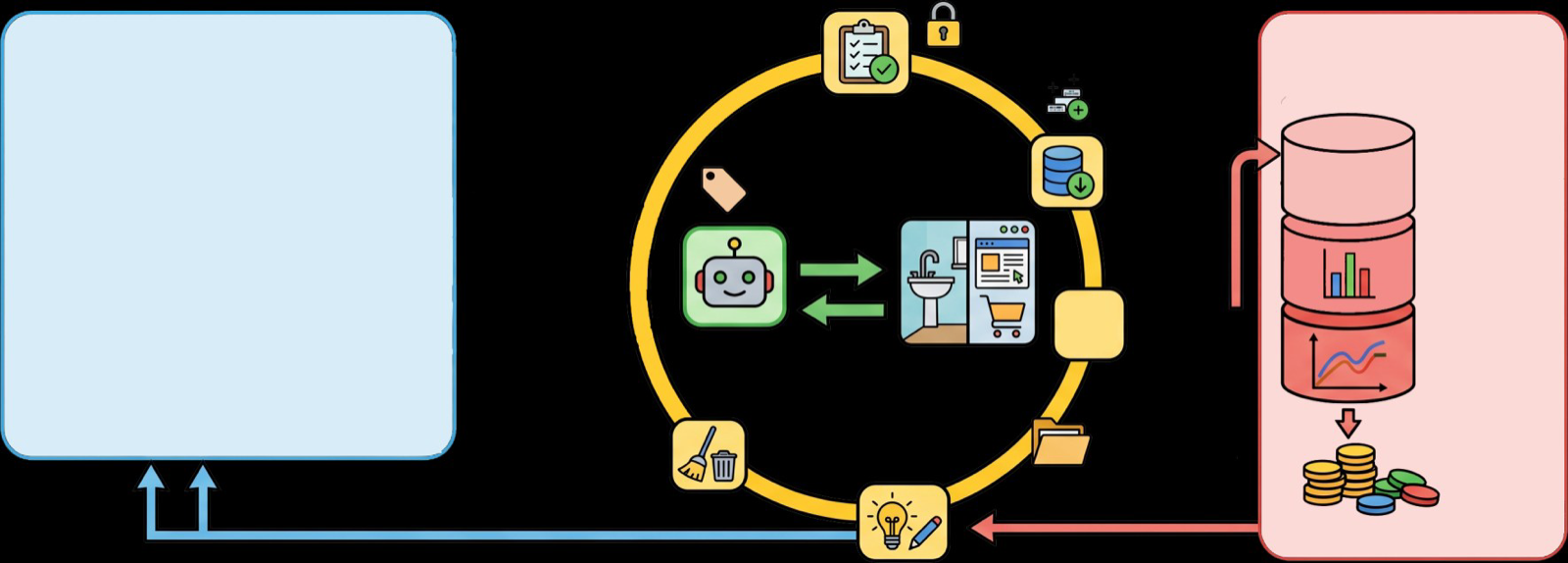
UCE represents a breakthrough in how LLM agents can accumulate and utilize experience across tasks, addressing the fundamental limitation that existing approaches either limit learning to current tasks or pool all experience without distinction. By decomposing experience into four complementary types (Memory, Strategy, Workflow, and Skill), UCE creates a more nuanced approach to knowledge management that mirrors human learning processes.
The framework's ability to track quality through use and balance library needs through a scheduling module demonstrates sophisticated resource management capabilities. This approach not only improves performance on benchmark tasks but also enables transfer to alternative actor backbones without retraining, suggesting that UCE could serve as a foundational component for more adaptable agent systems that can evolve their capabilities over time.
The substantial performance gains achieved across multiple benchmarks (ALFWorld success from 75.4% to 96.3% and WebShop task score from 45.1% to 61.3%) validate the effectiveness of this approach. These improvements indicate that the ability to retain and refine successful strategies is crucial for complex multi-step reasoning tasks, and that UCE's gradient-free approach offers a practical solution for experience accumulation in agent systems.
Key insight: Unified Context Evolution (UCE) framework enables LLM agents to learn from experience by externalizing knowledge into typed Evolvable Context Units, significantly improving performance on multi-step interactive tasks.
Multi-Agent Computer Use
arXiv: 2606.01533

The MACU framework addresses fundamental limitations of single-agent computer use agents by introducing a manager model that decomposes tasks into directed acyclic graphs and dispatches parallel subagents. This approach not only improves performance by 3.4-25.5% across various benchmarks but also demonstrates superior test-time scaling and the ability to solve complex tasks where single agents get stuck.
The design's treatment of partially observable environments as a first-class challenge through the DAG structure and information retention mechanisms represents a sophisticated approach to handling uncertainty in agent systems. This capability is particularly important for real-world applications where agents must make decisions based on incomplete information and adapt to changing conditions.
The demonstration that MACU improves average task completion wall-clock time by approximately 1.5x on long-horizon web navigation tasks highlights the practical benefits of multi-agent coordination. This efficiency gain suggests that multi-agent systems could be particularly valuable for time-sensitive applications and could enable more complex workflows that would be infeasible with single-agent approaches.
Key insight: Multi-agent computer use (MACU) systems that emphasize planning and parallel execution significantly outperform single-agent approaches on complex long-horizon tasks, demonstrating the value of coordination in agent systems.
Where Do Deep-Research Agents Go Wrong? Span-Level Error Localization in Agent Trajectories
arXiv: 2606.02060
TELBench and DRIFT framework address a critical gap in agent evaluation by providing span-level error localization that goes beyond simple success/failure metrics. This approach reveals that even when agents produce correct final answers, their reasoning processes may contain significant errors that could affect reliability in critical applications.
The claim-centric auditing framework in DRIFT represents a sophisticated approach to tracking agent claims and their support in trajectory evidence, providing a diagnostic lens for understanding how unsupported or conflicting claims affect answer paths. This methodological advancement is crucial for building more reliable deep-research agents that can be trusted in high-stakes applications.
The finding that DRIFT improves span-level error localization and first-error accuracy by up to 30 percentage points demonstrates the practical value of this approach. This improvement suggests that more granular evaluation methods can significantly enhance our understanding of agent reliability and help identify specific areas for improvement in reasoning and evidence evaluation processes.
Key insight: Span-level error localization in deep-research agents reveals that current evaluation methods focusing on final answers miss critical information about which parts of the trajectory make answers unreliable, necessitating more granular auditing approaches.
OpenWebRL: Demystifying Online Multi-turn Reinforcement Learning for Visual Web Agents
arXiv: 2606.02031

OpenWebRL addresses a major scalability bottleneck in visual web agent development by enabling training directly on live websites rather than relying on static datasets. This approach eliminates the need for expensive, curated trajectory collections and demonstrates that online RL can be effectively applied to visual web agents with only 0.4K initialization trajectories and 2.2K open-ended RL training tasks.
The framework's comprehensive pipeline covering scalable live-browser infrastructure, supervised initialization, multimodal context management, and efficient multi-turn policy optimization represents a significant step forward in making advanced agent training accessible to open-source communities. The ability to achieve competitive performance with proprietary systems while using minimal data highlights the potential for democratizing agent development.
The demonstration that OpenWebRL-4B outperforms prior open agents of similar or larger scale on challenging live-web benchmarks suggests that online RL can be a powerful tool for developing more capable and cost-efficient web agents. This approach could enable more rapid iteration and improvement of agent capabilities in real-world environments.
Key insight: OpenWebRL framework enables training of visual web agents with online multi-turn reinforcement learning on real websites, establishing a new open-source state of the art with minimal initialization data.
eMoT: evolving Memory-of-Thought via Symbolic Anchoring and Memory Corrosion
arXiv: 2606.02054

eMoT's approach of treating reasoning as evolving memories rather than transient processes represents a fundamental shift in how we think about multi-step reasoning in LLMs. By incorporating memory corrosion, symbolic anchoring, and consistency-driven refinement, the framework addresses core limitations such as hallucinations and poor numerical computation that plague standard models.
The framework's performance gains across multiple reasoning benchmarks, including achieving 100% accuracy on the Game of 24 task, demonstrate the effectiveness of treating reasoning as a dynamic process that can be refined and improved over time. This approach is particularly valuable for tasks requiring precise numerical computation and logical consistency.
The finding that eMoT achieves superior performance despite using a lightweight backbone model suggests that the framework's reasoning control mechanisms are more important than sheer model size for improving multi-step reasoning capabilities. This insight could lead to more efficient approaches to reasoning enhancement that don't require massive model scaling.
Key insight: eMoT framework treats reasoning trajectories as dynamic, evolving memories rather than static templates, significantly improving accuracy and solution consistency in multi-step reasoning tasks.
Bridging the Last Mile of Time Series Forecasting with LLM Agents
arXiv: 2606.02497
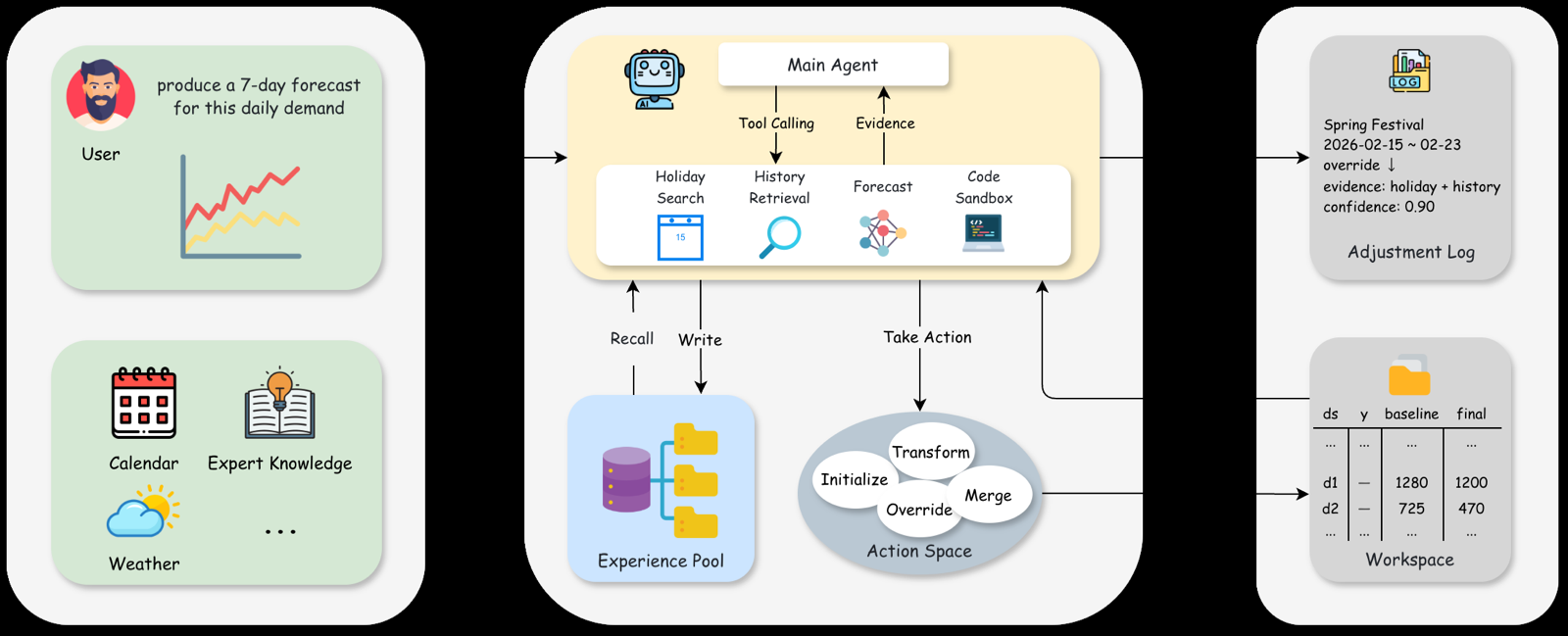
The last-mile forecasting problem addresses a critical gap in time series forecasting where statistical predictions need to be revised with business context before becoming decision-ready. The LLM-agent framework presented in this work provides a systematic approach to incorporating weakly structured business context such as holiday effects, campaign plans, and expert feedback into forecasting processes.
The system's ability to maintain a unified forecast workspace, invoke tools for contextual evidence retrieval, and convert reasoning trajectories into explicit forecast revision actions represents a sophisticated approach to integrating human expertise with automated forecasting. The inclusion of map-reduce-style decomposition and post-hoc reflection through memory banks enables long-horizon forecasting while maintaining controllability and auditability.
The real-world case studies demonstrate the practical value of this approach in bridging the gap between statistical prediction and business-ready forecasting. This work suggests that LLM agents can play a crucial role in making forecasting more actionable and context-aware, particularly in complex business environments where domain knowledge and expert feedback are essential for accurate decision-making.
Key insight: LLM agents can bridge the gap between statistical prediction and business-ready forecasting by incorporating business context and enabling controllable, auditable forecast revision processes.
RASER: Recoverability-Aware Selective Escalation Router for Multi-Hop Question Answering
arXiv: 2606.02488
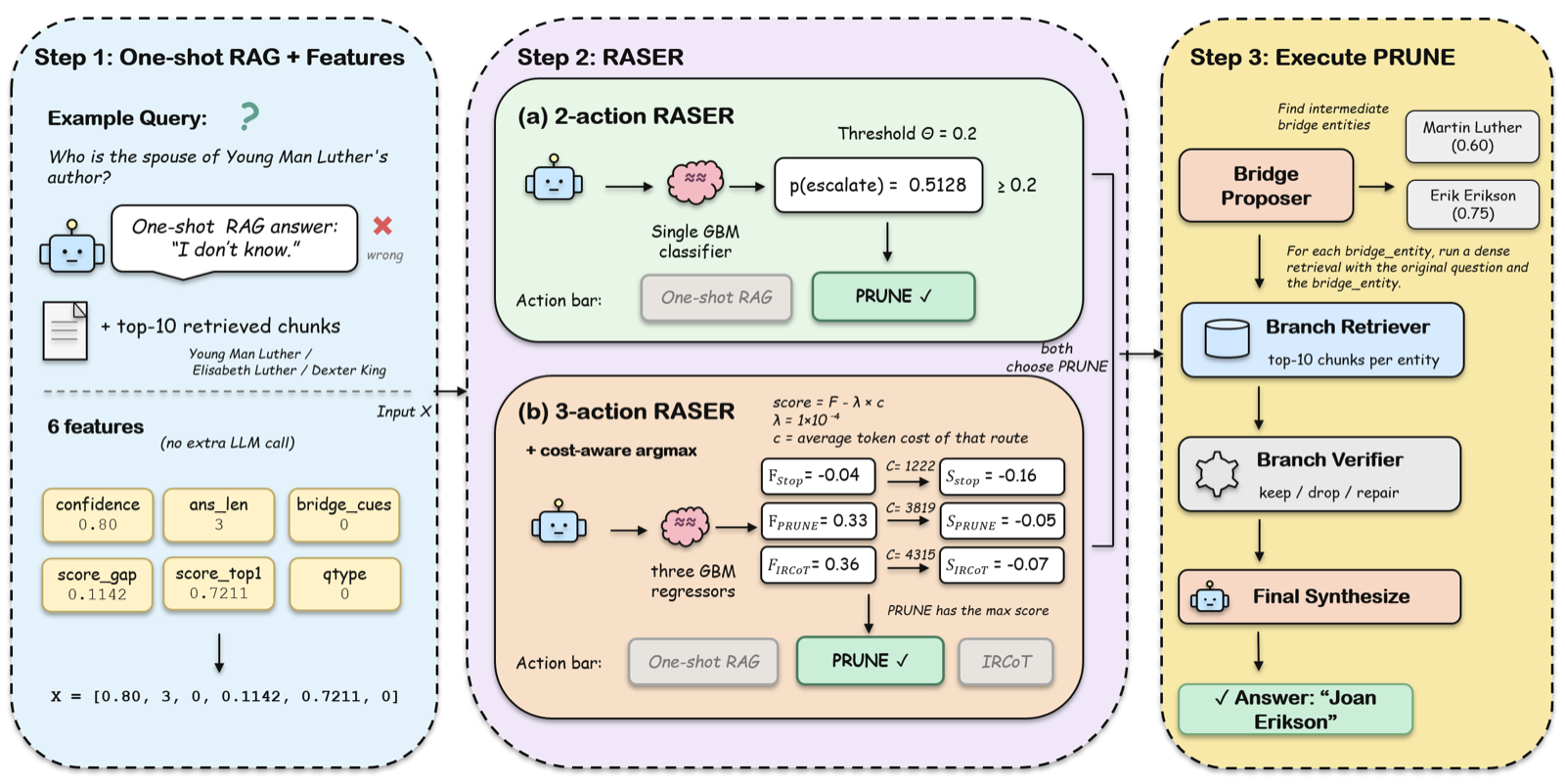
RASER addresses a fundamental inefficiency in multi-hop question answering systems where expensive retrieval is performed on every question, even when one-shot RAG would suffice. By using six features from one-shot RAG to make routing decisions, RASER achieves competitive performance while spending only 41-49% of the tokens used by always-prune approaches.
The router's design that makes decisions without additional LLM calls represents a significant efficiency improvement, particularly important when LLM budgets are tight. This approach demonstrates that careful feature engineering and decision-making can lead to substantial cost reductions without sacrificing performance, making multi-hop QA more scalable for practical applications.
The competitive performance across six LLMs and three benchmarks suggests that RASER's approach is broadly applicable and not dependent on specific model architectures or domains. This scalability makes it a promising technique for improving the efficiency of multi-hop QA systems in resource-constrained environments.
Key insight: RASER routers can significantly reduce token costs in multi-hop question answering by selectively escalating to extra-retrieval actions based on one-shot RAG features, without requiring additional LLM calls.
AGENTCL: Toward Rigorous Evaluation of Continual Learning in Language Agents
arXiv: 2606.02461

AGENTCL addresses the limitations of existing continual learning benchmarks by introducing controlled task streams that intentionally create reusability opportunities, enabling more accurate evaluation of memory design choices. This approach reveals that naive streams offer limited ability to distinguish memory designs, whereas controlled streams more clearly distinguish their plasticity.
The MemProbe probing method that stores interactions, insights, and skills while filtering unreliable experiences during consolidation provides a valuable diagnostic tool for understanding how memory design choices affect continual learning. This method's ability to distinguish between plasticity and stable reuse is crucial for developing more effective memory architectures.
The empirical analysis showing that controlled streams more clearly distinguish memory designs than naive streams suggests that the quality of task stream construction is critical for meaningful continual learning evaluation. This finding has implications for how future benchmarks should be designed to properly evaluate agent learning capabilities.
Key insight: AGENTCL framework provides rigorous evaluation of continual learning in language agents through controlled task streams that enable better distinction of memory design plasticity and stable reuse.
Beyond One-shot: AI Agents for Learning in Field Experiments
arXiv: 2606.02458
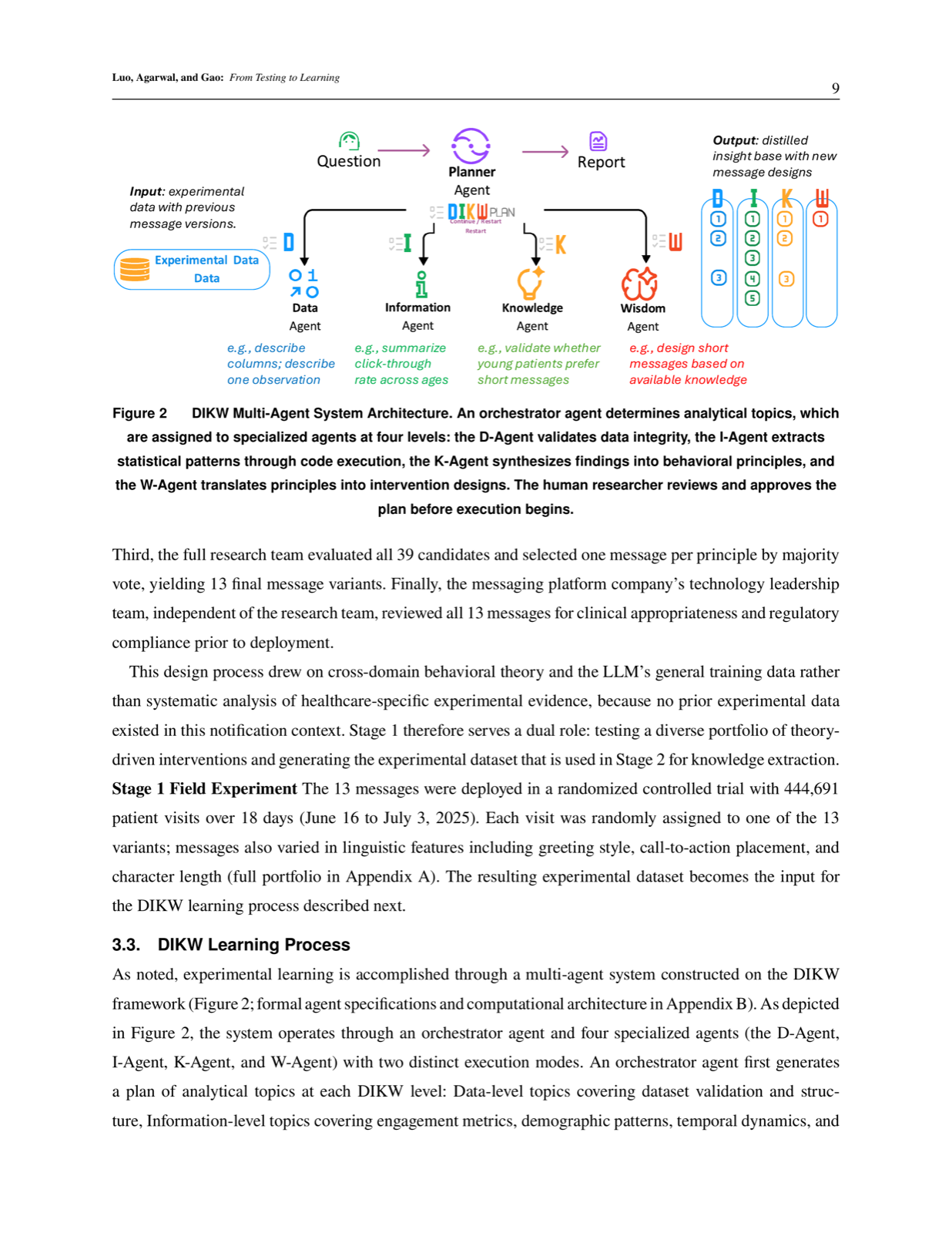
The field experiments demonstrate that tool-augmented AI can extract actionable knowledge from prior experimental data to generate improved interventions, showing that the value comes from domain-specific experimental data rather than general reasoning ability. This finding suggests that AI systems need to be designed to leverage domain-specific knowledge effectively.
The comparison between human + chatbot and tool-augmented agentic AI methods reveals that the AI approach achieved superior interventions with a 69.8% CTR, demonstrating the potential for AI to enhance experimental design and intervention generation. This approach transforms behavioral experimentation from one-shot evaluation into a scalable system for cumulative design learning.
The research highlights that general-purpose behavioral theories do not extend uniformly to specific healthcare contexts, motivating an agentic AI approach to theory audits at field-experiment scale. This suggests that AI systems need to be capable of adapting and auditing theoretical frameworks based on empirical evidence rather than relying solely on general principles.
Key insight: Tool-augmented agentic AI can learn from experimental data to generate new interventions, demonstrating that domain-specific experimental data provides value beyond general reasoning ability.
HLL: Can Agents Cross Humanity's Last Line of Verification?
arXiv: 2606.02449

HLL benchmark exposes a fundamental limitation of current multimodal agents in operating interfaces on behalf of users, particularly in tasks that require human-like interaction rather than simple recognition. The sharp performance variations across verification types and degradation under realistic interface conditions highlight the gap between current capabilities and human substitution requirements.
The benchmark's exposure of gaps in localization, action calibration, state tracking, and process consistency provides concrete testbed for measuring how close multimodal agents are to acting as human substitutes in protected real-world workflows. This focus on grounded interaction rather than recognition alone is crucial for understanding agent capabilities in practical applications.
The results suggest that while agents may perform well on recognition tasks, they struggle with the complex, multi-step interactions required for human substitution in protected workflows. This finding has implications for the development of more sophisticated agent architectures that can handle the nuanced requirements of real-world interface interactions.
Key insight: Current multimodal agents remain brittle at the human-substitution boundary, particularly in CAPTCHA verification tasks that require grounded, human-like interaction rather than recognition alone.
From Layers to Submodules: Rethinking Granularity in Replacement-Based LLM Compression
arXiv: 2606.02559
SubFit's approach to submodule-level compression challenges the conventional wisdom that redundancy in transformers is confined to contiguous regions, demonstrating that different submodule types require different compression strategies. This insight suggests that more sophisticated compression methods should consider the heterogeneous nature of transformer architectures.
The framework's ability to achieve better aggregate perplexity-accuracy trade-off across evaluated sparsity levels, with larger gains under aggressive compression, indicates that submodule-level compression can be particularly effective for resource-constrained applications. The 2.42x perplexity degradation at 25% sparsity while retaining 84.6% of dense downstream accuracy shows practical utility.
The post-training approach with only calibration data and the ability to deliver measurable inference speedup and KV-cache savings make SubFit particularly attractive for deployment scenarios where computational resources are limited. This approach could enable more widespread adoption of compressed models in practical applications.
Key insight: SubFit framework achieves better perplexity-accuracy trade-off by compressing LLMs at the submodule level rather than full-layer granularity, demonstrating that redundancy in transformers is not confined to contiguous regions.
Transferable Self-Harm Surveillance from Emergency Department Triage Notes Using an Evidence-Augmented Machine Learning Approach
arXiv: 2606.02545
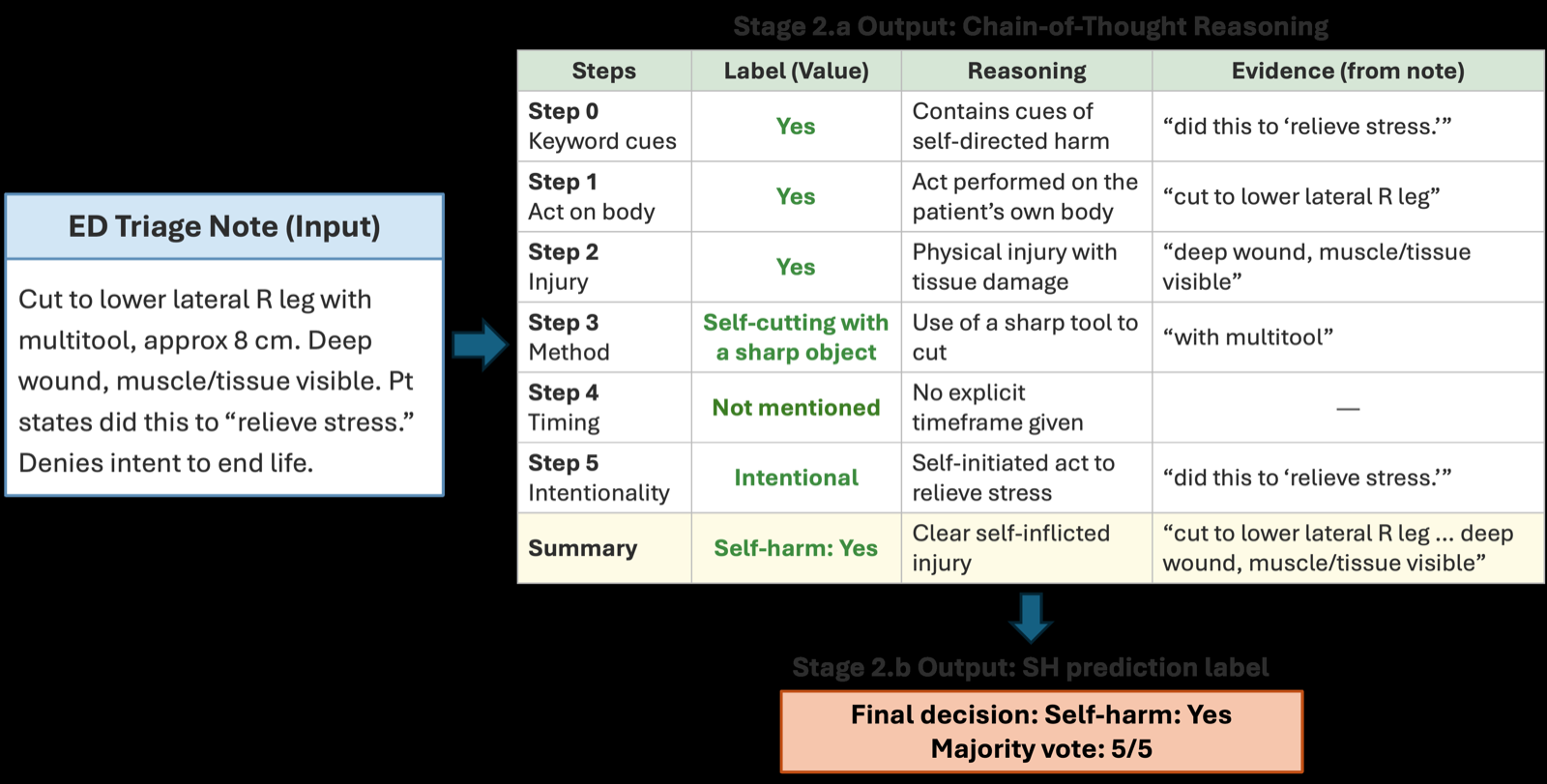
The three-stage approach combining traditional machine learning with LLM-based screening and evidence extraction shows that self-harm detection in ED triage notes can be effectively automated with high accuracy and transferability across different hospitals. The approach's ability to identify primary self-harm methods with 95% accuracy represents a significant advancement in clinical surveillance.
The demonstration of transferability without site-specific retraining across three Australian hospitals suggests that this approach could be readily adapted for broader clinical applications. The high AUPRC values indicate that the model is effective at identifying true positive cases while minimizing false positives, which is crucial for clinical decision-making.
The approach's potential to support more granular surveillance beyond binary classification highlights its value for clinical research and public health applications. The ability to identify specific self-harm methods could inform targeted intervention strategies and improve patient outcomes.
Key insight: Evidence-augmented machine learning approach demonstrates high transferability for detecting self-harm in ED triage notes, achieving AUPRCs of 0.887 +/- 0.016 in internal validation.
SimSD: Simple Speculative Decoding in Diffusion Language Models
arXiv: 2606.02544
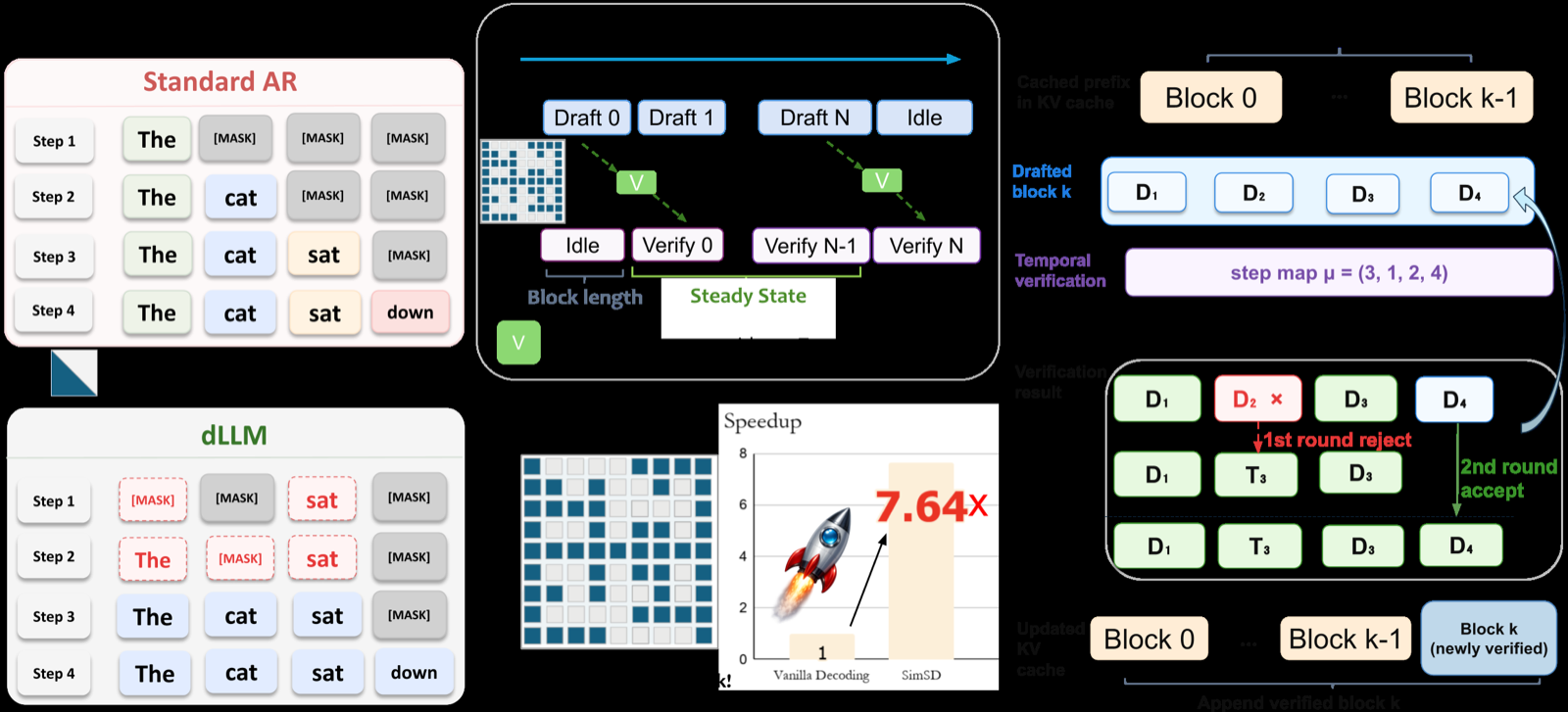
SimSD addresses a fundamental incompatibility between diffusion language models and standard token-level speculative decoding by introducing a novel masking strategy that preserves temporal validity while maintaining parallel decoding advantages. This approach restores the key verification ability provided by causal masking in autoregressive models.
The training-free nature of SimSD and its compatibility with other acceleration techniques such as KV cache and blockwise decoding make it a practical solution for improving inference efficiency in diffusion models. The algorithm achieves up to 7.46x higher decoding throughput while maintaining or improving generation quality.
The demonstration that SimSD can be flexibly integrated with existing acceleration methods suggests that it could serve as a valuable component in broader optimization strategies for diffusion language models. This compatibility with existing techniques makes it more likely to be adopted in practical applications.
Key insight: SimSD algorithm enables token-level speculative decoding for diffusion language models by introducing a plug-and-play masking strategy that equips dLLMs with temporally valid token-level contexts.
FigSIM: A Dataset for Fine-grained Suicide Severity and Figurative Language in Suicide Memes
arXiv: 2606.02523

The FigSIM dataset addresses a critical gap in understanding suicide-related content on social media by providing fine-grained annotations for suicide severity, figurative phenomena, and suicide-related content. This comprehensive annotation approach reveals that suicide memes present unique challenges that require specialized modeling approaches.
The finding that higher suicide severity levels are underpredicted, particularly for figurative memes, highlights the need for more sophisticated content analysis techniques that can handle metaphorical and indirect expressions of suicidal thoughts. This bias suggests that current models may miss critical warning signals in social media content.
The dataset's availability for benchmarking 16 unimodal and multimodal models provides a foundation for developing more effective content moderation approaches. The demonstration that suicide memes pose unique challenges for both modeling and content moderation underscores the importance of specialized approaches for handling sensitive content.
Key insight: FigSIM dataset reveals that suicide memes pose unique challenges for modeling and content moderation, with analysis showing biases such as underprediction of higher suicide severity levels, especially for figurative memes.
When Rating Scales Fall Short: LLM-Assisted Discovery of ADHD Signals in Turkish Teacher Narratives
arXiv: 2606.02509
The LLM-assisted theme discovery pipeline demonstrates that teacher narratives contain valuable information that complements structured assessments, with distinct patterns in attention, behavioral, and family-related signals that traditional rating scales fail to capture. This finding suggests that narrative analysis can provide important insights for ADHD diagnosis and intervention.
The observation that structured and narrative information encode complementary signals indicates that a combined approach using both structured assessments and narrative analysis could improve diagnostic accuracy and treatment planning. This approach could be particularly valuable in identifying cases where traditional assessments fail to clearly distinguish ADHD from non-ADHD students.
The application of this approach to Turkish teacher evaluation forms shows that the method is transferable across different cultural contexts, suggesting that LLM-assisted narrative analysis could be a valuable tool for ADHD screening in diverse populations. The ability to identify distinct behavioral patterns through natural language processing opens new possibilities for clinical decision-making.
Key insight: LLM-assisted theme discovery pipeline reveals that teacher narratives encode complementary signals to structured assessments, with distinct attention, behavioral, and family-related patterns that traditional rating scales miss.
CRAM: Centroid-Routing and Adaptive MoE for Multimodal Continual Instruction Tuning
arXiv: 2606.02502

CRAM's approach to multimodal continual instruction tuning resolves the fundamental tension between shared updates that cause forgetting and isolated expansion that limits parameter efficiency by using a hybrid approach that isolates task-specific patterns while maintaining shared capabilities. This design prevents catastrophic forgetting while enabling efficient parameter usage.
The adaptive-rank instantiation that identifies capability gaps and dynamically allocates necessary parameters represents a sophisticated approach to parameter efficiency in continual learning. The centroid-guided routing and orthogonality penalty mechanisms ensure stable reuse among tasks while preventing re-learning of general capabilities.
The extensive experiments demonstrating superiority over existing methods across diverse benchmarks validate the effectiveness of CRAM's approach. The framework's ability to maintain performance while achieving better parameter efficiency suggests it could be particularly valuable for real-world deployment scenarios where computational resources are limited.
Key insight: CRAM framework addresses the dilemma of continual instruction tuning by isolating task-specific patterns into independent modules while using adaptive-rank instantiation to boost parameter efficiency.
Not What, But How: A Communicative Audit of LLM Response Framing
arXiv: 2606.02493

FRANZ's automated framework for response characterization provides a systematic approach to understanding how LLMs communicate responses along four dimensions, revealing that cultural positioning and anthropomorphism are positively coupled with degree of coupling varying by country. This finding suggests that LLM responses are not just about factual correctness but also about cultural framing.
The SQUARE corpus of 376k subjective questions from 57 subreddits provides a rich resource for studying cultural differences in LLM communication patterns. The framework's ability to score responses from multiple open-weight LLMs across these dimensions enables comparative analysis of how different models handle cultural communication.
The diagnostic lens provided by FRANZ for identifying framing divergences suggests that understanding LLM communication patterns is crucial for developing culturally appropriate AI systems. This approach could be valuable for applications requiring cross-cultural communication or where cultural sensitivity is important.
Key insight: FRANZ framework reveals that LLM responses differ significantly across cultural positioning, generalizing language, anthropomorphic cues, and conversational maxims, with country-specific variations in these characteristics.
Towards Multidisciplinary Summarization of Hospital Stays: Efficient Sentence-Level Clinical Provenance Categorization
arXiv: 2606.02487
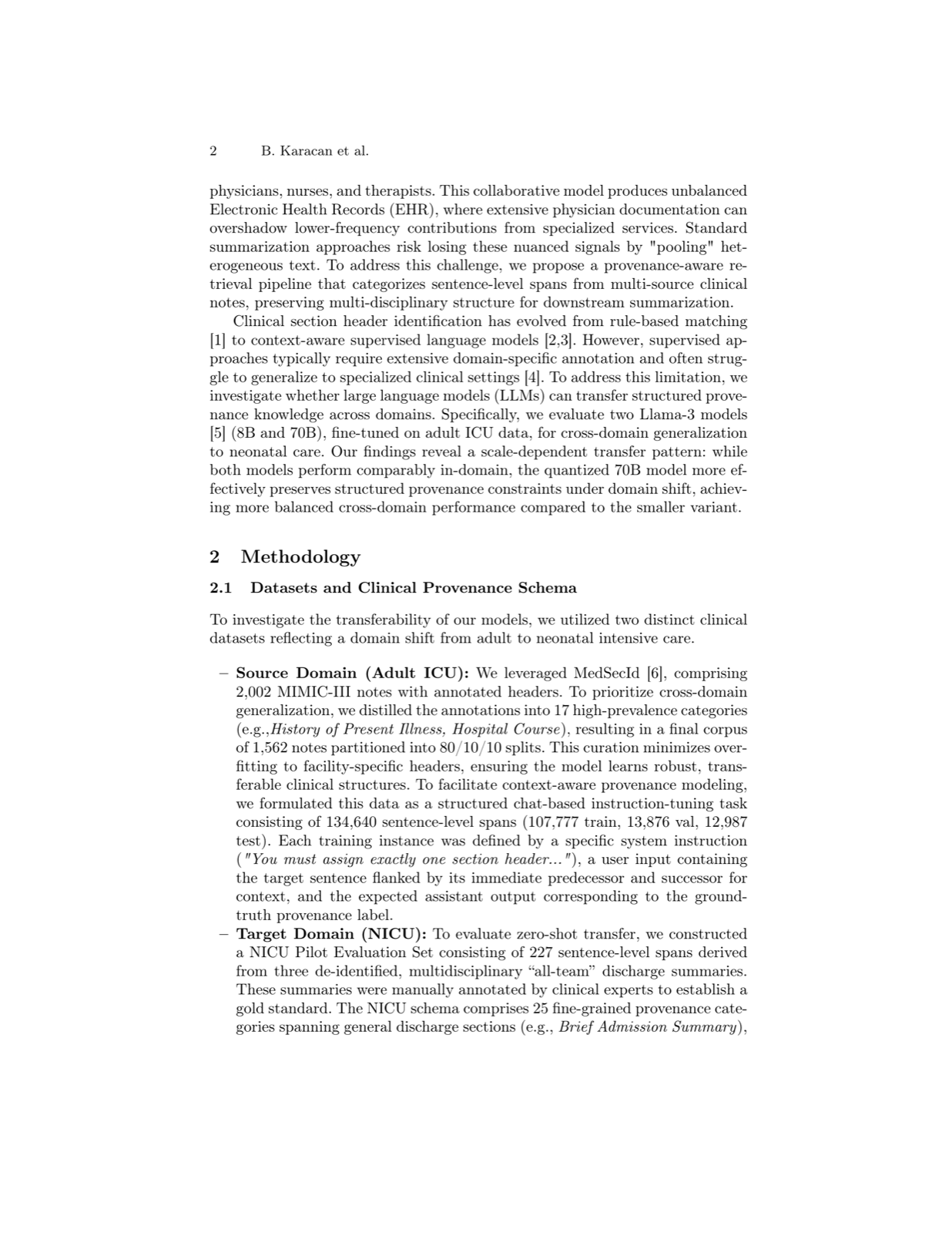
The clinical provenance categorization pipeline demonstrates that supervised fine-tuning of LLMs can achieve high accuracy in identifying sentence-level provenance across multi-source clinical notes, with in-domain Macro F1 scores above 92% for both 8B and 70B models. This accuracy is crucial for effective structured summarization in complex clinical environments.
The scale-dependent transfer effect showing that SFT produced only marginal changes for the 8B model but substantially improved the 70B model suggests that sufficient model capacity is critical for preserving semantic flexibility during cross-domain clinical transfer. This finding has implications for model selection in clinical applications.
The quantized fine-tuned 70B model's ability to outperform its full-precision baseline while substantially reducing computational requirements demonstrates the practical value of efficient quantized adaptation. This approach could enable structured provenance modeling for downstream summarization in resource-constrained clinical settings.
Key insight: Supervised fine-tuning of LLMs for clinical provenance categorization achieves high accuracy (Macro F1 scores above 92%) and demonstrates scale-dependent transfer effects that are critical for cross-domain clinical applications.
Learning When to Translate for Multilingual Reasoning
arXiv: 2606.02465
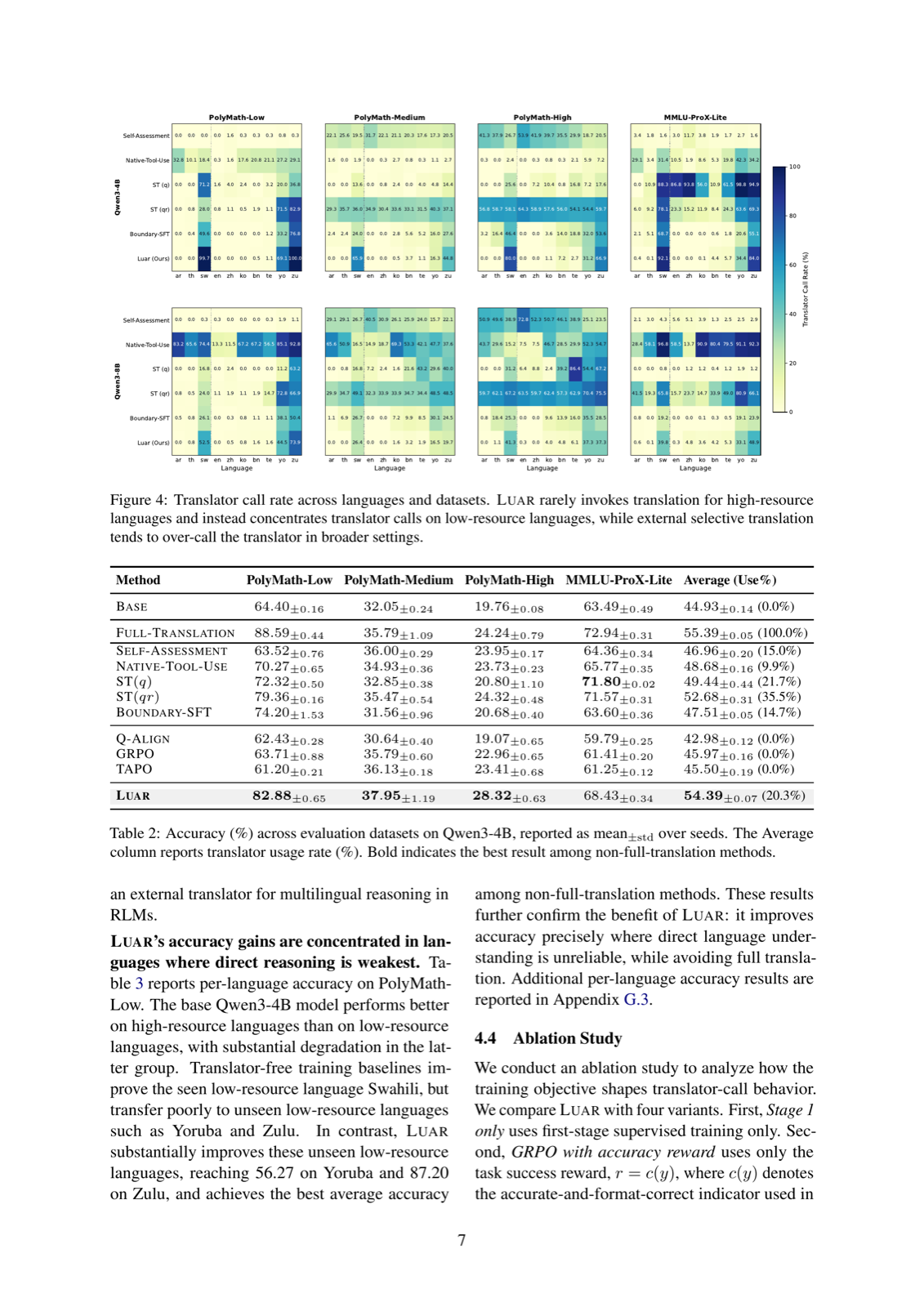
Luar's language understanding boundary-aware reinforcement learning framework addresses the multilingual reasoning gap by training models to choose between solving original inputs directly and reasoning over English translations. This selective approach ensures translation is only invoked when direct understanding is unreliable, avoiding unnecessary computational overhead.
The framework's performance gains on low-resource languages demonstrate that Luar can effectively leverage translation as a tool for improving reasoning capabilities in scenarios where direct understanding fails. This approach suggests that multilingual reasoning can benefit from strategic use of translation rather than universal application.
The finding that Luar avoids unnecessary translation in cases where direct reasoning is sufficient while extending its translator-call behavior to unseen low-resource languages indicates that the framework has generalizable capabilities. This adaptability makes it a promising approach for multilingual reasoning in diverse applications.
Key insight: Luar framework trains RLMs to selectively invoke translation when direct understanding is unreliable, achieving significant gains on low-resource languages while avoiding unnecessary translation.
IntraShuffler: A Privacy Preserving Framework for Heterogeneous DP Federated Learning
arXiv: 2606.02563
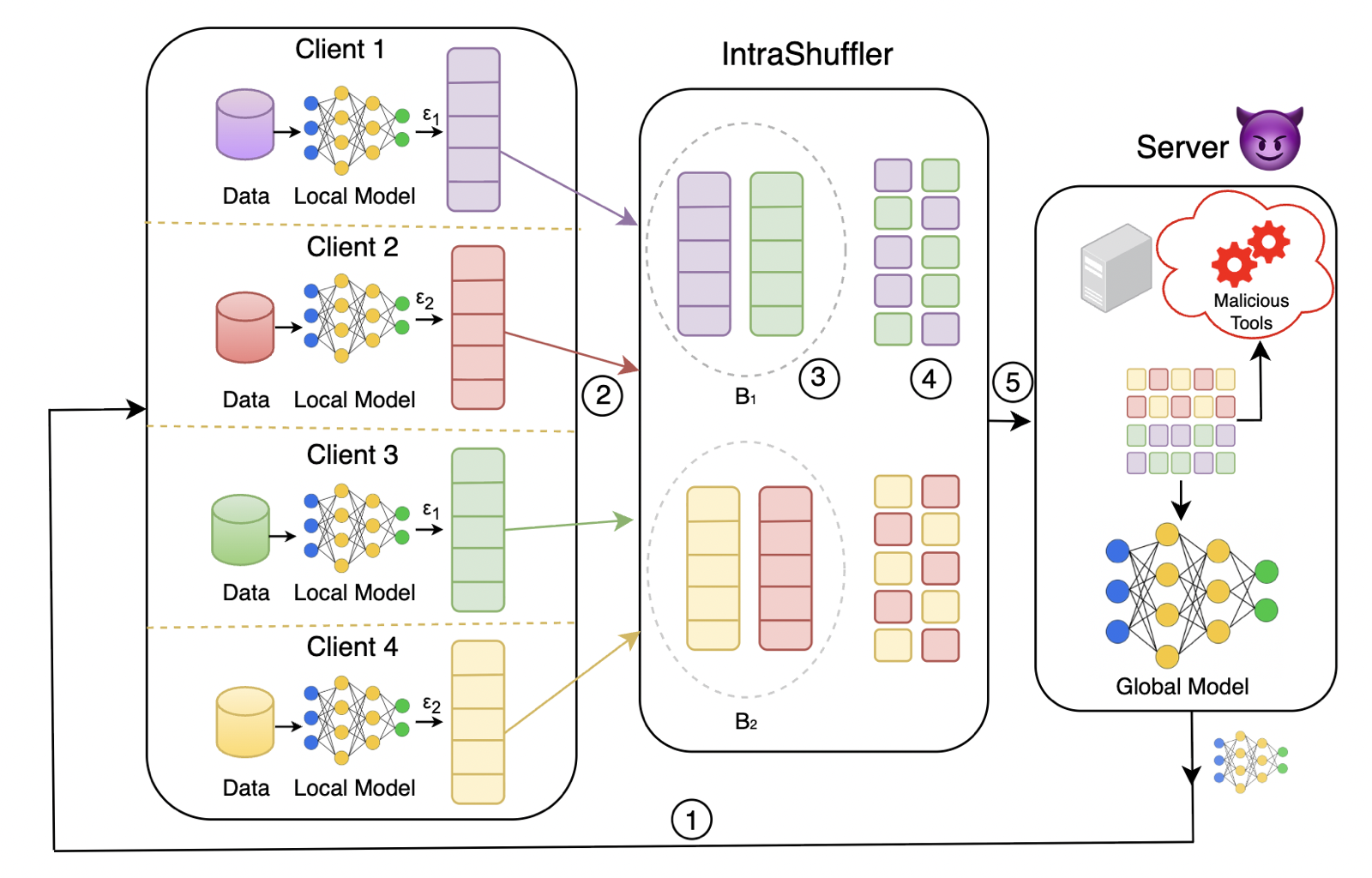
IntraShuffler addresses a critical security gap in heterogeneous differential privacy federated learning by introducing a middleware defense that disrupts persistent gradient structure while maintaining ε-aware aggregation. This approach prevents privacy inference attacks that could otherwise link updates from the same client across training rounds.
The framework's ability to reduce gradient recoverability by over 60% and decrease surrogate inference accuracy from 0.78 to 0.33 while maintaining comparable model utility demonstrates the effectiveness of the privacy-aware shuffling mechanism. This reduction in privacy risks makes HDP-FL more viable for sensitive applications.
The demonstration that IntraShuffler works across multiple datasets and aggregation rules suggests that the approach is broadly applicable to different HDP-FL scenarios. The framework's ability to preserve model utility while significantly improving privacy protection makes it a valuable contribution to secure federated learning systems.
Key insight: IntraShuffler framework defends against privacy inference attacks in HDP-FL by introducing privacy-aware shuffling that groups clients into privacy-compatible buckets while preserving ε-aware aggregation.
Drifting Preference Optimization for One-Step Generative Models
arXiv: 2606.02521

DrPO addresses the challenge of preference finetuning for one-step generative models by using a non-parametric dipole preference field approach that avoids the computational overhead of traditional methods. The framework's ability to train with large, black-box, or non-differentiable rewards while maintaining single generator calls represents a significant advancement in efficiency.
The 3.51x reduction in HPSv3 training computation achieved by DrPO demonstrates the practical benefits of this approach, particularly in scenarios where reward-model backpropagation is computationally expensive. This efficiency gain makes preference finetuning more accessible for practical applications.
The initial offline experiments suggesting that sample-based gradient synthesis can be used beyond online reward ranking indicate that DrPO's approach could be extended to other domains where traditional gradient-based methods are not feasible. This versatility makes the framework potentially valuable for a wide range of generative modeling applications.
Key insight: DrPO framework enables online preference-finetuning of deterministic one-step generators without requiring policy likelihoods, denoising trajectories, or differentiable reward gradients, significantly reducing training computation.
A Biconvex Formulation for Stable Transport of Mixture Models with a Unique Solution
arXiv: 2606.02515

OMT's biconvex formulation provides a principled approach to optimal transport that addresses computational demands and interpretability issues associated with traditional pointwise transport plans. The framework's ability to decouple computational complexity from sample size by formulating subpopulations as exponential-family distributions represents a significant advancement in scalability.
The theoretical guarantees on stability of the OMT map, showing that bounded perturbations lead to bounded changes in transport plans, provide confidence in the reliability of the framework for practical applications. This stability is crucial for real-world deployment where data variations are common.
The demonstration of effectiveness on synthetic benchmarks and real-world datasets including image data and single-cell RNA sequencing measurements validates the framework's practical utility. The scalable nature of OMT makes it suitable for large-scale applications where traditional transport methods would be computationally prohibitive.
Key insight: OMT framework reformulates optimal transport as a strictly biconvex optimization with a unique global minimizer, enabling scalable transport of mixture models that decouples computational complexity from sample size.
Expressivity of congruence-based architectures for DNNs on positive-definite matrices
arXiv: 2606.02490

The analysis reveals that the (semi)-orthogonality constraint commonly imposed on weight matrices in congruence-like layers leads to a fundamental limitation in expressivity, as demonstrated by the loss of spectral diversity and Poincaré's separation theorem. This finding challenges the conventional wisdom about the benefits of orthogonality constraints.
The study's focus on the expressivity of neural architectures for classifying symmetric positive-definite matrices provides insights into the limitations of current approaches and suggests that alternative architectures may be needed for more effective representation learning. The theoretical analysis provides a foundation for understanding the trade-offs in architectural design.
The examination of classifier compatibility with feature maps produced by congruence-like layers highlights the importance of considering the entire pipeline when designing neural architectures. This comprehensive approach to understanding architectural limitations could guide future research toward more expressive and efficient models.
Key insight: Congruence-like layers with semi-orthogonality constraints limit expressivity due to loss of spectral diversity, revealing that the (semi)-orthogonality constraint commonly imposed on weight matrices is a fundamental limitation.
Speculative Sampling For Faster Molecular Dynamics
arXiv: 2606.02455

LSD's approach to accelerating molecular dynamics through speculative sampling represents a significant advancement in computational efficiency, particularly for systems where serial computation is a bottleneck. The method's ability to generalize across different systems and draft-target combinations while maintaining theoretical and empirical validity demonstrates its broad applicability.
The extension of speculative sampling to second-order Langevin dynamics and the derivation of achievable speedup as a function of physical parameters provides a theoretical foundation for understanding the method's performance characteristics. This theoretical analysis helps in optimizing the approach for specific applications.
The demonstration that LSD achieves 3-9x speedup across different systems and draft-target combinations suggests that the approach can be effectively applied to various molecular dynamics problems. The method's ability to maintain target model distribution while achieving significant speedup makes it valuable for large-scale simulations.
Key insight: Langevin Speculative Dynamics (LSD) accelerates molecular dynamics by using a draft model to propose fast simulation steps and verifying them in parallel with a slower target model, achieving 3-9x speedup.
On the Scaling of PEFT: Towards Million Personal Models of Trillion Parameters
arXiv: 2606.02437

The framing of PEFT as a substrate for persistent personal models rather than just a budget substitute represents a fundamental shift in how we think about personalization in language models. This approach treats adapters as persistent local state that can carry instance-specific behavior, enabling more sophisticated personalization capabilities.
The MinT infrastructure example demonstrates how PEFT can be managed for adapter identity, revision, provenance, evaluation, and serving residency, providing a practical framework for managing personal models at scale. This infrastructure is crucial for realizing the potential of personal models in real-world applications.
The results suggesting that PEFT can be a compact substrate for persistent personal models rather than only a budget substitute indicate that this approach could enable more sophisticated personalization without the computational overhead of full fine-tuning. This scalability makes personal models more practical for widespread adoption.
Key insight: PEFT can serve as a compact substrate for persistent personal models rather than only a budget substitute for full fine-tuning, with adapters carrying instance-specific behavior such as preferences, skills, tool habits, and memory-like updates.
A Local Perturbation Theory for Cross-Domain Interference and Recovery in Multi-Domain RL
arXiv: 2606.02398
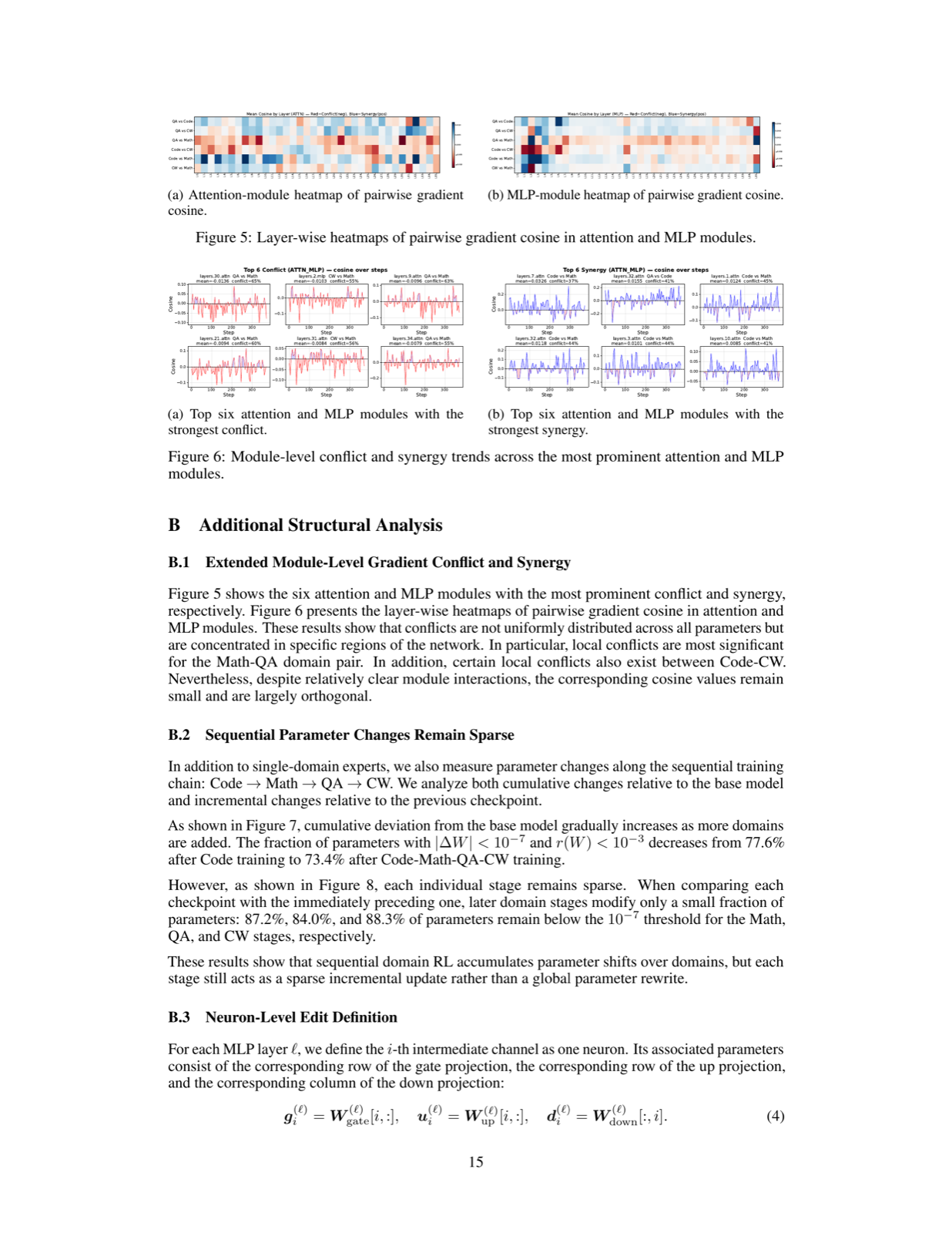
The local perturbation theory provides a mechanistic account of interference and recovery in multi-domain reinforcement learning, revealing that the harmful effects of later-domain training are concentrated in a low-dimensional shared conflict subspace rather than being distributed across all parameters. This insight suggests that targeted recovery methods can be more effective than global approaches.
The demonstration that a brief Re-Math refresh after a sequence of training domains can recover performance while largely preserving other domains shows that selective recovery is possible with minimal collateral damage. This finding has implications for how multi-domain learning systems should be designed to balance learning and retention.
The theoretical analysis and empirical validation of the local perturbation model provide a foundation for understanding how to manage interference in multi-domain RL. The approach's ability to identify and target specific conflict subspaces could lead to more sophisticated methods for managing knowledge transfer and avoiding catastrophic forgetting.
Key insight: Local perturbation model reveals that later-domain training harms earlier domains mainly through a second-order damage term concentrated in a low-dimensional shared conflict subspace, enabling selective recovery with limited collateral damage.
Policy and World Modeling Co-Training for Language Agents
arXiv: 2606.02388
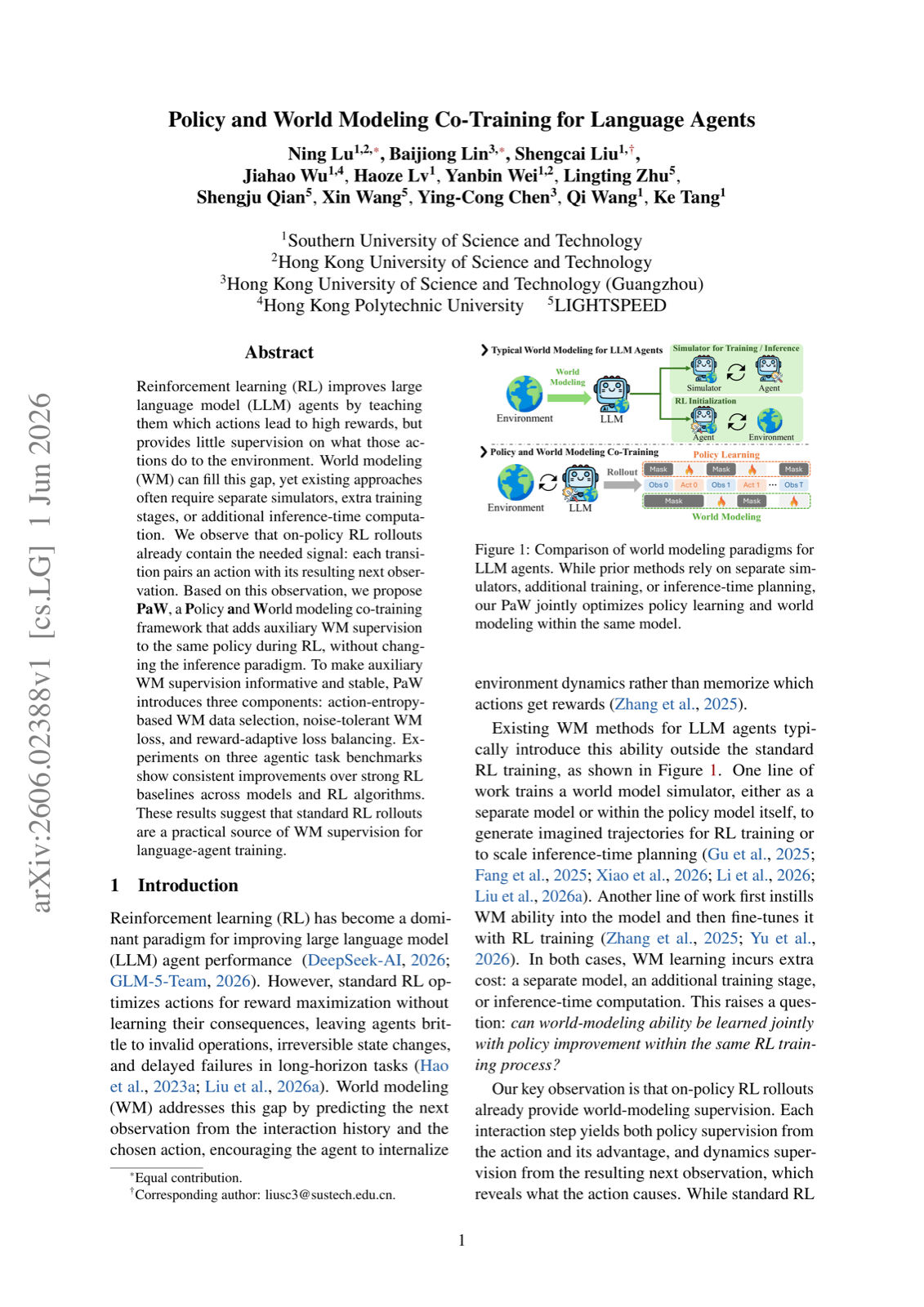
PaW's approach to policy and world modeling co-training represents a practical solution for incorporating world modeling supervision into language agent training without requiring separate simulators or additional inference-time computation. The framework's ability to use standard RL rollouts as a source of world modeling supervision makes it accessible and efficient.
The three components of action-entropy-based data selection, noise-tolerant loss, and reward-adaptive loss balancing work together to make auxiliary world modeling supervision informative and stable. This combination addresses key challenges in world modeling that can lead to instability or poor performance in traditional approaches.
The consistent improvements over strong RL baselines across multiple benchmarks and models demonstrate the practical value of PaW's approach. The framework's ability to enhance policy performance through world modeling supervision suggests that this type of auxiliary training can be a valuable component of agent development.
Key insight: PaW framework adds auxiliary world modeling supervision to policy training without changing inference paradigm, achieving consistent improvements over strong RL baselines across models and algorithms.
TabPrep: Closing the Feature Engineering Gap in Tabular Benchmarks
arXiv: 2606.02384
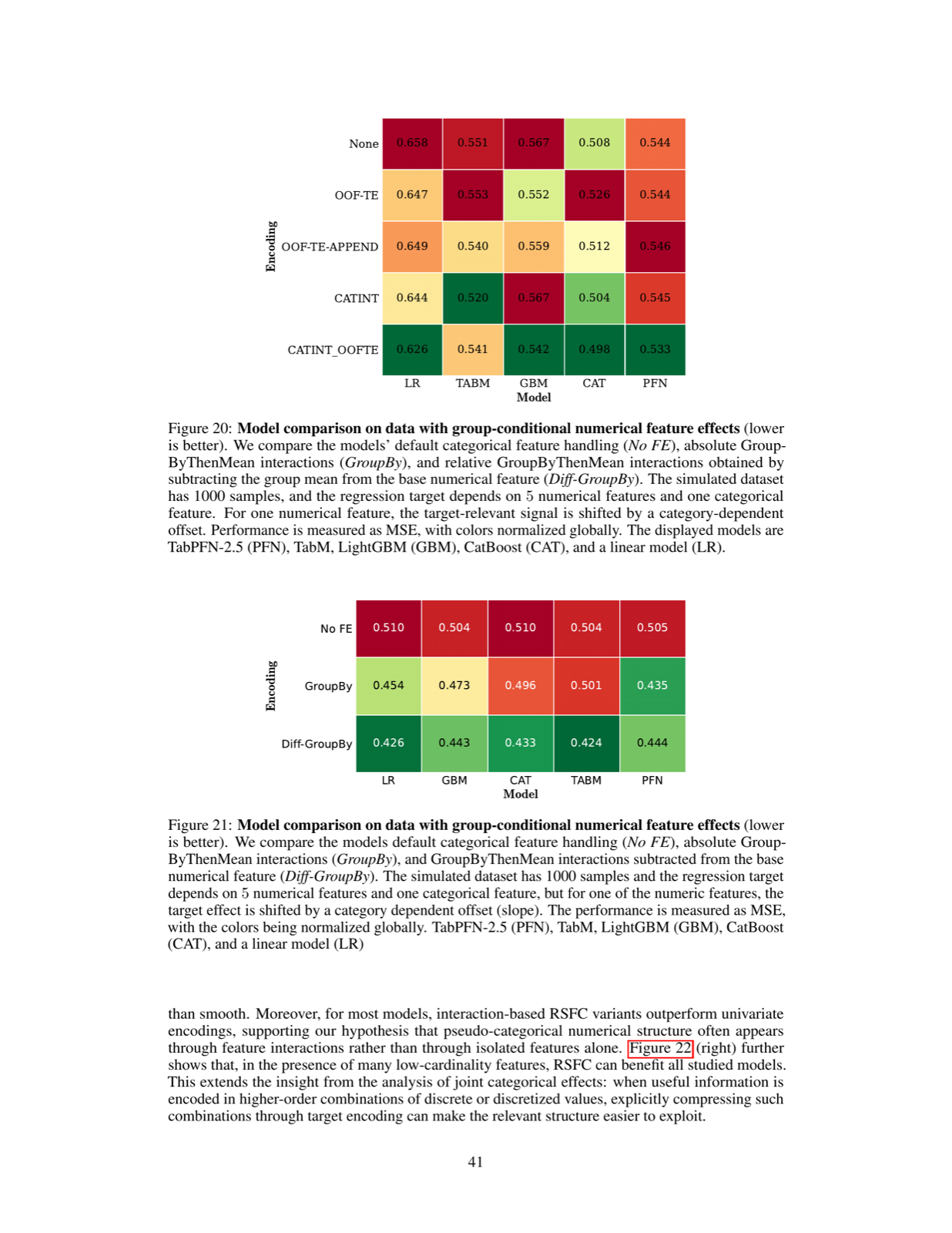
TabPrep addresses a critical gap in tabular machine learning benchmarks by introducing a lightweight preprocessing pipeline that systematically addresses three specific structural data patterns. The approach's ability to establish new peak performance through feature engineering alone demonstrates the importance of preprocessing in achieving optimal results.
The comprehensive evaluation across TabArena benchmark shows that integrating TabPrep consistently improves performance for diverse model classes, including tree-based, neural, linear, and foundation models. This broad applicability suggests that systematic feature engineering can be a valuable component of tabular modeling pipelines.
The demonstration that TabPrep outperforms previous automated feature engineering approaches in performance, efficiency, and applicability across datasets makes it a valuable tool for researchers and practitioners. The framework's ability to integrate into large-scale benchmarks could help close the evaluation gap between model-centric and preprocessing-centric innovations.
Key insight: TabPrep preprocessing pipeline demonstrates that systematic feature engineering alone can establish new peak performance, often surpassing gains achieved by model-centric innovations alone.
When Do Attention Circuits Form? Developmental Trajectories of Capability and Attention-Sink Emergence Across Three 1B-ClassArchitectures
arXiv: 2606.02378
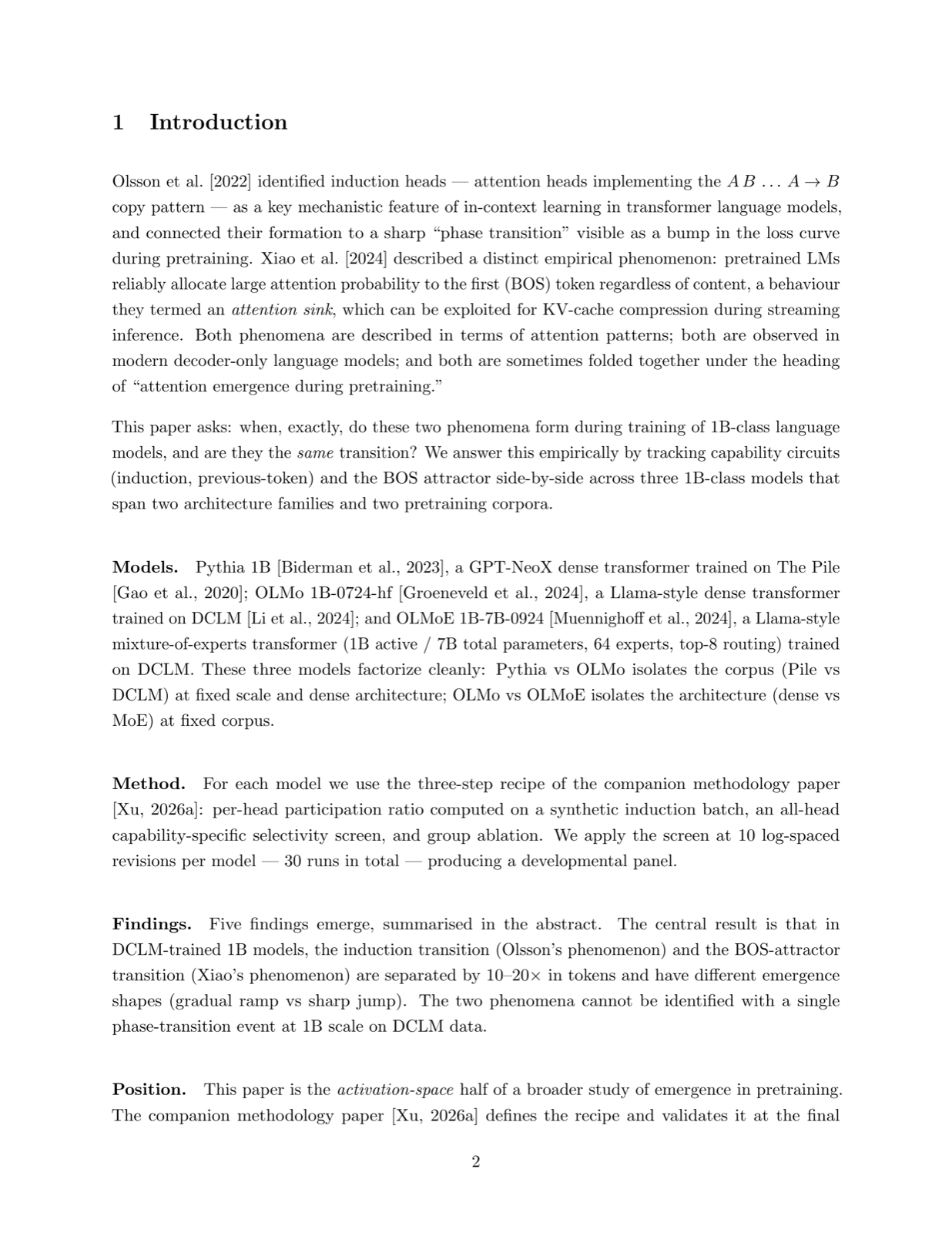
The developmental trajectory analysis reveals that attention-head circuit formation occurs in distinct phases with different emergence shapes, challenging the notion that induction transitions happen uniformly across all models. The finding that BOS-attractor fraction follows three distinct emergence shapes suggests that the timing and nature of circuit formation varies significantly.
The observation that capability-circuit formation and attention-sink formation are two separate transitions, not one, provides important insights into the developmental process of attention mechanisms. This separation suggests that different types of attention circuits develop at different times and through different mechanisms.
The finding that per-head PR is elevated at or before the first revision at which that head crosses its capability-selectivity threshold indicates that circuit identification does not require the final model, which has implications for early circuit detection and understanding of attention mechanism development.
Key insight: Attention-head circuit formation occurs in distinct phases with different emergence shapes, and capability-circuit formation and attention-sink formation are two separate transitions rather than one.
FOAM: Frequency and Operator Error-Based Adaptive Damping Method for Reducing Staleness-Oriented Error for Shampoo
arXiv: 2606.02365
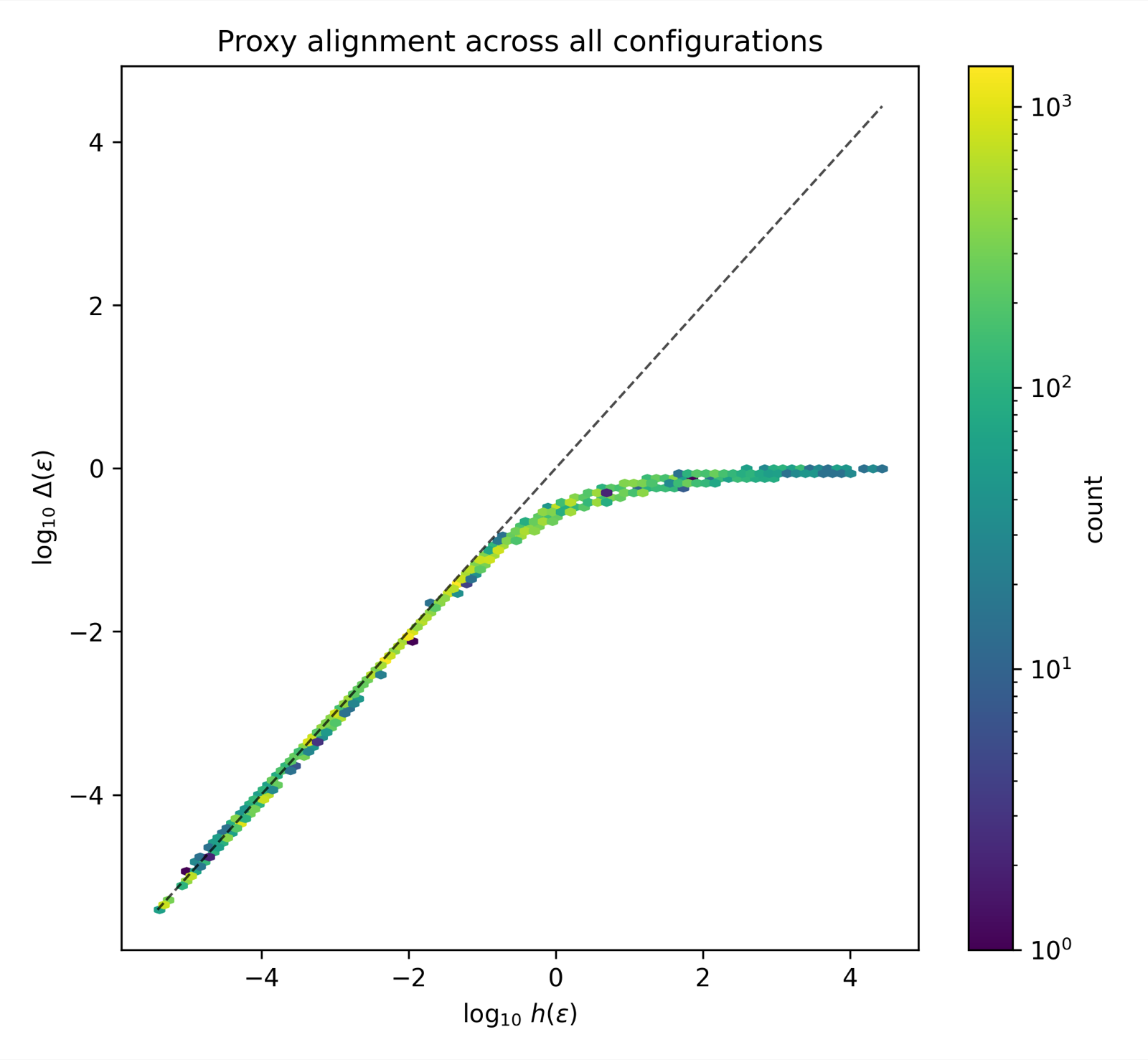
FOAM's adaptive approach to damping and eigendecomposition frequency addresses the fundamental trade-off between computational efficiency and optimization fidelity in Shampoo. By dynamically controlling these parameters based on an approximation of staleness-oriented error, FOAM achieves better performance than standard Shampoo.
The theoretical study of staleness through convergence and stability lenses provides a comprehensive understanding of the trade-offs involved in Shampoo optimization. The identification of damping as a numerical stabilizer that can suppress negative effects of staleness offers insights into how to balance computational efficiency with optimization quality.
The experimental results demonstrating that FOAM reduces wall-clock time while maintaining robust convergence validate the effectiveness of the adaptive approach. This improvement in efficiency makes Shampoo more practical for large-scale optimization problems where computational resources are limited.
Key insight: FOAM algorithm dynamically controls damping factor and eigendecomposition frequency based on staleness-oriented error, reducing wall-clock time compared to standard Shampoo while maintaining robust convergence.
Minimax-Optimal Policy Regret in Partially Observable Markov Games
arXiv: 2606.02363
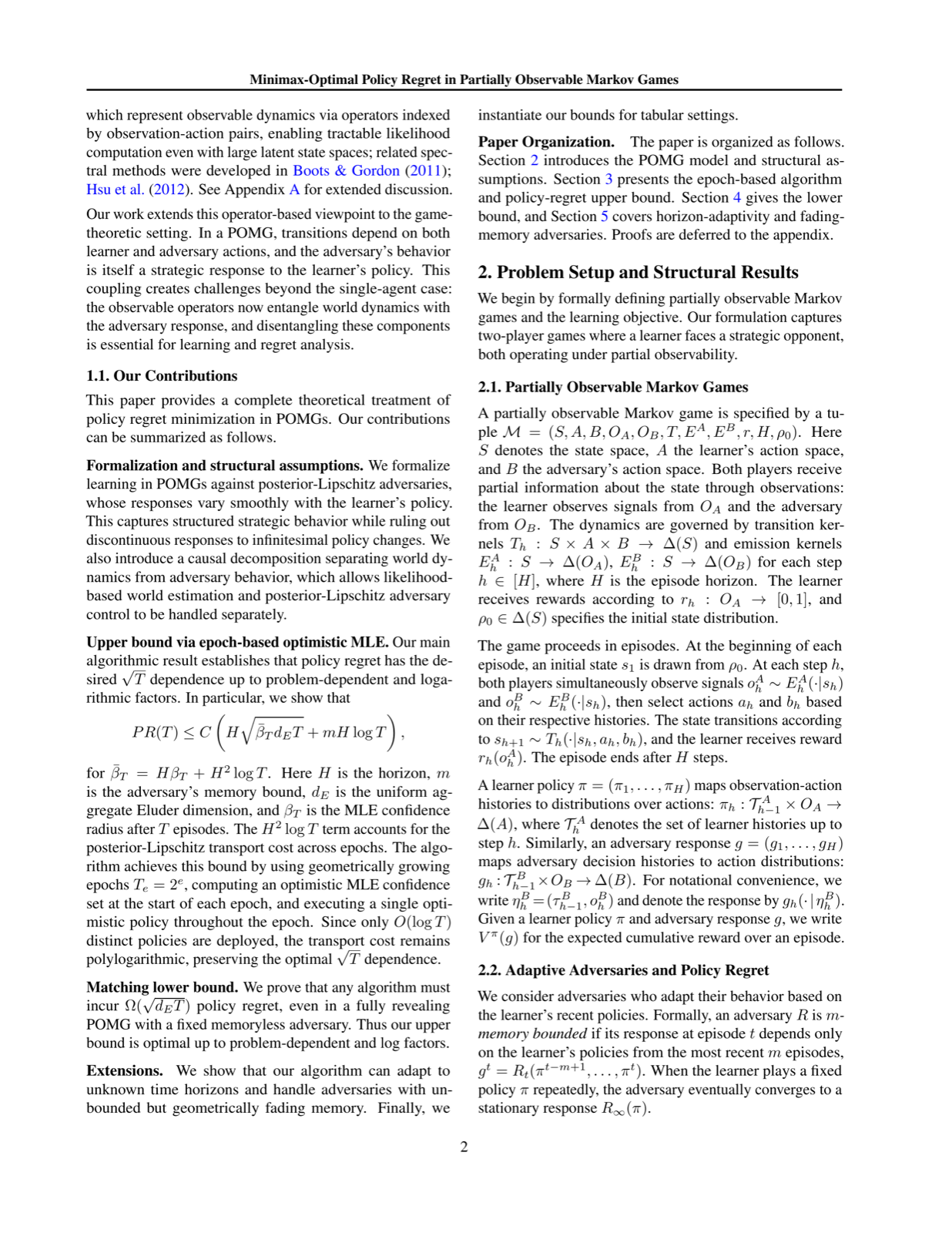
The minimax-optimal policy regret result provides a theoretical foundation for understanding the performance limits of learning in partially observable environments against strategic opponents. The explicit dependence on horizon, adversary memory, confidence radius, and aggregate Eluder dimension offers insights into the factors that influence learning performance.
The algorithm's approach of selecting one policy per geometrically growing epoch using confidence sets built cumulatively from past data provides a practical method for balancing exploration and exploitation in complex environments. This approach keeps the cost of comparing adversary responses logarithmic in T, making it computationally feasible.
The extension to horizon-adaptive guarantees and adversaries with geometric fading memory demonstrates the framework's flexibility and robustness. The lower bound matching the algorithm's performance up to problem-dependent and logarithmic factors validates the optimality of the approach and provides a benchmark for future developments.
Key insight: Epoch-based optimistic maximum-likelihood algorithm achieves minimax-optimal policy regret in partially observable Markov games, with explicit dependence on horizon, adversary memory, confidence radius, and aggregate Eluder dimension.
A Game-Theoretic Decision Framework for Optimal Selection of Coordination Detection Methods in Multi-UAV Fleet Operations
arXiv: 2606.02383
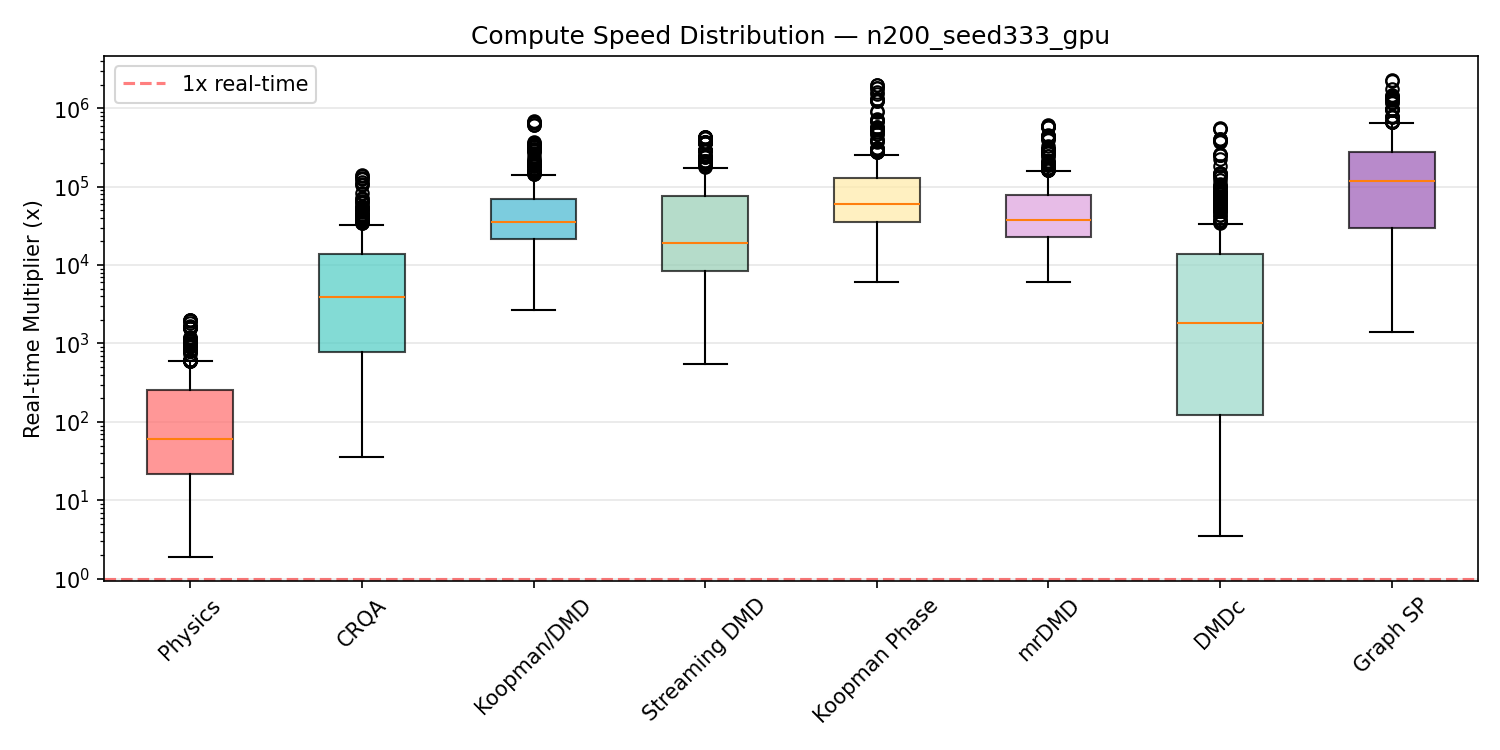
The game-theoretic approach to method selection in UAV fleet monitoring provides a principled solution to the fundamental speed-accuracy trade-off in real-time traffic management. By formulating the problem as a two-player zero-sum game, the framework identifies robust mixed strategies that guarantee worst-case performance regardless of scenario uncertainty.
The minimax solution's ability to recommend distinct method portfolios depending on operational priority demonstrates the framework's adaptability to different mission requirements. The guaranteed game value across all tested preference profiles suggests that the approach can be reliably applied to diverse operational scenarios.
The experimental evaluation across 200 randomized configurations shows that the framework achieves practical performance improvements while maintaining robustness. The approach's ability to balance multiple objectives and provide scenario-adaptive recommendations makes it valuable for complex multi-UAV operations.
Key insight: Game-theoretic framework resolves the speed-accuracy trade-off in UAV fleet monitoring by formulating method selection as a two-player zero-sum game, providing robust mixed strategies for different operational priorities.
Agentic-J: An AI Agent for Biological Microscopy Image Analysis
arXiv: 2606.02080
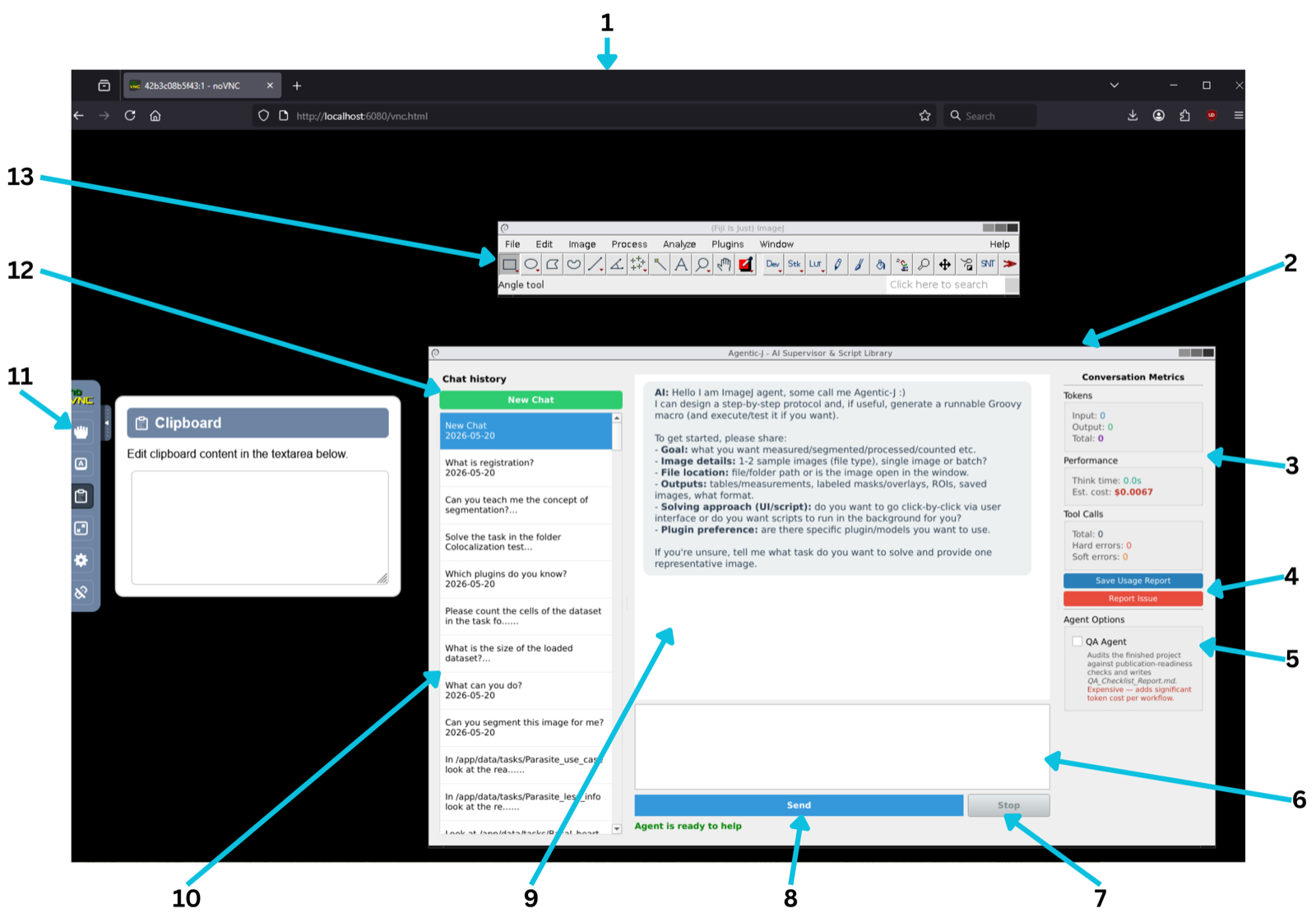
Agentic-J represents a significant advancement in making complex biological microscopy analysis accessible to researchers who may not have extensive programming expertise. The system's ability to translate natural language specifications into executable scripts organized into documented project structures enables reproducible workflows.
The specialized sub-agents for plugin management, code generation, debugging, quality assurance, and statistical reporting provide a comprehensive solution for biological image analysis. This modular approach ensures that each aspect of the analysis process is handled effectively, from initial setup to final reporting.
The demonstration of real biological microscopy image analysis workflows shows that the system can handle complex tasks such as nuclei segmentation, cell tracking, and multi-condition quantification. The containerized approach makes the system portable and easy to deploy in different research environments.
Key insight: Agentic-J system enables biologists to specify analysis tasks in natural language and generates executable scripts organized into documented project structures, making biological microscopy analysis more accessible and reproducible.
A Simple Hierarchical Causality Primer
arXiv: 2606.01979
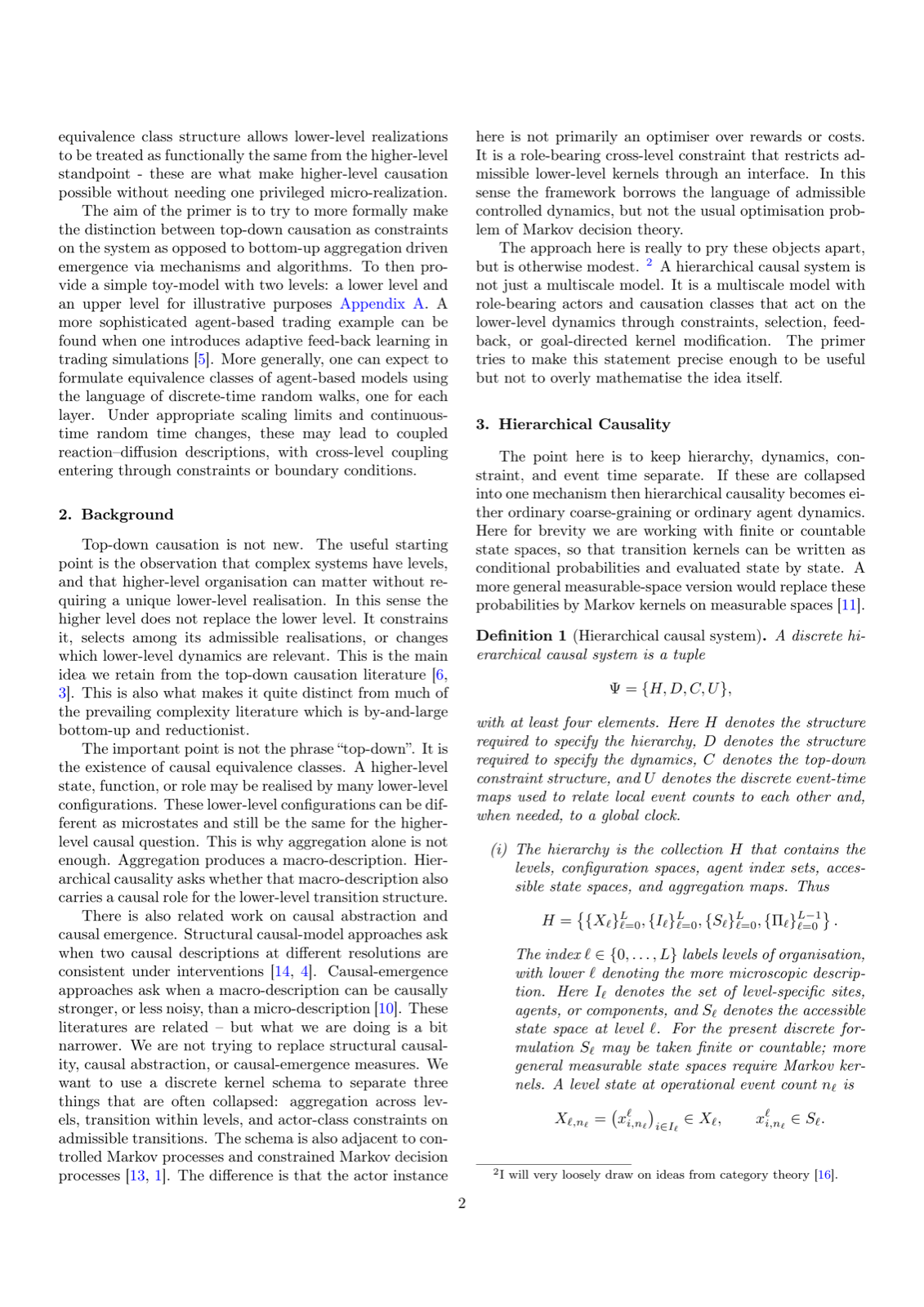
The hierarchical causality primer provides a simple yet comprehensive framework for understanding causation in complex systems by abstracting causation classes that actors instantiate. This approach moves beyond simple agent-based models to capture the nuanced relationships between different levels of organization.
The requirement for three additional structures—causation classes, aggregation operators, and discrete event-time maps—provides a formal foundation for modeling hierarchical causality. These structures enable the framework to handle the complexity of multi-level causal relationships while maintaining mathematical rigor.
The discrete and purposefully simple formulation of the framework suggests that it can be applied to various complex systems without requiring overly complex mathematical machinery. This accessibility makes it a valuable tool for researchers working with complex systems across different domains.
Key insight: Hierarchical causality framework abstracts causation classes to describe how actor-level roles constrain, select, and organise agent-level behaviour across levels, requiring three additional structures: causation classes, aggregation operators, and discrete event-time maps.
QoEReasoner: An Agentic Reasoning Framework for Automated and Explainable QoE Diagnosis in RANs
arXiv: 2606.01925
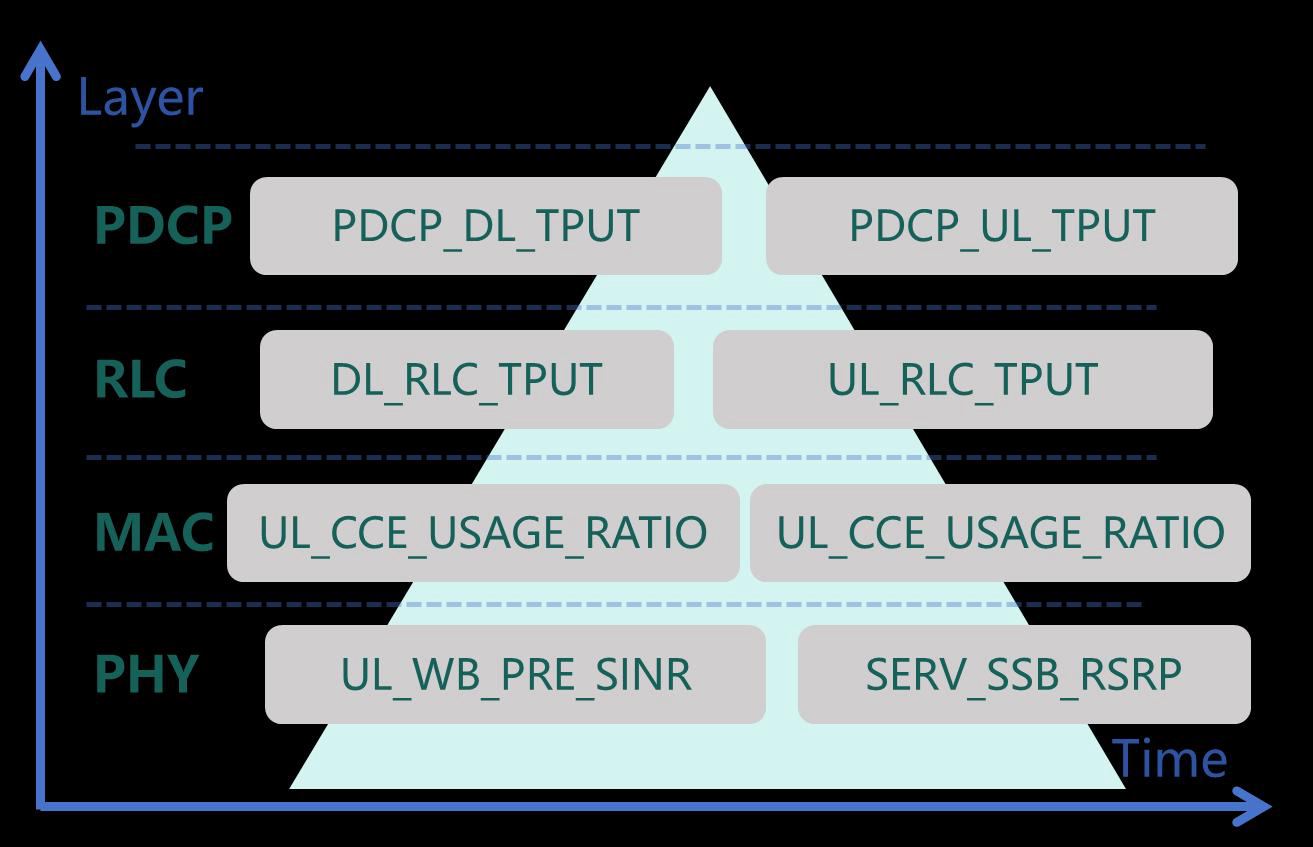
QoEReasoner addresses the limitations of LLMs in raw RAN troubleshooting by grounding their reasoning in physical network realities through deterministic tools, domain-specific knowledge base, and historical expert cases. This approach prevents hallucinations and ensures protocol-consistent fault propagation.
The framework's ability to reduce diagnostic time from 30 minutes to 3 minutes per session while maintaining expert-grade accuracy demonstrates significant practical value for operational RANs. The closed-loop process of anomaly detection, causal tracing, and root-cause localization provides a comprehensive solution for QoE diagnosis.
The demonstration that QoEReasoner outperforms strong baselines by 18%-40% across multiple diagnostic tasks validates the effectiveness of the integrated approach. The framework's robustness across diverse LLM backbones suggests that it can be effectively applied to different technical contexts.
Key insight: QoEReasoner framework combines deterministic tools for numeric KPI translation with domain-specific knowledge base and historical bank to provide automated and explainable QoE diagnosis with 18%-40% accuracy improvements.
RadioMaster: Multi-Agent System for Autonomous Radio Signal Generation
arXiv: 2606.01862

RadioMaster addresses the challenge of translating user intents into physical radio signals by creating a fully autonomous multi-agent framework that combines domain-specific knowledge retrieval, collaborative I/Q sample generation, and closed-loop physical layer verification. This approach overcomes the limitations of current models that fail to accomplish radio signal generation.
The three-pillar architecture of RadioWiki, RadioAgent, and RadioEmulator provides a comprehensive solution for radio signal generation that addresses domain ignorance and physical hardware constraints. The framework's ability to generate real-world wireless emissions demonstrates the potential for AI to revolutionize wireless prototyping.
The extensive real-world evaluations showing that RadioMaster significantly outperforms state-of-the-art baselines in configuration viability and signal fidelity validate the framework's practical effectiveness. The approach's ability to handle complex physical layer requirements makes it valuable for wireless engineering applications.
Key insight: RadioMaster framework translates user intents into real-world wireless emissions through three synergistic pillars: RadioWiki for domain knowledge, RadioAgent for I/Q sample generation, and RadioEmulator for physical layer verification.
From Global Policies to Local Strategies: Multi-Objective Optimization of Resource-Specific Handover Policies
arXiv: 2606.01857
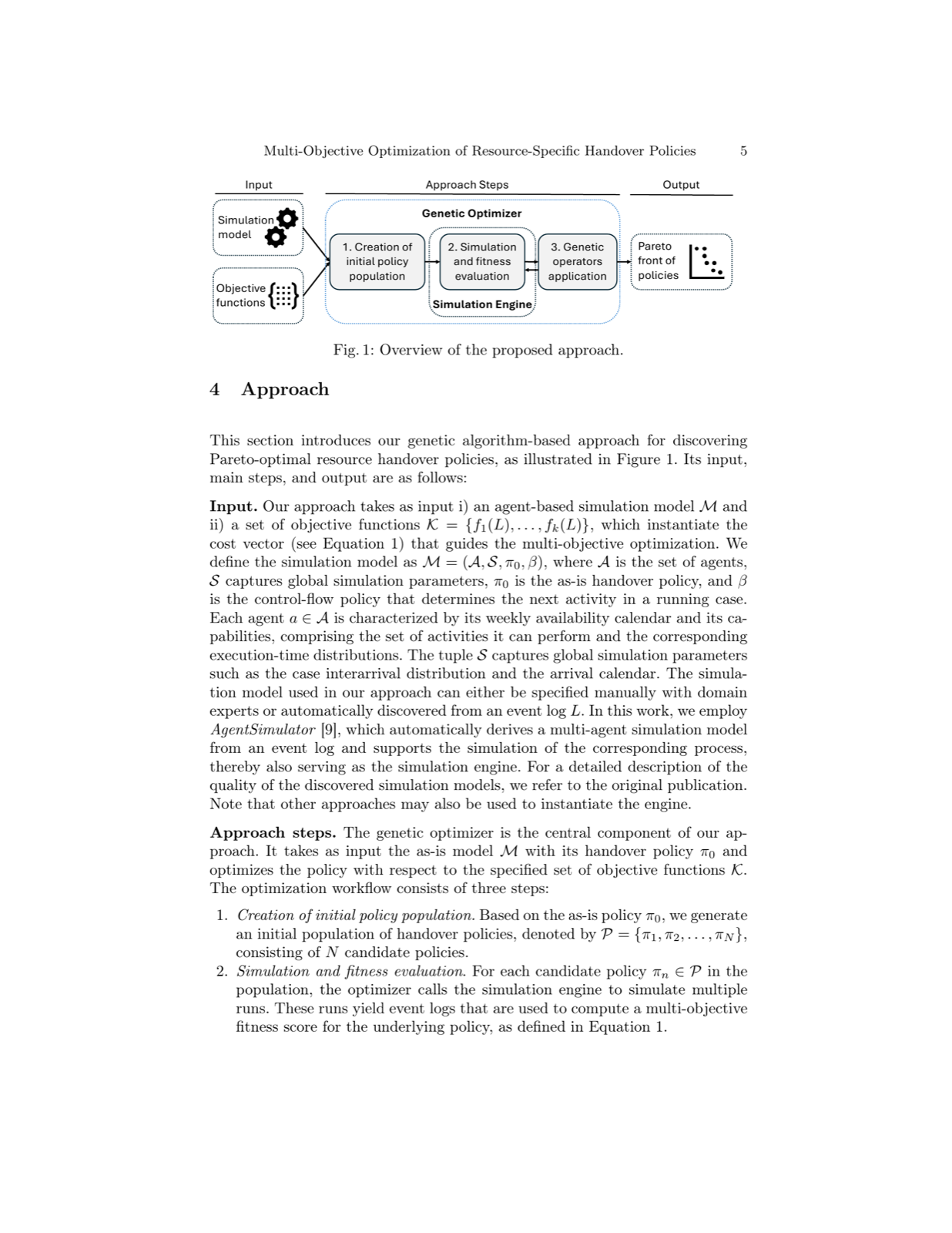
The approach combines a Multi-Agent System-based process simulator with a multi-objective evolutionary algorithm to produce resource-specific handover policies that optimize multiple objectives simultaneously. This method addresses the challenge of inter-resource collaboration patterns that traditional RL approaches neglect.
The significant performance improvements achieved (37% cost reduction and 58% waiting time reduction) demonstrate the value of collaboration-aware optimization in business process management. The approach's ability to consistently outperform heuristic baselines suggests that it can provide practical benefits for real-world applications.
The demonstration that the approach works on both synthetic and real-world datasets validates its applicability across different contexts. The method's ability to recommend person-specific handover policies suggests that it can be adapted to various organizational structures and operational requirements.
Key insight: Multi-objective optimization approach for resource-level decision-making produces Pareto-optimal, resource-specific policies that reduce costs by 37% and waiting time by 58% compared to heuristic baselines.
Dynamic Trust-Aware Sparse Communication Topology for LLM-Based Multi-Agent Consensus
arXiv: 2606.01828
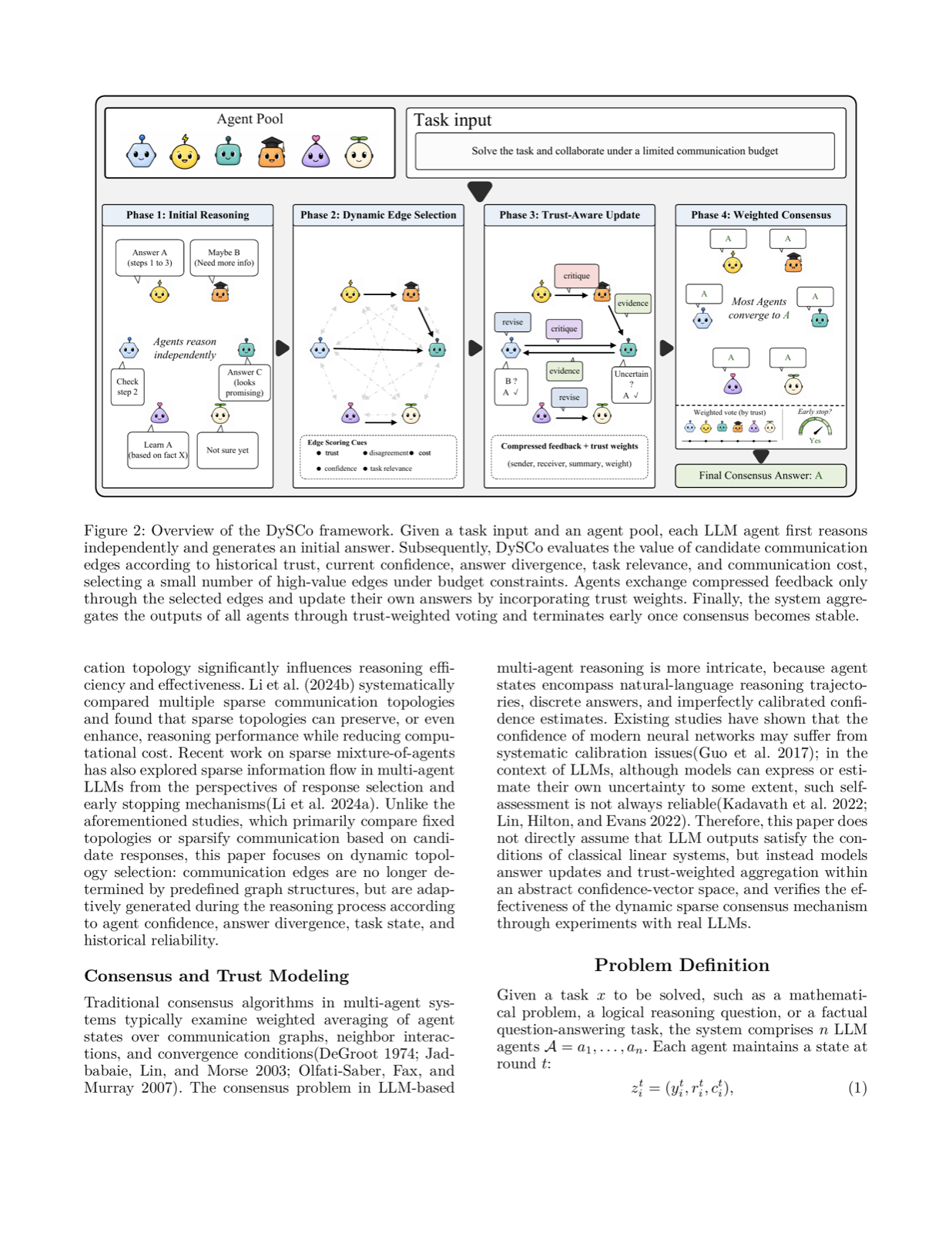
DySCo's dynamic trust-aware sparse consensus mechanism addresses the communication overhead problem in LLM-based multi-agent systems by replacing universal broadcasting with on-demand communication. The approach estimates communication edge value based on agent reliability, answer divergence, and task relevance.
The mechanism's ability to select high-value edges for message exchange under budget constraints while preserving essential cross-validation information demonstrates a sophisticated approach to balancing communication efficiency and information retention. The early termination of discussions once consensus stabilizes further improves efficiency.
The evaluation of DySCo on mathematical reasoning, logical reasoning, and factual question-answering tasks shows that the approach can be effectively applied to different types of reasoning tasks. The reduction in communication overhead while maintaining essential validation information suggests that DySCo can improve scalability of multi-agent systems.
Key insight: DySCo mechanism replaces universal broadcasting with on-demand communication by estimating communication edge value based on agent reliability, answer divergence, and task relevance.
MetaForge: A Self-Evolving Multimodal Agent that Retrieves, Adapts, and Forges Tools On Demand
arXiv: 2606.01801

MetaForge's closed-loop approach to tool use represents a significant advancement in multimodal agent capabilities, enabling agents to make decisions about tool invocation and evolution dynamically rather than relying on static tool inventories. The four-stage process of Decide, Retrieve, Adapt, and Forge creates a comprehensive framework for adaptive tool use.
The joint optimization of invocation necessity, retrieval accuracy, execution effectiveness, and forged-skill reusability through reinforcement learning with explicit invocation-cost penalty demonstrates sophisticated learning mechanisms. This approach ensures that agents make efficient use of tools while avoiding redundant calls.
The consistent performance improvements across 12 benchmarks validate MetaForge's effectiveness in addressing the limitations of static tool inventories. The paradigm shift from predefined tools to on-demand self-evolution suggests that agents can become more adaptable and capable over time.
Key insight: MetaForge framework learns when to invoke tools and how to evolve its toolset on demand through a closed judge-retrieve-adapt-forge-recycle loop, surpassing 16 baselines in accuracy, efficiency, and generalization.
Agent System Operations: Categorization, Challenges, and Future Directions
arXiv: 2606.01581

AgentOps framework addresses the gap in systematic approaches to agent system operations by providing a clear categorization of anomalies and a comprehensive operational framework. The distinction between intra-agent and inter-agent anomalies helps focus efforts on the most critical issues.
The four-stage operational framework of monitoring, anomaly detection, root cause localization, and resolution provides a structured approach to maintaining agent system stability and security. This systematic approach is crucial for the widespread adoption of agent systems in critical applications.
The survey's emphasis on the need for comprehensive operational approaches highlights the growing importance of agent system maintenance and security. As agent systems become more prevalent, the need for robust operational frameworks will become increasingly critical.
Key insight: Agent System Operations (AgentOps) framework provides systematic approach to agent system operations, defining four key stages: monitoring, anomaly detection, root cause localization, and resolution.
Coordinating Task Switching in a Robotics Multi-Agent System Using Behavior Trees
arXiv: 2606.01170
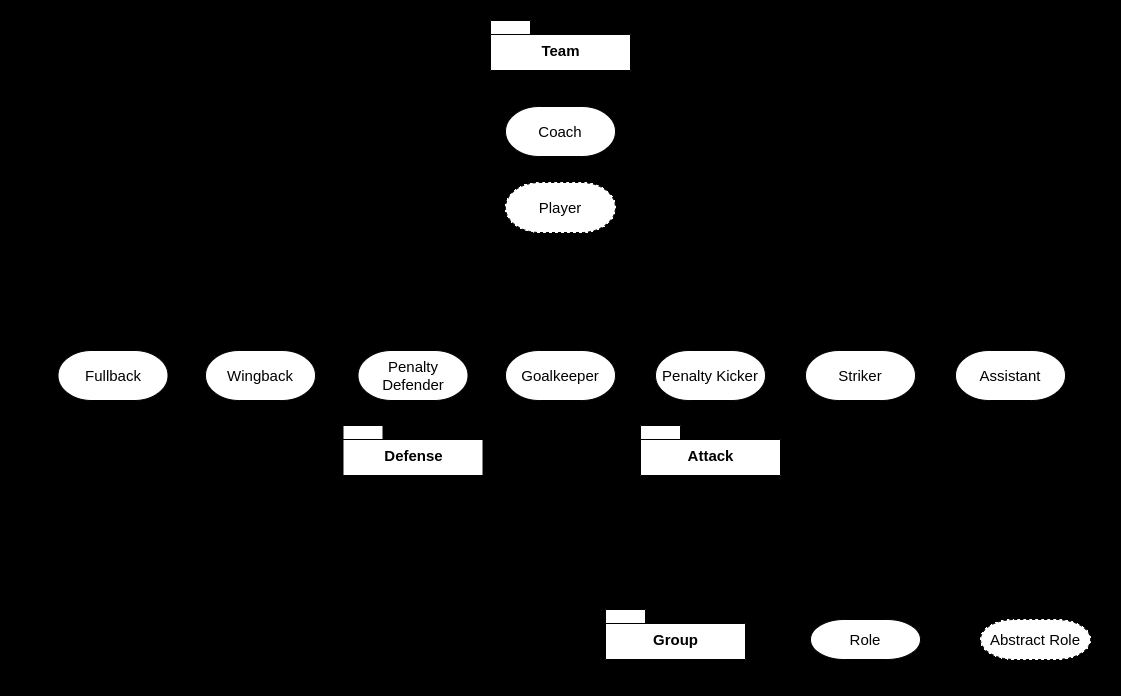
The Behavior-Tree-based approach for multi-robot coordination in the IEEE VSSS competition shows that structured decision-making frameworks can significantly improve performance in dynamic environments. The comparison with finite state machine-based approach using FIRASim simulator validates the practical benefits of behavior trees.
The evaluation in an academic robotics competition demonstrates that the new strategy can be effectively applied beyond simulation to real-world scenarios. The approach's ability to handle the dynamic nature of soccer games while maintaining coordination among robots is crucial for practical applications.
The demonstration that behavior trees can be effectively applied to robotics multi-agent systems suggests that this approach could be valuable for other dynamic environments where coordination is important. The framework's adaptability to different robotic applications makes it a promising approach for multi-agent robotics.
Key insight: Behavior-Tree-based approach for multi-robot coordination in VSSS competition demonstrates improved performance over finite state machine-based approach in dynamic soccer environment.
FinCom: A Financial Multi-Agent Demo with Disagree-or-Commit Deliberation
arXiv: 2606.00939
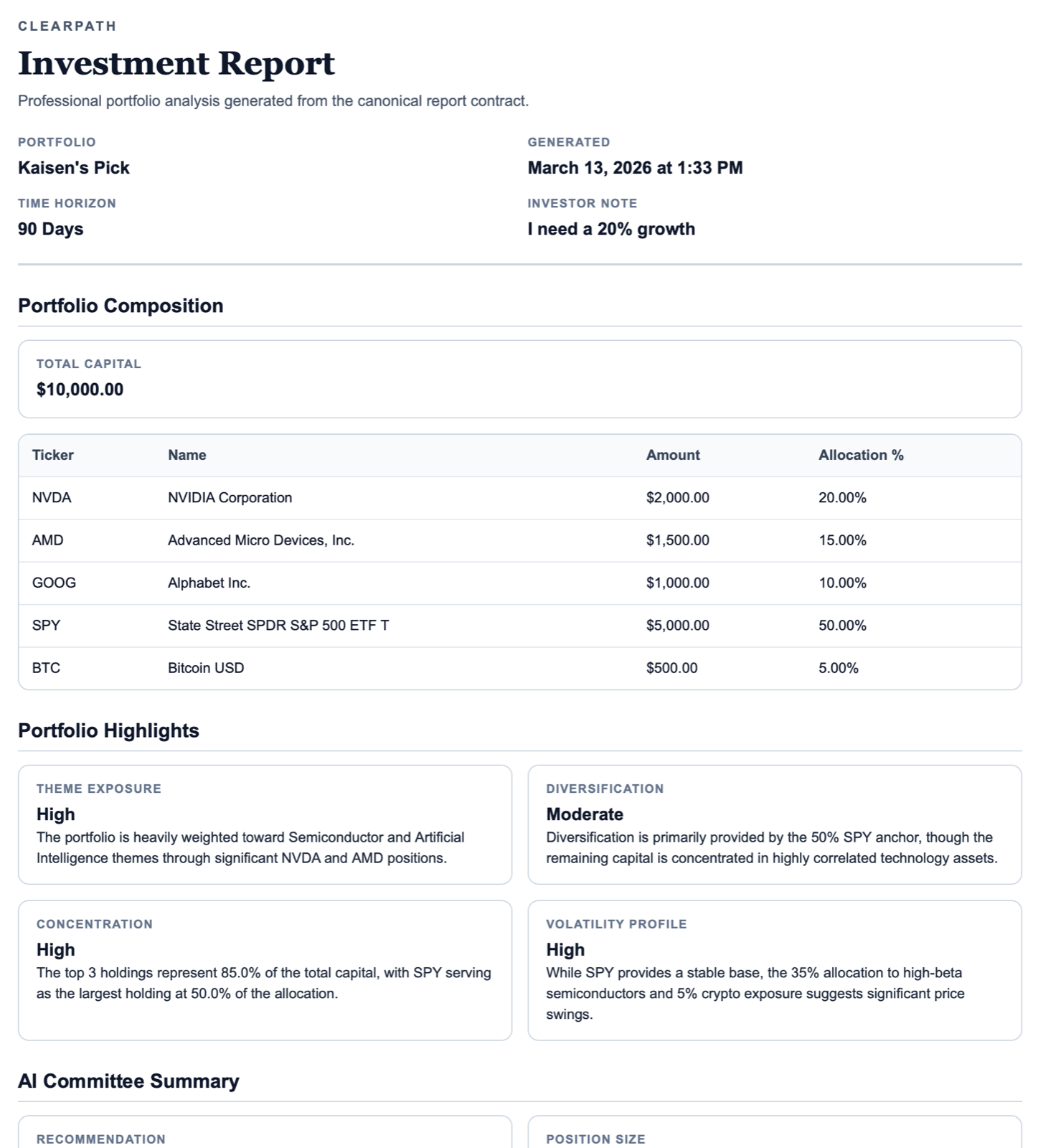
FinCom's implementation of the Disagree-or-Commit protocol addresses the vulnerability of consensus-seeking approaches to sycophancy by embedding structured dissent into financial AI committees. This approach prevents premature agreement and degraded outcomes that can result from conforming to peer reasoning.
The three ReAct-enabled specialist agents (Research, Quantitative, and Risk) with role-specific tools for retrieval, computation, and stress testing provide a comprehensive framework for financial analysis. The requirement for explicit critique or commitment before converging on recommendations ensures that dissent is properly structured and considered.
The evaluation showing significant improvements in reasoning accuracy and risk awareness over consensus-seeking baselines demonstrates the practical value of structured dissent in financial AI systems. The framework's ability to improve accountability, transparency, and epistemic robustness suggests that it can be valuable for high-stakes financial applications.
Key insight: FinCom framework operationalizes Disagree-or-Commit protocol to embed structured dissent into financial AI committees, improving reasoning accuracy and risk awareness by 18%-40% over consensus-seeking baselines.