NVIDIA and Hugging Face have released Cosmos 3, the first open omni-model for physical AI reasoning and action, featuring a Mixture-of-Transformers architecture that combines world generation, physical reasoning, and action generation. The model includes two versions optimized for different inference needs and supports multiple input/output modalities for applications in robotics, autonomous vehicles, and smart spaces. Meanwhile, research continues to advance agent frameworks with innovations in task-focused memorization, context management, and tool calling generalization.
AI Model Releases
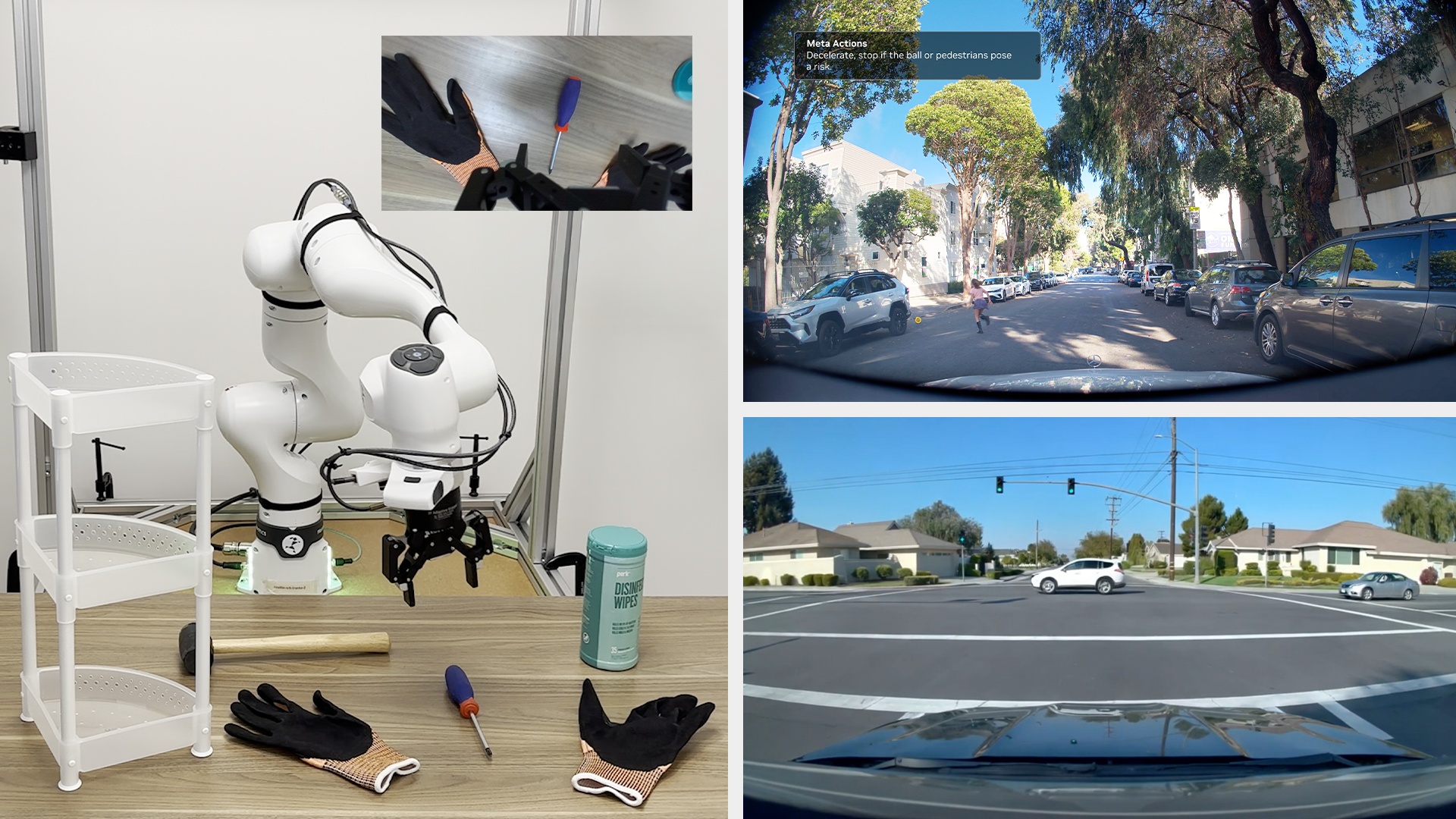
Welcome NVIDIA Cosmos 3: The First Open Omni-model for Physical AI Reasoning and Action
NVIDIA and Hugging Face have released Cosmos 3, the first open omni-model for physical AI reasoning and action. The model uses a Mixture-of-Transformers (MoT) architecture to combine world generation, physical reasoning, and action generation in a single unified model. It includes two versions: Cosmos 3 Nano (8B parameters) optimized for workstation inference and Cosmos 3 Super (32B parameters) for large-scale research. The model supports multiple input/output modalities including text, image, video, and action for applications in robotics, autonomous vehicles, and smart spaces.
Why it matters: This represents a major advancement in world foundation models for physical AI, consolidating multiple specialized capabilities into a single accessible model that can reason about physical properties and generate realistic video worlds. The open release on Hugging Face democratizes access to this powerful physical AI foundation model for researchers and developers.

Making sense of the debate over AI psychosis
Research Papers
Task-Focused Memorization for Multimodal Agents
arXiv: 2605.31075

The paper introduces TaskMem, a reinforcement-learning-based framework that addresses a critical gap in multimodal agent design: determining what to memorize from an unbounded stream of observations. Unlike traditional approaches that focus on memory module design or basic accuracy requirements, TaskMem frames memory generation as a learnable policy that adapts to task-specific demands. This approach is particularly important for embodied agents that continuously perceive, reason, and act in real or virtual environments, where information combinatorial explosion makes selective retention essential.
The two-phase training paradigm implemented in TaskMem is innovative: Phase One learns how to memorize by optimizing memory quality under fidelity requirements, while Phase Two, occurring after deployment, enables the agent to learn what to memorize by tuning an adapter on its base MLLM. This allows the system to adapt its memorization strategy based on recent environment tasks, using a reward model that guides the policy toward task-relevant content. The evaluation on streaming benchmarks like VideoMME, EgoLife, and EgoTempo demonstrates significant improvements in VQA accuracy, showing that task-focused memorization can substantially enhance agent performance.
The practical implications of TaskMem extend beyond just performance gains. By enabling agents to dynamically adjust their memory focus, this approach addresses fundamental challenges in continual learning and experience accumulation. The framework's ability to isolate memory assessment and evaluate performance using only agent memory without raw video access suggests a more robust and scalable approach to multimodal agent development, particularly for applications requiring long-term memory management and task adaptation.
Key insight: Multimodal agents need task-focused memorization policies that dynamically adjust what to remember based on real-time task demands, rather than relying on static memory modules.
Learning Agent-Compatible Context Management for Long-Horizon Tasks
arXiv: 2605.30785
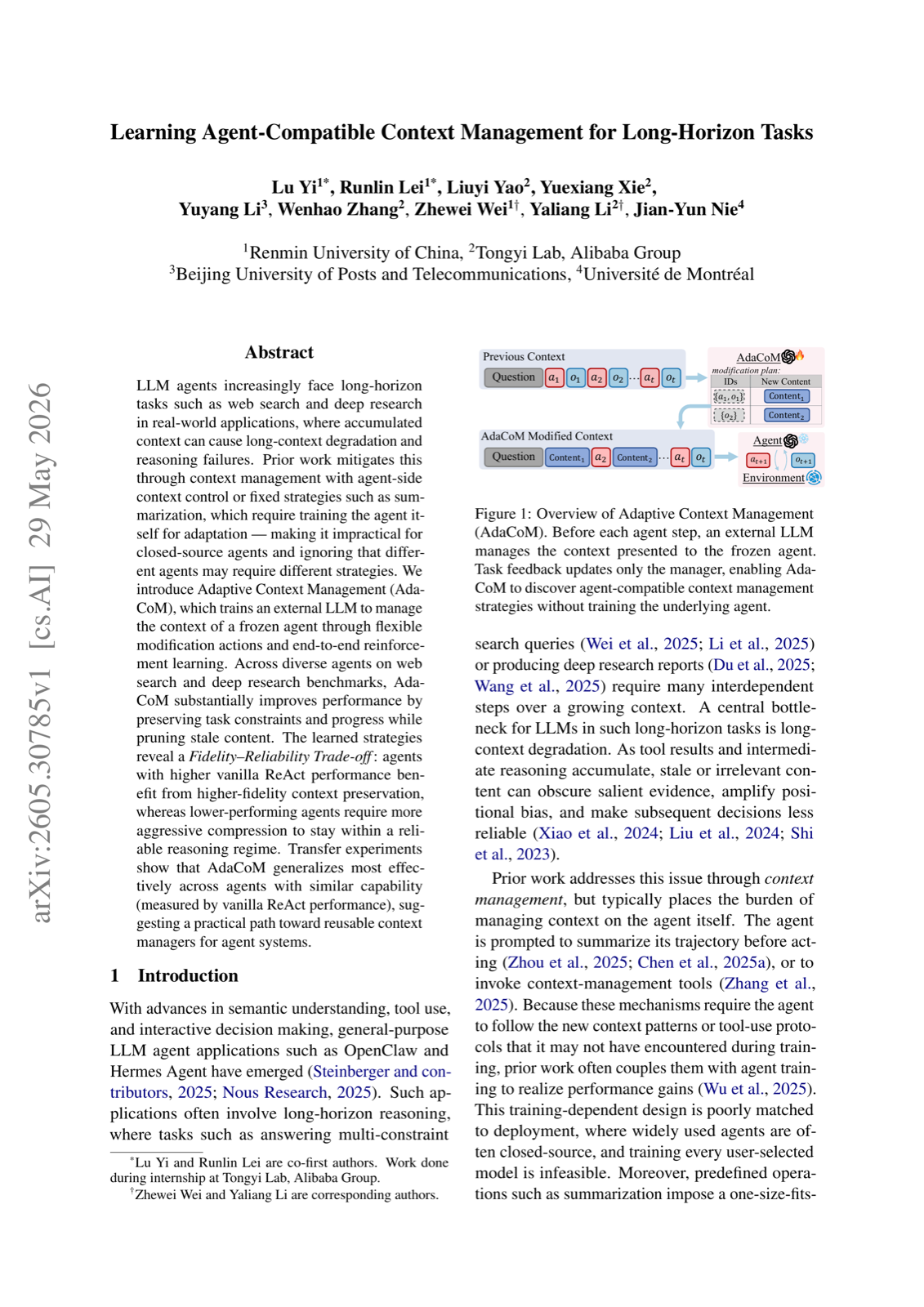
Adaptive Context Management (AdaCoM) represents a significant advancement in addressing long-context degradation in LLM agents performing long-horizon tasks. The approach trains an external LLM to manage context of frozen agents through flexible modification actions and end-to-end reinforcement learning, overcoming limitations of fixed strategies like summarization that require agent retraining. This external management approach is particularly valuable for closed-source agents where internal adaptation is impractical.
The discovery of the Fidelity-Reliability Trade-off is a key contribution: agents with higher vanilla ReAct performance benefit from higher-fidelity context preservation, whereas lower-performing agents require more aggressive compression to stay within a reliable reasoning regime. This finding suggests that context management strategies should be tailored to agent capabilities rather than applying uniform approaches, opening new research directions for agent-specific optimization.
Transfer experiments showing that AdaCoM generalizes most effectively across agents with similar capability provide a practical path toward reusable context managers. This insight is crucial for scalable agent systems where different agents may require different context management strategies, suggesting that effective context management can be modularized and shared across similar agent types, potentially reducing development overhead and improving system robustness.
Key insight: Adaptive context management through external LLMs can significantly improve long-horizon task performance by preserving task constraints while pruning stale content, revealing a fidelity-reliability trade-off.
From Prompt Injection to Persistent Control: Defending Agentic Harness Against Trojan Backdoors
arXiv: 2605.31042

The paper introduces ClawTrojan, a benchmark that reveals a critical threat in local agentic harnesses where attackers can embed prompt injection within files or tool outputs, creating multi-step trojan attacks that turn untrusted text into persistent control content. This threat model is particularly concerning because no individual step appears malicious on its own, making detection challenging for existing defenses that inspect each step in isolation.
The proposed DASGuard defense mechanism addresses this by scanning control-like text in sensitive local files, tracing its origin, and removing control content that does not originate from a trusted source. This approach combines runtime attack blocking with sanitized commits to the workspace, providing a dynamic defense that can prevent the propagation of backdoors through file system interactions. The 95.5% attack success rate achieved by ClawTrojan on GPT-5.4 demonstrates the severity of this threat and validates the need for such sophisticated defense mechanisms.
This work highlights the evolving security landscape for agentic systems, where the attack surface expands beyond simple prompt injection to include persistent control through file system interactions. The findings suggest that future agent security must consider not just immediate actions but also the long-term implications of agent state management and file system access, particularly in local environments where agents can read and write files across sessions.
Key insight: Multi-step trojan attacks in local agentic harnesses can create persistent control through prompt injection that plants backdoors in files, requiring dynamic defense mechanisms that trace control content origins.
MAVEN: Improving Generalization in Agentic Tool Calling
arXiv: 2605.30738
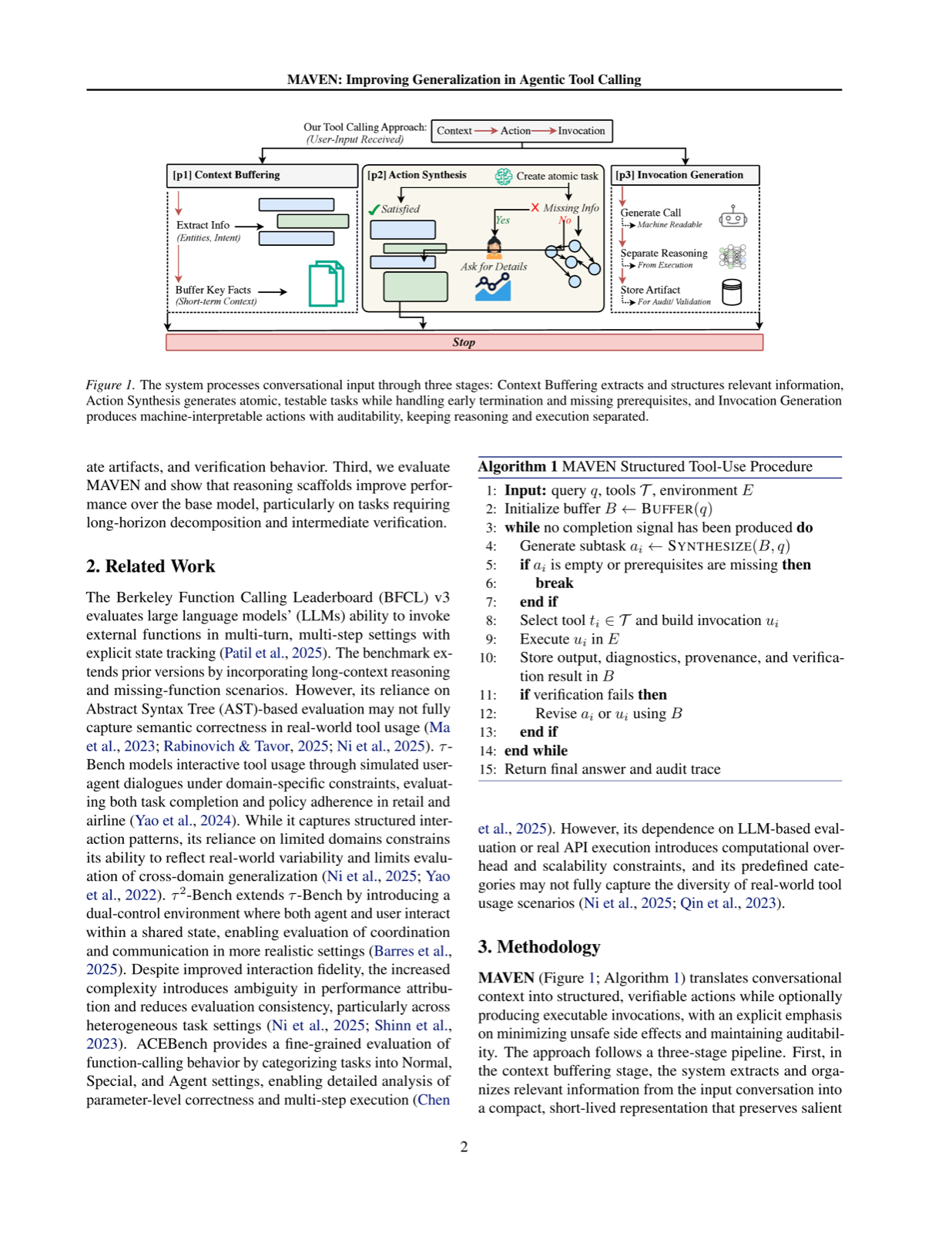
MAVEN (Modular Agentic Verification and Execution Network) addresses a fundamental challenge in agentic tool calling: generalization across diverse environments. The approach introduces a lightweight symbolic reasoning scaffold that enables structured decomposition, adaptive tool orchestration, and intermediate verification, which are crucial for reliable agentic reasoning systems. This is particularly important given that while LLMs achieve strong results on individual benchmarks, their ability to compose reasoning strategies and coordinate tools across domains remains underexplored.
The evaluation on established benchmarks including BFCL v3, TauBench, and the newly introduced MAVEN-Bench reveals a substantial gap between partial reasoning quality and end-to-end task success. MAVEN's improvement from 48% to 71% accuracy on its base model without additional training demonstrates the effectiveness of verification-centered scaffolds in strengthening compositional reasoning. This approach suggests that lightweight verification mechanisms can be more effective than complex training procedures for improving agent reliability.
The competitive performance against frontier proprietary baselines while using an open-weight backbone with an estimated cost ratio of roughly 1/10 indicates that MAVEN's approach is not only theoretically sound but also practically viable. This cost efficiency combined with performance gains suggests that modular verification frameworks could become a standard component in agentic systems, particularly for applications where cost and performance are both critical factors.
Key insight: Modular agentic verification and execution networks can significantly improve tool calling generalization by providing structured decomposition, adaptive orchestration, and intermediate verification.
LongDS-Bench: On the Failure of Long-Horizon Agentic Data Analysis
arXiv: 2605.30434

LongDS-Bench reveals a critical bottleneck in long-horizon agentic data analysis: the ability to maintain, update, restore, and compose evolving analytical states. The benchmark's construction from real-world Kaggle notebooks with 2,225 turns across six domains demonstrates the complexity of real-world analytical tasks that require sustained state management. The finding that performance drops nearly 47 points from early to late turns and that long-horizon errors account for 52-69% of failures underscores that the core challenge is not computational resources but state management fidelity.
The observation that additional agent steps do not necessarily improve performance is particularly significant for agent design. It suggests that future research should focus on improving state representation and management rather than simply increasing interaction budgets. This insight has implications for agent architectures that must balance computational efficiency with state fidelity, particularly in applications requiring iterative analysis over extended periods.
The release of LongDS to support research on reliable long-horizon agentic data analysis represents a valuable contribution to the field. The benchmark's complexity and realistic task construction provide a rigorous testbed for evaluating agent capabilities in sustained analytical work, potentially driving innovations in memory management, state tracking, and long-term reasoning architectures that can handle the demands of complex, evolving analytical contexts.
Key insight: Long-horizon agentic data analysis fails primarily due to maintaining correct analytical state rather than increasing interaction budget, with performance dropping significantly in later turns.
Planner-Centric Reinforcement Learning for Deep Research with Structure-Aware Reward
arXiv: 2605.30824
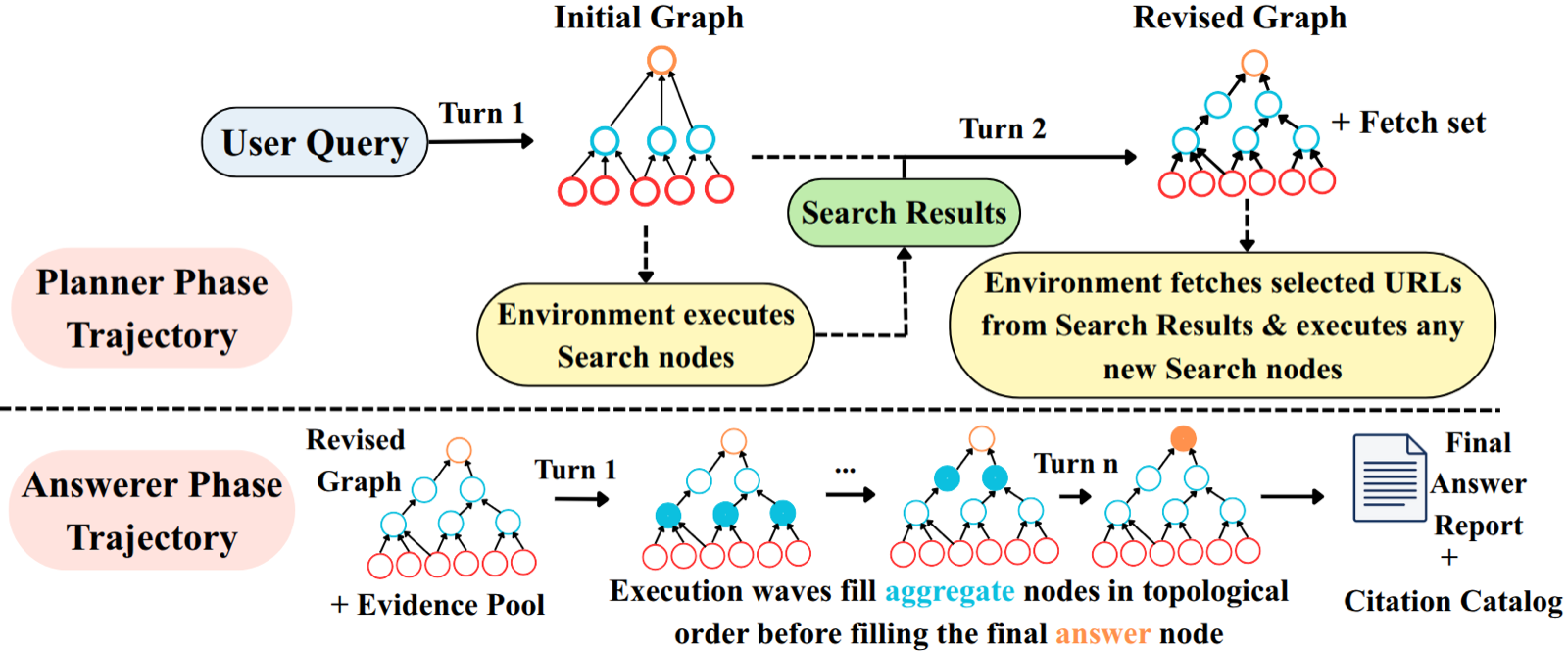
DecomposeR introduces a novel planner-centric deep research framework that represents research plans as typed directed acyclic graphs (DAGs), enabling explicit planning and structured reward assignment. This approach addresses the limitations of existing training paradigms that either rely on short-form verifiable QA or optimize monolithic long trajectories, which makes planning and execution difficult to disentangle and yields weak credit assignment for planning processes.
The two-stage training process in DecomposeR - first training a planner reinforcement learning model to learn graph structure and query decomposition, then training an answerer reinforcement learning model conditioned on the learned plan - provides a clear separation of planning and execution. This structure enables finer-grained optimization of planning while reducing ambiguity of end-to-end training, leading to improved planning and answering capabilities. The 5.1-8.0 point improvements over strong open baselines on long-form benchmarks demonstrate the effectiveness of this approach.
The structured reward assignment that focuses on explicit planner tokens and structured components rather than flat trajectories represents a significant advancement in credit assignment for complex reasoning tasks. This approach not only improves performance but also provides insights into how planning and execution can be better separated in agent systems, potentially leading to more interpretable and maintainable agentic architectures for complex problem-solving tasks.
Key insight: Planner-centric reinforcement learning with structured reward functions can significantly improve deep research capabilities by explicitly representing research plans as typed directed acyclic graphs.
SLAT: Segment-Level Adaptive Trimming for Efficient CoT Reasoning
arXiv: 2605.30832
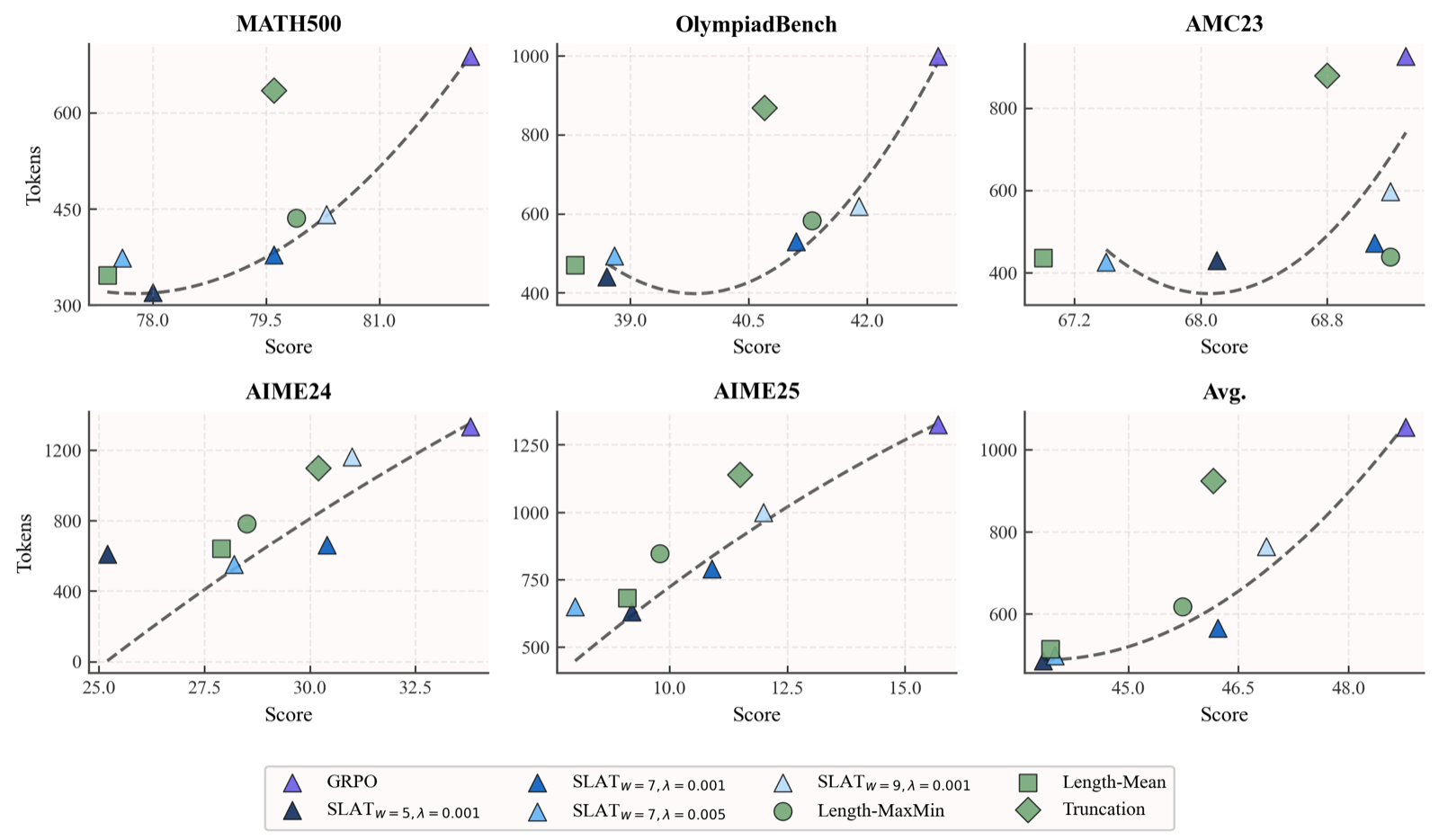
SLAT (Segment-Level Adaptive Trimming) addresses the structural redundancy problem in chain-of-thought reasoning by identifying that inefficiency concentrates in high-probability segments with low marginal utility. This theoretical characterization of segment suboptimality under correctness-length trade-off objective provides a principled approach to efficient reasoning that goes beyond coarse token-uniform length penalties.
The empirical results showing that SLAT establishes a superior accuracy-efficiency Pareto frontier, reducing reasoning length by 50% relative to uncompressed baselines while maintaining competitive accuracy, demonstrate the practical value of theoretically grounded, segment-aware trimming. This approach is particularly relevant for large language models where computational overhead can be substantial, and where the quality of reasoning is not necessarily improved by longer outputs.
The framework's ability to selectively suppress redundant segments based on marginal utility criteria suggests a promising direction for efficient CoT reasoning in LLMs. This approach could be particularly valuable in applications where computational resources are constrained or where the cost of generating long reasoning chains outweighs the benefits of increased detail, potentially leading to more scalable and efficient reasoning systems.
Key insight: Segment-level adaptive trimming can significantly reduce reasoning length by 50% while maintaining competitive accuracy by selectively suppressing redundant segments based on marginal utility.
LinTree: Improving LLM Reasoning with Explicitly Structured Search Histories
arXiv: 2605.31492
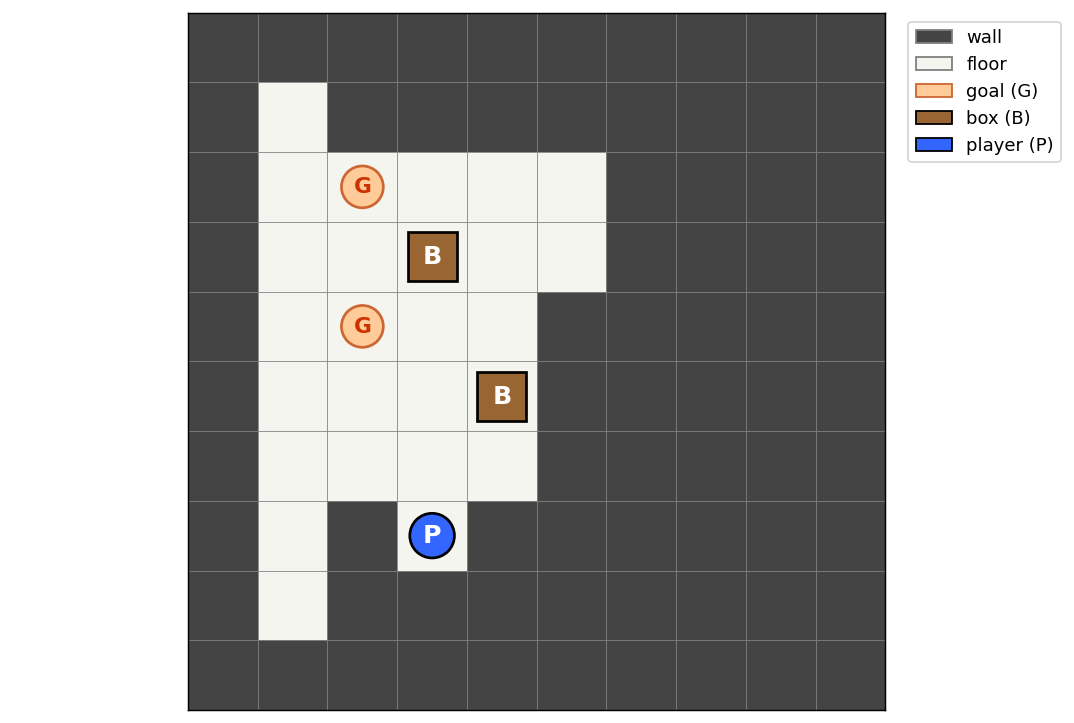
LinTree addresses a fundamental limitation in how LLMs utilize search history by recognizing that raw access to search history alone is insufficient for reliable performance improvements. The approach demonstrates that when models backtrack or switch branches, the trace does not explicitly identify which earlier search state is being revisited, creating a gap in the representation of the underlying search structure.
The experimental results across Blocks World, grid Navigation, and Sokoban environments show that adding simple parent pointers to explicitly represent the linearized tree structure significantly improves both task performance and search efficiency relative to implicit reasoning models and LLM-heuristic-guided search. This finding suggests that search history becomes most useful when its tree structure is made explicit, which has implications for how LLMs should be designed to handle complex reasoning tasks.
The LinTree approach motivates more structure-aware representations for LLM reasoning, suggesting that future systems should not only process search traces but also explicitly model the relationships between different states in the search process. This could lead to more sophisticated reasoning architectures that better leverage the inherent structure of problem-solving processes, potentially improving both the efficiency and effectiveness of LLM-based reasoning systems.
Key insight: Explicitly structured search histories (LinTree) improve LLM reasoning performance by making the underlying search tree structure explicit, enabling better task performance and search efficiency.
AutoSci: A Memory-Centric Agentic System for the Full Scientific Research Lifecycle
arXiv: 2605.31468

AutoSci presents a comprehensive memory-centric agentic system for the full scientific research lifecycle, addressing a gap in existing systems that either partially satisfy or fail to satisfy requirements for persistent memory and continuous improvement. The system's organization around four modules - SciMem, SciFlow, SciDAG, and SciEvolve - creates a persistent research environment that can execute, remember, and evolve across projects.
The separation of Long-Term Knowledge Memory for reusable scientific knowledge from Active Research Memory for project-level artifacts represents a sophisticated approach to managing different types of information in scientific research. This schema-governed approach to research memory allows for both immediate project needs and long-term knowledge accumulation, which is crucial for advancing scientific understanding over time.
The integration of feedback signals into versioned updates to SciMem organization, SciFlow skills, and SciDAG templates demonstrates how agents can learn and improve their own research procedures. This self-improving capability suggests that future scientific agents could become increasingly effective at research tasks, potentially accelerating the pace of scientific discovery and reducing the burden on human researchers.
Key insight: Memory-centric agentic systems can automate the full scientific research lifecycle by maintaining structured persistent memory and improving research procedures over time.
Learning to Adapt: Self-Improving Web Agent via Cognitive-Aware Exploration
arXiv: 2605.31365

SCALE introduces a novel framework for building autonomous web agents that leverage three adversarial roles - Selector, Predictor, and Judger - to autonomously discover agent limitations and expand cognitive boundaries through environmental exploration. This approach addresses the limitations of existing web agents that rely on handcrafted execution pipelines or expensive expert trajectories, which restrict adaptability to complex, dynamic environments.
The proposed SCALE-Hop graph exploration strategy facilitates global planning and helps agents avoid local exploration traps, which is particularly important for web environments where the search space can be vast and complex. The framework's ability to construct a large-scale dataset (SCALE-20k) from 19 real-world websites provides valuable resources for training and evaluating web agents in diverse environments.
Experimental results showing significant performance improvements and generalization across various web environments demonstrate the practical effectiveness of the SCALE approach. The framework offers a scalable and generalizable solution for building truly autonomous and adaptive web agents, which could have broad implications for applications ranging from web automation to complex online task completion.
Key insight: Self-cognitive-aware learning and exploration (SCALE) enables web agents to autonomously discover limitations and expand cognitive boundaries through adversarial roles and graph exploration strategies.
Diagnosing Failure Modes of Shared-State Collaboration in Resource-Constrained Visual Agents
arXiv: 2605.31354

CoSee's auditing framework provides critical insights into the failure dynamics of collaborative reasoning with weak learners, revealing that naive shared workspaces often amplify hallucinations rather than resolve them. This counter-intuitive finding challenges conventional wisdom about shared working memory and highlights the importance of communication fidelity in multi-agent systems.
The identification of two dominant failure modes - Noise Reinforcement and Policy Collapse - offers concrete mechanisms for understanding and addressing collaboration failures in resource-constrained environments. Noise Reinforcement occurs when ungrounded notes are reused as evidence, while Policy Collapse happens when added context shifts models toward under-specified, short-form answers, suggesting that the problem lies not in reasoning depth but in information flow and context management.
The use of cost-accuracy Pareto frontiers to analyze performance reveals that increased compute can correlate negatively with performance without explicit verification, indicating that computational resources alone are insufficient for improving collaborative reasoning. This finding has important implications for designing modular systems where the focus should be on communication fidelity and verification mechanisms rather than simply increasing computational capacity.
Key insight: Failure modes in shared-state collaboration for resource-constrained agents are primarily due to communication fidelity issues rather than reasoning depth, with noise reinforcement and policy collapse being dominant failure modes.
TraceGraph: Shared Decision Landscapes for Diagnosing and Improving Agent Trajectories
arXiv: 2605.31308
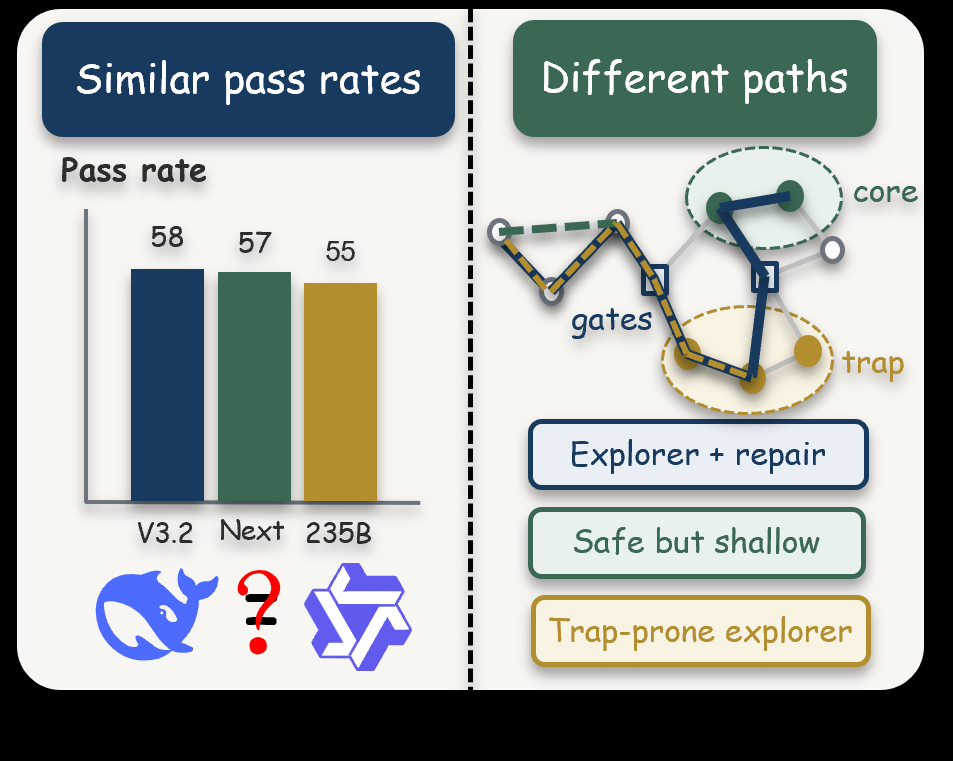
TraceGraph introduces a novel approach to agent trajectory analysis by creating shared decision landscapes that turn multi-model agent trajectories into structured representations. This framework builds graphs over observable action-observation states from pooled rollouts, overlaying outcome-informed productive cores and trap regions to provide deeper insights into agent behavior than traditional pass rates or reward scores.
The framework's ability to profile navigation differences hidden by aggregate scores demonstrates its value for understanding where models diverge on a shared landscape and how failure regions can guide downstream improvement. This approach reveals that different benchmark splits may reward avoiding traps versus recovering from them, providing insights that can inform better evaluation and improvement strategies.
The trap-aware recovery pipeline demonstrated on SWE-bench shows practical benefits of the TraceGraph approach, with improvements in resolved rates from 40.4% to 43.5% and 41.0% to 44.8% on different subsets. This suggests that understanding the shared decision landscape can lead to more effective recovery strategies, potentially improving agent performance in complex tasks where failure modes are not immediately apparent from aggregate metrics.
Key insight: TraceGraph's graph-based framework for analyzing agent trajectories reveals navigation differences hidden by aggregate scores and enables trap-aware recovery pipelines that improve performance.
COLLEAGUE.SKILL: Automated AI Skill Generation via Expert Knowledge Distillation
arXiv: 2605.31264

COLLEAGUE.SKILL presents an end-to-end workflow for distilling heterogeneous traces into inspectable, correctable, and agent-usable skills, addressing a critical gap in current memory and persona systems. The system's ability to generate versioned skill packages with both capability and bounded behavior tracks represents a significant advancement in creating person-grounded agents that can carry bounded representations of human expertise and interaction style.
The framework's design allows skills to be inspected, invoked, updated through natural-language feedback, rolled back, installed across agent hosts, and optionally prepared for controlled distribution. This portability and correctability make the approach particularly valuable for applications where agent behavior needs to be consistent, auditable, and adaptable to changing requirements or feedback.
The open-source system's success with 18.5k GitHub stars, 215 skills from 165 contributors, and more than 100k cumulative stars across listed skill cards demonstrates the practical value and community adoption of this approach. This suggests that the ability to represent person-grounded skills as portable, correctable packages rather than opaque prompts or hidden memories is a crucial capability for building more sophisticated and trustworthy AI systems.
Key insight: Automated trace-to-skill distillation enables the generation of person-grounded AI skills that can be inspected, invoked, updated, and distributed across agent hosts.
Preference-Aware Rubric Learning for Personalized Evaluation
arXiv: 2605.31545

PARL (Preference-Aware Rubric Learning for Personalized Evaluation) addresses the critical bottleneck in personalized alignment by formulating personalized evaluation as a learning problem rather than static judgment. This approach recognizes that existing evaluation methods fail to capture subjective, user-specific preferences embedded in long-term interaction histories, which is essential for aligning model behavior with individual preferences.
The framework's integration of rubric induction with a discriminative reinforcement learning objective that contrasts user-authored responses against competitive personalized model outputs enables learned rubrics to capture precise, user-specific decision boundaries. This approach demonstrates that personalized evaluation can be both effective and generalizable across users and tasks, while capturing stable stylistic preferences and fine-grained evaluative patterns.
The results showing that PARL consistently induces high-fidelity rubrics that reliably identify user-aligned responses and generalize across users and tasks suggest that this paradigm shift from static evaluation to learning-based evaluation could become a standard approach for personalized AI systems. This has implications for how we design evaluation metrics and systems that can adapt to individual user preferences and behaviors.
Key insight: Personalized evaluation as learning can capture precise, user-specific decision boundaries by learning preference-aware rubrics directly from raw user histories.
If LLMs Have Human-Like Attributes, Then So Does Age of Empires II
arXiv: 2605.31514

This paper makes a provocative but important point about the validity of anthropomorphic attributions to LLMs by demonstrating that any entity in a sufficiently powerful substrate, such as LEGO or the Greater Boston Area, could also present similar attributes. This challenges the assumption that observed behaviors in LLMs are unique to the computational substrate and suggests that the attribution of human-like qualities may be a function of the system's complexity rather than its specific implementation.
The argument that the purported anthropomorphic attributes of LLMs are empirically non-unique has significant implications for how we approach the study and evaluation of AI systems. It suggests that any empirically-grounded discussion requires explicit measurement criteria rather than relying on representation-based interpretations, which could lead to more rigorous and objective approaches to AI evaluation and understanding.
The proposed 'null' assumption, where one assumes LLM non-uniqueness instead of assuming anthropomorphic attributes, provides a framework for setting up experiments that avoids circular or uninformative conclusions. This approach could be particularly valuable in fields where the interpretation of AI behavior is subjective and where the substrate's influence on behavior is not well understood, potentially leading to more robust and reliable AI research methodologies.
Key insight: The anthropomorphic attribution of attributes to LLMs is empirically non-unique, as any sufficiently powerful substrate can exhibit similar behaviors, suggesting that empirical measurement criteria are essential for valid conclusions.
Skill Reuse as Compression in Agentic RL
arXiv: 2605.31509
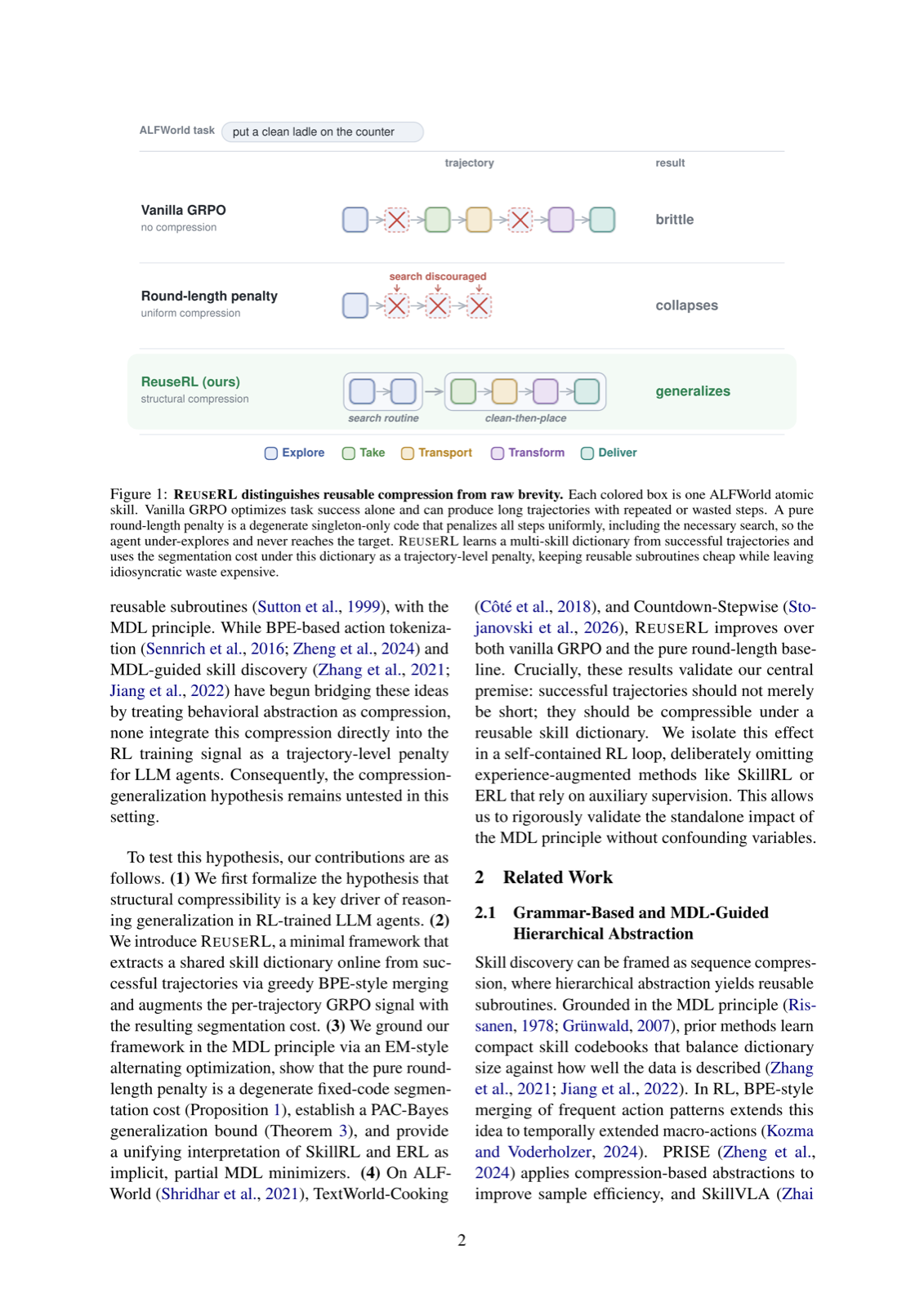
ReuseRL introduces a novel formalization of skill reuse in agentic reinforcement learning by grounding it in the Minimum Description Length (MDL) principle. This approach treats successful trajectories as compressible patterns that can be decomposed into a small set of reusable abstract skills, addressing the brittleness of task-specific shortcuts that plague existing approaches.
The framework's theoretical foundation in PAC-Bayes generalization bounds provides a rigorous mathematical basis for the compression penalty, demonstrating that the segmentation cost explicitly penalizes idiosyncratic behaviors that encode poorly. This formalization suggests that agents that learn to generalize better are those that can identify and reuse structural patterns in their successful trajectories.
The empirical results across ALFWorld, TextWorld-Cooking, and Countdown-Stepwise showing improvements in in- and out-of-distribution success over vanilla GRPO and strong round-length baselines validate the practical effectiveness of the MDL-based approach. This suggests that future agentic systems could benefit from architectures that explicitly encourage skill reuse and structural compression, potentially leading to more efficient and generalizable agents.
Key insight: Skill reuse in agentic RL can be formalized using the Minimum Description Length principle, where successful trajectories that are structurally compressible lead to better generalization.
Dreaming Of Others: Latent Teammate Modeling In World Models For Multi-Agent Reinforcement Learning
arXiv: 2605.31361
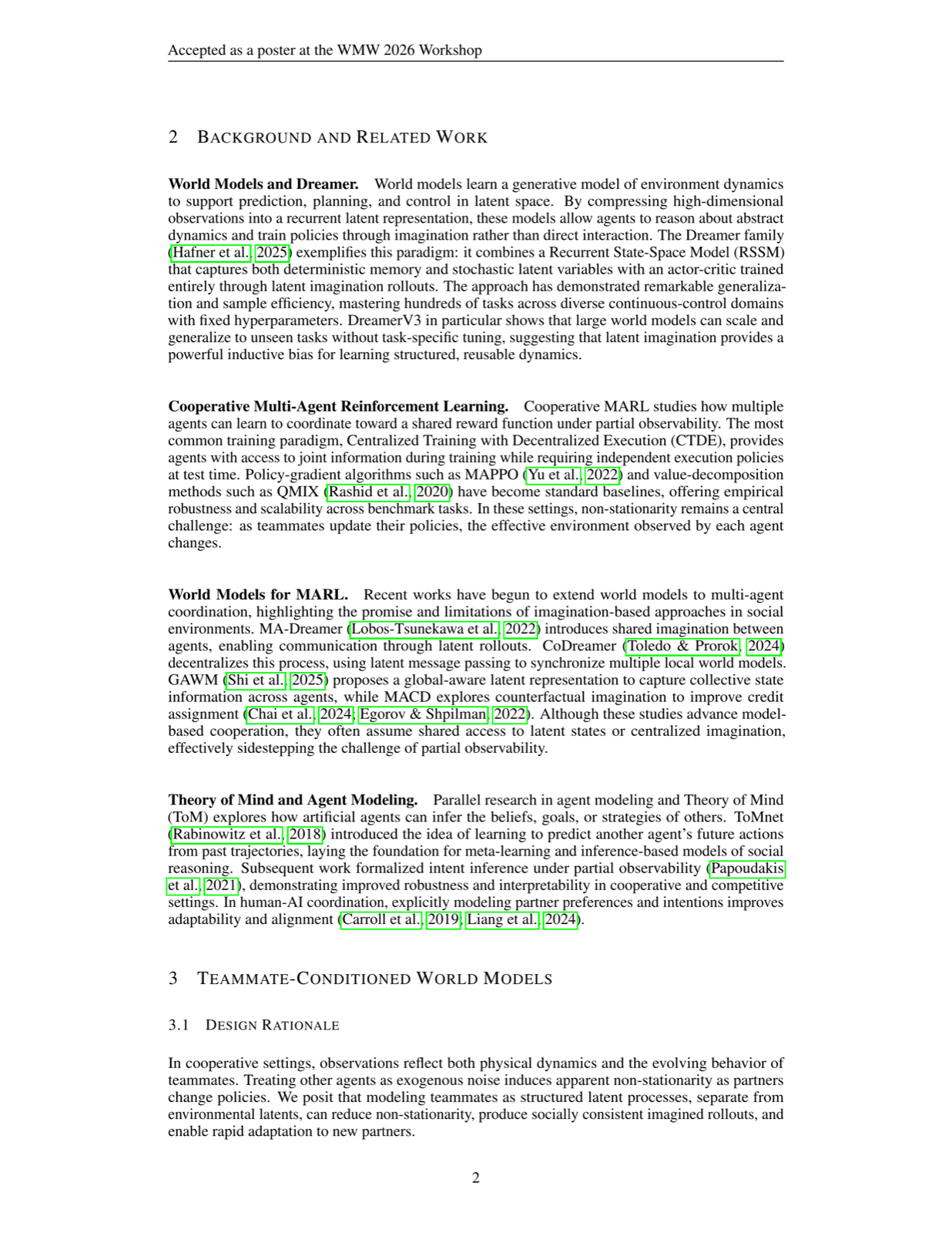
The paper proposes a novel perspective on multi-agent reinforcement learning by treating teammates as structured, learnable components within the agent's world model, rather than as external entities to be coordinated with. This approach factorizes the latent state of a Dreamer-style recurrent state-space model into environment and teammate components, enabling the agent to learn latent embeddings of partner behavior such as character, intent, and predicted actions.
The introduction of a Theory-of-Mind (ToM) head that infers latent embeddings of partner behavior from partial trajectories represents a significant advancement in modeling teammate uncertainty. This capability allows agents to not only predict teammate actions but also understand their underlying intentions and characteristics, which is crucial for effective coordination in cooperative settings.
The framework's potential for supporting zero-shot and few-shot coordination in partially observable settings suggests that this approach could be particularly valuable for complex multi-agent environments where agents must adapt to unknown collaborators. This represents a step toward more generalizable, human-compatible AI systems that can effectively coordinate with diverse partners without extensive training or prior knowledge.
Key insight: Treating teammates as structured, learnable components within world models enables agents to imagine and adapt to diverse collaborators, supporting zero-shot and few-shot coordination in partially observable settings.
Safe Equilibrium Policy Optimization for Strategic Agent Policies
arXiv: 2605.30854
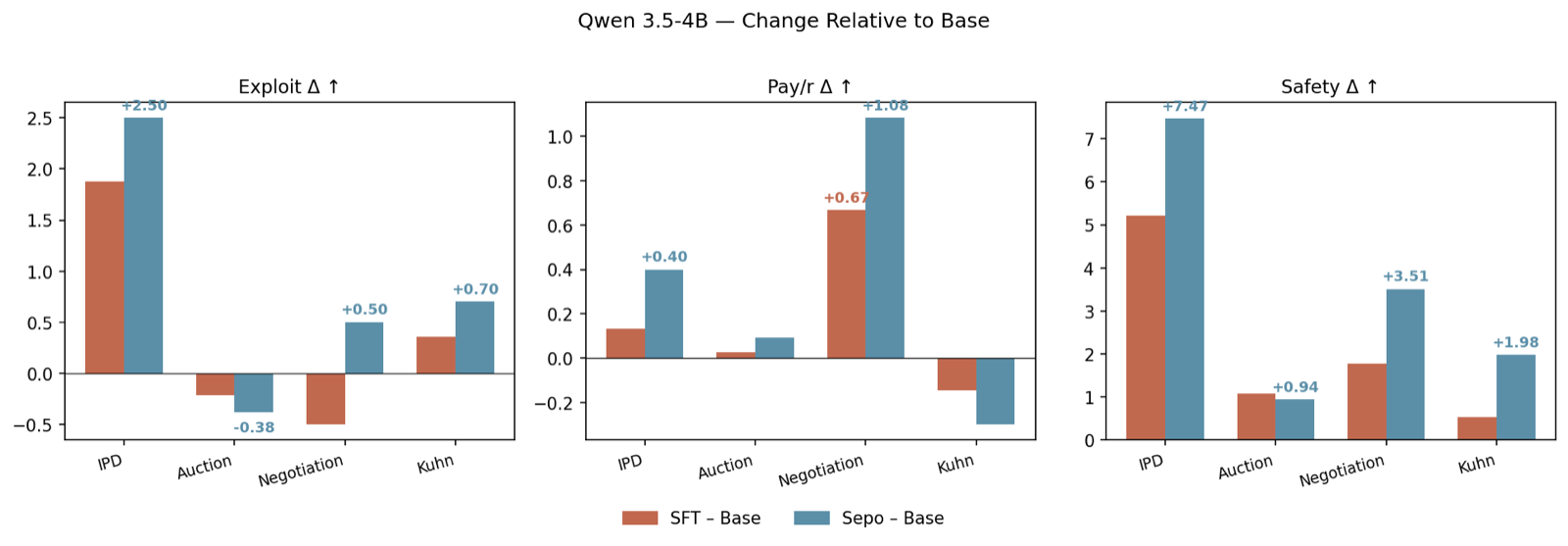
SEPO addresses a critical gap in language model fine-tuning where agents typically optimize for task reward while ignoring multi-agent strategic structure. The approach introduces explicit penalties for exploitability, collusion risk, and externality cost, which are inseparable from the language interface itself in strategic domains. This is particularly important for applications where agents must interact with other agents in competitive or cooperative settings.
The implementation of SEPO as a reward signal for Group Relative Policy Optimization (GRPO) demonstrates how strategic safety can be integrated into existing reinforcement learning frameworks. The evaluation across five strategic domains including Iterated Prisoner's Dilemma, repeated auctions, and Kuhn Poker shows that SEPO achieves zero exploit-pool advantage in Kuhn Poker and outperforms base models on safety in four domains, correcting over-cooperative behavior introduced by SFT.
The ablation experiments confirming that per-rollout exploit computation is necessary for effective SEPO highlight the importance of dynamic strategic evaluation rather than constant penalties. This finding suggests that strategic safety requires adaptive mechanisms that can respond to the specific strategic context rather than static safety measures, potentially leading to more sophisticated approaches to multi-agent safety in AI systems.
Key insight: Safe Equilibrium Policy Optimization (SEPO) addresses strategic failure modes in language agents by augmenting expected payoff with explicit penalties for exploitability, collusion risk, and externality cost.
Design and Evaluation of Multi-Agent AI Oracle Systems for Prediction Market Resolution
arXiv: 2605.30802
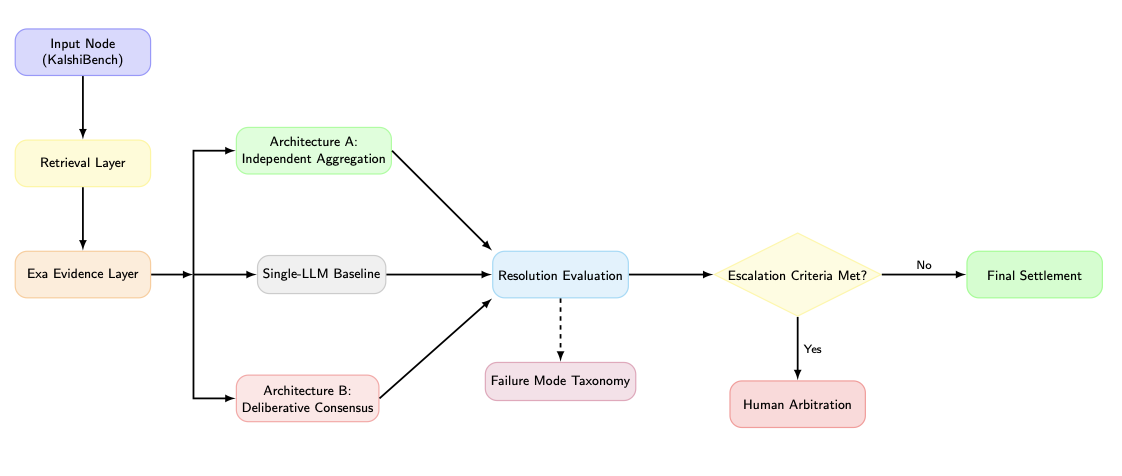
The evaluation of multi-agent LLM architectures for prediction market resolution reveals that independent aggregation with confidence-weighted voting achieves the highest accuracy at 83.43 percent, outperforming the best individual model by 1.01 percentage points. This demonstrates that ensemble approaches can provide meaningful improvements over single-model baselines, particularly when the agents have diverse capabilities and can be effectively combined.
The degradation of accuracy in deliberative consensus approaches to approximately 76 percent, below every single-model baseline, is attributed to error propagation during debate where confidently wrong models flip correct ones. This finding highlights the challenges of multi-agent reasoning and suggests that the benefits of deliberation may be offset by the amplification of errors in ensemble systems, particularly when agents have varying levels of reliability.
The routing criteria for hybrid AI-human oracle systems that auto-resolve only unanimous, high-confidence questions yields 97.87 percent accuracy on 47 percent of the dataset, with inter-agent disagreement flagging the remainder for human review. This approach provides a practical framework for balancing automation with human oversight, potentially leading to more reliable oracle systems that can identify when human intervention is necessary for complex or uncertain cases.
Key insight: Multi-agent LLM architectures can improve oracle resolution accuracy over single-model baselines through independent aggregation, though deliberative consensus approaches may degrade performance due to error propagation.
A Theory-Guided LLM Pedagogical Agent for STEM+C Scaffolding Without Over-Reliance
arXiv: 2605.30539
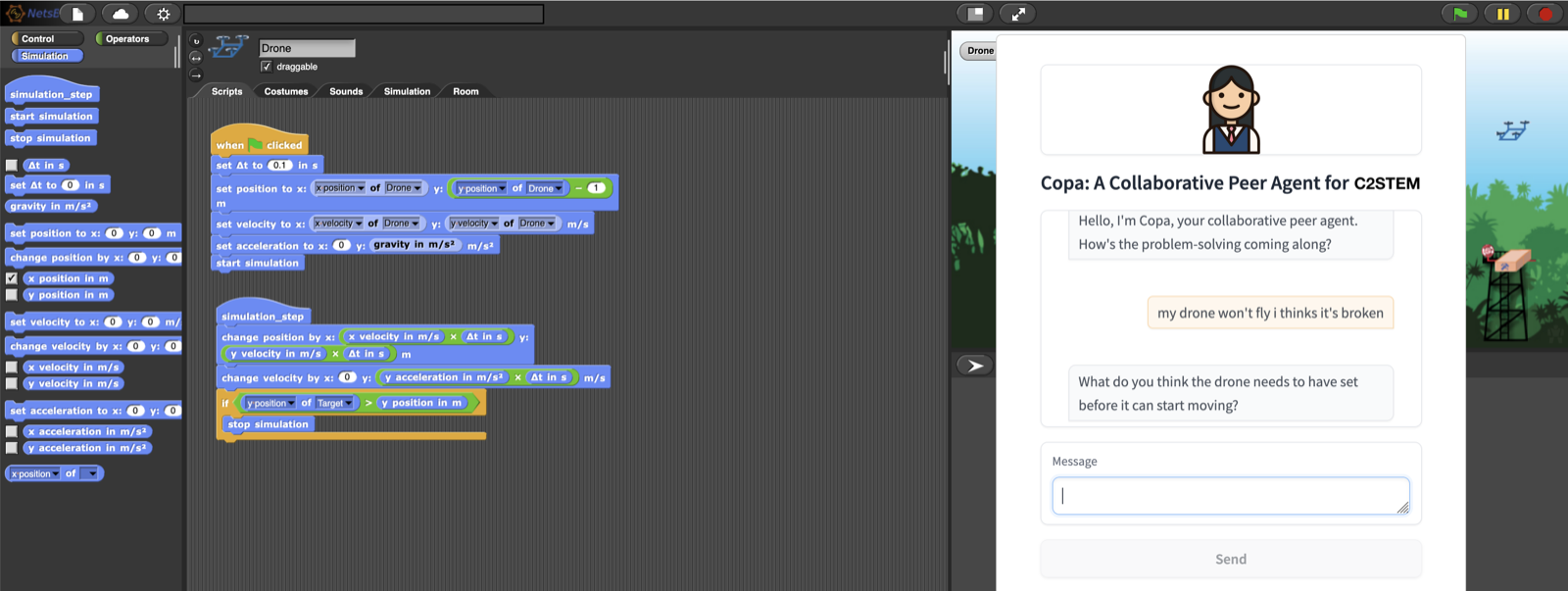
Copa represents a significant advancement in pedagogical AI by grounding its interactions in established theories of learning such as Social Cognitive Theory and Social Constructivism, rather than relying on simple answer-seeking approaches. This theory-guided approach promotes sense-making through adaptive, dialogic support that encourages students to verbalize conceptual understanding rather than simply seeking answers.
The demonstration that Copa supports students' confidence building and ability to verbalize conceptual understanding without causing dependence shows that well-designed pedagogical agents can amplify student reasoning rather than replace it. This is particularly important in educational contexts where the goal is to develop students' own reasoning capabilities rather than simply providing correct answers.
The multimodal nature of Copa, which provides adaptive feedback personalized to learners based on their multimodal input data, suggests that future educational AI systems should leverage multiple modalities to better understand and support student learning. This approach could lead to more effective and engaging educational experiences that adapt to individual student needs and learning styles.
Key insight: Theory-guided, multimodal LLM agents can support student confidence building and conceptual understanding without causing dependence, by grounding interactions in social cognitive theory and social constructivism.
Delayed Repression and Emergent Instability in Adaptive Multi-Agent Systems
arXiv: 2605.30392
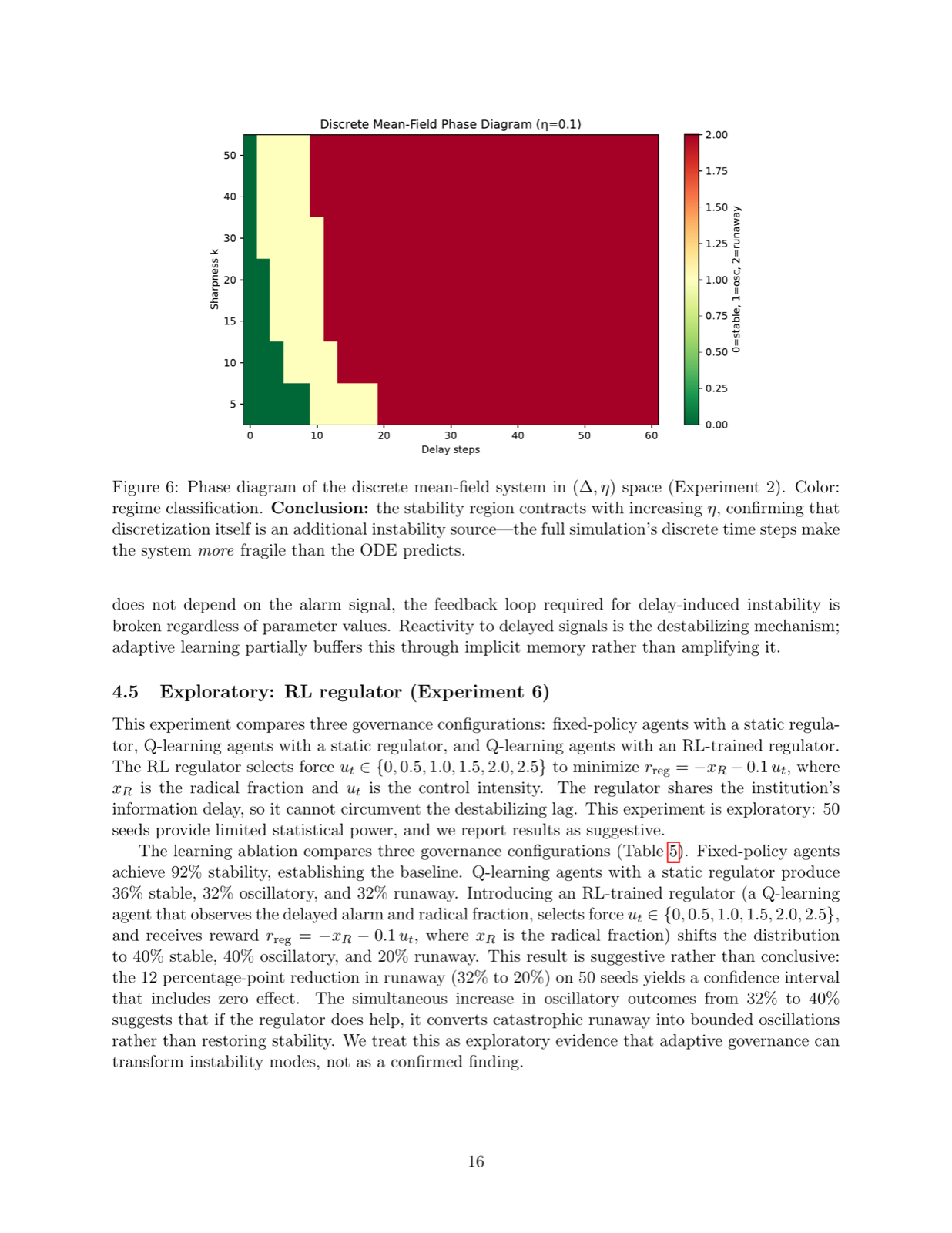
The paper reveals that regulatory delays in multi-agent systems can create instability even in the absence of external shocks, coordination among agents, or malicious actors. This finding challenges the assumption that system stability is primarily determined by agent behavior or environmental factors, showing that the timing of information processing itself can be destabilizing.
The analysis of delayed replicator equations and the derivation of a closed-form critical delay threshold provides a mathematical framework for understanding when systems become unstable through Hopf bifurcation. The proof that the bifurcation is supercritical (producing bounded oscillations rather than explosive growth) offers insights into the nature of the instability that emerges from delayed processing.
The experimental results with Q-learning agents showing partial resilience (66% runaway at delay = 20) compared to reactive agents (96% runaway by delay ≥ 8 steps) demonstrate that learning can buffer against destabilizing effects of delayed signals. This suggests that adaptive agents with memory of past decisions may be more robust to delays than simple threshold-based systems, potentially informing the design of more stable multi-agent systems.
Key insight: Processing delays alone can destabilize multi-agent systems without exogenous shocks, with learning providing implicit punishment memory that buffers against destabilizing reactivity to delayed signals.
Generalized Intention Modeling in Multi-Agent Reinforcement Learning
arXiv: 2605.31318
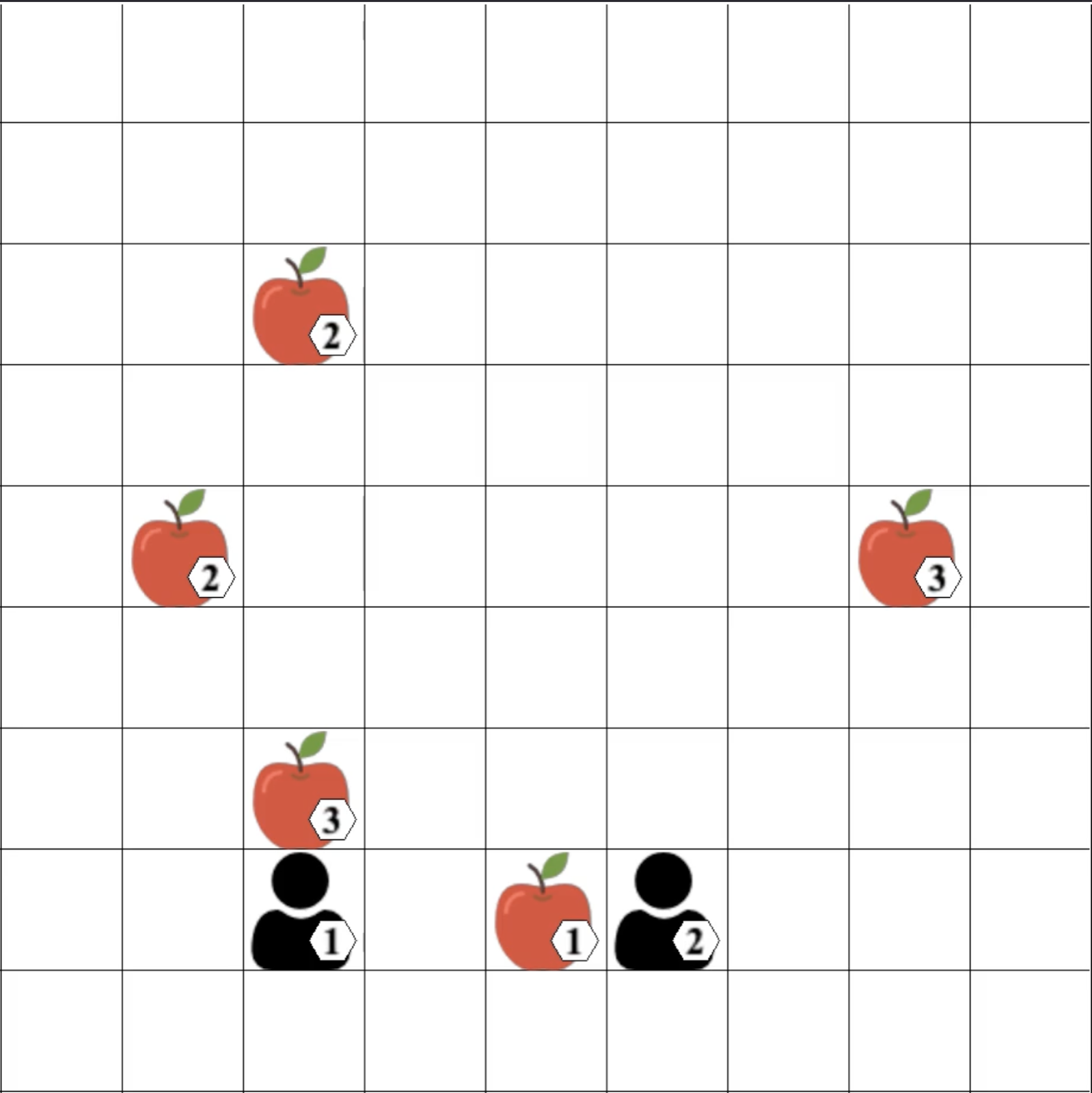
The approach introduces a task-adaptive opponent modeling framework that learns a performance-driven mixture of multiple intent representations, addressing the limitation of existing methods that assume chosen information is universally representative of intent. This is particularly important because intentions are often task- and environment-dependent, making fixed representations inadequate for effective decision-making.
The new intention representation that maximizes mutual information with the ego-agent's future returns captures opponent information that is most directly relevant to performance, rather than relying on arbitrary choices about what information to encode. This performance-driven approach to intention modeling suggests that effective opponent modeling should be tailored to the specific goals and outcomes of the agent.
The consistent matching or exceeding of state-of-the-art baselines across diverse tasks demonstrates the practical effectiveness of the task-adaptive approach. This suggests that future multi-agent systems could benefit from opponent modeling that adapts to specific contexts and tasks rather than using fixed representations, potentially leading to more effective coordination and decision-making in complex multi-agent environments.
Key insight: Task-adaptive opponent modeling that learns a performance-driven mixture of multiple intent representations can consistently outperform state-of-the-art baselines across diverse tasks.
HADT: A Heterogeneous Multi-Agent Differential Transformer for Autonomous Earth Observation Satellite Cluster
arXiv: 2605.31023

HADT addresses the challenge of autonomous resource management in heterogeneous satellite clusters conducting Earth Observation missions by proposing a novel transformer-based architecture tailored for this specific application. The approach uses relational observations-actions tokenization and differential attention mechanism to enable adaptive and real-time resource management, overcoming limitations of traditional mathematical modeling approaches.
The experimental results demonstrating significant performance improvements compared to available baselines, along with strong adaptability and transferability with respect to varying numbers of satellite clusters, suggest that the proposed architecture is well-suited for complex, dynamic space mission environments where traditional optimization approaches may be insufficient.
The model-free reinforcement learning approach used in HADT is particularly valuable for space missions where underlying models may not be available, over complex, and inaccurate due to dynamic changes and uncertainties inherent in the space environment. This makes the approach more robust and adaptable to real-world conditions where precise mathematical models may be difficult to obtain or maintain.
Key insight: Heterogeneous multi-agent differential transformer architecture enables autonomous resource management in satellite clusters by learning from relational observations-actions tokenization.