Claude Code receives significant updates to plugin loading and search capabilities, while researchers advance automated LLM reasoning strategies and AI agent frameworks. Meanwhile, Google Cloud's Nano Banana models and Figma's AI tools demonstrate practical applications in edge deployment and design workflows.
Claude Code introduces flexible plugin loading from .zip archives and URLs, global search command history, and worktree branching features that enhance developer productivity. Researchers have developed automated techniques to optimize LLM reasoning strategies, achieving a 69.5% reduction in token usage while maintaining performance. Figma announces four new AI-powered features that streamline the transition from concept to product development, reducing time between ideation and implementation. Google Cloud's Nano Banana 2 and Nano Banana Pro models are now generally available, offering lightweight, edge-optimized AI for resource-constrained devices. Additional research spans from physics-supervised AI development showing agent limitations in architectural innovation to novel approaches in PCB schematic generation, time-series anomaly detection, and multi-agent system coordination. These developments collectively advance AI tooling, edge deployment capabilities, and fundamental understanding of agent reasoning and cooperation.
AI Tooling
In Week 19, Claude Code adds support for loading plugins from .zip archives and URLs, enabling more flexible plugin distribution. The update also introduces global search command history across all projects using Ctrl+R, and allows developers to branch new worktrees from local HEAD or remote defaults. These features enhance developer productivity by providing better plugin management, search capabilities, and version control integration within the Claude Code environment.
Why it matters: These improvements strengthen Claude Code's developer ecosystem by making plugin management more accessible and search functionality more powerful. The worktree branching feature particularly enhances collaborative development workflows in complex projects.
VentureBeat | Transformative tech coverage that matters
Researchers have developed a method to automate the design of LLM reasoning strategies, achieving a 69.5% reduction in token usage. The approach uses automated techniques to optimize how language models process information, reducing computational overhead while maintaining performance. This advancement addresses key challenges in deploying LLMs at scale, particularly in resource-constrained environments or applications requiring real-time responses. The technique could be applied across various AI orchestration platforms.
Why it matters: This research represents a significant efficiency breakthrough for LLM deployment, potentially enabling broader adoption of large language models in edge computing and real-time applications where token costs and latency are critical factors.
UI/UX Tools

4 New Ways to Go From Idea to Product With AI Tools | Figma Blog
Figma has announced four new AI-powered features that streamline the transition from concept to product development. These include AI-assisted prototyping, automated design system generation, smart component suggestions, and integrated testing workflows. The updates aim to reduce the time between ideation and implementation by leveraging AI to handle repetitive design tasks and suggest optimizations. All features are designed to integrate seamlessly with existing Figma workflows and support both individual designers and team collaboration.
Why it matters: These AI enhancements position Figma as a more comprehensive design platform, addressing the entire product development lifecycle. By automating key design processes, they could significantly accelerate time-to-market for digital products.
Firebase/GCP

Nano Banana 2 and Nano Banana Pro available for everyone | Google Cloud Blog
Google Cloud has made the Nano Banana 2 and Nano Banana Pro generally available. These are lightweight, edge-optimized AI models designed for deployment on resource-constrained devices. The Nano Banana 2 offers improved performance over its predecessor, while the Pro variant includes enhanced capabilities for more complex inference tasks. Both models are optimized for low latency and energy efficiency, making them suitable for mobile and IoT applications. They support ONNX and TensorFlow Lite formats for easy integration into existing workflows.
Why it matters: These releases represent a significant step toward democratizing AI at the edge, enabling developers to deploy sophisticated models on low-power devices. This advancement could accelerate adoption of AI in mobile applications, wearables, and IoT ecosystems where computational resources are limited.
Research Papers
Physics Is All You Need? A Case Study in Physicist-Supervised AI Development of Scientific Software
arXiv: 2605.30353
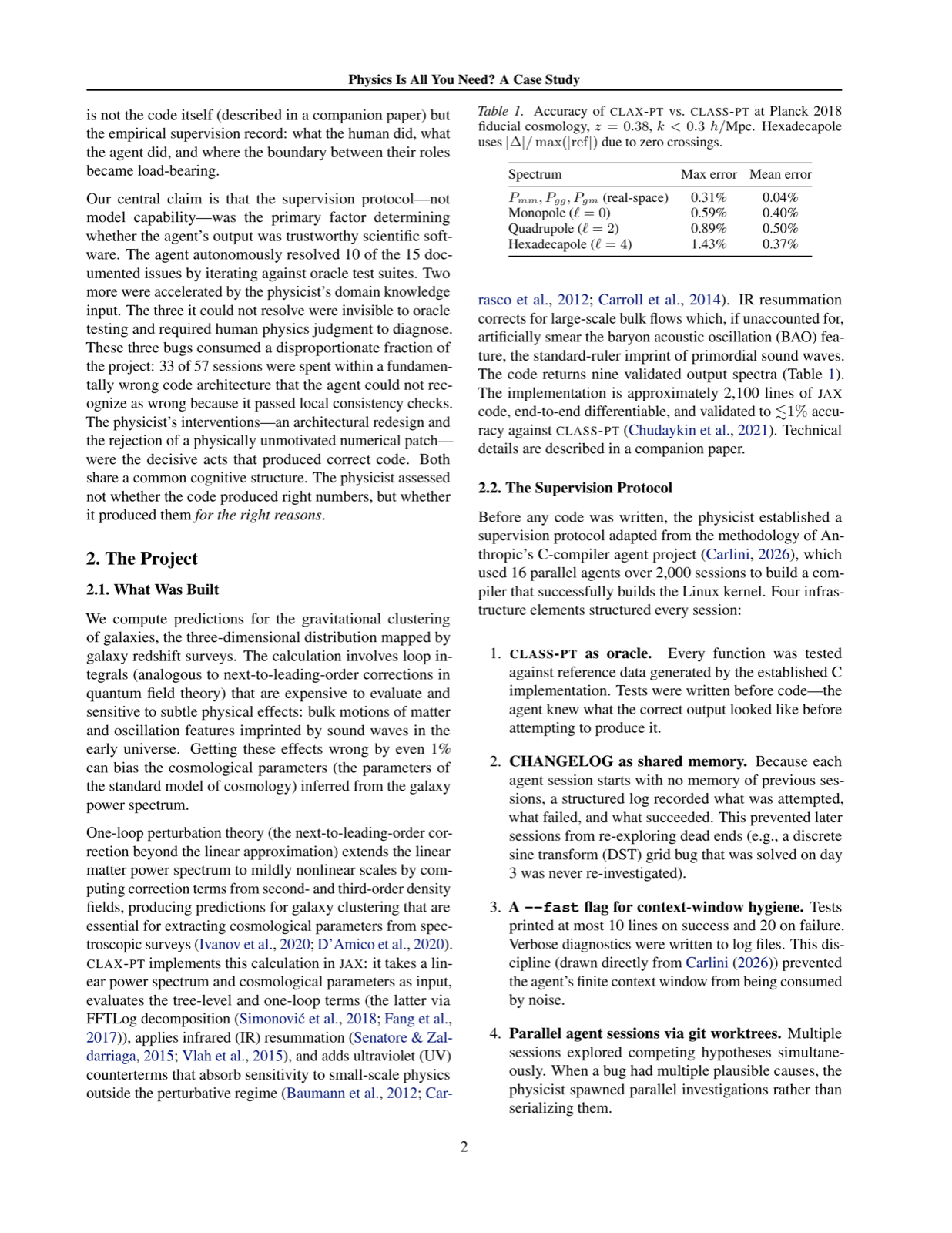
This case study provides a compelling example of how current AI agents, even when supervised by domain experts, can fail to recognize fundamental flaws in their approach. The physicist-supervised AI coding agent spent 33 of 57 sessions adjusting coefficients within a code architecture that could not represent the target physics, demonstrating a persistent failure to re-evaluate its core assumptions. This behavior reveals a critical limitation in current AI systems: they tend to treat symptom reduction as root-cause resolution, optimizing within a given structure rather than questioning the structure itself.
The study's findings underscore a fundamental challenge in AI agent development - the gap between model capability and supervision design. While the agent was able to resolve ten tasks autonomously and two more through domain knowledge, it failed on three critical tasks that required architectural redesign. The fact that only an injected physics concept (anisotropic BAO damping) triggered the redesign suggests that current agents lack the ability to self-correct at the architectural level. This limitation is particularly concerning for complex scientific tasks where the correct approach may not be immediately apparent.
The research highlights the importance of supervision design in determining agent trustworthiness, suggesting that future developments should focus on creating agents that can propose architectural alternatives rather than simply optimize within given constraints. The authors note that closing this gap would require agents that distinguish predictive adequacy from explanatory correctness - capabilities that are not exhibited in current systems and are not obviously addressed by scaling alone. This insight points toward a new direction in agent architecture design that emphasizes meta-cognitive abilities and architectural flexibility.
Key insight: AI agents struggle with architectural innovation and may persist in flawed approaches even when prompted to reconsider, highlighting the need for agents that can propose alternative architectures rather than optimize within fixed structures.
SchGen: PCB Schematic Generation with Semantic-Grounded Code Representations
arXiv: 2605.30345

SchGen represents a significant advancement in applying generative AI to hardware design by addressing a fundamental challenge: the lack of LLM-suited representations for PCB schematics. Traditional schematic formats are dominated by verbose, tool-specific syntax and geometry-heavy descriptions, making them difficult to generate reliably. The introduction of a semantically grounded code representation that encodes schematic editing primitives with relative placement and pin-name-based wiring transforms a geometry-driven generation problem into a semantics-driven matching task amenable to LLMs.
The paper's approach demonstrates that representation design is not just a technical detail but a critical factor in enabling generative models for complex tasks. By converting PCB schematics into a format that captures semantic relationships rather than geometric properties, SchGen achieves superior performance in wire connectivity accuracy and functional correctness compared to alternative representations and even larger general-purpose LLMs. This suggests that the success of generative AI in specialized domains often depends more on the quality of the representation than on model size or complexity.
The human-agent collaborative pipeline used to construct the dataset is particularly noteworthy, as it demonstrates how synthetic data generation can be effectively combined with human expertise to create high-quality training materials. This approach could be extended to other domains where expert knowledge is crucial but difficult to encode directly into models, potentially opening new pathways for AI assistance in engineering and design tasks.
Key insight: Effective representation design is crucial for enabling generative models to tackle complex hardware design tasks, with semantically grounded code representations significantly outperforming traditional geometry-heavy formats.
Tiny but Trusted: Efficient Vision-Language Reasoning for Time-Series Anomaly Detection
arXiv: 2605.30344
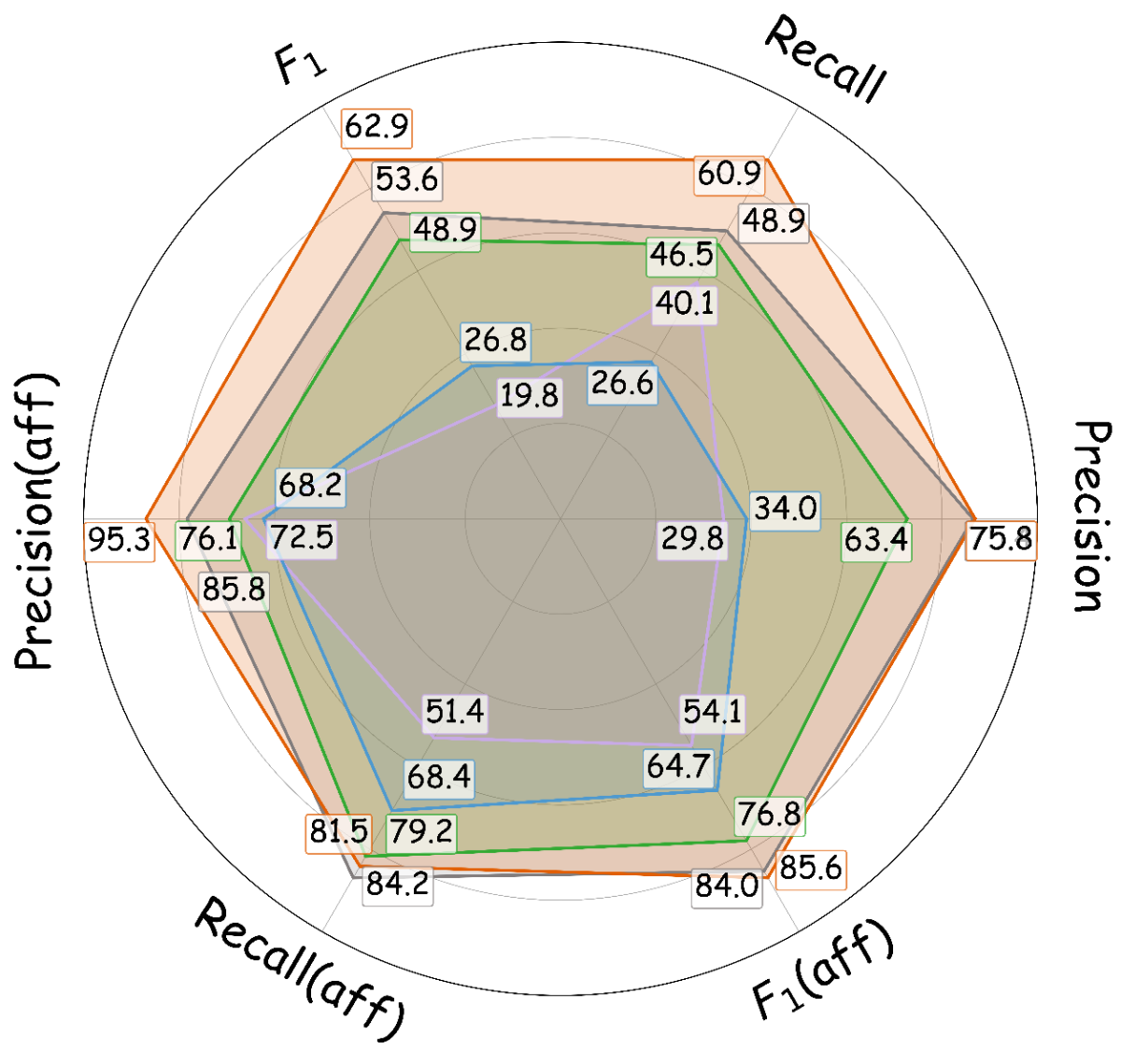
VisAnomReasoner addresses a critical gap in multimodal model applications by creating a benchmark specifically designed for time-series anomaly detection with natural-language rationales. The key insight is that public anomaly detection benchmarks typically provide interval annotations but not natural-language rationales, making it difficult to fine-tune VLMs to produce grounded, interpretable decisions. By constructing VisAnomBench with high-quality anomaly explanations selected from multiple large VLMs, the researchers created a training environment that enables parameter-efficient models to learn meaningful reasoning patterns.
The experimental results show that VisAnomReasoner achieves more accurate anomaly localization and consistently outperforms all baselines, with improvements of at least 21.23 and 23.87 percentage points in precision and F1, respectively. This demonstrates that when properly trained on task-specific data with rich semantic information, even parameter-efficient models can match or exceed the performance of much larger models. The cross-benchmark generalization results on TSB-AD-U further validate the robustness of the approach.
This work highlights the importance of domain-specific benchmark construction for multimodal reasoning tasks. The success of VisAnomReasoner suggests that future research should focus on creating high-quality, task-specific datasets that provide both the data and the semantic context necessary for models to learn meaningful patterns. The approach also demonstrates how parameter-efficient fine-tuning can be effective when the training data is carefully curated to provide the right kind of supervision.
Key insight: Parameter-efficient VLMs can achieve state-of-the-art performance in time-series anomaly detection when properly trained on benchmarks with high-quality explanations, demonstrating the importance of task-specific training data.
Locally Coherent, Globally Incoherent: Bounding Compositional Incoherence in Multi-Component LLM Agents
arXiv: 2605.30335
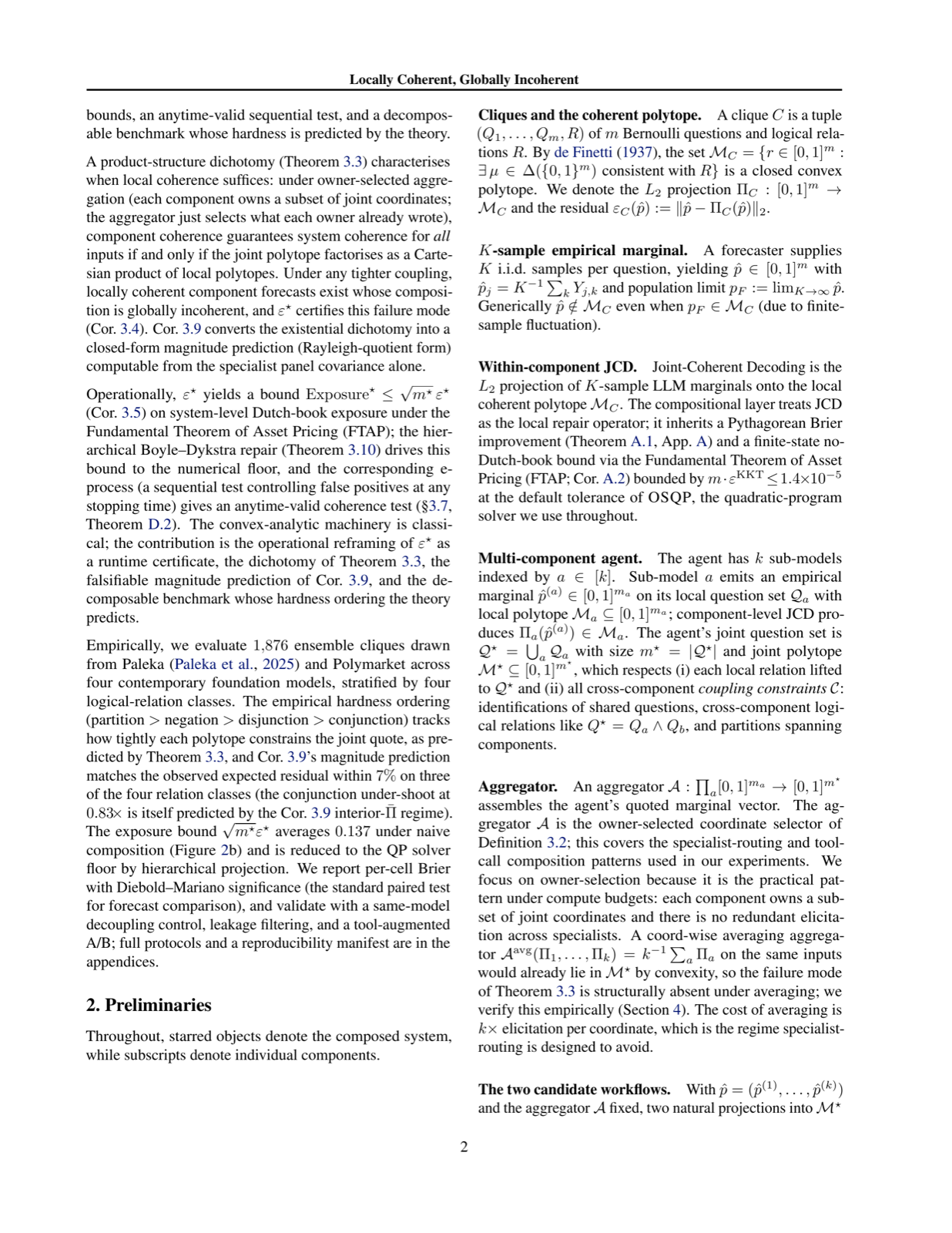
This paper presents a formal framework for understanding how multi-component LLM agents can fail even when individual components are locally coherent. The concept of compositional residual eps* provides a quantitative measure of how far the composed output is from the joint coherent polytope, revealing that even small incoherences can accumulate and cause significant problems in ensemble systems. The finding that eps* > 0 on 33-94% of cliques across 1,876 ensemble configurations demonstrates that this is a widespread problem rather than an edge case.
The research introduces several methods for addressing compositional incoherence, including hierarchical Boyle-Dykstra projection for deterministic repair and anytime-valid e-processes for sequential coherence monitoring. However, the paper also shows that three intuitive LLM-side mitigations (retrieval, partition-aware prompting, aggregator-LLM) each fail or regress, suggesting that the problem requires more sophisticated solutions than simple architectural tweaks. This finding is particularly important for multi-agent systems where agents must coordinate their outputs to produce coherent collective behavior.
The implications extend beyond just multi-agent systems to any scenario where multiple probabilistic components must be combined. The work suggests that future agent architectures need to incorporate mechanisms for ensuring compositional consistency, potentially through explicit belief tracking or other forms of meta-reasoning that can detect and correct for these incoherence patterns. The framework also provides a useful diagnostic tool for evaluating the reliability of ensemble systems.
Key insight: Multi-component LLM agents can exhibit locally coherent behavior while globally producing incoherent results due to compositional failures, requiring new methods for ensuring consistency across agent components.
Demystifying Data Organization for Enhanced LLM Training
arXiv: 2605.30334
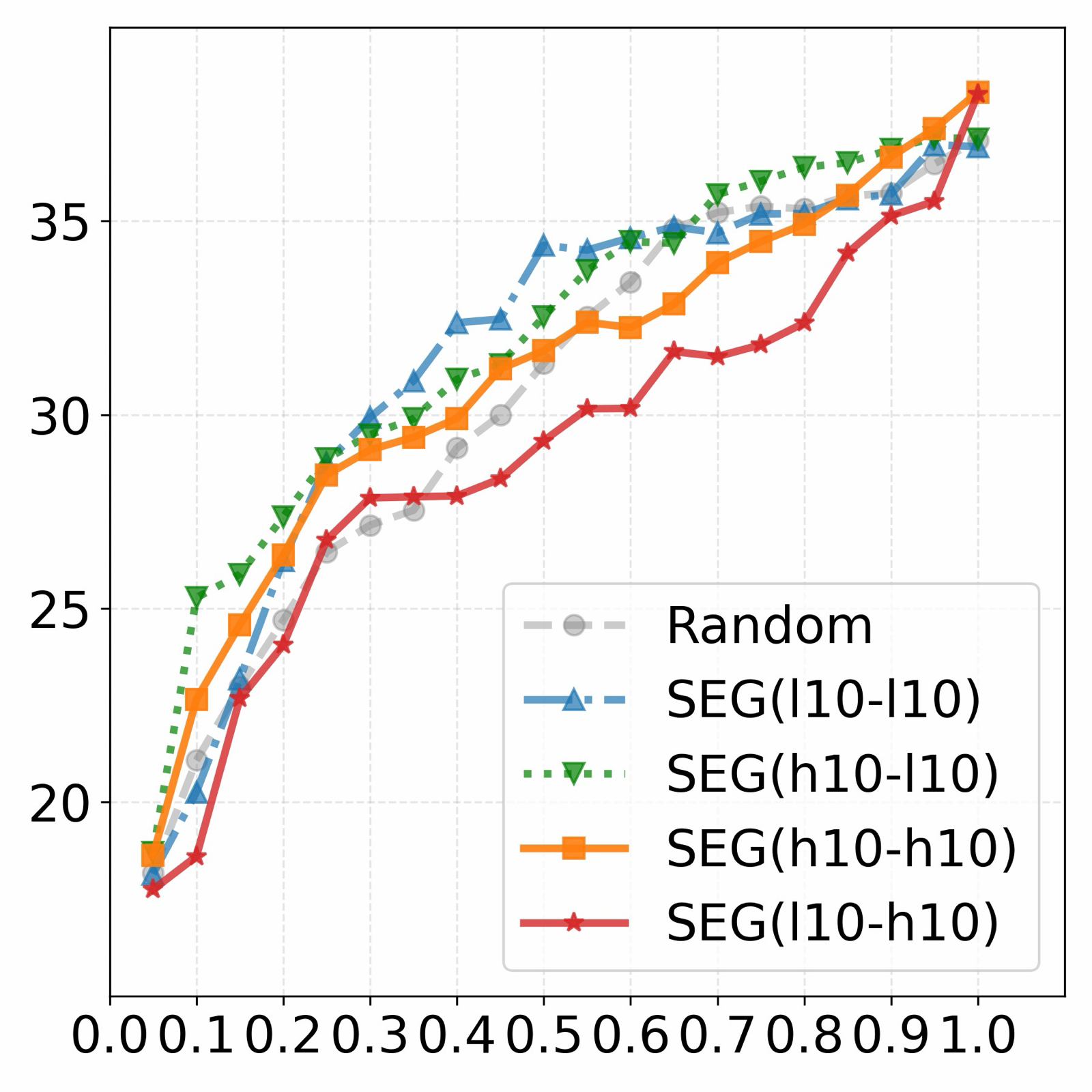
This research addresses a critical but underexplored area in LLM training by systematically studying how data organization affects training efficiency. The paper's approach of reusing pre-computed sample-level scores to guide data ordering represents a clever way to minimize additional computational overhead while still achieving significant improvements in training performance. The identification of four key guidelines provides a practical framework that can be applied across different model scales and data sizes.
The introduction of STR and SAW data ordering methods demonstrates that simple but principled approaches to data organization can yield substantial benefits. The fact that these methods are effective across both pre-training and SFT stages suggests that the principles of good data organization are fundamental to LLM training rather than specific to particular phases. This finding has important implications for how training resources are allocated and how data curation strategies are designed.
The work's emphasis on data organization as a strategic rather than just a technical consideration is particularly valuable. It suggests that future research should focus not just on improving model architectures or training algorithms, but also on developing better methods for organizing and curating training data. The approach also highlights the importance of considering the entire training pipeline rather than focusing on isolated components, which could lead to more holistic improvements in LLM development.
Key insight: Strategic data organization significantly impacts LLM training efficiency, with four key guidelines (Boundary Sharpening, Cyclic Scheduling, Curriculum Continuity, and Local Diversity) providing a framework for optimizing training data ordering.
MIRA: Mid-training Rubric Anchoring for Source-Aware Data Selection
arXiv: 2605.30288

MIRA addresses a critical gap in mid-training data selection by introducing a source-aware filtering framework that makes rubric construction part of the data selection process. This approach is particularly important because mid-training data selection involves heterogeneous sources with different formats and training roles, requiring both scalability and source-adaptive semantic criteria. The framework's ability to discover evaluation criteria for each source group and then distill those judgments into scalable student scorers represents a significant advancement in handling the complexity of modern LLM development.
The paper's demonstration that MIRA outperforms selection baselines across nine code benchmarks while using only half the tokens shows the practical value of this approach. This efficiency gain is particularly important in the context of large-scale LLM development where computational resources are a major constraint. The fact that the approach works across 21 sources and 5 source groups suggests that it can be generalized to other domains with similar challenges.
The work's focus on source-aware selection highlights the importance of understanding the heterogeneity of training data in modern LLM development. As models become more sophisticated and are trained on increasingly diverse datasets, the ability to adapt selection criteria to different data sources becomes crucial. MIRA's approach of combining self-anchored rubric discovery with scalable filtering provides a promising path forward for handling the complexity of large-scale data curation.
Key insight: Source-aware data selection frameworks like MIRA can significantly improve mid-training data curation by discovering what should be evaluated for each source group and distilling those judgments into scalable student scorers.
ProjectionBench: Evaluating Scientific Hypothesis Generation in LLMs Under Progressive Information Disclosure
arXiv: 2605.30284
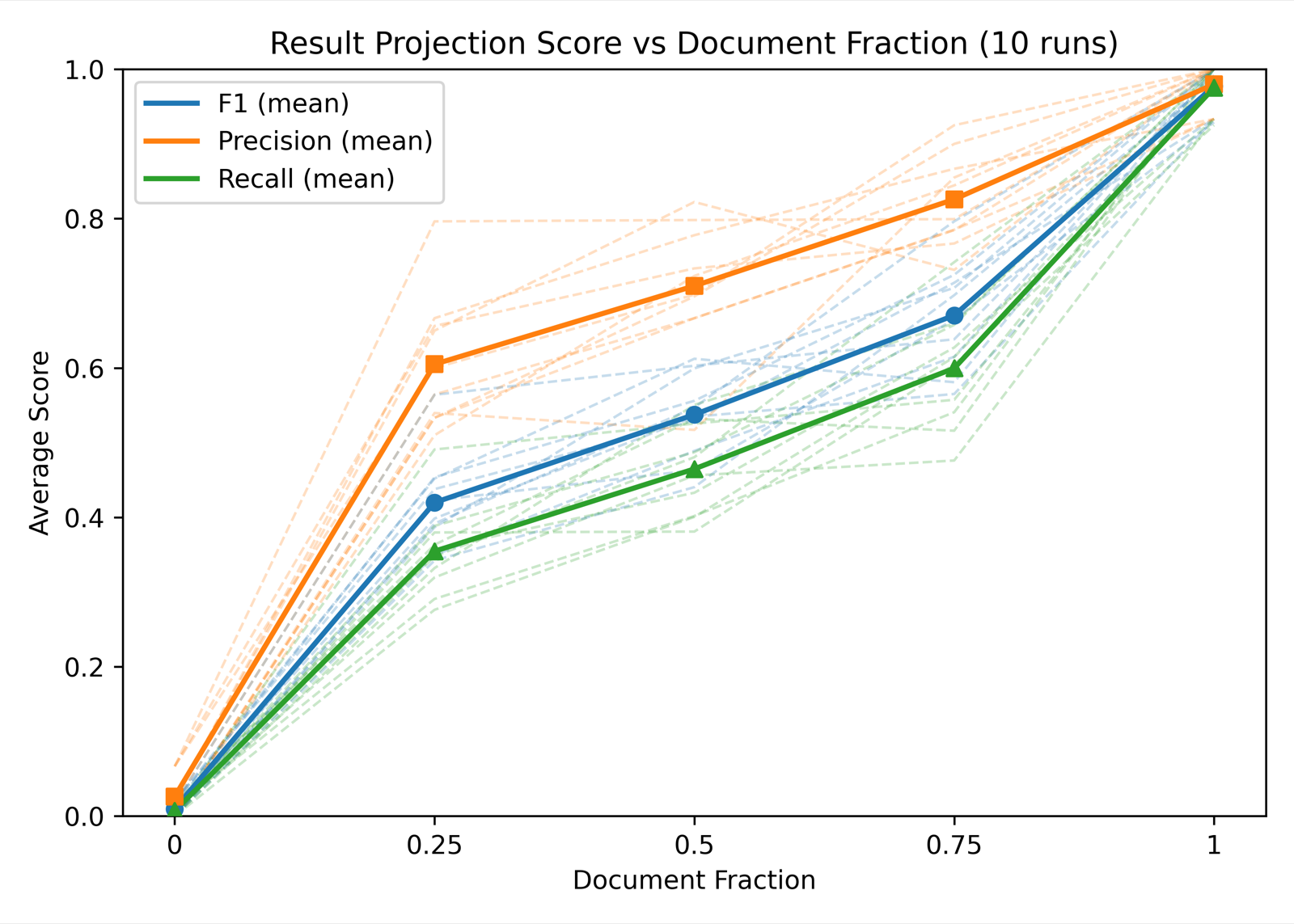
ProjectionBench provides a novel evaluation framework for scientific discovery that addresses a critical gap in existing benchmarks. By progressively revealing technical details and measuring how models' hypothesis generation changes at each stage, the framework can assess both innovative reasoning capabilities (under minimal information) and grounded reasoning (under full experimental details). This approach is particularly valuable because it captures the creative and uncertain nature of scientific discovery that goes beyond simple knowledge recall.
The evaluation results show that GPT-5.4 and Gemini 3.1 pro outperform their predecessors, with GPT-5.4 maintaining 0.7 F1 score alignment with ground truth conclusions even under minimal context. This demonstrates that while current models can generate creative hypotheses with limited information, they still struggle to maintain alignment with established scientific conclusions as more information becomes available. The framework's ability to systematically evaluate these different aspects of scientific reasoning provides valuable insights into the capabilities and limitations of current LLMs.
The work's emphasis on progressive information disclosure reflects the real-world nature of scientific research, where knowledge is typically acquired incrementally. This approach could be extended to other domains where incremental knowledge acquisition is important, such as medical diagnosis or legal reasoning. The framework also provides a foundation for developing more sophisticated AI systems that can handle the uncertainty and incomplete information that characterize scientific discovery.
Key insight: Progressive information disclosure frameworks like ProjectionBench can effectively evaluate LLMs' scientific reasoning capabilities by measuring how well models generate hypotheses under increasing context, revealing the gap between minimal information creativity and grounded reasoning.
When Should Models Change Their Minds? Contextual Belief Management in Large Language Models
arXiv: 2605.30219
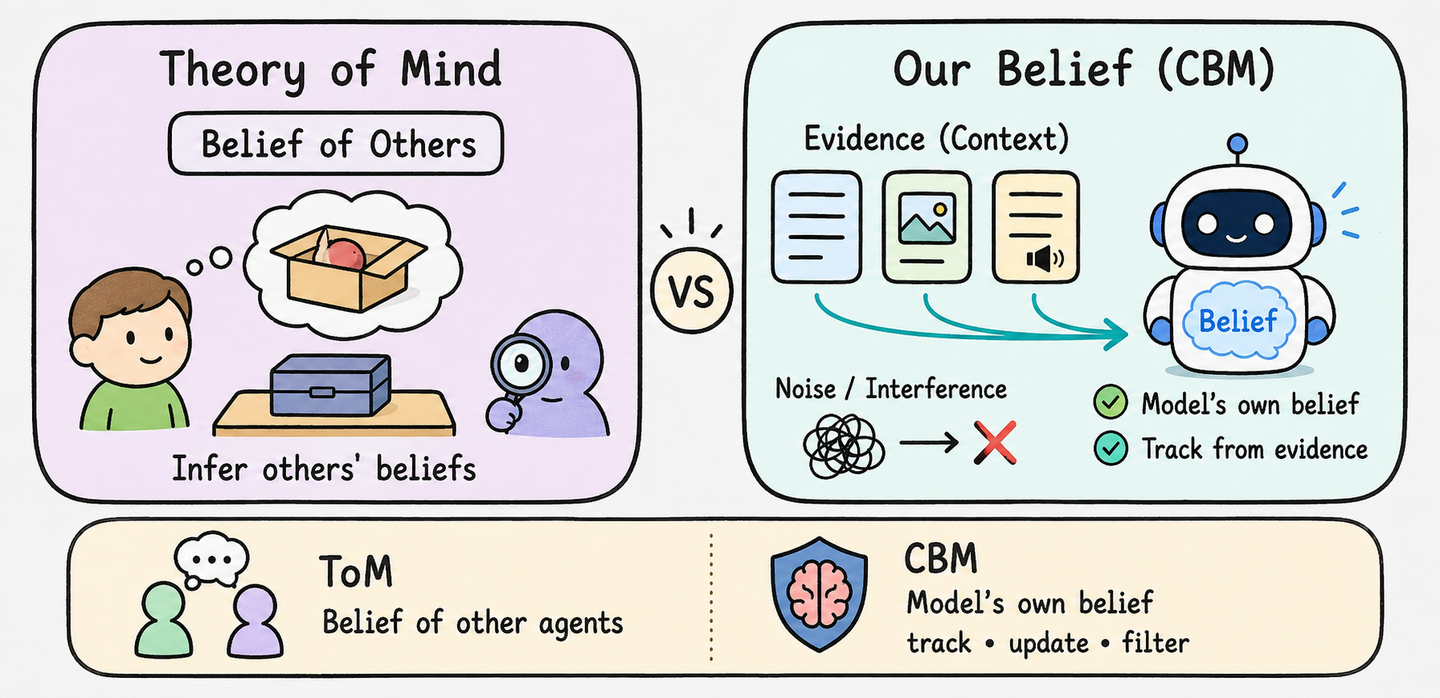
BeliefTrack introduces a closed-world benchmark that makes CBM measurable by using finite belief spaces and symbolic verifiers, enabling exact turn-level evaluation of belief management in LLMs. The identification of three failure modes - Failed Stay, Failed Update, and Failed Isolation - provides a clear framework for understanding how LLMs struggle with maintaining accurate belief states over long-horizon interactions. The finding that vanilla models exhibit severe CBM failures while explicit belief-tracking prompts provide only limited gains suggests that this is a fundamental architectural challenge rather than a simple prompting issue.
The paper's demonstration that reinforcement learning with belief-state rewards reduces failure rates by 70.9% on average shows that CBM can be significantly improved through targeted training methods. The additional finding that representation-level steering reduces failure rates by 46.1% across two tasks suggests that the problem can be addressed at multiple levels of the system. These results indicate that CBM is not just a theoretical challenge but a practical one that can be solved through appropriate training and architectural modifications.
The implications extend beyond just LLMs to any system that needs to maintain and update beliefs over time. The framework's focus on formal evidence and symbolic verification provides a principled approach to belief management that could be applied to other domains where maintaining accurate knowledge states is crucial. The work also highlights the importance of considering belief management as a core component of agent design rather than an afterthought.
Key insight: Contextual Belief Management (CBM) challenges LLMs to maintain belief states aligned with formal evidence while isolating task-irrelevant noise, with reinforcement learning and representation-level steering showing promise for reducing belief management failures.
Unlocking the Working Memory of Large Language Models for Latent Reasoning
arXiv: 2605.30343

RiM represents a significant departure from traditional autoregressive reasoning approaches by introducing fixed memory blocks that unlock the working-memory capacity of LLMs. This approach addresses the fundamental problem that autoregressive generation couples internal computation with external communication, making it computationally expensive and limiting the complexity of reasoning that can be performed. By using fixed sequences of special tokens, RiM enables compute-efficient latent reasoning that can be processed in a single forward pass.
The two-stage curriculum approach used in RiM - first grounding memory blocks by predicting explicit reasoning steps, then refining the final answer without step-level supervision - provides a practical framework for training models to use working memory effectively. The fact that RiM matches or exceeds existing latent reasoning methods while avoiding autoregressive generation demonstrates that the approach is both theoretically sound and practically effective. This suggests that working memory could be a key component in future LLM architectures.
The work's demonstration that RiM works across language models of different families and sizes indicates that the approach is broadly applicable and not dependent on specific model architectures. This universality makes RiM a promising technique for improving reasoning capabilities in existing models without requiring major architectural changes. The approach also opens up new possibilities for designing LLMs that can perform complex reasoning tasks more efficiently.
Key insight: Reasoning in Memory (RiM) enables compute-efficient latent reasoning by replacing autoregressive generation with fixed memory blocks, allowing LLMs to use working memory as an effective mechanism for internal computation.
COMPOSE: Composing Future Theorems from Citations and Formal Structure
arXiv: 2605.30333
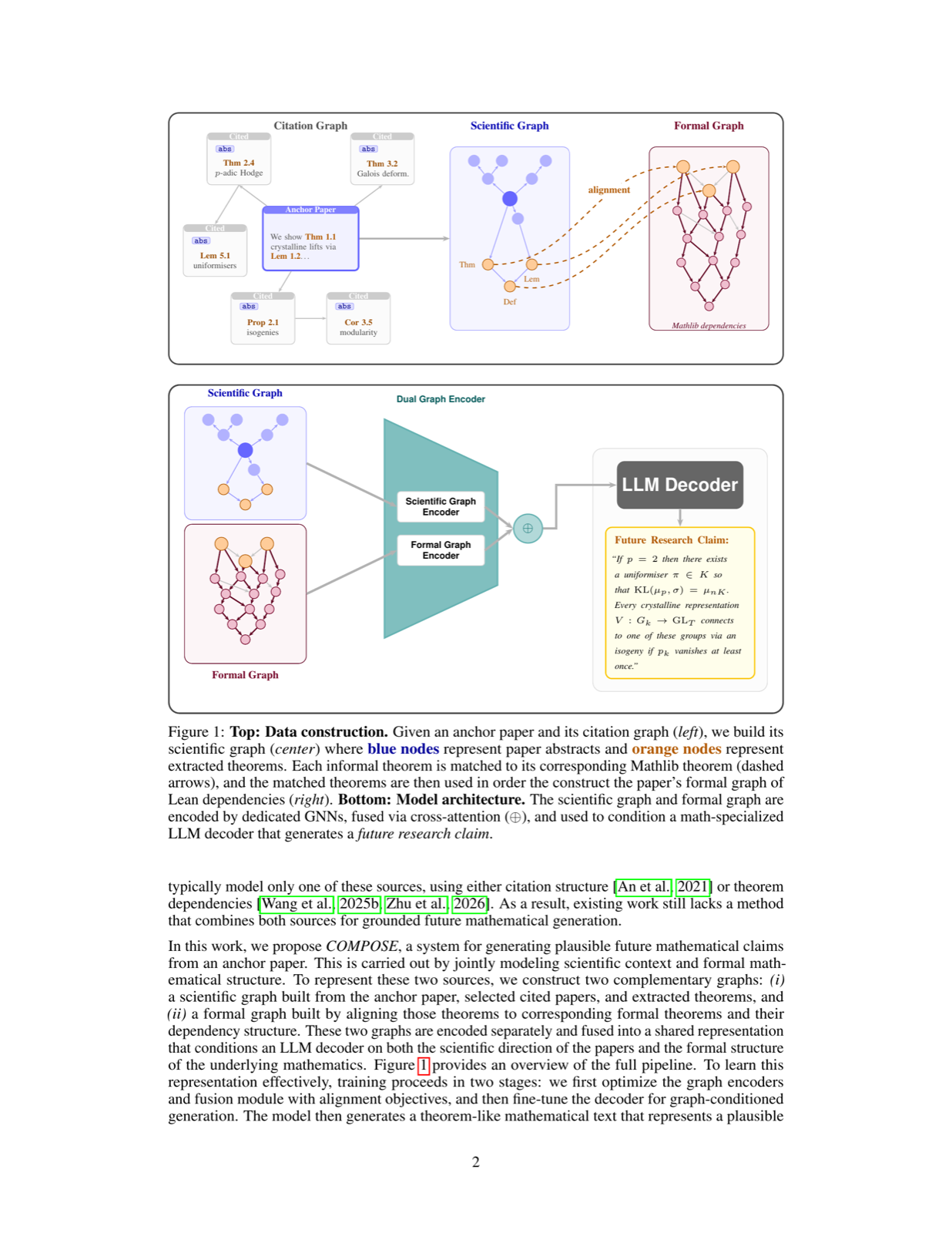
COMPOSE addresses a fundamental limitation in future mathematical generation by combining two complementary sources of context: scientific citation graph and formal theorem dependency graph. This dual approach recognizes that plausible future mathematical claims must satisfy both the direction of prior work and the formal dependencies that constrain what can validly follow. The paper's construction of a dataset of 108K paired scientific-formal graph examples from arXiv and Mathlib provides a solid foundation for training and evaluating this approach.
The experimental results show that COMPOSE outperforms strong baselines on retrieval to real future papers and achieves the best overall performance under LLM-judge evaluation, producing more grounded and mathematically richer outputs. This demonstrates that combining scientific context with formal structure leads to more meaningful and useful mathematical generation. The approach's ability to leverage both the social and structural aspects of mathematical development represents a significant advancement in the field.
The work's contribution extends beyond just the technical approach to include the construction of a comprehensive dataset and benchmark that can be used to evaluate future mathematical generation approaches. This resource will be valuable for researchers working on mathematical reasoning and theorem generation, providing a standardized way to measure progress in this area. The approach also suggests that future work in mathematical AI should consider both the social and formal aspects of mathematical development.
Key insight: Combining scientific citation context with formal theorem structure in a dual-graph framework enables more grounded and mathematically rich future theorem generation compared to approaches that rely on only one source of context.
MedCase-Structured: A Text-to-FHIR Dataset for Benchmarking Diagnostic Reasoning in Clinically Realistic EHR Settings
arXiv: 2605.30295
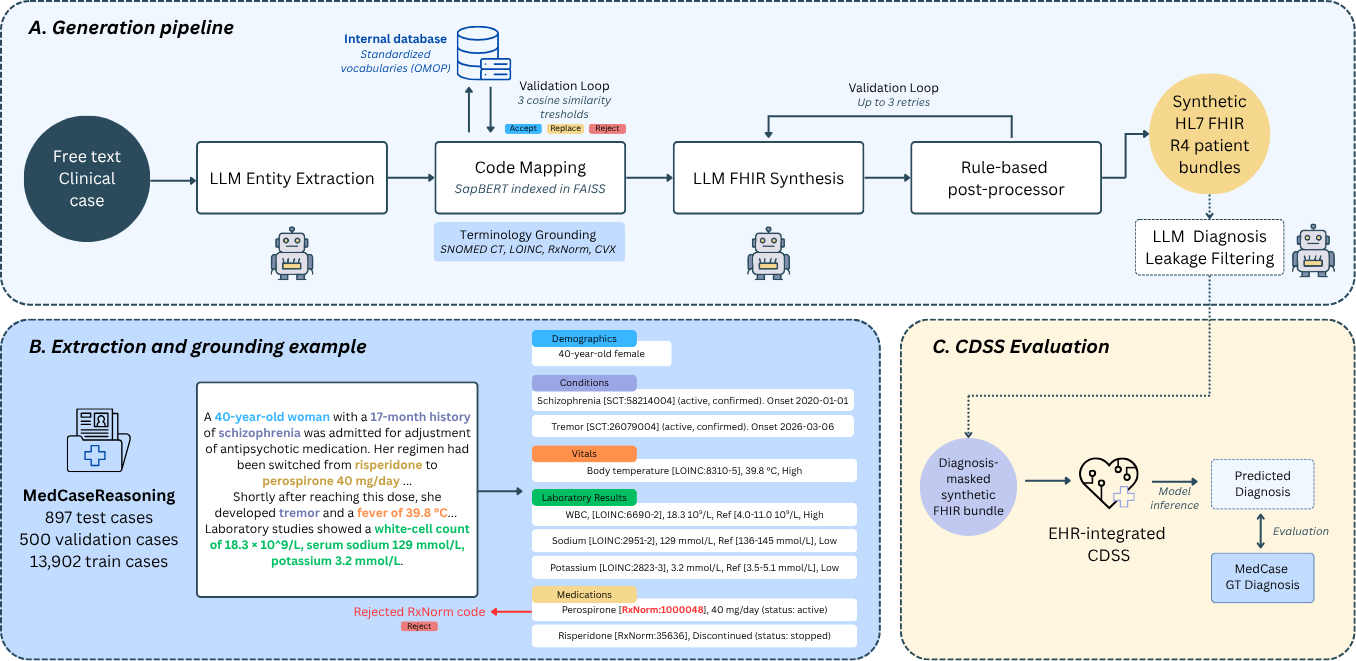
MedCase-Structured addresses a critical gap in clinical reasoning evaluation by providing a pipeline for generating clinically realistic HL7 FHIR R4 bundles from unstructured text. This approach enables controllable evaluation of clinical decision support systems using the structured, interoperable data formats that are actually used in clinical systems, rather than relying on static datasets or unstructured inputs. The pipeline's combination of staged LLM generation with terminology-grounded validation and repair reduces hallucinated codes and enforces structural and semantic consistency.
The finding that LLMs show consistently lower diagnostic accuracy on structured FHIR inputs than with plain text highlights the importance of deployment-aligned benchmarking. This suggests that current evaluation methods may be overly optimistic about LLM performance in clinical settings, as they don't reflect the real-world constraints and requirements of clinical decision support systems. The approach also reveals that structured data formats, while more realistic, may present additional challenges for LLMs that need to be addressed in future development.
The work's contribution to clinical AI evaluation is significant because it provides a framework for testing LLMs in realistic clinical settings where they would actually be deployed. The pipeline's ability to generate valid FHIR bundles for 82.5% of cases demonstrates its practical utility, while the evaluation results provide important insights into how LLMs perform when faced with the structured data formats they would encounter in real clinical environments.
Key insight: Structured FHIR datasets enable more realistic clinical decision support evaluation by providing the interoperable data formats used in clinical systems, revealing that LLMs perform worse on structured FHIR inputs than with plain text.
Loong: A Human-Like Long Document Translation Agent with Observe-and-Act Adaptive Context Selection
arXiv: 2605.30274
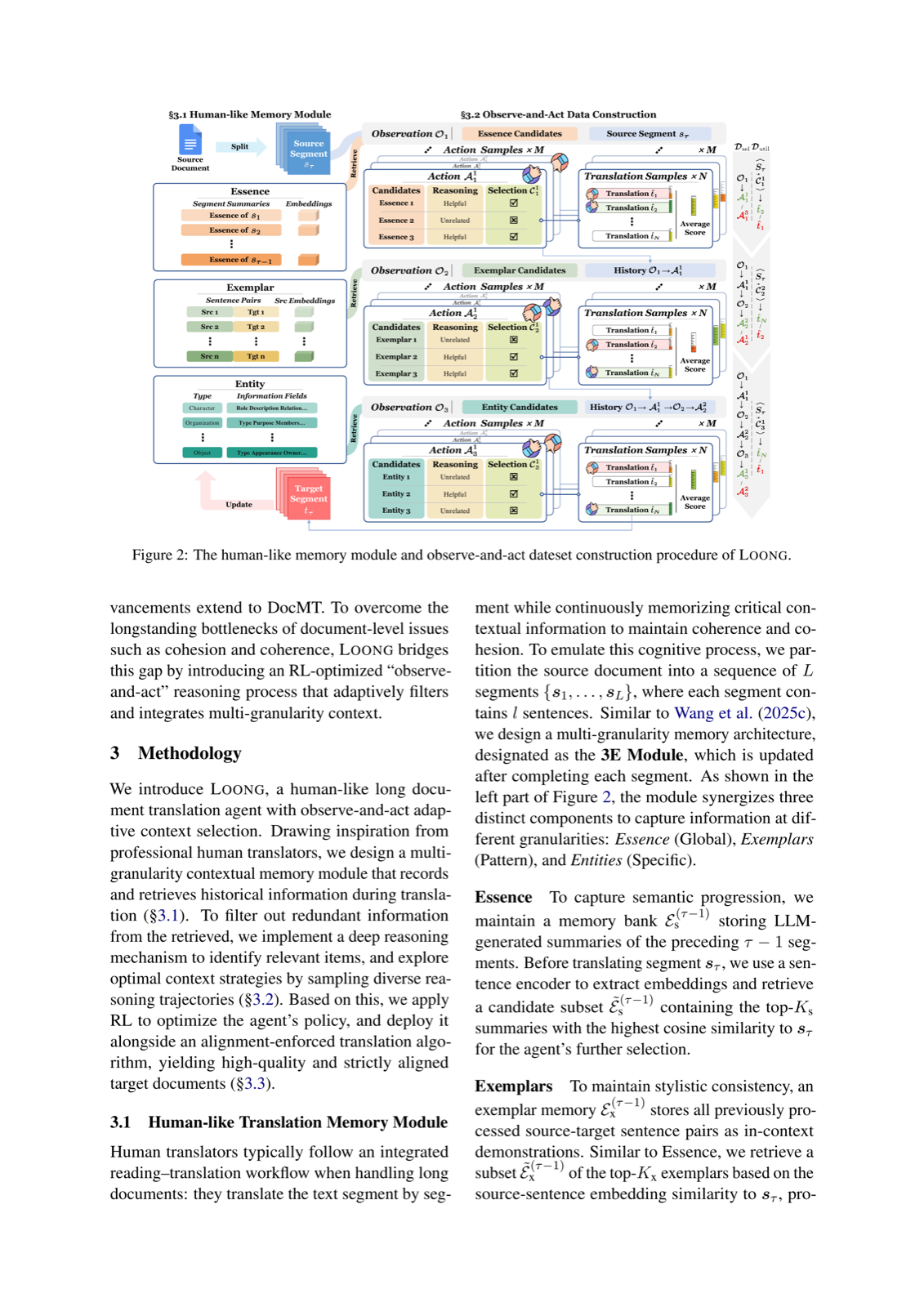
Loong represents a sophisticated approach to long document translation that addresses two major challenges: limited context windows that impede global cohesion and redundant contextual information that degrades translation quality. The 3E memory module (Essence-Exemplar-Entity) stores summaries, sentence pairs, and entity records as historical context, allowing the agent to make informed decisions about what information to use for translation guidance. This approach moves beyond passive attention to all history toward active, intelligent context selection.
The reinforcement learning optimization of context policy through observe-and-act reasoning trajectories demonstrates how the agent can learn to adaptively identify optimal context for translation guidance. The substantial translation quality improvements achieved (average gains of up to 13.0 points across evaluation metrics) show that this approach is effective in practice. The agent's strong generalization across domains and robustness against contextual noise further demonstrate its practical value.
The work's emphasis on human-like behavior in long document translation is particularly valuable because it recognizes that effective translation requires more than just linguistic competence - it requires understanding how to manage context and maintain coherence over extended texts. The approach also demonstrates how reinforcement learning can be used to optimize complex decision-making processes in translation, providing a framework that could be applied to other long-sequence generation tasks.
Key insight: Human-like long document translation agents using 3E memory modules and adaptive context selection achieve substantial quality improvements by leveraging deep reasoning to identify optimal translation guidance.
How LoRA Remembers? A Parametric Memory Law for LLM Finetuning
arXiv: 2605.30260
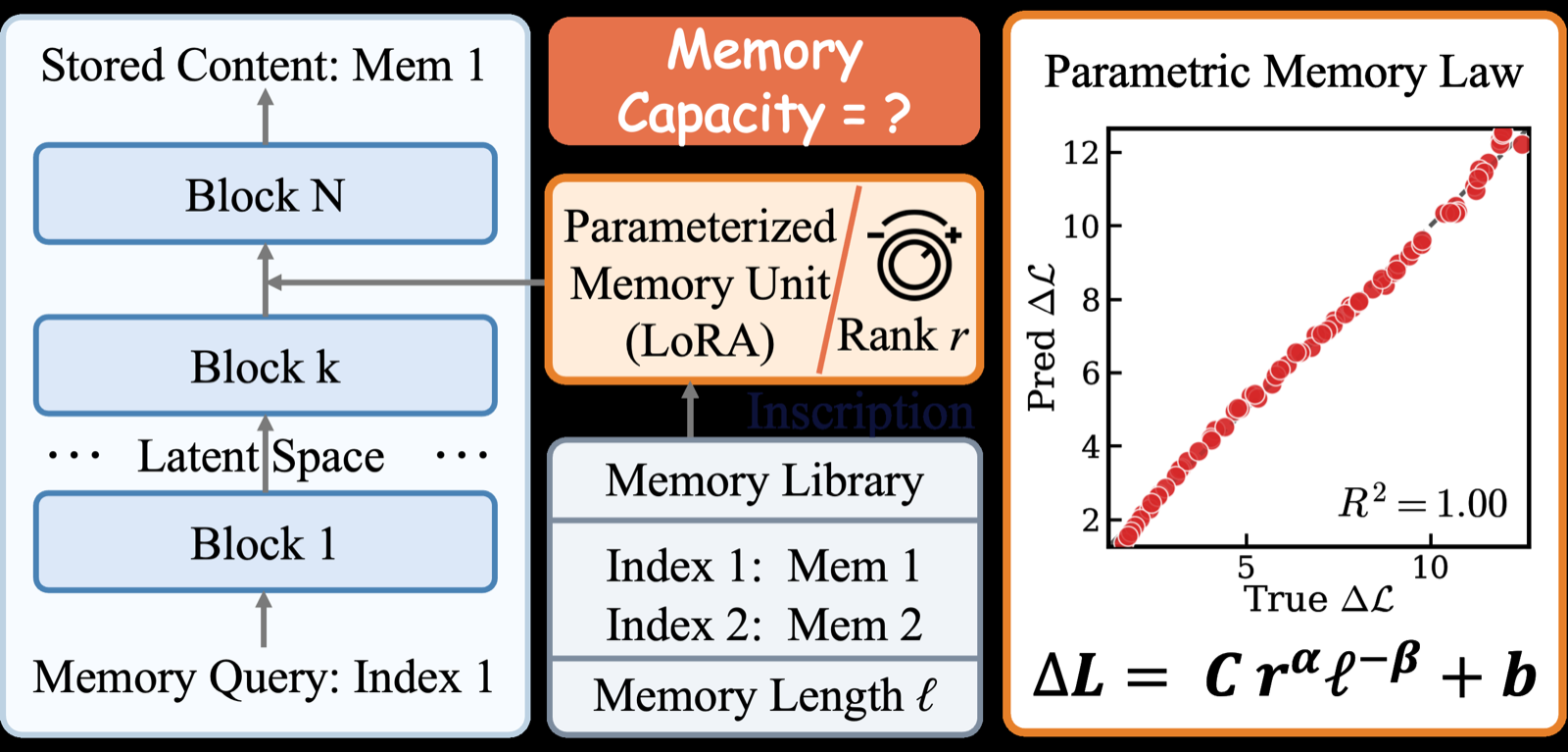
The Parametric Memory Law provides a fundamental understanding of how LoRA adapts to memory constraints by establishing a robust power law relationship between loss reduction, effective parameters, and sequence length. This quantitative framework allows researchers to systematically quantify exact parametric memory, which was previously an unexplored area. The discovery that a prediction probability of p > 0.5 constitutes a sufficient condition for verbatim recall under greedy decoding provides a clear threshold for understanding when memory is preserved versus when it is lost.
The introduction of MemFT, a threshold-guided optimization strategy that dynamically redistributes the training budget toward sub-threshold tokens, represents a practical application of these insights. The empirical evaluation showing that MemFT can enhance memory fidelity and efficiency demonstrates that the theoretical understanding can be translated into practical improvements. This approach addresses the challenge of optimizing memory usage in LLM fine-tuning, which is crucial for maintaining performance while reducing computational costs.
The work's contribution extends beyond just understanding LoRA's memory dynamics to providing actionable optimization strategies. The finding that fine-grained analysis reveals a deterministic phase transition suggests that memory behavior is not random but follows predictable patterns that can be leveraged for better performance. This insight could be extended to other fine-tuning methods and could inform the design of more efficient memory systems for LLMs.
Key insight: The Parametric Memory Law reveals that LoRA's memory capacity follows a power law relationship with effective parameters and sequence length, enabling precise quantification of exact parametric memory and informing optimization strategies.
Same Evidence, Different Answers: Canonical-Context On-Policy Distillation for Multi-Turn Language Models
arXiv: 2605.30251
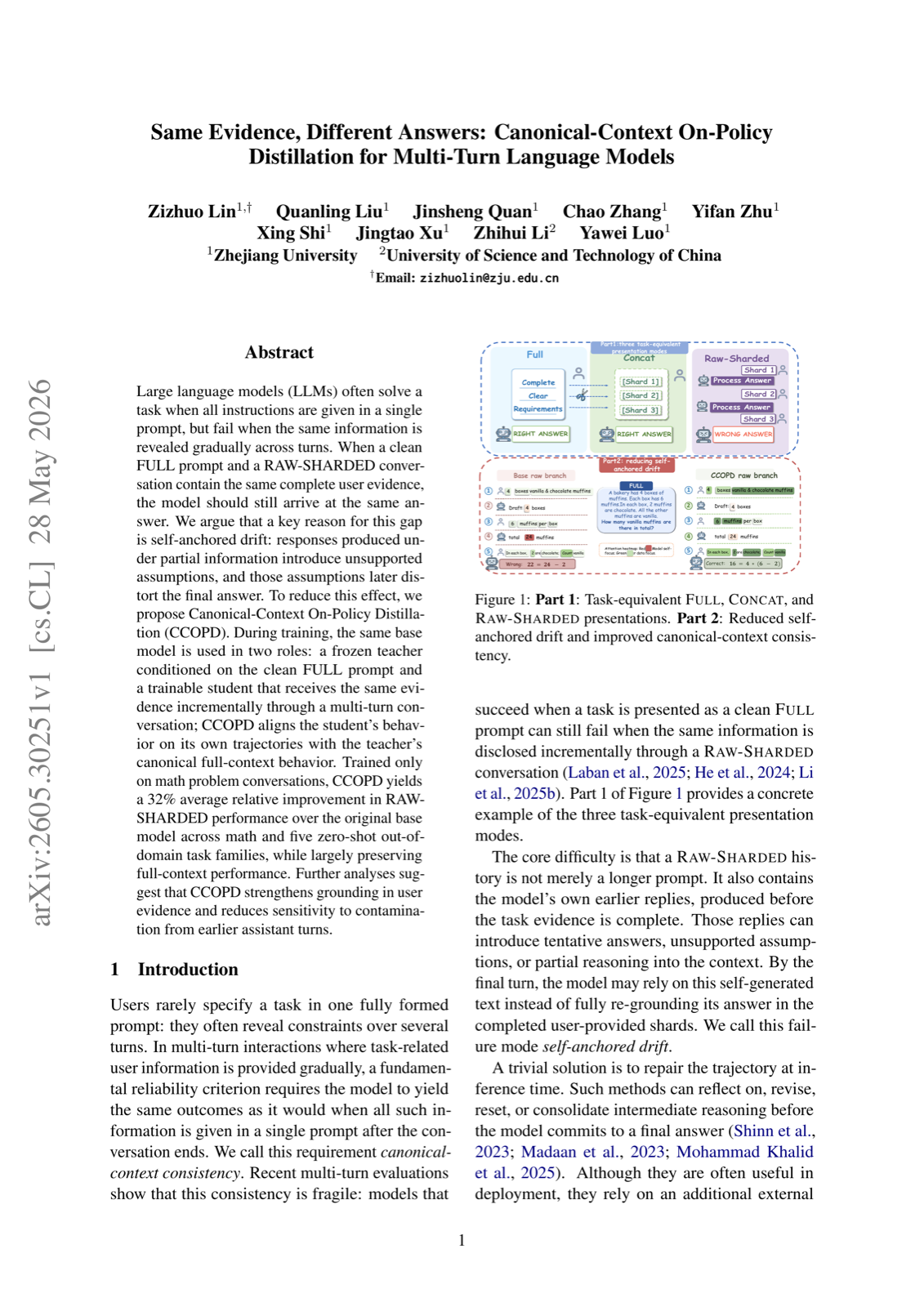
CCOPD tackles a fundamental problem in multi-turn language modeling where models fail to produce consistent answers when the same information is revealed gradually across turns. The approach addresses self-anchored drift by using a frozen teacher conditioned on the clean FULL prompt and a trainable student that receives the same evidence incrementally through a multi-turn conversation. This alignment ensures that the student's behavior on its own trajectories matches the teacher's canonical full-context behavior.
The 32% average relative improvement in RAW-SHARDED performance over the original base model across math and five zero-shot out-of-domain task families demonstrates the effectiveness of this approach. The finding that CCOPD strengthens grounding in user evidence and reduces sensitivity to contamination from earlier assistant turns suggests that the method addresses the root cause of the problem rather than just its symptoms. This is particularly important for applications where consistency across different presentation formats is crucial.
The work's contribution to multi-turn reasoning is significant because it provides a principled approach to maintaining consistency in LLM responses across different information presentation formats. The approach also demonstrates how on-policy distillation can be used to improve model behavior without requiring extensive retraining or additional computational resources. The method's ability to preserve full-context performance while improving multi-turn performance shows that it can be effectively applied to real-world scenarios where both types of performance are important.
Key insight: Canonical-Context On-Policy Distillation (CCOPD) addresses self-anchored drift by aligning student behavior with teacher behavior on canonical full-context trajectories, significantly improving performance on multi-turn tasks.
Knowing What to Solve Before How: Preplan Empowered LLM Mathematical Reasoning
arXiv: 2605.30245
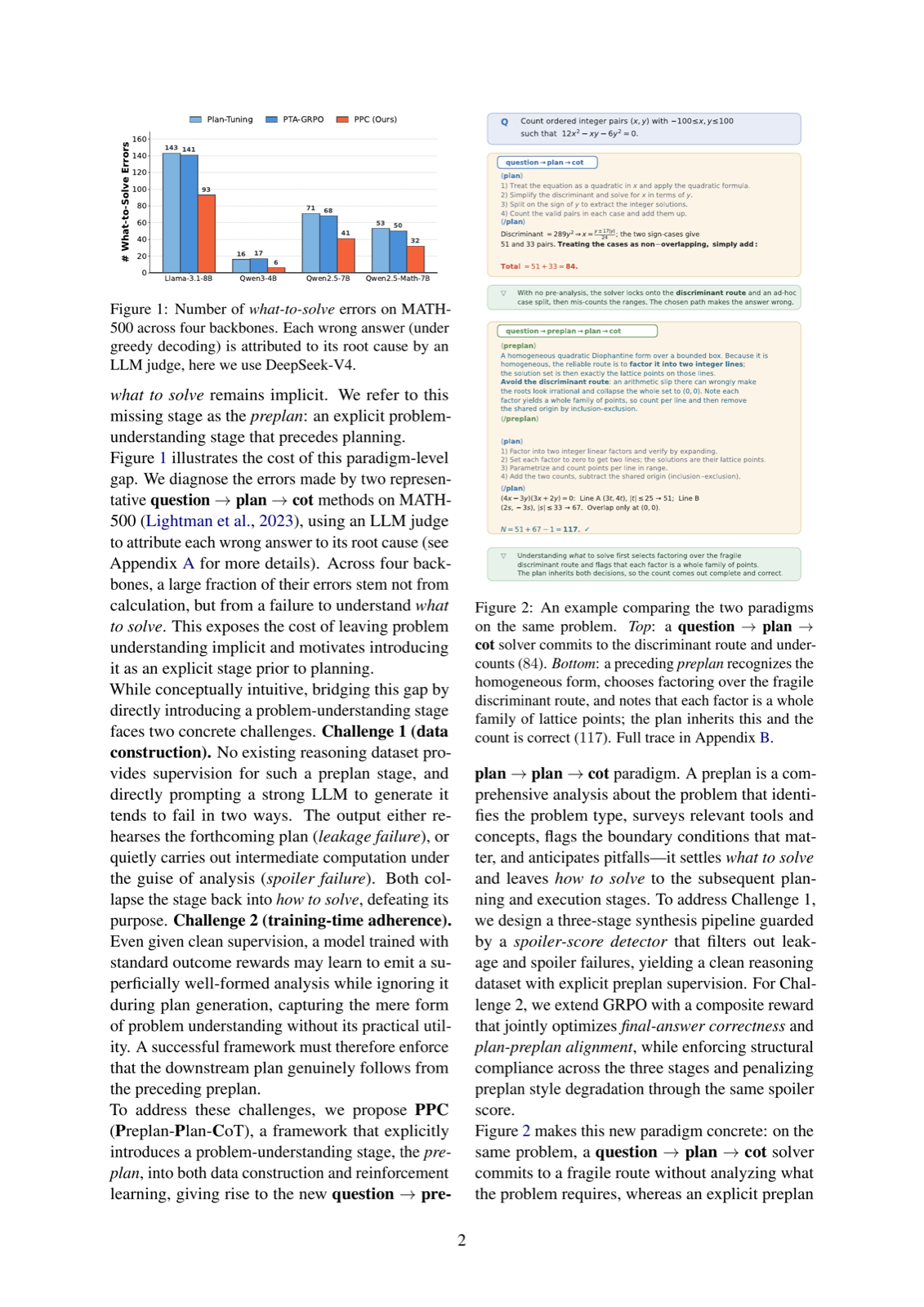
PPC (Preplan-Plan-CoT) addresses an inherent paradigm-level gap in current plan-based reasoning methods by introducing an explicit problem-understanding stage. This approach recognizes that while planning and execution stages decide how to solve a problem, the prior question of what to solve - recognizing the problem type, applicable tools, and foreseeable pitfalls - remains entirely implicit in current methods. The framework's three-stage synthesis pipeline with spoiler-score detector and composite GRPO reward ensures conceptual integrity at both ends of the preplan process.
The experimental results show that PPC achieves the best results on 39 of 40 metrics, improving maj@16 and pass@16 by +2.23 and +3.06 over the strongest baseline without introducing additional inference token overhead. This demonstrates that the explicit problem-understanding stage provides significant value without compromising efficiency. The approach's ability to improve performance across multiple mathematical reasoning benchmarks suggests that it addresses a fundamental limitation in how LLMs approach complex reasoning tasks.
The work's contribution to mathematical reasoning is particularly valuable because it provides a framework that can be applied to various types of problems while maintaining efficiency. The emphasis on conceptual integrity and the use of sophisticated supervision mechanisms (spoiler-score detector, composite GRPO reward) suggests that the approach could be extended to other domains where understanding the problem structure is crucial for effective solution generation. This represents a shift toward more systematic and principled approaches to problem-solving in LLMs.
Key insight: Preplan-Plan-CoT framework introduces an explicit problem-understanding stage that recognizes the problem type, applicable tools, and foreseeable pitfalls, significantly improving mathematical reasoning performance.
Do Language Models Track Entities Across State Changes?
arXiv: 2605.30233
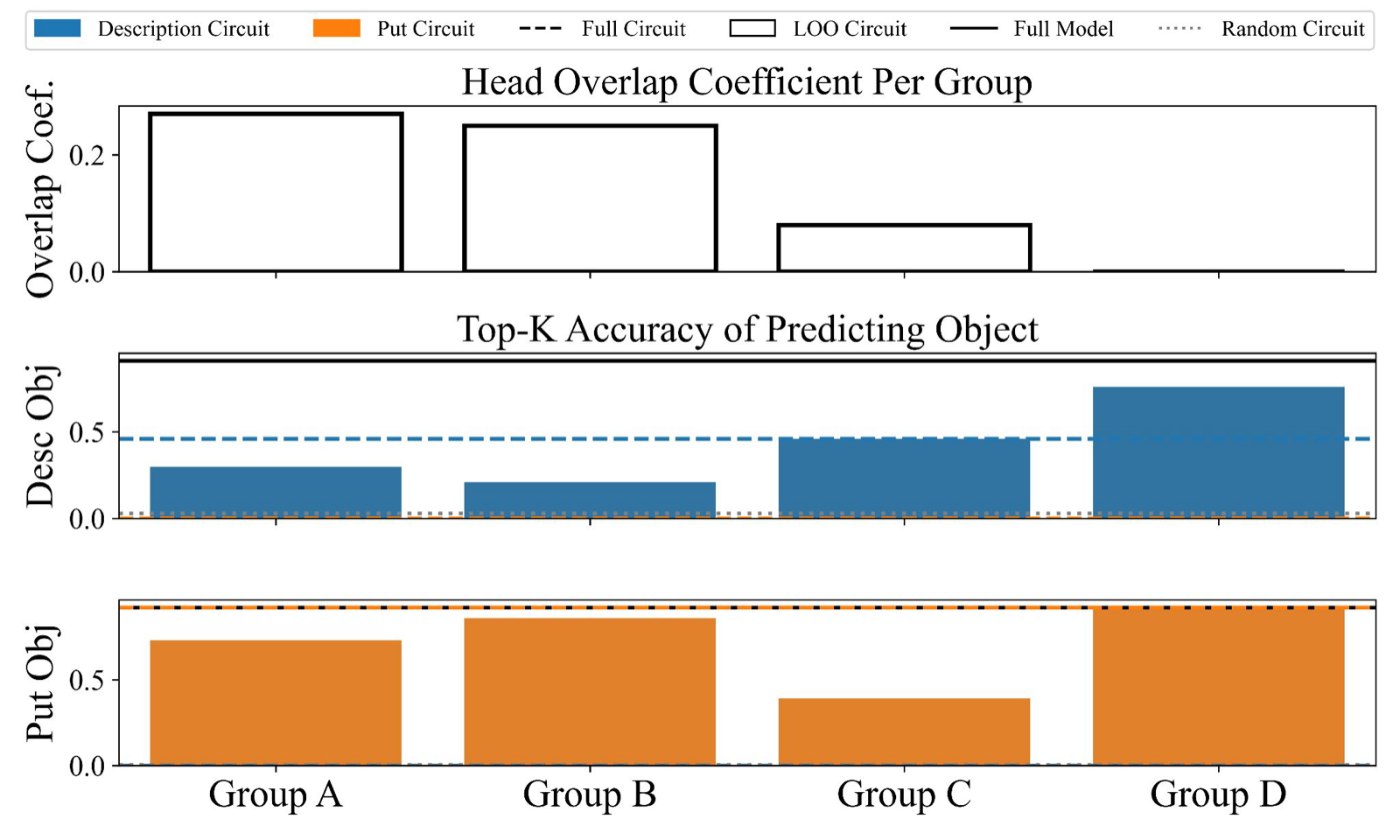
This research reveals a fundamental limitation in how LLMs handle entity tracking by demonstrating that they do not incrementally track world states across tokens or query-relevant states across layers. Instead, LMs aggregate relevant information in parallel at the last token when the query becomes evident. This non-sequential approach to a fundamentally sequential task suggests that LLMs may be missing crucial aspects of how humans process information and maintain state over time.
The discovery that LMs implement the REMOVE operation with a fragile global suppression tag and that this mechanism predicts various failure modes is particularly significant. It shows that the underlying mechanisms of entity tracking in LLMs are not robust and can lead to systematic errors. The mechanistic solution of nullifying this tag to partially address the issue provides a concrete way to improve performance, but also highlights the need for more fundamental architectural changes.
The work's interaction between behavioral and mechanistic analyses demonstrates how understanding the underlying mechanisms can inform better evaluation methods. The fact that behavioral results inform mechanistic hypotheses, and insights from mechanistic analyses help build stronger behavioral evaluations, suggests that future research should continue this approach to gain deeper understanding of LLM capabilities and limitations. This work also highlights the importance of considering both the functional and mechanistic aspects of AI systems.
Key insight: LMs solve entity tracking problems using non-sequential strategies, aggregating relevant information in parallel at the last token rather than incrementally tracking world states, revealing fundamental limitations in how LLMs handle sequential reasoning.
Efficient Test-Time Finetuning of LLMs via Convex Reconstruction and Gradient Caching
arXiv: 2605.30337
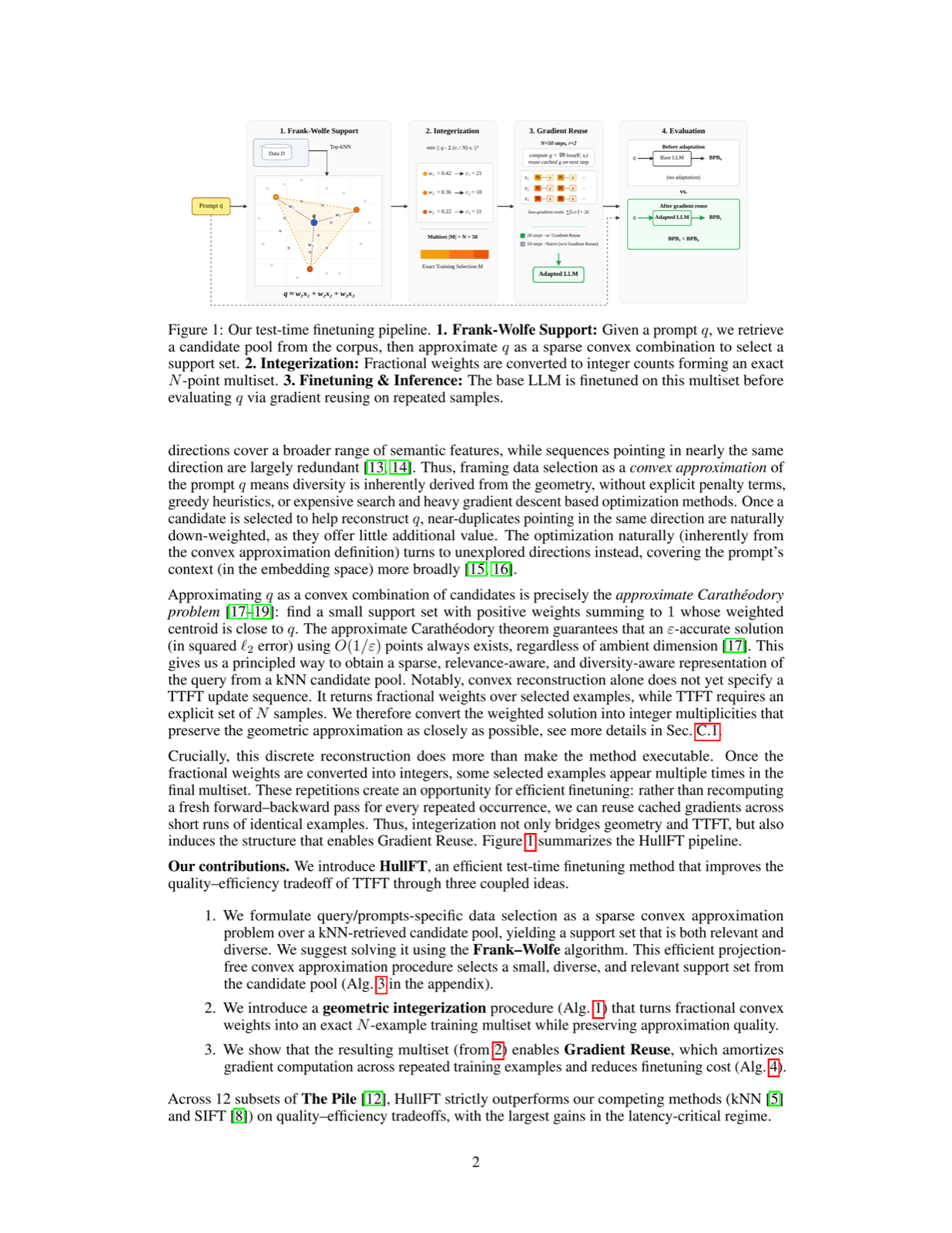
HullFT addresses the computational bottlenecks in test-time fine-tuning (TTFT) by introducing a geometric approach that represents query embeddings as sparse convex combinations of training sequences using efficient projection-free Frank-Wolfe optimization. This approach naturally creates a support set that is inherently relevant and diverse, eliminating the need for expensive diversity-aware selection methods. The conversion of fractional convex weights into exact integer multiset for finetuning through geometric integerization creates repeated examples that can be exploited with Gradient Reuse.
The experimental results show that HullFT improves the quality-efficiency tradeoff over current state-of-the-art TTFT methods, achieving lower bits-per-byte at substantially lower total runtime. This demonstrates that the geometric approach is not only theoretically sound but also practically effective in reducing computational costs while maintaining or improving performance. The approach's ability to handle the per-query bottleneck that makes existing methods impractical is particularly valuable for real-world applications.
The work's contribution to TTFT is significant because it provides a principled geometric framework that can be applied to various TTFT scenarios. The approach's focus on efficiency without sacrificing quality makes it particularly suitable for applications where computational resources are limited or where rapid response times are required. The method's ability to leverage gradient reuse also suggests potential for further optimization in other TTFT scenarios.
Key insight: HullFT's geometric approach to TTFT using convex reconstruction and gradient caching achieves better quality-efficiency tradeoff by representing query embeddings as sparse convex combinations and exploiting gradient reuse.
Reasoning with Sampling: Cutting at Decision Points
arXiv: 2605.30327
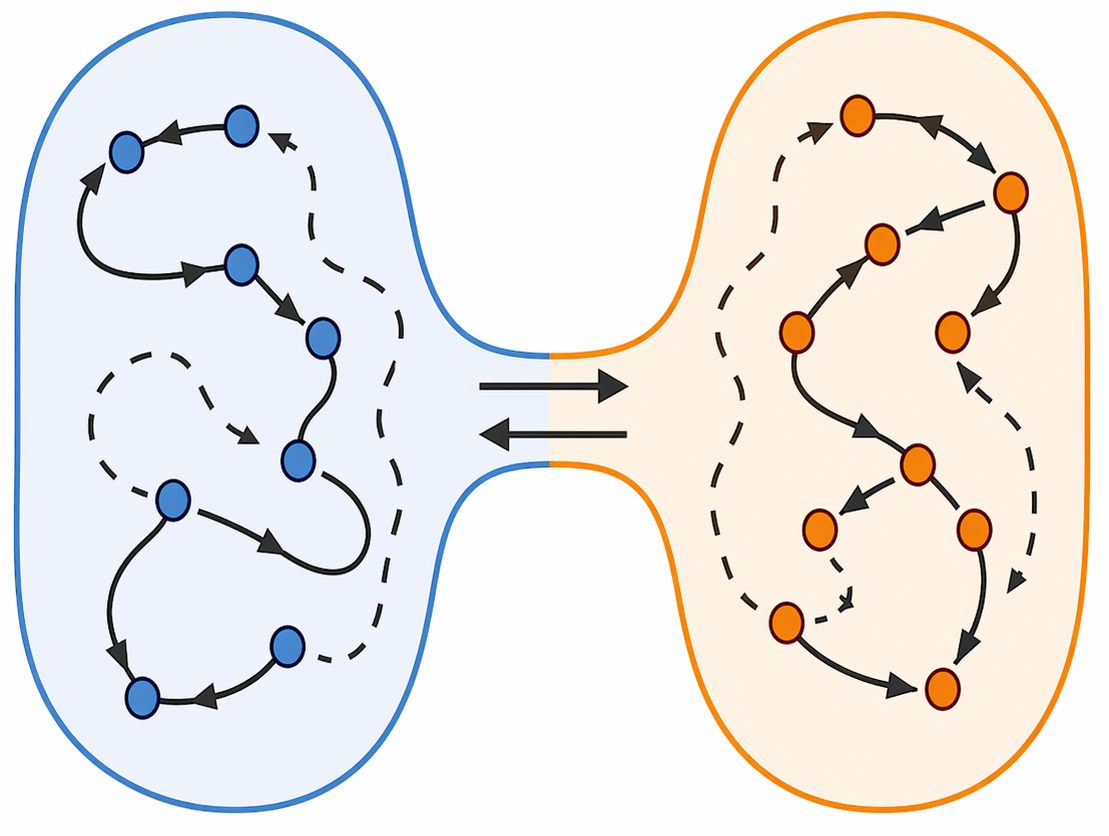
The Entropy-Cut Metropolis-Hastings algorithm addresses a critical limitation in sampling-based reasoning methods by using the base model's next-token entropy as a proxy to identify key decision points. This approach recognizes that uniform random cuts tend to rewrite local details rather than revisit consequential decisions, which is inefficient for reasoning tasks that require exploring different strategies or approaches. By focusing on decision points, the algorithm can more effectively sample from the power distribution.
The theoretical proof that the method's mixing time scales with the number of decisions in a trace rather than with the number of tokens (which can be much larger) demonstrates the algorithm's efficiency advantage. This is particularly important for complex reasoning tasks where the number of tokens can be orders of magnitude larger than the number of meaningful decisions. The empirical verification across multiple benchmarks (MATH500, HumanEval, GPQA Diamond, and AIME26) shows consistent improvements over baselines and RL-trained models.
The work's contribution to reasoning methods is significant because it provides a practical solution to a fundamental problem in sampling-based approaches. The approach's ability to improve performance without requiring additional training or curated datasets makes it particularly valuable for real-world applications. The method also demonstrates how understanding the underlying structure of reasoning traces can lead to more efficient sampling strategies that better match the actual complexity of the reasoning process.
Key insight: Entropy-Cut Metropolis-Hastings algorithm improves sampling efficiency by using base model's next-token entropy as a proxy to identify key decision points, significantly reducing mixing time compared to uniform cut approaches.
Self-Trained Verification for Training- and Test-Time Self-Improvement
arXiv: 2605.30290
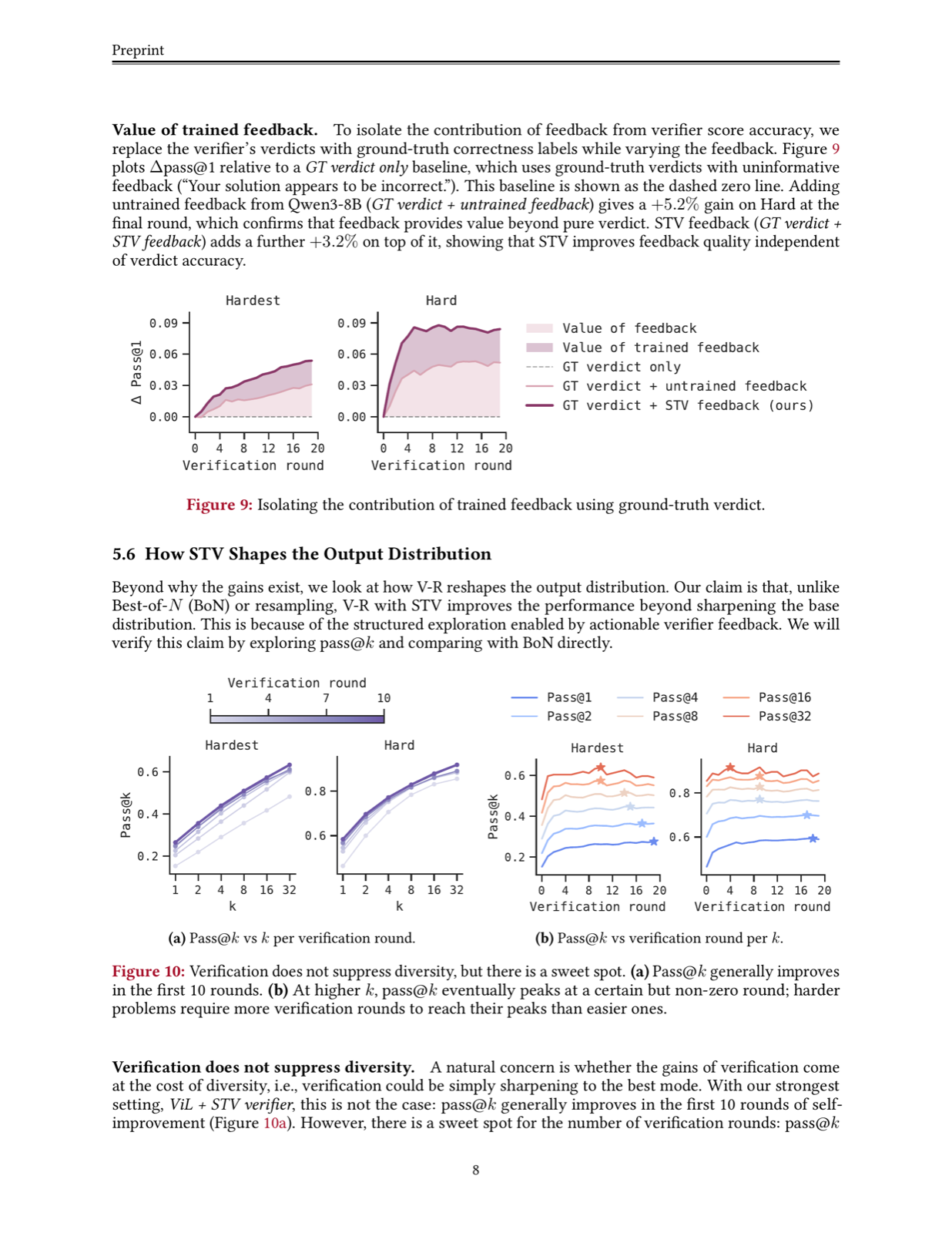
STV addresses the fundamental bottleneck in self-improvement approaches by turning the asymmetry between model capabilities and verification requirements into a supervision target. The key insight is that while a model cannot catch errors alone, it can when shown the reference solution, allowing the verifier to be trained to imitate a more informed version of itself. This approach overcomes the challenge that the capability we want to train - catching self-generated errors - lacks training signal.
The experimental results demonstrate that STV substantially improves V-R loops on hard problems, with accuracy improvements of 30% in pass@1 for mathematical reasoning and 14x improvement for scientific reasoning tasks. The approach's ability to work both at test time and training time through verifier-in-the-loop training (ViL) shows its versatility and broad applicability. The finding that ViL yields a further 33% gain in pass@1 and lifts standalone pass@1 by 30% relative to standard RL demonstrates the cumulative benefits of combining verification with training.
The work's contribution to reasoning systems is significant because it provides a framework for training models to improve themselves through verification, which is crucial for tackling hard problems where traditional approaches may fail. The approach also demonstrates how the same verification mechanism can be used for both immediate problem-solving and long-term capability improvement, making it a powerful tool for developing more robust and capable AI systems.
Key insight: Self-trained verification (STV) enables both test-time and training-time self-improvement by training verifiers to imitate more informed versions of themselves, achieving substantial accuracy gains in mathematical and scientific reasoning.
Neural Operator-Based Surrogate Model for CFD:Helical Coil Steam Generator in Small Modular Reactor
arXiv: 2605.30277
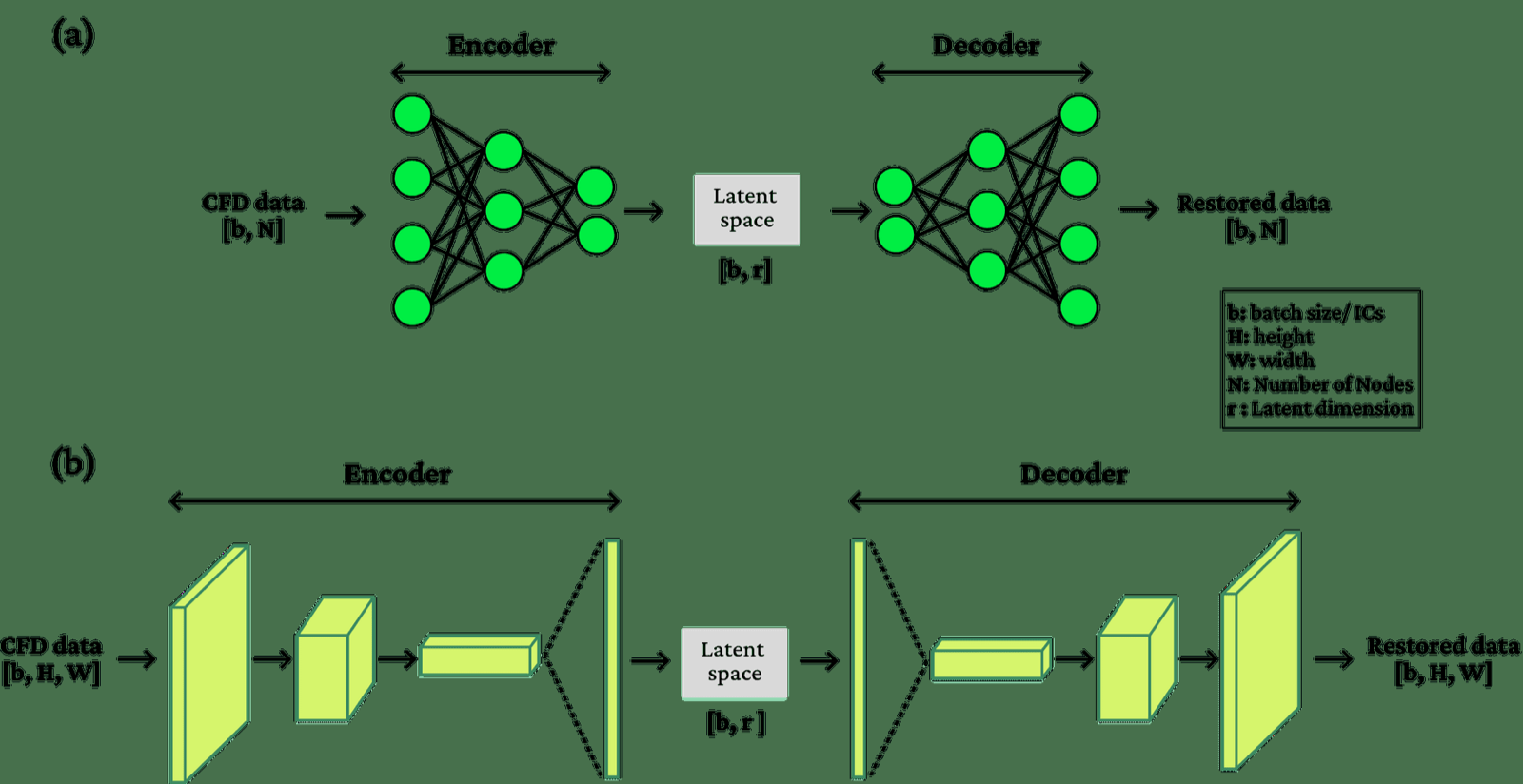
This work demonstrates how neural operator-based surrogate models can effectively address the computational challenges of real-time thermal-hydraulic simulation in digital twin applications for small modular reactors. The integration of reduced-order models with neural operators provides a framework that can handle the complex, transient analysis required for helical coil steam generators while maintaining computational efficiency. The comparison between MLP-based autoencoder and convolutional autoencoder strategies shows how different approaches can be tailored to specific data types.
The multi-scale technique incorporated into both frameworks to mitigate spectral bias and improve prediction of Kármán vortex streets demonstrates the importance of addressing specific challenges in different types of flow analysis. The finding that the multi-scale L-DeepONet captured instantaneous periodic vortex dynamics while FNO provided reliable pressure drop estimates shows that different architectures can be complementary for different objectives. This suggests that model selection should be based on specific DT requirements rather than a one-size-fits-all approach.
The work's practical implications for SMR digital twin applications are significant because it provides concrete guidance for model selection based on specific requirements. The approach's ability to handle both velocity and pressure field predictions while maintaining computational efficiency makes it suitable for real-time applications where both accuracy and speed are crucial. The multi-scale approach also demonstrates how advanced techniques can be combined to address the specific challenges of different flow phenomena.
Key insight: Neural operator-based surrogate models for CFD can capture complex flow dynamics while providing complementary characteristics for different DT objectives, offering practical model-selection guidelines for SMR applications.
OOD-GraphLLM: Graph Large Language Model for Out-of-Distribution Generalized Drug Synergy Prediction
arXiv: 2605.30247
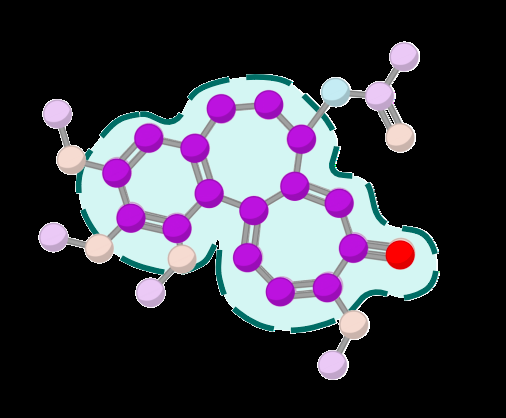
OOD-GraphLLM represents a significant advancement in drug synergy prediction by addressing the challenge of out-of-distribution generalization in a novel way. The approach recognizes that the continual emergence of novel compounds results in variations in molecular scaffolds and sizes, causing drug synergy data to exhibit out-of-distribution shifts with respect to topological structure. By jointly optimizing molecular graph representation and biomedical semantic language representations, the framework provides a unified approach to handling both structural and semantic information.
The method's use of retrieval-augmented biomedical instruction tuning strategy to align molecular topological information and molecular semantic information with language-based reasoning is particularly innovative. This approach allows the model to leverage both the structural properties of molecules and the semantic context from biomedical literature, which is crucial for understanding drug interactions. The finetuning of DrugSyn-LLM, a biomedical LLM, demonstrates how existing specialized models can be adapted for new tasks.
The work's contribution to drug discovery applications is significant because it provides a framework that can handle the variability and complexity of real-world drug data. The approach's ability to predict drug synergy under O.O.D. settings while maintaining performance suggests that it can be applied to new compounds and contexts that were not present in the training data. This is particularly important for drug development where new compounds are constantly being discovered and tested.
Key insight: OOD-GraphLLM addresses out-of-distribution generalized drug synergy prediction by jointly optimizing molecular graph representation and biomedical semantic language representations in a unified manner.
SpecBench: Evaluating Specification-Level Reasoning for Software Engineering LLM Agents
arXiv: 2605.30314

SpecBench addresses a critical gap in software engineering agent evaluation by focusing on specification-level reasoning rather than implementation-focused metrics. The approach recognizes that in real-world complex and critical software systems, initial specifications are often incomplete and flawed, requiring extensive expert reviews and revisions before being accepted for implementation. By using tasks derived from the RFC process used by mature open-source projects, SpecBench provides a realistic evaluation of agents' ability to reason about system design.
The evaluation results showing that the best performing agent, GPT-5.4, achieves 44.4% accuracy in identifying specification deficiencies reveal significant limitations in current SWE agents. This suggests that while agents may be good at generating code given fixed requirements, they struggle with the more challenging task of identifying and correcting specification problems. The approach's focus on expert critiques during historical RFC reviews provides a valuable benchmark for measuring agents' ability to reason about system design.
The work's contribution to software engineering AI is significant because it provides a framework for evaluating agents at a level that more closely matches real-world requirements. The approach's emphasis on identifying omissions, ambiguities, inconsistencies, or incorrect assumptions in initial proposals reflects the actual challenges faced by software engineers in practice. This evaluation method could help guide the development of more sophisticated agents that can handle the complexity and uncertainty inherent in software design.
Key insight: SpecBench evaluates specification-level reasoning by requiring agents to identify specification deficiencies in initial proposals, revealing that current SWE agents struggle with reasoning about system design without execution feedback.
EASE Configuration Facilitates A Reproducible Science of LLM Social Simulations
arXiv: 2605.30258
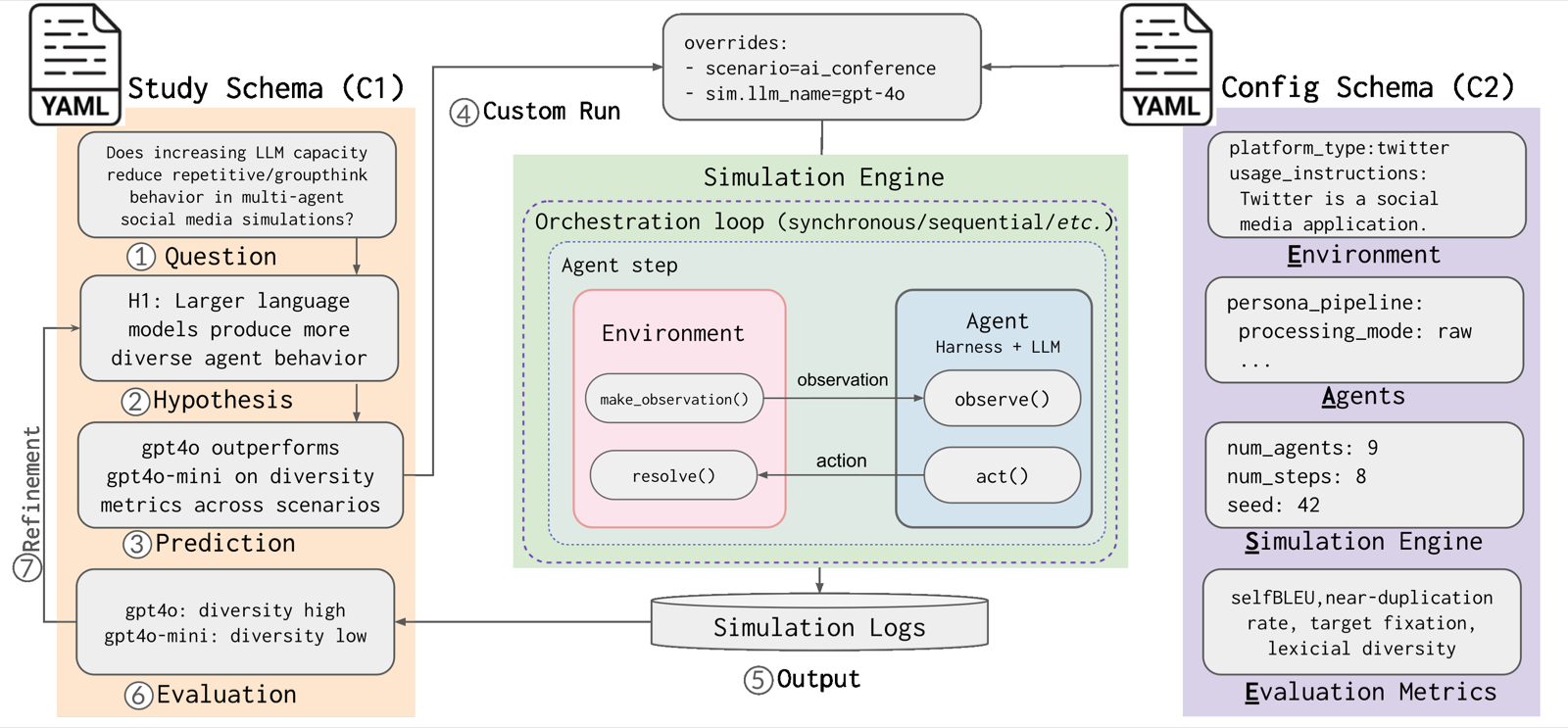
EASE provides a modular framework for LLM-based multi-agent simulation that addresses the lack of architectural standardization that prevents reproducible research and complicates downstream evaluation. By modularizing core components into Environments, Agents, Simulation engines, and Evaluation metrics, EASE creates a standardized approach that can be applied across different research questions and domains. This modularization enables researchers to systematically study how individual design choices impact key results.
The demonstration of EASE through SiliSocS, an open-source, research-ready Silicon Society Sandbox, shows how the framework can be practically implemented and applied to real research questions. The three case studies highlight the limitations of current modeling approaches and isolate the impacts of design choices on key results, providing valuable insights for future research. The approach's ability to enable highly configurable and reproducible LLM-based social simulations demonstrates the importance of standardization in advancing the field.
The work's contribution to the science of LLM-based multi-agent systems is significant because it provides a foundation for reproducible research that can be built upon by future studies. The framework's emphasis on systematic evaluation and design choice isolation makes it particularly valuable for understanding how different components of multi-agent systems interact and influence outcomes. This approach could help establish more rigorous standards for evaluating and comparing different multi-agent approaches.
Key insight: EASE configuration modularizes core components of LLM-based multi-agent simulations, enabling reproducible research and comprehensive assessment of existing questions while isolating impacts of design choices.
Unifying Temporal and Structural Credit Assignment in LLM-Based Multi-Agent Prompt Optimization
arXiv: 2605.30227
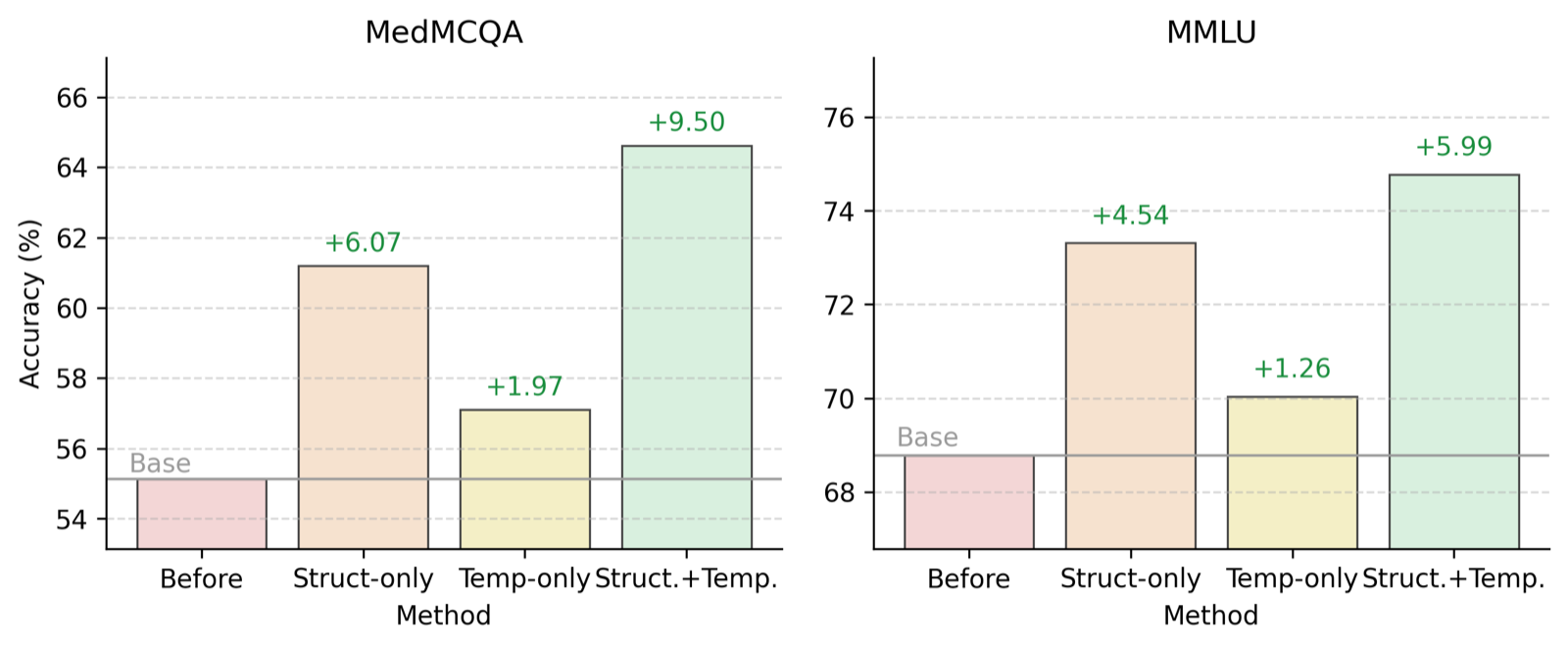
This work addresses the challenge of optimizing multi-agent systems (MAS) by proposing temporal and structural credit assignment that decomposes the objective along two axes: temporal credit using state-space bottlenecks to identify critical rounds, and structural credit using stationary role policies to isolate agent contributions. This decomposition provides the tractable inductive biases needed to disentangle error signals that existing black-box optimizers struggle with.
The discrete, verbalized block coordinate descent algorithm introduced in this work alternates between optimizing role prompts and aggregation protocols using LLM-generated 'proxy gradients' to target only identified weak links. This approach significantly reduces query complexity while improving performance, providing a principled and interpretable path toward self-improving MAS. The method's ability to focus optimization efforts on specific components rather than performing indiscriminate global updates represents a major advancement in MAS optimization.
The work's contribution to multi-agent systems is significant because it provides a framework for understanding and optimizing complex MAS dynamics that was previously difficult due to the discrete, non-differentiable nature of computation graphs and sparsity of global supervisory signals. The approach's emphasis on both temporal and structural credit assignment suggests that effective MAS optimization requires understanding how different aspects of the system contribute to overall performance and how to optimize these components effectively.
Key insight: Temporal and structural credit assignment decomposes objective along temporal and structural axes, enabling discrete, verbalized block coordinate descent for iterative refinement of multi-agent systems.
When Cloud Agents Meet Device Agents: Lessons from Hybrid Multi-Agent Systems
arXiv: 2605.30102

This research systematically examines the design space of hybrid multi-agent systems that combine on-device and cloud models, revealing that while SLMs can effectively benefit from LLM assistance, the optimal architecture is highly task-dependent. The study's adaptation of two representative MAS architectures to support hybrid inference and systematic analysis of how individual design choices shift the operating point along the Pareto frontier of power, cost, and performance provides valuable insights into the trade-offs involved.
The finding that greater frontier-level compute does not consistently translate to better performance highlights the complexity of hybrid MAS design and suggests that optimization should not be approached as a simple matter of increasing computational resources. Instead, the optimal architecture depends on the specific requirements and constraints of each task, making the design space highly nuanced and requiring careful consideration of multiple factors. This complexity underscores the need for more sophisticated design principles for hybrid systems.
The work's contribution to multi-agent system design is significant because it provides empirical evidence for the complex relationship between computational resources and performance in hybrid systems. The approach's emphasis on systematic evaluation rather than ad hoc decisions offers a framework for making more informed design choices. The findings also suggest that future research should focus on developing general principles that can guide the design of hybrid systems for specific application domains.
Key insight: Hybrid multi-agent systems combining cloud and device models offer a middle ground between high-performance but expensive cloud models and cost-efficient but limited device models, but optimal architecture is highly task-dependent.
Discovering Cooperative Pipelines: Autoresearch for Sequential Social Dilemmas
arXiv: 2605.30003
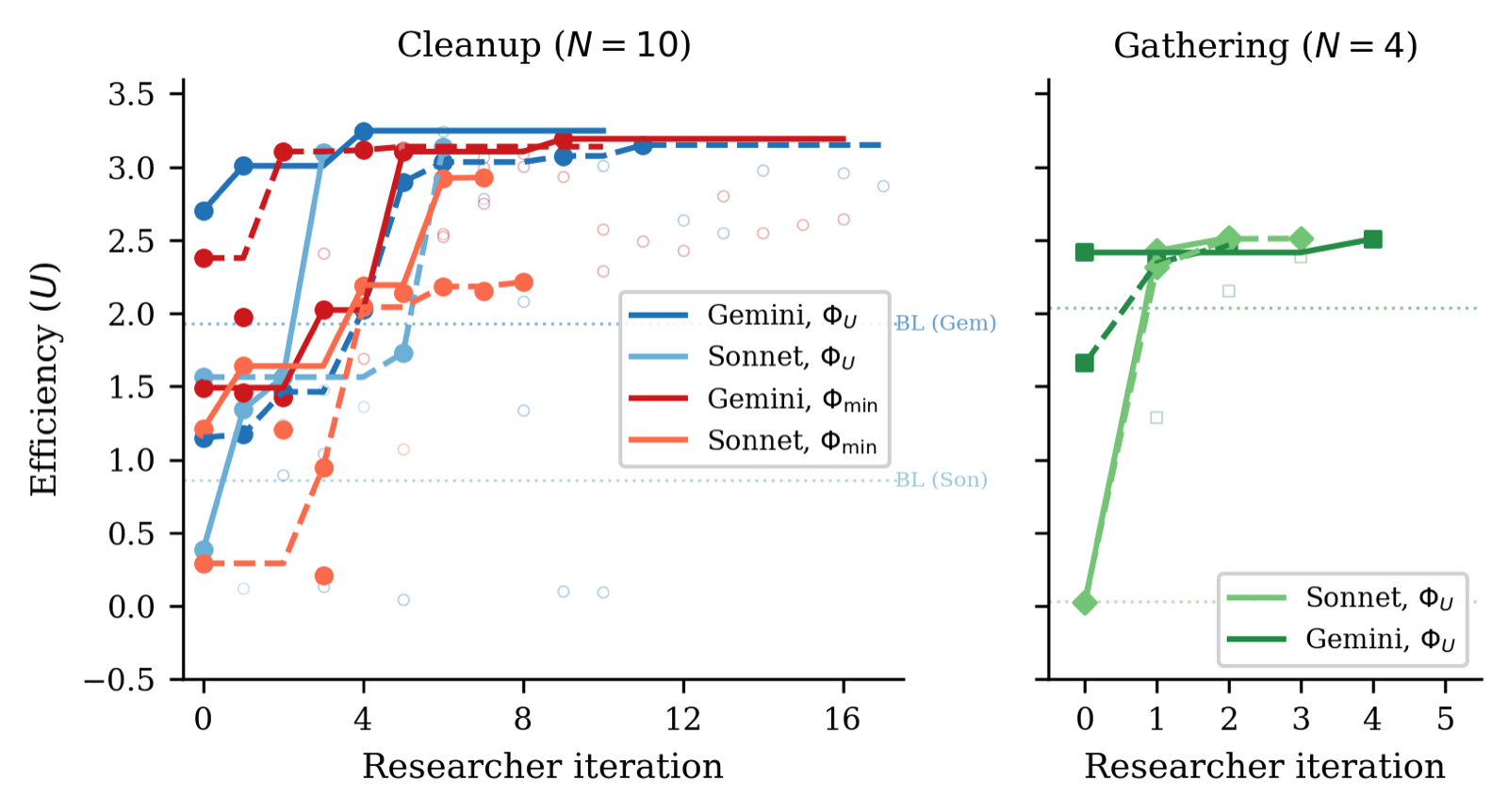
This work demonstrates how two-level autoresearch can be applied to cooperation in Sequential Social Dilemmas by having an outer-loop AI agent autonomously redesign the inner-loop pipeline of an LLM policy-synthesis system. The researcher agent reads source code, edits system prompts, feedback functions, helper libraries, and iteration logic, and decides what to keep, following the autoresearch paradigm. This approach enables the discovery of cooperative pipelines that significantly outperform hand-designed baselines.
The finding that the discovered pipelines are objective-dependent - only under maximin does the researcher inject an explicit fairness mechanism - supports an information-design reading where the researcher chooses what to reveal to the boundedly rational synthesizer as a function of the welfare objective. This suggests that the approach can be adapted to different objectives by adjusting what information is revealed to the system, providing a flexible framework for different types of cooperative scenarios.
The work's contribution to cooperative AI is significant because it demonstrates how AI agents can improve their own systems through autonomous redesign, leading to more effective cooperation in complex social dilemmas. The approach's ability to sharply tighten run-to-run variance and outperform prompt-only optimization shows that the method can produce more reliable and consistent results. This represents a step toward more autonomous and adaptive AI systems that can improve their own performance over time.
Key insight: Two-level autoresearch enables AI agents to autonomously redesign inner-loop pipelines for multi-agent Sequential Social Dilemmas, discovering cooperative pipelines that outperform hand-designed baselines and reduce run-to-run variance.
Evolutionary Dynamics of Cooperation in Next-Generation LLM Agent Systems: A Cross-Provider Empirical Extension
arXiv: 2605.29874
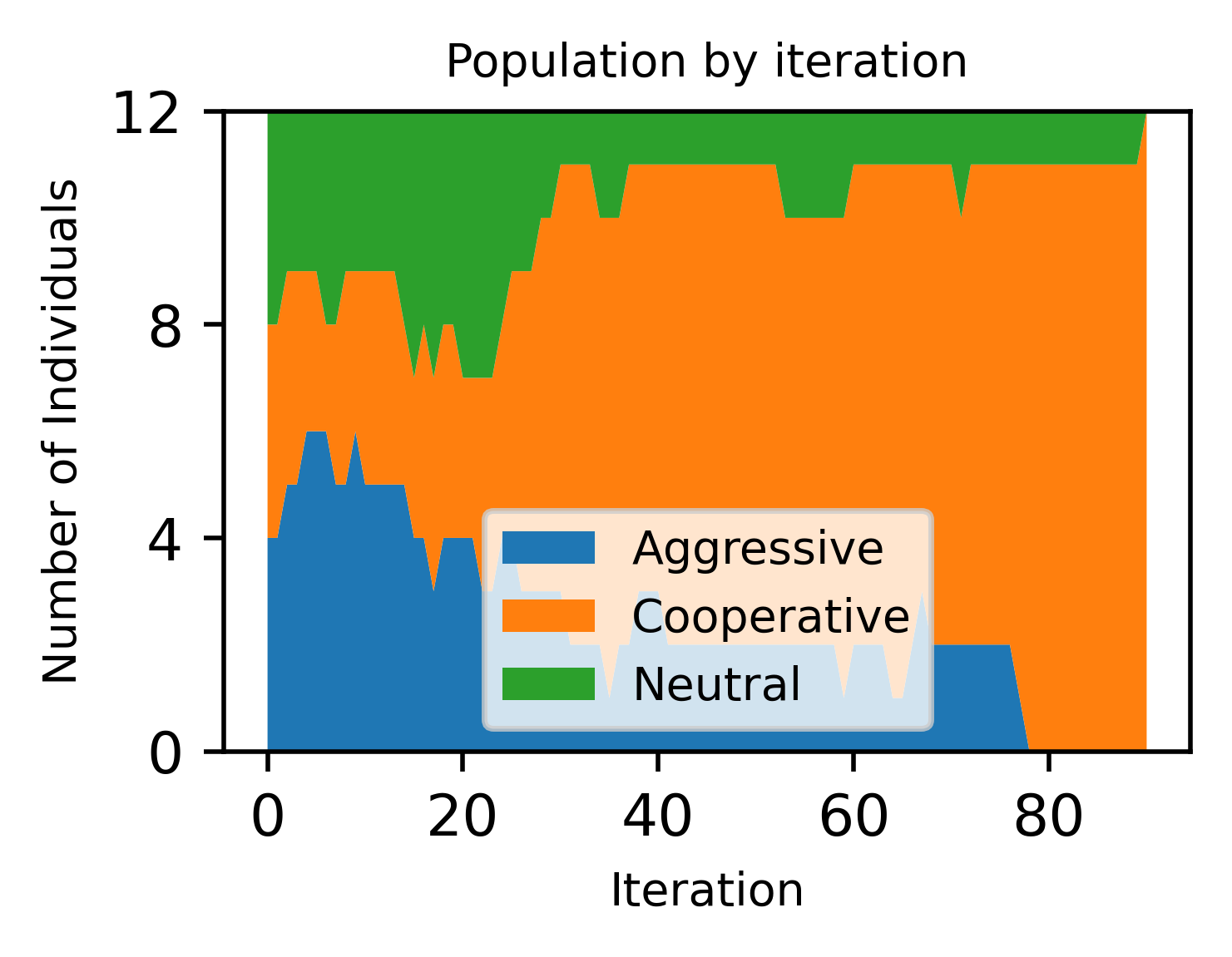
This work extends previous research on cooperative behavior in LLM agents by examining a broader range of models released in 2025-2026, including Claude Sonnet 4.6, Gemini 2.5 Flash, Gemini 3.1 Pro, and GPT-5.4 Mini. The findings show that cooperative bias persists across providers, but cross-provider divergence is substantial, with different models showing different levels of aggressive behavior under similar conditions. This suggests that while there are common cooperative tendencies, the specific implementation details of different providers significantly influence behavior.
The key insight that provider identity, rather than model generation, is the strongest correlate of equilibrium outcomes is particularly important for understanding how different AI systems behave in competitive multi-agent settings. The finding that Self-Refine raises ICD in all models and Claude Sonnet 4.6 Refine achieves the highest ICD suggests that prompting strategies can have significant impacts on cooperative behavior, but the overall pattern is more dependent on the underlying system design than on the specific version of the model.
The work's contribution to understanding LLM cooperation is significant because it provides empirical evidence for how cooperative behavior varies across different providers and how different prompting strategies affect these behaviors. The approach's use of evolutionary game theory and the Iterated Prisoner's Dilemma provides a rigorous framework for studying cooperation that can be applied to other multi-agent scenarios. The findings also suggest that future research should focus on understanding how different system designs influence cooperative behavior rather than just focusing on model architecture.
Key insight: Next-generation LLM agents inherit cooperative biases from predecessors but show substantial cross-provider divergence, with provider identity being the strongest correlate of equilibrium outcomes rather than model generation.
Evolve as a Team: Collaborative Self-Evolution for LLM-based Multi-Agent Systems
arXiv: 2605.29790

Meta-Team addresses the challenge of experience-driven MAS evolution by preserving execution context of each agent and coordinating post-task communication, enabling agents to exchange distributed evidence for evolution. This approach transforms execution experience into reusable improvements to agent behaviors, inter-agent coordination, and team-level organization. The framework's multi-scale self-evolution capability allows for both fine-grained behavior improvements and broader organizational changes.
The experimental results across six long-horizon agent benchmarks show that Meta-Team consistently outperforms single-agent systems, hand-crafted MAS, and prior MAS evolution methods, demonstrating the effectiveness of collaborative self-evolution. The approach's ability to enable more reliable and scalable MAS self-evolution suggests that it can be applied to complex tasks where traditional approaches may fail. The framework's emphasis on preserving execution context and coordinating communication provides a robust foundation for continuous improvement.
The work's contribution to MAS evolution is significant because it provides a framework for agents to learn from their own experiences and improve their performance over time. The approach's focus on collaborative evolution rather than individual agent improvement suggests that the most effective learning occurs when agents work together to identify and address system weaknesses. This represents a step toward more autonomous and adaptive multi-agent systems that can continuously improve their own performance.
Key insight: Meta-Team's collaborative self-evolution framework enables multi-scale self-evolution by preserving execution context and coordinating post-task communication, leading to more reliable and scalable MAS self-evolution.
CONCAT: Consensus- and Confidence-Driven Ad Hoc Teaming for Efficient LLM-Based Multi-Agent Systems
arXiv: 2605.29612

CONCAT addresses the computational overhead problem in LLM-based multi-agent systems by introducing a training-free framework based on consensus and confidence-driven ad hoc teaming. The approach clusters agents based on their initial answers, selects leaders based on confidence, and uses a heuristic function based on Theory of Mind to predict collaboration benefits between leaders. This method organizes an ad hoc multi-agent network by evicting a percentage of communications based on predicted benefits, achieving significant efficiency gains without task-specific training.
The experimental results show that CONCAT achieves up to 2.02x higher efficiency (accuracy/latency ratio) than LLM-Debate and outperforms training-aware methods such as AgentDropout, while reducing average latency by 50.1% on Qwen2.5-14B-Instruct. This demonstrates that the approach can significantly improve computational efficiency while maintaining or improving performance. The training-free nature of the approach makes it particularly valuable for applications where training resources are limited or where rapid deployment is required.
The work's contribution to multi-agent systems is significant because it provides a practical solution to the communication overhead problem that has limited the scalability of multi-agent approaches. The approach's ability to achieve substantial efficiency gains without requiring additional training or task-specific adaptation makes it broadly applicable to different types of multi-agent scenarios. The method's focus on ad hoc teaming also suggests that it can adapt to changing conditions and requirements.
Key insight: CONCAT's training-free approach to multi-agent collaboration uses consensus and confidence-driven ad hoc teaming to efficiently organize agent interactions, achieving up to 2.02x higher efficiency and 50.1% latency reduction.
DynaGraph: Lightweight Multi-Model Interaction Framework via Dynamic Topological Reconfiguration
arXiv: 2605.29511
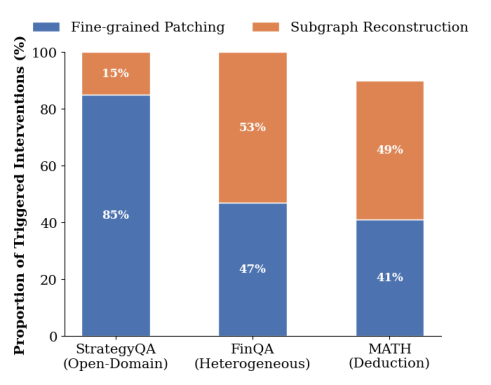
DynaGraph addresses the computational redundancy problem in complex reasoning tasks by introducing a lightweight multi-model framework driven by dynamic topological reconfiguration. The approach multiplexes time-division PEFT adapters over a shared base model, enabling both full system training and inference deployment on a single consumer-grade GPU. This represents a significant advancement in making complex reasoning tasks accessible on resource-constrained hardware.
The Evaluator's continuous monitoring of execution confidence to trigger hierarchical self-healing - including fine-grained Patching for localized data gaps and Subgraph Reconstruction for severe logical ruptures - provides robust error handling that maintains system reliability. The experimental results demonstrate that the 8B model closely approximates the reasoning capabilities of a 72B monolithic model on StrategyQA and MATH benchmarks, while reducing latency by up to 68.1% and token consumption by 68.6% compared to unconstrained dynamic architectures.
The work's contribution to multi-model interaction is significant because it provides a framework that can achieve performance comparable to much larger models while using significantly fewer computational resources. The approach's ability to handle both complex reasoning tasks and computational efficiency constraints makes it particularly valuable for practical applications. The dynamic topological reconfiguration also suggests that future systems could adapt their architecture based on task requirements, leading to more flexible and efficient AI systems.
Key insight: DynaGraph's dynamic topological reconfiguration enables lightweight multi-model interaction by multiplexing time-division PEFT adapters over a shared base model, achieving performance comparable to monolithic models with reduced computational overhead.
LLM-ALSO: LLM-Driven Adaptive Learning-Signal Optimization for Multi-Agent Reinforcement Learning
arXiv: 2605.29293
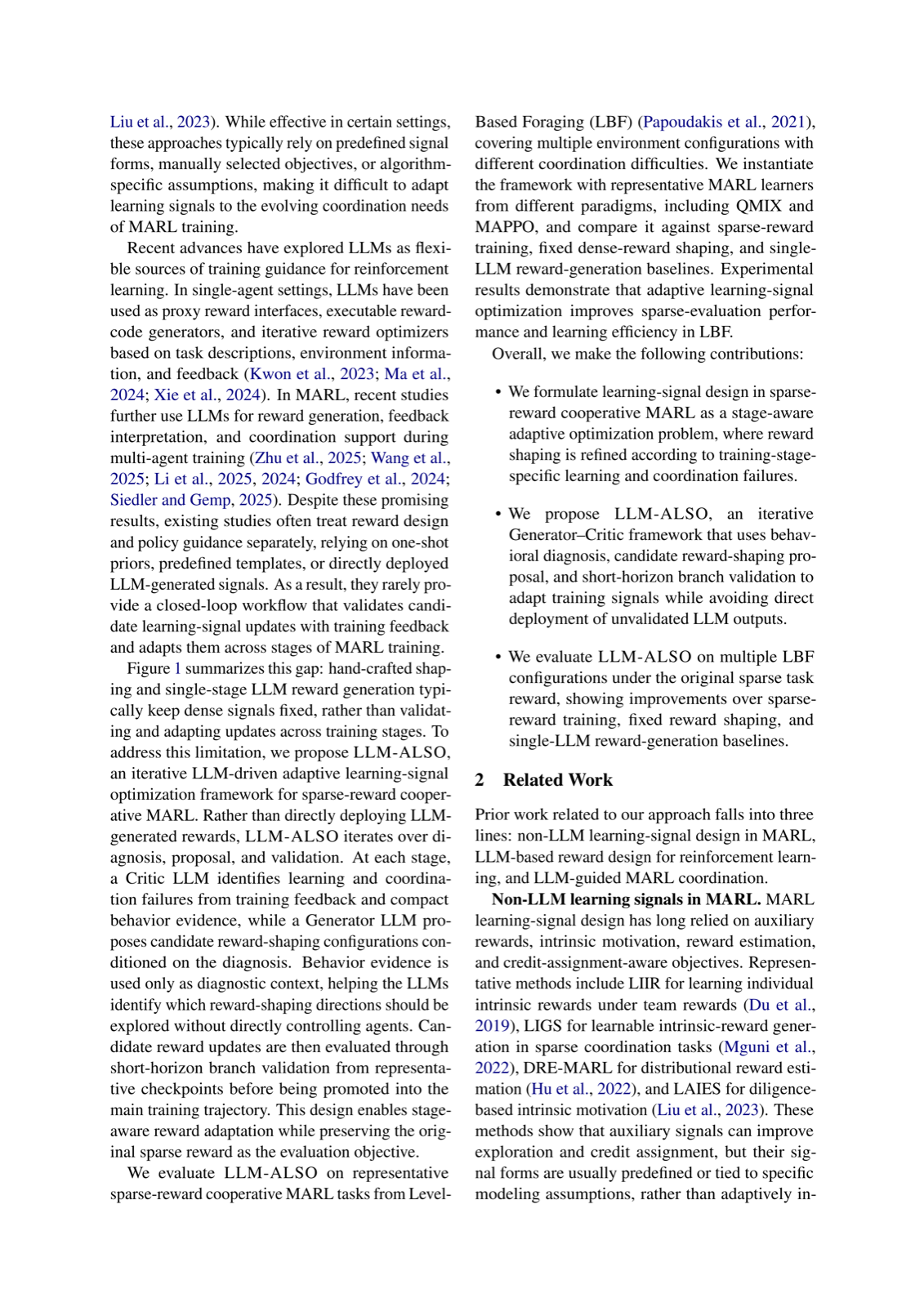
LLM-ALSO addresses the challenge of effective training-time guidance in sparse-reward cooperative MARL by introducing an iterative framework that decomposes adaptation into diagnosis, proposal, and validation phases. The Critic LLM diagnoses stage-specific learning and coordination failures from sparse-return metrics and compact behavior evidence, while the Generator LLM proposes candidate reward-shaping configurations conditioned on the diagnosis. The branch-validation feedback refines candidates before they affect the main training trajectory, promoting only validated updates into training.
The experimental results show that LLM-ALSO improves sparse-evaluation performance and learning efficiency, demonstrating that the iterative approach can effectively address the limitations of existing methods that often require substantial domain expertise or manual design effort. The framework's ability to provide flexible learning-signal design without requiring manual intervention or extensive domain knowledge makes it particularly valuable for complex cooperative tasks where weak supervision limits coordination and policy improvement.
The work's contribution to MARL is significant because it provides a framework that can adapt learning signals dynamically based on the evolving training dynamics of cooperative MARL. The approach's emphasis on validation before applying changes reduces the risk of unreliable LLM-generated modifications, making it more robust than approaches that directly deploy LLM-generated rewards. This represents a step toward more autonomous and adaptive reinforcement learning systems that can improve their own training signals over time.
Key insight: LLM-ALSO's iterative LLM-driven adaptive learning-signal optimization framework improves sparse-reward cooperative MARL by decomposing adaptation into diagnosis, proposal, and validation phases with branch-validation feedback.