Anthropic has released an updated Responsible Scaling Policy to govern the development of increasingly powerful AI systems. Simultaneously, several research papers demonstrate significant advances in autonomous AI agents, clinical AI pipelines, and formal methods integration with LLMs.
Anthropic's updated Responsible Scaling Policy establishes new governance frameworks for managing catastrophic risks from frontier AI systems, emphasizing safety protocols and risk assessment as AI capabilities grow. In parallel, research advances span multiple domains including autonomous disease forecasting using LLM-guided tree search, self-evolving agent memory through population broadcast mechanisms, and fully open clinical LLM pipelines that achieve state-of-the-art performance while maintaining auditability. Additional papers explore the integration of formal methods with LLMs for compliance monitoring and the design principles for effective compound LLM agents in adversarial environments.
AI Model Releases

Announcing our updated Responsible Scaling Policy
Anthropic has published an updated Responsible Scaling Policy (RSP) to govern potential catastrophic risks from frontier AI systems. The policy outlines new governance frameworks for scaling AI capabilities while mitigating risks. It includes enhanced safety protocols and risk assessment procedures for AI development. The update comes as AI systems become increasingly powerful and potentially dangerous. Anthropic emphasizes the importance of responsible AI development as the field advances toward more advanced capabilities.
Why it matters: This policy update reflects the growing industry recognition that AI development must be accompanied by robust risk governance frameworks. As AI systems approach more advanced capabilities, such policies become critical for ensuring responsible development and deployment.
Research Papers
Prospective multi-pathogen disease forecasting using autonomous LLM-guided tree search
arXiv: 2605.16238
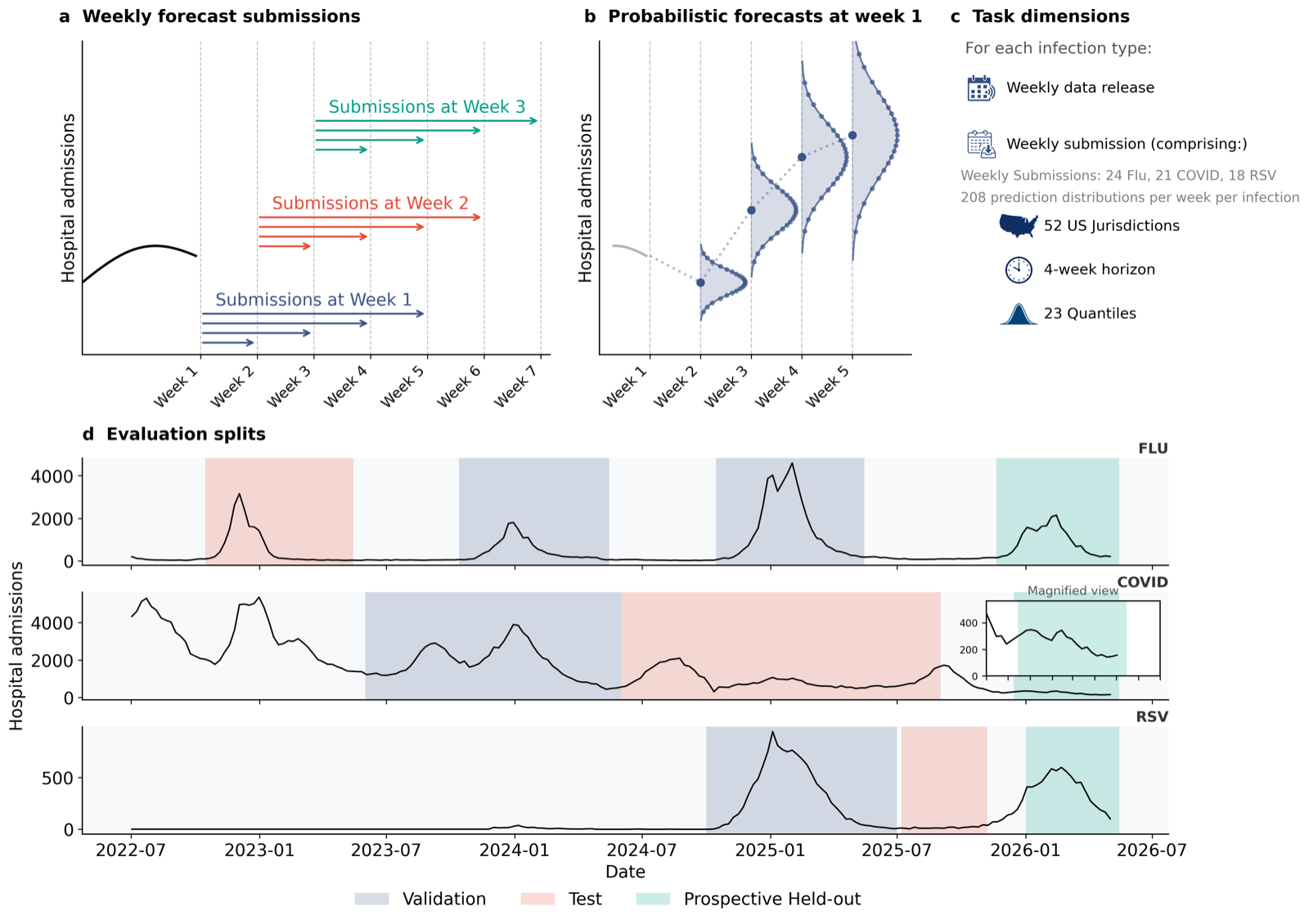
This paper introduces an autonomous system that leverages Large Language Models (LLMs) to generate, evaluate, and optimize forecasting models for infectious diseases. By using LLM-guided tree search, the system iteratively produces executable forecasting software, enabling rapid deployment of expert-level models at unprecedented scales. The approach was tested prospectively during the 2025-2026 US respiratory season, where it autonomously discovered diverse models for influenza, COVID-19, and RSV, outperforming traditional human-curated ensembles.
A key innovation is the system's ability to navigate data-scarce 'cold start' scenarios, such as those encountered with RSV, demonstrating robustness in real-world conditions. The framework also incorporates a judge-in-the-loop mechanism to ensure structural fidelity to scientific theories, and uses log-scale distance metrics to prevent reward hacking. These features collectively address major bottlenecks in epidemiological modeling, including labor-intensive curation and scalability challenges.
The implications extend beyond public health, suggesting that autonomous LLM systems can be applied to other domains requiring rapid model generation and adaptation. The work highlights how LLMs can translate complex scientific theory into transparent, accurate code, thereby democratizing access to expert-level modeling capabilities while maintaining high performance and interpretability.
Key insight: Autonomous LLM-guided tree search enables scalable, expert-level disease forecasting without manual model curation, achieving performance comparable to CDC gold-standard ensembles while handling data-scarce scenarios.
FORGE: Self-Evolving Agent Memory With No Weight Updates via Population Broadcast
arXiv: 2605.16233
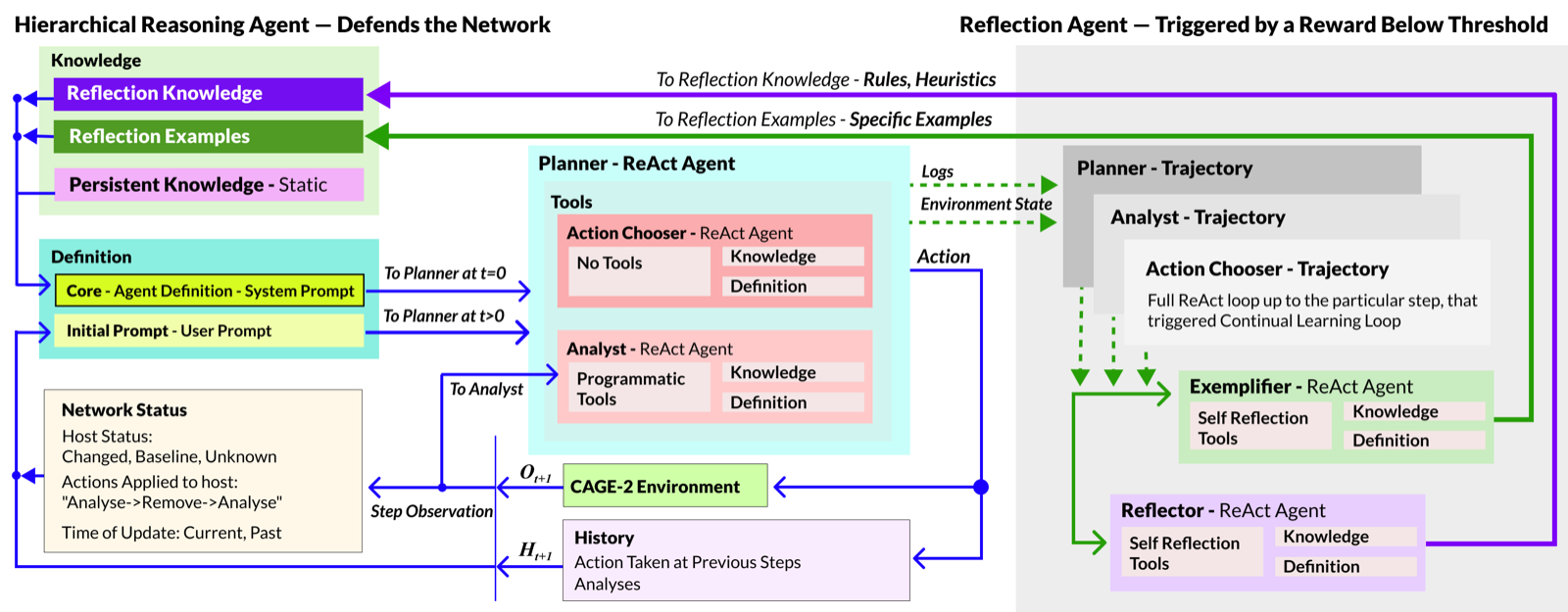
FORGE presents a novel approach to agent memory evolution that avoids traditional gradient-based learning by using a population-based protocol. It wraps a Reflexion-style inner loop where failed trajectories are converted into reusable knowledge artifacts—such as textual heuristics or few-shot examples—and these are propagated across a population via broadcast mechanisms. This method allows for continuous improvement without requiring model retraining or distillation.
In the CybORG CAGE-2 environment, FORGE demonstrated substantial performance gains over both zero-shot and Reflexion baselines, improving average returns by up to 7.7x over zero-shot and 72% over Reflexion. Crucially, the study reveals that population broadcast is the core driver of performance gains, while graduation primarily saves compute. The approach also shows disproportionate benefits for weaker models, suggesting potential for reducing capability gaps in LLM-based agents.
The findings suggest that FORGE's design principles—especially the use of population broadcast and staged evolution—can be generalized to other domains where agent memory and learning are critical. This method offers a promising alternative to traditional reinforcement learning paradigms, particularly in settings where gradient updates are costly or impractical.
Key insight: FORGE enables self-evolving agent memory through population-based broadcast without gradient updates, significantly improving decision-making in adversarial environments like network defense.
Fully Open Meditron: An Auditable Pipeline for Clinical LLMs
arXiv: 2605.16215

Fully Open Meditron introduces a groundbreaking pipeline for building clinical LLMs that is fully transparent and auditable, addressing a major gap in current LLM-based clinical decision support systems (CDSS). Unlike existing 'open' models that only release weights, this framework exposes the entire training stack, including data provenance, curation procedures, and generation pipelines. This transparency is essential for clinical applications where trust and reproducibility are paramount.
The pipeline unifies eight public medical QA datasets and expands them with three clinician-vetted synthetic extensions, ensuring broad coverage and high-quality data. It enforces system-wide decontamination, gold-label resampling, and end-to-end validation by a panel of physicians. Evaluation results show that MeditronFO variants outperform their base models, with Apertus-70B-MeditronFO achieving a +6.6 point improvement on aggregate benchmarks, establishing a new SoTA in fully open clinical LLMs.
This work demonstrates that fully open pipelines can achieve top-tier performance without sacrificing auditability or reproducibility. It sets a new standard for how clinical AI systems should be developed, emphasizing the importance of transparency and clinician involvement in model construction. The success of MeditronFO suggests that open, auditable frameworks are not only feasible but also superior in high-stakes domains like healthcare.
Key insight: Fully Open Meditron establishes the first end-to-end open pipeline for clinical LLMs, achieving state-of-the-art performance while maintaining auditability and reproducibility.
Context, Reasoning, and Hierarchy: A Cost-Performance Study of Compound LLM Agent Design in an Adversarial POMDP
arXiv: 2605.16205
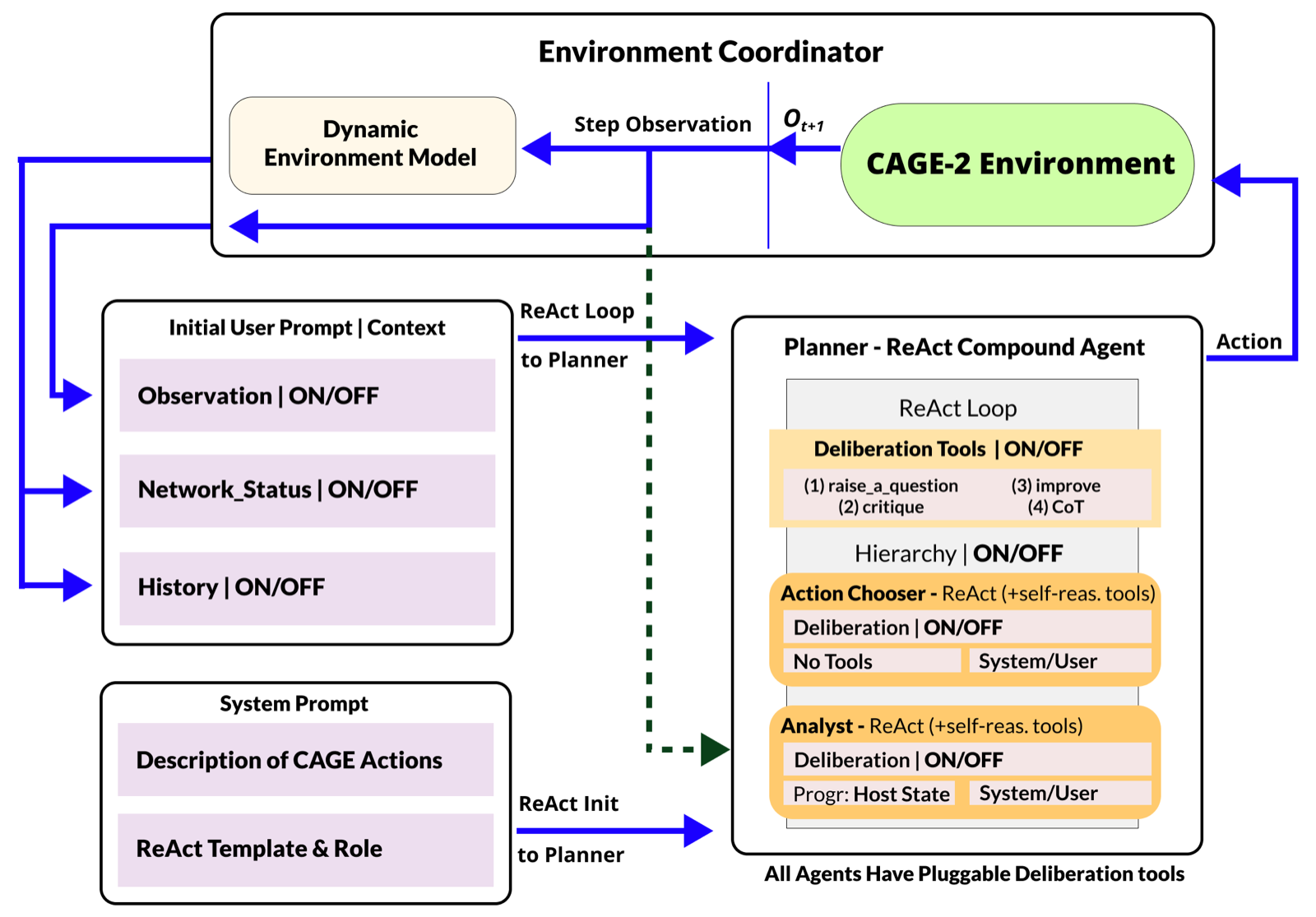
This study provides a rigorous cost-performance analysis of compound LLM agent designs in adversarial, partially observable environments like CybORG CAGE-2. It systematically evaluates how different design choices—context representation, reasoning mechanisms, and hierarchical decomposition—affect agent performance and inference costs. The findings reveal that programmatic state abstraction delivers the largest performance gains per token spent, improving returns by up to 76% over raw observations.
Contrary to expectations, distributing deliberation tools across a hierarchical structure actually degraded performance, a phenomenon termed 'deliberation cascade.' This effect was observed across all model families, indicating that deeper reasoning does not always translate to better outcomes when combined with task decomposition. Instead, the study finds that hierarchical decomposition without deliberation achieves the best absolute performance for most models.
These insights suggest a clear design principle for adversarial POMDPs: prioritize programmatic infrastructure and clean task decomposition over deeper per-agent reasoning. The results emphasize that context engineering is generally more cost-effective than deliberation, offering practical guidance for practitioners building LLM agents in complex, adversarial environments.
Key insight: In adversarial POMDPs, context engineering and clean task decomposition yield better performance than deeper per-agent reasoning, suggesting a design principle for structured agent architectures.
Formal Methods Meet LLMs: Auditing, Monitoring, and Intervention for Compliance of Advanced AI Systems
arXiv: 2605.16198
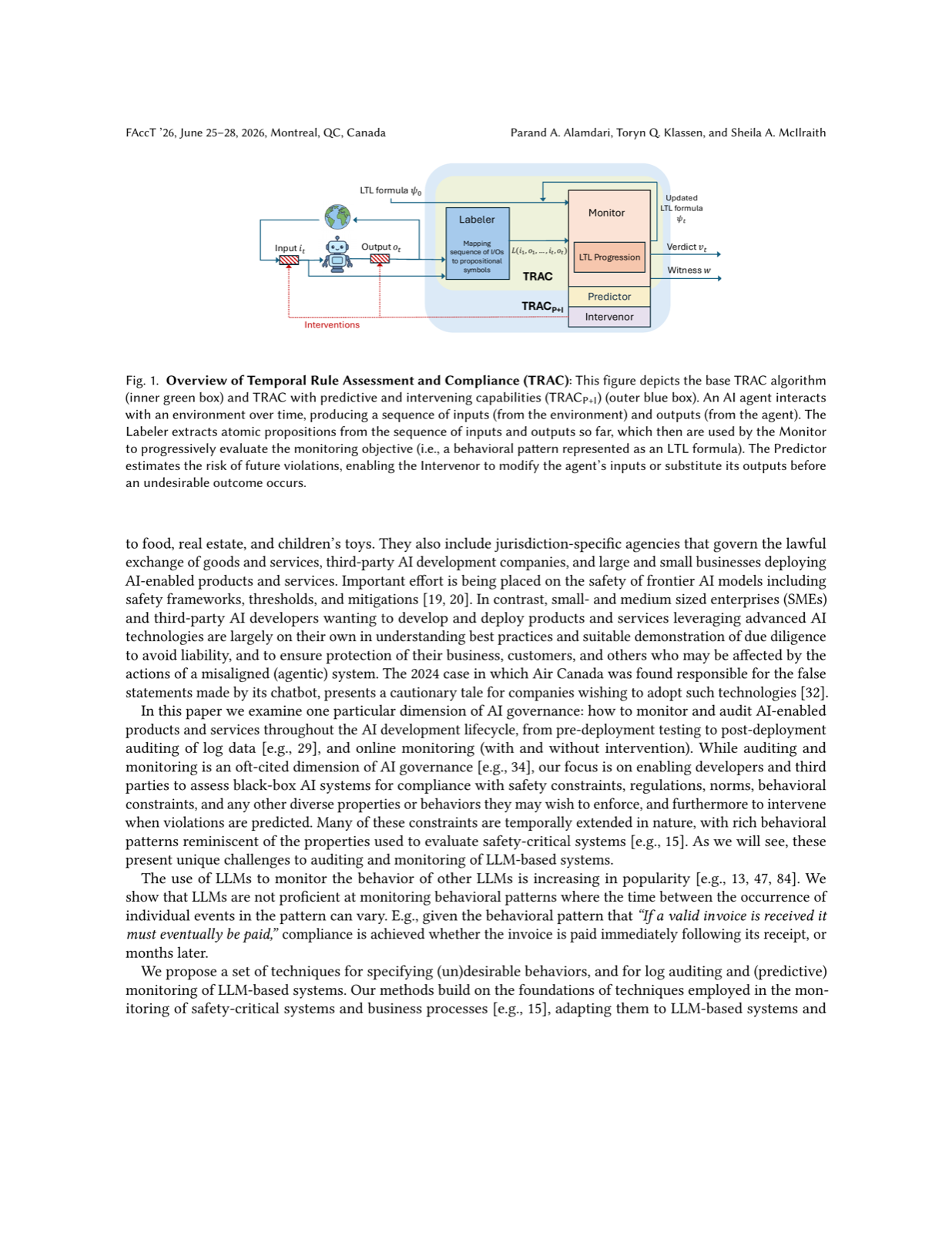
This paper bridges formal methods and LLMs to address AI governance challenges, particularly in monitoring and auditing AI systems throughout their lifecycle. By leveraging Linear Temporal Logic (LTL), the authors propose techniques for offline auditing and online runtime monitoring of behavioral constraints such as safety rules and regulations. These methods enable developers and evaluators to detect violations of temporally extended constraints more effectively than traditional LLM-based approaches.
Experimental results show that even small-model labelers using LTL-based techniques match or exceed frontier LLM judges in detecting constraint violations. The approach also introduces predictive and intervening monitors that preemptively mitigate predicted violations while preserving task performance. These monitors significantly reduce violation rates, demonstrating the practical utility of formal methods in real-world AI systems.
However, the study also reveals that LLMs' temporal reasoning degrades with increasing event distance, number of constraints, and propositions, highlighting a limitation in current LLM architectures. Despite this, the integration of formal methods with LLMs offers a promising path forward for ensuring compliance and safety in advanced AI systems, especially in regulated domains where adherence to rules is critical.
Key insight: Combining formal methods with LLMs enables robust auditing, monitoring, and intervention for compliance in advanced AI systems, outperforming baseline LLM judges in detecting temporal behavioral constraints.