Anthropic has released an updated Responsible Scaling Policy to govern the development of advanced AI systems, emphasizing safety measures as AI capabilities approach human-level performance. Concurrently, Cursor introduces self-driving codebase management, enabling AI agents to autonomously handle software development tasks. These developments reflect growing industry focus on responsible AI development and automation of routine coding workflows.
Anthropic's updated Responsible Scaling Policy establishes stricter guidelines for AI system development, particularly as systems approach human-level capabilities, addressing concerns about catastrophic risks and implementing enhanced safety testing requirements. Meanwhile, Cursor has launched a preview of its self-driving codebase system that allows AI agents to autonomously manage code repositories, including issue identification, solution proposal, and implementation without human intervention. These announcements come amid significant research advances in AI reasoning, agent frameworks, and tool use calibration, with papers introducing innovations like Bradley-Terry aggregation for parallel reasoning, distributed architectures for agentic workflows, and case-based calibration for tool execution. The developments signal a maturation of AI safety frameworks and increasing automation in software development practices.
AI Model Releases

Announcing our updated Responsible Scaling Policy
Anthropic has published an updated Responsible Scaling Policy (RSP) to govern the development of frontier AI systems. The policy outlines new risk mitigation strategies for potential catastrophic risks associated with scaling AI capabilities. It establishes stricter guidelines for when and how AI systems can be scaled, including requirements for safety testing and risk assessment. The update comes after the company's previous policy was criticized for being too permissive. This policy will guide Anthropic's approach to developing future AI systems, particularly those approaching human-level performance.
Why it matters: This update reflects growing industry consensus that AI development must be governed by robust safety frameworks as systems approach human-level capabilities. It signals a shift toward more cautious scaling practices that prioritize long-term safety over rapid advancement.
AI Tooling

Towards self-driving codebases · Cursor
Cursor has released a preview of its multi-agent research that enables self-driving codebases. The system allows AI agents to autonomously manage code repositories, including identifying issues, proposing solutions, and implementing changes without human intervention. The preview includes capabilities for automated code review, dependency management, and bug fixing. Early adopters can test the system with a limited set of repositories, with full functionality expected in upcoming releases. The tool is designed to work with existing development workflows while reducing manual overhead for developers.
Why it matters: This represents a significant step toward AI-powered software development automation, potentially reducing the time and effort required for routine coding tasks. It could fundamentally change how development teams approach code maintenance and project management.
Research Papers
OpenDeepThink: Parallel Reasoning via Bradley--Terry Aggregation
arXiv: 2605.15177
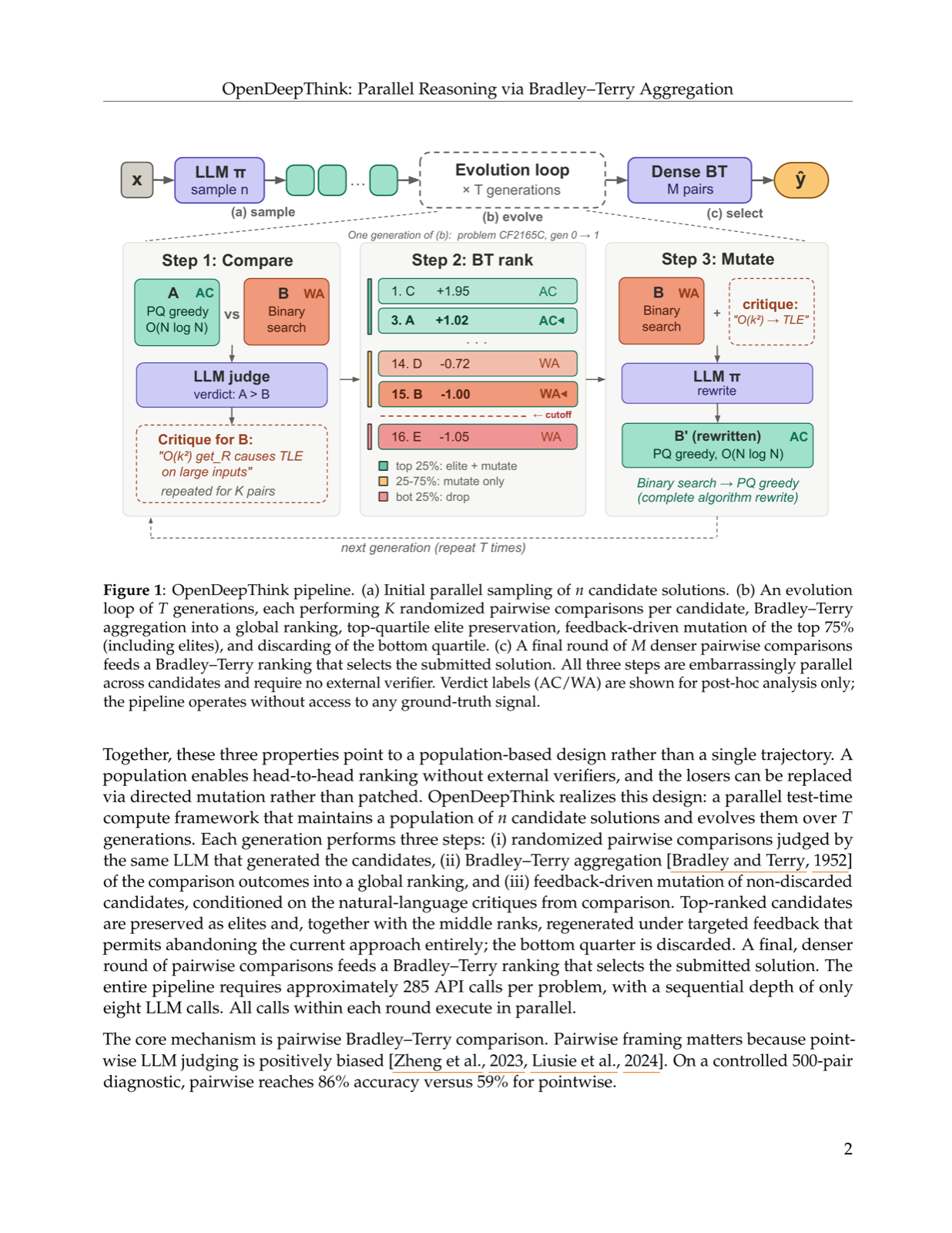
OpenDeepThink addresses a critical bottleneck in LLM reasoning: the selection of high-quality candidates from parallel reasoning traces. By employing a Bradley-Terry aggregation mechanism, the system enables LLMs to judge pairs of candidates and iteratively refine the best paths through mutation and pruning. This approach avoids the noise and bias inherent in pointwise LLM judging, leading to a 405-point improvement in Codeforces Elo for Gemini 3.1 Pro over eight rounds of LLM calls.
The framework's strength lies in its ability to scale reasoning breadth without sacrificing quality, and it transfers effectively across different model strengths. This makes it particularly valuable for real-world applications where computational resources are limited and model performance must be maximized. The method's success on the HLE benchmark also shows its effectiveness in objective domains, though it underperforms in subjective ones, indicating a nuanced application scope.
The release of CF-73, a curated dataset of expert-rated Codeforces problems, adds significant value to the research by providing a standardized benchmark for evaluating reasoning performance. This dataset not only supports the validation of OpenDeepThink but also contributes to the broader community by offering a high-quality resource for training and testing reasoning systems.
Key insight: OpenDeepThink introduces a Bradley-Terry aggregation framework for selecting the best reasoning candidates in parallel, significantly improving LLM reasoning performance without requiring ground-truth verifiers.
APWA: A Distributed Architecture for Parallelizable Agentic Workflows
arXiv: 2605.15132

APWA tackles a major challenge in autonomous multi-agent systems: scaling beyond single-agent limitations to handle complex, parallelizable tasks. By decomposing workflows into independent subproblems, APWA allows for parallel execution without cross-communication, significantly improving throughput and efficiency. This is particularly important as task complexity increases and traditional systems begin to fail.
The architecture supports heterogeneous data and processing patterns, making it adaptable to a wide range of domains. This flexibility is crucial for real-world deployment, where tasks vary widely in structure and requirements. The framework's ability to dynamically decompose complex queries into manageable parallelizable workflows demonstrates its practical utility in scaling multi-agent systems.
Evaluation results show that APWA can effectively scale on larger tasks where prior systems fail completely. This scalability is a key advantage in environments where computational resources are abundant but must be used efficiently. The architecture's design allows for seamless integration with existing LLMs and provides a foundation for future advancements in multi-agent systems.
Key insight: APWA presents a distributed architecture that enables efficient parallel execution of agentic workflows, overcoming bottlenecks in multi-agent systems by decomposing tasks into non-interfering subproblems.
Why Neighborhoods Matter: Traversal Context and Provenance in Agentic GraphRAG
arXiv: 2605.15109

The paper challenges the traditional view of citation faithfulness in Agentic GraphRAG by introducing the concept of traversal context and provenance. It demonstrates that accurate answers can depend on uncited entities and the structure of the graph visited during traversal, not just the cited evidence. This insight shifts the focus from source support to a more holistic evaluation of retrieval trajectories.
Through controlled ablation experiments, the authors show that removing cited evidence substantially changes answers and reduces accuracy, but that citations alone are insufficient. This finding has implications for how we design and evaluate retrieval systems, suggesting that future systems must account for the broader context of the retrieval process, not just the final cited sources.
The work highlights the complexity of evaluating agentic systems and calls for more nuanced metrics that consider the entire retrieval trajectory. This is particularly relevant in domains where the structure of the knowledge graph plays a significant role in shaping the final answer, such as in scientific or legal reasoning, where context and provenance are crucial.
Key insight: Agentic GraphRAG's citation faithfulness depends not only on cited evidence but also on the traversal context and surrounding graph structure, necessitating a broader provenance evaluation approach.
Dual-Dimensional Consistency: Balancing Budget and Quality in Adaptive Inference-Time Scaling
arXiv: 2605.15100

Dual-Dimensional Consistency (DDC) addresses the inefficiency of current inference-time scaling strategies by treating sampling width and depth as interdependent rather than orthogonal. This approach prevents the reinforcement of hallucinations while accelerating consensus, leading to a more efficient use of computational resources. The framework's ability to concentrate resources on high-quality reasoning paths is a significant advancement.
The method's evaluation across five benchmarks shows that DDC reduces token consumption by over 10 times while maintaining or exceeding baseline accuracy. This efficiency gain is crucial for deploying LLMs in resource-constrained environments or for applications requiring high throughput. The framework's adaptability across various LLMs further enhances its practical value.
By integrating confidence-weighted Bayesian protocols with trend-aware stratified pruning, DDC provides a robust mechanism for adaptive termination. This ensures that reasoning chains are neither prematurely truncated nor unnecessarily extended, striking a balance that maximizes both quality and efficiency. The approach represents a step forward in making LLM reasoning more scalable and cost-effective.
Key insight: DDC introduces a unified framework that balances sampling budget and reasoning quality by coupling confidence-weighted Bayesian protocols with trend-aware pruning, significantly reducing token consumption while maintaining accuracy.
Case-Based Calibration of Adaptive Reasoning and Execution for LLM Tool Use
arXiv: 2605.15041
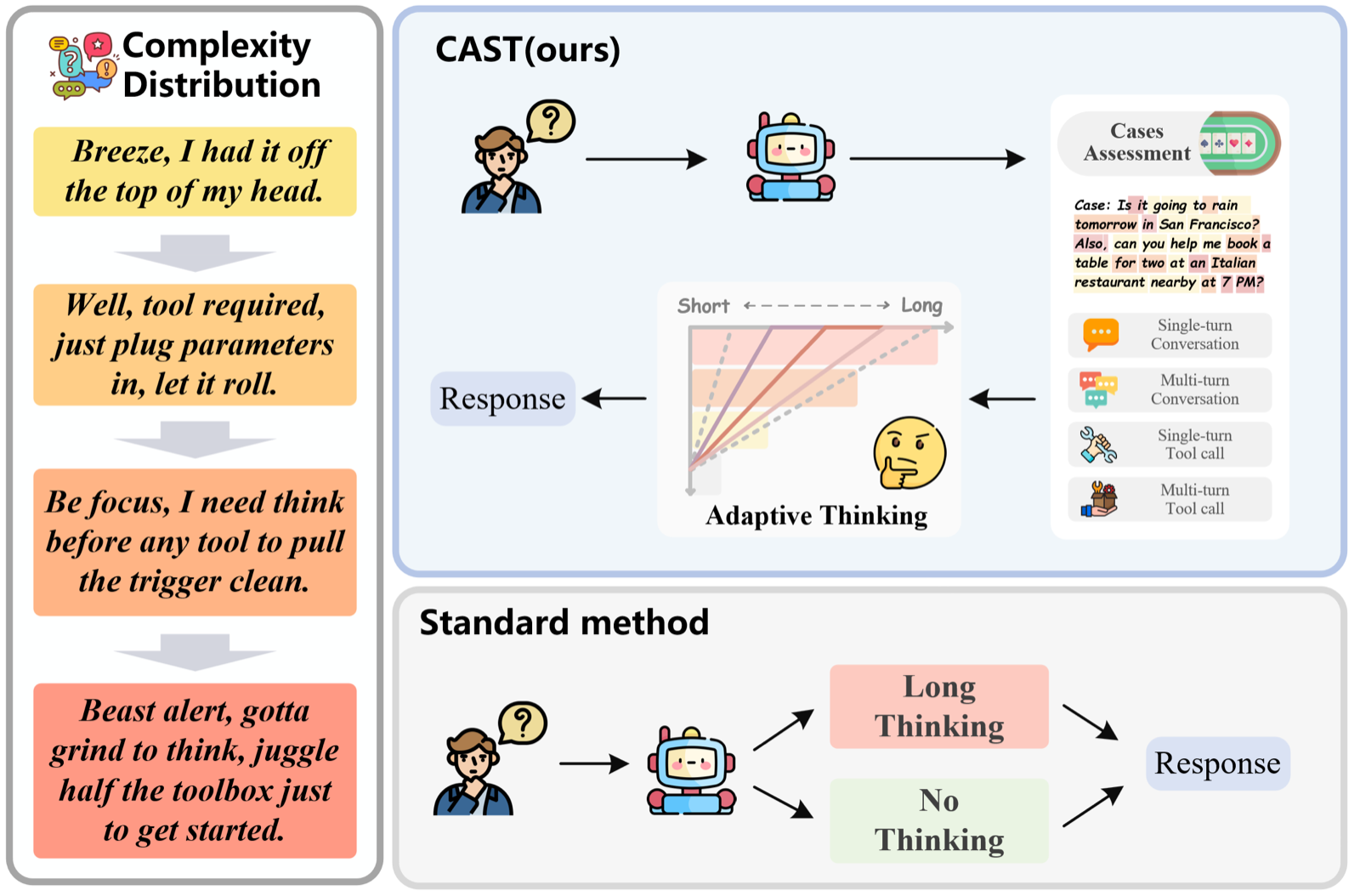
CAST introduces a case-based approach to calibrating LLM tool use, leveraging historical execution trajectories to identify complexity and failure profiles. This method allows the model to autonomously internalize strategies for optimal reasoning depth and structural validity, significantly improving execution accuracy and reducing unnecessary deliberation. The framework's ability to translate case knowledge into reward design and adaptive reasoning is a key innovation.
The experiments on BFCLv2 and ToolBench demonstrate that CAST achieves up to a 5.85 percentage point gain in execution accuracy and reduces average reasoning length by 26%. These improvements are particularly significant in reducing high-impact structural errors, which are common in tool use scenarios. The approach shows that historical data can be effectively reused to enhance performance without requiring extensive retraining.
CAST's success in improving both task-level tool-use success and schema-faithful execution highlights its potential for real-world applications where reliability and efficiency are paramount. The framework's adaptability to different tool use scenarios and its ability to reduce computational overhead make it a valuable contribution to the field of LLM tool use and agent systems.
Key insight: CAST uses historical execution cases to calibrate reasoning and execution in LLM tool use, improving schema-faithful execution and reducing unnecessary deliberation through case-derived signals.